Archive

Comedy

Released in 2005, The 40 year Old Virgin is raucous, frank, funny, well-grounded, and fortified by the sweet lead performance of Steve Carell. Carell, a 40 year old technician at an electronics chain, is a lonely man-child, surrounded by mint-condition action figures and video games. His younger co-workers (Paul Rudd, Seth Rogen, Romany Malco) learn he is a virgin and push him out in the world so he can “bust a nut.” They each have their own theories, which are terrible, but Carell does happen upon a young grandma, Catherine Keener, and a romance develops. It all ends well in a joyous finale, a brilliant post-coital rendition of “Aquarius” and one of the finest ends to any film.

This is a roller coaster ride of potential mates (the criminally drunk Leslie Mann, the creepily seductive Jane Lynch, and the sex freak Elizabeth Banks) and inevitably disastrous consequences.

Everyone is funny, including Jonah Hill, David Koechner, Kevin Hart, and Carell’s mate from The Office, Mindy Kaling, even in the briefest of scenes. The milieu – young working stiffs in retail – also lends itself to not only hilarity derived from the vagaries of the job, but communality. The bro’ talk is sharp and true, if occasionally overdone, but is counterbalanced by Carell’s sweet humanity and earnestness.

Fast forward 7 years.  Apatow is a film titan, producer of 14 movie comedies and two TV series, but director of only 3 feature films. His fourth is the execrable This is 40.  Gone is the working world and the empathetic center of a lost boy.  Instead, Rudd reappears in rich California suburbia, a struggling indie record company owner whose financial pressures still allow for nights away with his craven, hissing, shrewish wife (Mann) in what has to be a $1000 night oceanside resort. So much for communality.

Worse, the film is populated by unfortunate and unfunny characters. Rather than finding common cause or sympathizing in their plight, an exalted Apatow mocks them through his condescending leads. And as it all unravels, he amps up the gross-out factor to the point where Rudd is spreading his legs, demanding that Mann inspect his asshole for polyps or fissures.

Ah, success.
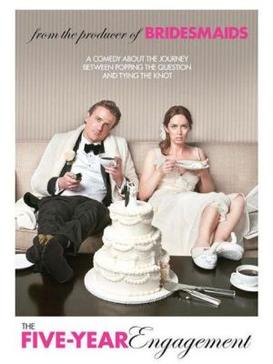
Another from the factory of producer Judd Apatow, director Nicholas Stoller co-wrote the script with star Jason Segal, which tells the story of Segal and Emily Blunt, he a San Francisco chef and she a would-be psychology professor at the University of Michigan.  They fall in love but then endure the long stretch of pre-marriage, with its attendant insecurity, doldrums and misgiving.  While the stretch can be a little rough on the viewer, Blunt is charming and as he did in Forgetting Sarah Marshall and Get Him to the Greek, Stoller wisely populates the story with supporting characters who offer varied, funny bits.  In particular, David Paymer and Mimi Kennedy shine as Segal’s blunt, atypically private parents.  Alison Brie (Trudy from Mad Men) is also strong as Blunt’s happily married sister and she and Blunt pull off a hilarious conversation/confrontation in front of her young children in the guises of Elmo and The Cookie Monster, thus masking the seriousness of their subject matter.

Still, there are glaring problems.  Stoller and Segal over-rely on the easy laughs of adults using dirty words (though nothing quite so bad as Apatow’s embarrassing This is 40); the image of Segal’s bare ass or failing and/or harried while humping really isn’t all that funny; the replacement mates when Segal and Blunt break up (Rhys Ifans and Dakota Johnson) are gruesome, easy marks; and there’s nothing really new here.

There is also the problem of Segal, who is perhaps the only actor who makes Paul Rudd seem manly.  From his awful sitcom How I Met Your Mother to just about every film in which he’s carried the load, Segal is a tiny variation on the same persona – aw shucks, hapless, sweet and prone to self-pitying outburst.  Summed up, a huge pussy.  I’m happy to defer, but in a romantic comedy, he’s a natural best friend, not the lead.

Image result for this is the end

The first third is sharp. Comic actor Jay Baruchel comes to LA to hang with his big star pal Seth Rogen and before long, they’re at a celebrity-studded party at James Franco’s house, where Michael Cera snorts coke and slaps Rhianna’s ass, Jason Segal tries to convey the pedestrian nature of his sitcom to Kevin Hart (Hart is genuinely cracked up by the scenario Segal bemoans), and Jonah Hill shows pictures of his new rescue dog, who is incontinent and doesn’t know how to bark.  There are scads of other notables revealed in their self-involved element, which is great fun when The Apocalypse begins and they are dispatched in hideous, hilarious fashion. Example: a gaping sinkhole takes stars galore to the fiery depths and as Aziz Ansari clings to the edge, Craig Robinson responds to his pleas with a cold calculation.

Unfortunately, the middle third, which features Baruchel, Rogen, Hill, Franco and Robinson holed up and survivalist, is ragged. Much of it feels like creaky improv, and the self-centeredness becomes tedious as the fellas bicker and crack under the strain.  There is a self-satisfied laziness, a “this is cracking us up, so that’s enough” vibe that bores. Andrew O’Hehir nailed it: “I’m all in favor of movie stars making jokes at their own expense, but an entire movie based on that premise starts to seem like a suspiciously large amount of upside-down vanity.”

You know you’re in the tall grass when an SNL bit about chewing food for someone else is shamelessly recycled. Worse, Danny McBride joins the group, his turn is singularly unfunny, and he compensates by cranking up the volume.

Luckily, McBride exits, Hill is possessed by a demon, and a laugh-out-loud exorcism gets the picture back on pace to its largely satisfying conclusion.  Good laughs, but wait for DVD and you’ll value it more.

An ingenious concept undone by a tedious pace, a dull heroine, an indecisive tone, and a cheezy feel.

First, the concept. The world is post-apocalyptic and zombies mill about, waiting to eat human brains. One twist – when they eat the brains, they get a rush of the memories of the prior owner. Our protagonist. Nicolas Hoult (About a Boy, X-Men: First Class) eats the brains of Dave Franco (brother to James), fiance’ to Teresa Palmer, and immediately falls in love with Palmer.  So, he saves Palmer’s life and an unlikely romance ensues. So far, so good.

Palmer, clearly an acolyte of the Kristen Stewart school of acting, makes no impression. She’s all smarm and attitude and lacks any depth necessary for material deeper than Glee. It may seem like niggling but it is not, because she has to convey that she has fallen for a zombie. She doesn’t come close.

With Palmer failing to communicate a romance, what is left is the scary.  It is not scary, at all, and the use of CGI skeletors – really evil zombies who have lost all their flesh – suggests the old stop motion visual effects of the Harry Hamlin Clash of the Titans – and not in a good way.

Since it is not scary, it should be funny. After all, talk about your clash of cultures. But it is only occasionally amusing. Hoult, whose speaking is necessarily rudimentary, mainly mumbles and moons at Palmer. While he is given a voiceover to explain what he feels and sees, the observances are pedestrian.

The picture looks just awful – again, not in a good way. The post-apocalyptic world looks more like a Meadowlands dump, the encampment where the humans are holding out looks like the porn set of a parody (Dawn of the Head? apologies)*, and in comparison to Zombieland or even The Walking Dead, the feel just seems chintzy.

It’s also deathly slow. At only 90 minutes, I started to feel like the zombies themselves, numb and mindlessly staring at the TV, waiting desperately for something to chew on.

*  I made that up, but I shouldn’t have had to.

This Is 40 - Wikipedia

A Bataan death march of a rom-com. Let me count the ways.

1) As secondary characters in Knocked Up, Paul Rudd and Leslie Mann were welcome respites from the manic upheaval of the leads.  As primary characters, they outstay their welcome very quickly.  Mann is a limited, mannered actress without a shred of heart. ready-made for a brief comic turn.  She is also director Judd Apatow’s wife.  He lightens her wispy load by primarily having her repeat the lines of other characters quizzically or allowing her to deliver others with a lilting, sing songy chirp. He also uses his daughters, the younger of whom is charming and genuine and the older of whom is as grating and one-note as her mother.  Nepotism . . .bad!  Rudd’s goofy, sweet smarm is tiresome.  If there was ever an actor who needed to play a villain quick, it’s Rudd.

2) The film is annoyingly haphazard.  Hey, we just ate a marijuana cookie.  Hey, we’re going to the doctors and we have witty things to say as they explore the orifices of our just-turned-40 bodies.  Hey, look at my asshole, honey.  Hey, we have fathers (John Lithgow and Albert Brooks) who do their schtick and both have young children.  Hilarious!

3) It feels as if Apatow let Mann and Rudd riff and most of it lays as flat and listless as a Navy base whore. Apatow definitely let Melissa McCarthy improv in one of the laziest, saddest scenes ever.  How the hell do you make Melissa McCarthy unfunny?

4) Apart from a few laughs provided by secondary characters, this movie is drudgery, and the leads do and say things so odious or stupid that not enough bad things can happen to them to satisfy the viewer.

5) If this couple has been married for 14 years, one of them would have to have been in a coma for 13 of them to avoid a murder-suicide.

6) The movie is over 2 hours long. Brutal.

7) The film confuses sexual frankness and obscenity with the funny, as if saying cock and fuck a lot does the trick.

8) A primary source of marital discord is money, but these people live in a mansion and want for nothing, so they are particularly punch-able.

9) As Dana Stevens of Slate so nicely put it, the flick is as funny as a hemorrhoid.

On the plus side, it features a nice Ryan Adams song. but alas, he has aged as well as the flick.

My son makes me watch pieces of these Adam Sandler films now that they are on  regular cable rotation, in what appears to be some kind of social experiment.  I watch the movies, which masquerade as comedies, and I don’t laugh.  My son watches me intently.  If I do laugh, which is rare, he mocks me for having laughed.  At the end of the endeavor, we shake our heads, and then, when we have time to reflect, we ponder larger questions:

Does Adam Sandler make the least funny movies ever made?

It’s hard to come to any other conclusion but yes.  Add Bedtime Stories, Billy Madison, Click, Just Go With It, The Waterboy, Little Nicky, 50 First Dates, You Don’t Mess with the Zohan, Mr. Deeds, I Now Pronounce You Chuck and Larry, Bulletproof, Anger Management, and Big Daddy.  There’s barely a laugh in any of them, though I am partial to some parts of Happy Gilmore, and The Wedding Singer was cute.  But that was 1996 and 1998, respectively.

Does Sandler have any films that reflect well on what purports to be his talent?  

Two. He was apt in Paul Thomas Anderson’s overlooked Punch Drunk Love, and Judd Apatow’s underrated Funny People was greatly reliant on his ability to play himself (a mega star comedian who makes crappy movies).

Is there a major star less deserving of his success?

I’m a fan of Clint Eastwood’s line in Unforgiven (“deserves got nuthin’ to do with it”), but, no.

Is there a major star more loyal to his pals?

No.  If there is one thing consistent in Sandler’s films, other than being unfunny, it is the presence of his regulars: Allen Covert (15 Sandler films), Jonathan Loughren (13 Sandler films), Peter Dante (11 Sandler films), Rob Schneider (10), Blake Clark (9), Nick Swarsdon (8), Steve Buscemi (7) and Dennis Dugan (7 as actor, 8 as director).  So, while his movies suck, he is certifiably a loyal and true friend.

Why is Sandler fascinated with sex and old women?

I won’t catalogue all the examples, but randy oldsters getting it on with folks 50 years their junior is heavy in his oeuvre.  Sandler may have noticed it himself and course-corrected, because in That’s My Boy, he went the other way.

Which film goes the longest without eliciting a laugh?

Grown Ups, which is a little surprising, because Sandler is supported by a bevy of other semi-accomplished comedians. But there really isn’t a hearty laugh in this picture, and hooray! Part Two is in post-production.

Frank Langella lives alone in the country a few hours from New York City.  He is slowly succumbing to Alzheimer’s, functional but slipping, and at first, appears to be little more than a forgetful, petty thief of decorative soaps sold in the town’s gift shop.  When his son (James Marsden) brings him a robot for company and guidance, we learn that Langella was once a second story burglar who did two stints in prison.  He loathes the robot until he learns it has no conscience.  A friendship develops, and soon, the robot is acting as his accomplice in a jewel heist.

The movie is clever, often touching, and a bit subversive.  There is a hilarious section where Langella’s anti-robot daughter (Liv Tyler) visits.  Horrified at her father’s reliance on the robot, she turns it off, only to surreptitiously turn it on when she wants the house cleaned.

Though the film is set in the not too distant future, the credits are accompanied by clips of the work robots are currently doing (or being designed to do) for humans, and the future is now.

Co-written by Jay Baruchel (of Knocked Up and Tropic Thunder) and Evan Goldberg (writer of Superbad and Pineapple Express), this comedy has a Judd Apatow feel and a direct lineage to Slap Shot. Seann William Scott (Doug Glatt) plays a dim but lovable lunk in Canada who is recruited as a goon by the Halifax franchise after he dismantles an out-of-control hockey player who jumped into the stands. He soon finds his purpose, his love, and his destiny, in the form of the greatest enforcer of all, Ross Rhea (Liev Schreiber).  In the process, he coalesces a fractured club.

This is a clever meld of sports schmaltz and sharp, crude comedy, unfairly overlooked. Scott is supremely disciplined in playing a sweet dolt. We get none of his smirk from the American Pie movies, which makes his elevation from the ranks of security guard and bouncer to hockey hero touching and sweet. When his love interest (Allison Pill) runs up to him crying after breaking up with her boyfriend, he asks “Did you just see Rudy?” and you believe the question is sincere. When Pill, a hockey player groupie, tells him, “You make me wanna stop sleeping with a bunch of guys,” he replies, “That’s the nicest thing anyone’s ever said to me” and it seems so.

The hockey itself is not particularly realistic but, like Slap Shot, director Michael Dowse handles the speed, fluidity and violence of the game well and largely for comedic effect.  Goldberg and Baruchel even include their own version of the Hansen brothers, two Russian jokesters who plague the team’s insecure goalie.

Great fun.


Poor little rich girl, Amy Minsky (Melanie Lynskey) is in her early 30s, recently divorced, depressed and living at her parents beautiful, opulent home in Westport, CT.  My how times change. When Jill Clayburgh did it, she was An Unmarried Woman and it was kind of a big deal because she had to face economic dislocation, romantic inexperience and societal reproval.

Here, Amy is surrounded by the usual troupe of insensitive caricatures who serve to make us feel she is really the good one, and in case we forget, she is juxtaposed against her ambitious parents, high school friends who have not moved on, and a would-be suitor utilized to show that though Amy presents as a wallowing mope, at least she’s not a loser like him.  And she’s a photographer, no less, but she gave it up for love. Odds on a return to that vocation by the end of the film are, obviously, high.

The character is too fortunate and too dull to gin up any sympathy or interest.  She flings with the 19 year old son of friends of her parents (Christopher Abbott), whose charming little quirk is that he is an actor who hates acting (Abbott’s character ends up going to Oberlin, which, coincidentally, is where his character in HBO’s Girls matriculated).  They bemoan their uncool parents, Westport, and their sad stations (his second quirk is pretending to be gay for his mother because she is “into being accepting”). Minsky’s Mrs. Robinson experience does not make her more compelling.

Expectedly, the film sports precious acoustic music and a pile of Lilith Fair ditties to cement its indie bona fides (Liz Phair should sue Laura Veirs, but I guess there ain’t a lot of money there), and in most other respects is as cookie-cutter as any studio assembly line production.

It does have one good line, when her ogre of a mother (at least, as played by Blythe Danner, she is supposed to be an ogre) upbraids her for her laze and self-pity with, “What did you think life was going to be, one ribbon cutting after another?”

But that’s like after an hour.

Silver Linings Playbook,' Directed by David O. Russell - The New York Times

David O. Russell (Three Kings, The Fighter) has written and directed a special drama/romance, made all the better by a flawless ensemble. Bradley Cooper is just out of an 8 month court ordered stint in a psychiatric ward after having found his wife in the shower with her lover and beating the hell out of the former. Cooper is also bipolar. Under police supervision and ensconced in the Philadelphia home of his OCD, Philadelphia Eagle fanatic, bookie father (Robert De Niro) and supportive mother (Jackie Weaver), Cooper plots his way back into his wife’s heart, enlisting the help of a neighbor (Jennifer Lawrence) who has a few not insubstantial psychiatric and familial problems of her own. Unfortunately, he does this while forswearing the medications that will keep him on an even keel.

The film seamlessly portrays the pressure and effect of mental illness on a family with the Herculean effort of love and commitment it takes to manage it. Intertwined is a beautiful, engaging love story.

Cooper is rightly nominated for Best Actor. His performance is riveting, and no easy feat.  He presents a character plagued by demons, trying to hold them back, while leveling off to actually grow. As I walked out of the theater, my estimation of Cooper as merely a more electric Ryan Reynolds was erased, and Daniel Day Lewis’s turn as Lincoln seemed humdrum in comparison.

Jennifer Lawrence, also nominated, also wows. She is wounded and in crisis, and as she reaches for Cooper, her desperation and need are palpable. De Niro, who I wrongly suspected might have been nominated for best supporting actor as a nod to his overall body of work, is touchingly desperate as a father who carries his own mental disability as well as the weight of failing his son. Last, but certainly not least, the film’s fourth nominee Jackie Weaver plays Cooper’s mother lovingly while communicating the weariness of someone who has been required to hold a tenuous family together. The rest of the cast is also very funny, especially a portly Chris Tucker, who plays a patient from the psychiatric ward with a penchant for self-furlough.

This is a tough film to make. Mental illness does not lend itself either to yuks or romance, and without Russell’s deft hand, it could easily have been offensive, pat and/or schmaltzy. Cooper’s outbursts are funny, but that is because he’s a funny character whose disability has removed his filter. But Russell does not sugarcoat the illness, and when Cooper is manic, we are scared for him and those around him. Lawrence is also hard, mercurial and often tough to take, and normally, she would have been the whore with a heart of gold. In fact, her damage requires Cooper’s strength and the two share a strong chemistry.

To be able to construct a sweet, original romance from such stuff is both an achievement and a damning indictment of almost all romantic comedies/dramedies that have so little to say about people. This is the best movie of the year.