Archive

Comedy

My son makes me watch pieces of these Adam Sandler films now that they are on  regular cable rotation, in what appears to be some kind of social experiment.  I watch the movies, which masquerade as comedies, and I don’t laugh.  My son watches me intently.  If I do laugh, which is rare, he mocks me for having laughed.  At the end of the endeavor, we shake our heads, and then, when we have time to reflect, we ponder larger questions:

Does Adam Sandler make the least funny movies ever made?

It’s hard to come to any other conclusion but yes.  Add Bedtime Stories, Billy Madison, Click, Just Go With It, The Waterboy, Little Nicky, 50 First Dates, You Don’t Mess with the Zohan, Mr. Deeds, I Now Pronounce You Chuck and Larry, Bulletproof, Anger Management, and Big Daddy.  There’s barely a laugh in any of them, though I am partial to some parts of Happy Gilmore, and The Wedding Singer was cute.  But that was 1996 and 1998, respectively.

Does Sandler have any films that reflect well on what purports to be his talent?  

Two. He was apt in Paul Thomas Anderson’s overlooked Punch Drunk Love, and Judd Apatow’s underrated Funny People was greatly reliant on his ability to play himself (a mega star comedian who makes crappy movies).

Is there a major star less deserving of his success?

I’m a fan of Clint Eastwood’s line in Unforgiven (“deserves got nuthin’ to do with it”), but, no.

Is there a major star more loyal to his pals?

No.  If there is one thing consistent in Sandler’s films, other than being unfunny, it is the presence of his regulars: Allen Covert (15 Sandler films), Jonathan Loughren (13 Sandler films), Peter Dante (11 Sandler films), Rob Schneider (10), Blake Clark (9), Nick Swarsdon (8), Steve Buscemi (7) and Dennis Dugan (7 as actor, 8 as director).  So, while his movies suck, he is certifiably a loyal and true friend.

Why is Sandler fascinated with sex and old women?

I won’t catalogue all the examples, but randy oldsters getting it on with folks 50 years their junior is heavy in his oeuvre.  Sandler may have noticed it himself and course-corrected, because in That’s My Boy, he went the other way.

Which film goes the longest without eliciting a laugh?

Grown Ups, which is a little surprising, because Sandler is supported by a bevy of other semi-accomplished comedians. But there really isn’t a hearty laugh in this picture, and hooray! Part Two is in post-production.

Frank Langella lives alone in the country a few hours from New York City.  He is slowly succumbing to Alzheimer’s, functional but slipping, and at first, appears to be little more than a forgetful, petty thief of decorative soaps sold in the town’s gift shop.  When his son (James Marsden) brings him a robot for company and guidance, we learn that Langella was once a second story burglar who did two stints in prison.  He loathes the robot until he learns it has no conscience.  A friendship develops, and soon, the robot is acting as his accomplice in a jewel heist.

The movie is clever, often touching, and a bit subversive.  There is a hilarious section where Langella’s anti-robot daughter (Liv Tyler) visits.  Horrified at her father’s reliance on the robot, she turns it off, only to surreptitiously turn it on when she wants the house cleaned.

Though the film is set in the not too distant future, the credits are accompanied by clips of the work robots are currently doing (or being designed to do) for humans, and the future is now.

Co-written by Jay Baruchel (of Knocked Up and Tropic Thunder) and Evan Goldberg (writer of Superbad and Pineapple Express), this comedy has a Judd Apatow feel and a direct lineage to Slap Shot. Seann William Scott (Doug Glatt) plays a dim but lovable lunk in Canada who is recruited as a goon by the Halifax franchise after he dismantles an out-of-control hockey player who jumped into the stands. He soon finds his purpose, his love, and his destiny, in the form of the greatest enforcer of all, Ross Rhea (Liev Schreiber).  In the process, he coalesces a fractured club.

This is a clever meld of sports schmaltz and sharp, crude comedy, unfairly overlooked. Scott is supremely disciplined in playing a sweet dolt. We get none of his smirk from the American Pie movies, which makes his elevation from the ranks of security guard and bouncer to hockey hero touching and sweet. When his love interest (Allison Pill) runs up to him crying after breaking up with her boyfriend, he asks “Did you just see Rudy?” and you believe the question is sincere. When Pill, a hockey player groupie, tells him, “You make me wanna stop sleeping with a bunch of guys,” he replies, “That’s the nicest thing anyone’s ever said to me” and it seems so.

The hockey itself is not particularly realistic but, like Slap Shot, director Michael Dowse handles the speed, fluidity and violence of the game well and largely for comedic effect.  Goldberg and Baruchel even include their own version of the Hansen brothers, two Russian jokesters who plague the team’s insecure goalie.

Great fun.


Poor little rich girl, Amy Minsky (Melanie Lynskey) is in her early 30s, recently divorced, depressed and living at her parents beautiful, opulent home in Westport, CT.  My how times change. When Jill Clayburgh did it, she was An Unmarried Woman and it was kind of a big deal because she had to face economic dislocation, romantic inexperience and societal reproval.

Here, Amy is surrounded by the usual troupe of insensitive caricatures who serve to make us feel she is really the good one, and in case we forget, she is juxtaposed against her ambitious parents, high school friends who have not moved on, and a would-be suitor utilized to show that though Amy presents as a wallowing mope, at least she’s not a loser like him.  And she’s a photographer, no less, but she gave it up for love. Odds on a return to that vocation by the end of the film are, obviously, high.

The character is too fortunate and too dull to gin up any sympathy or interest.  She flings with the 19 year old son of friends of her parents (Christopher Abbott), whose charming little quirk is that he is an actor who hates acting (Abbott’s character ends up going to Oberlin, which, coincidentally, is where his character in HBO’s Girls matriculated).  They bemoan their uncool parents, Westport, and their sad stations (his second quirk is pretending to be gay for his mother because she is “into being accepting”). Minsky’s Mrs. Robinson experience does not make her more compelling.

Expectedly, the film sports precious acoustic music and a pile of Lilith Fair ditties to cement its indie bona fides (Liz Phair should sue Laura Veirs, but I guess there ain’t a lot of money there), and in most other respects is as cookie-cutter as any studio assembly line production.

It does have one good line, when her ogre of a mother (at least, as played by Blythe Danner, she is supposed to be an ogre) upbraids her for her laze and self-pity with, “What did you think life was going to be, one ribbon cutting after another?”

But that’s like after an hour.

Silver Linings Playbook,' Directed by David O. Russell - The New York Times

David O. Russell (Three Kings, The Fighter) has written and directed a special drama/romance, made all the better by a flawless ensemble. Bradley Cooper is just out of an 8 month court ordered stint in a psychiatric ward after having found his wife in the shower with her lover and beating the hell out of the former. Cooper is also bipolar. Under police supervision and ensconced in the Philadelphia home of his OCD, Philadelphia Eagle fanatic, bookie father (Robert De Niro) and supportive mother (Jackie Weaver), Cooper plots his way back into his wife’s heart, enlisting the help of a neighbor (Jennifer Lawrence) who has a few not insubstantial psychiatric and familial problems of her own. Unfortunately, he does this while forswearing the medications that will keep him on an even keel.

The film seamlessly portrays the pressure and effect of mental illness on a family with the Herculean effort of love and commitment it takes to manage it. Intertwined is a beautiful, engaging love story.

Cooper is rightly nominated for Best Actor. His performance is riveting, and no easy feat.  He presents a character plagued by demons, trying to hold them back, while leveling off to actually grow. As I walked out of the theater, my estimation of Cooper as merely a more electric Ryan Reynolds was erased, and Daniel Day Lewis’s turn as Lincoln seemed humdrum in comparison.

Jennifer Lawrence, also nominated, also wows. She is wounded and in crisis, and as she reaches for Cooper, her desperation and need are palpable. De Niro, who I wrongly suspected might have been nominated for best supporting actor as a nod to his overall body of work, is touchingly desperate as a father who carries his own mental disability as well as the weight of failing his son. Last, but certainly not least, the film’s fourth nominee Jackie Weaver plays Cooper’s mother lovingly while communicating the weariness of someone who has been required to hold a tenuous family together. The rest of the cast is also very funny, especially a portly Chris Tucker, who plays a patient from the psychiatric ward with a penchant for self-furlough.

This is a tough film to make. Mental illness does not lend itself either to yuks or romance, and without Russell’s deft hand, it could easily have been offensive, pat and/or schmaltzy. Cooper’s outbursts are funny, but that is because he’s a funny character whose disability has removed his filter. But Russell does not sugarcoat the illness, and when Cooper is manic, we are scared for him and those around him. Lawrence is also hard, mercurial and often tough to take, and normally, she would have been the whore with a heart of gold. In fact, her damage requires Cooper’s strength and the two share a strong chemistry.

To be able to construct a sweet, original romance from such stuff is both an achievement and a damning indictment of almost all romantic comedies/dramedies that have so little to say about people. This is the best movie of the year.

The exploration of the Tarantino oeuvre ended last night as me and the boy watched Tarantino’s opus (I will not subject my son to Death Proof from Grindhouse or Tarantino’s contribution to Four Rooms unless he’s really bad). Pulp Fiction is audacious in its break with continuity and vibrant in dialogue.  The film is essentially a series of riffs (and nobody riffs better than Samuel Jackson and Christopher Walken) or two person sketches. A stunning follow-up to Reservoir Dogs, the movie is a pop culture totem, demonstrating Tarantino’s love for kitsch as well as his sharp ear for a modern, urban, tough guy patter, Spillane-meets-Quisp.

Almost all of the performances are brilliant.  I’ve criticized Tarantino’s reclamation projects, but his insistence on JohnTravolta (over Daniel Day Lewis) was exactly right.  In the words of Tarantino’s agent, at the time, “John Travolta was at that time as cold as they get.  He was less than zero.” But Tarantino would not budge, and as hit man/enforcer Vincent Vega, Travolta is just the right amount of cool and introspection to Jackson’s ferocity. When the boss’s wife (Uma Thurman) mistakes his heroin for coke and overdoses, Travolta snaps out of his own drug-induced laze and, in one of many comic but harrowing scenes, becomes electric. The performance is artful, it resulted in an Academy Award nomination, and it resurrected his career.

If there is a criticism, it is of one vignette, after Jackson and Travolta accidentally shoot a man’s head off in their car. They need to get off the street, and end up at the home of one . . . Quentin Tarantino. Even the introduction of “The Wolf” (Harvey Keitel), a Mr. Fix-It who arrives to assist the stranded duo, cannot save this halting sequence or Tarantino’s amateurish acting. Rank has its privileges, but this particular hubris was detrimental.

But that’s a minor bump in the road in this highly engaging and original flick.  Related — The Pulp Fiction Oral History:  Uma Thurman, Quentin Tarantino, and John Travolta Retrace the Movie’s Making.

Ted Movie Review – New Bedford Guide

For better or worse, Seth MacFarlane is our Academy Award host this year. It almost has to be better given Billy Crystal’s snooze-inducing Borscht Belt performance last year and the train wreck that was stoner James Franco and clueless ingenue Anne Hathaway the year before. MacFarlane is the force behind numerous animated television shows, the best of which is the occasionally funny but mainly awful Family Guy, an outlet for easy shots and pro forma crudity still outclassed by the tired old Simpsons and never, ever near the same class as the brilliant South Park. So, I’m no fan. But I am hopeful. MacFarlane is a gifted mimic and I watched him on a recent Saturday Night Live. He was surprisingly deft and his impression of swimmer Ryan Lochte was nothing short of brilliant.

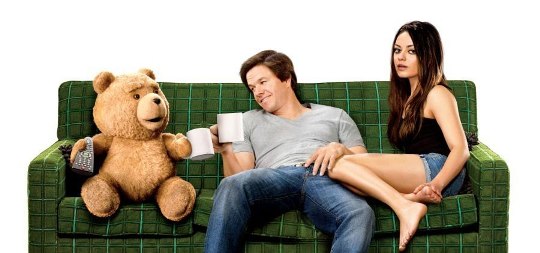
Ted is MacFarlane’s creation, a live teddy bear wished for by a young Mark Wahlberg. Wahlberg is all grown up and he and Ted remain roomies, even as Wahlberg hits year four with his luminous girlfriend, Mila Kunis. Kunis wants commitment and maturity, Ted and Wahlberg smoke dope all day and watch TV, and things come to a head when, after an anniversary dinner, the live couple come home to find Ted with a passel of hookers.

There are a few clunker lines, but for the most part, this is a very funny, very crude (Ted’s come-on to a grocery store checker is waaaaay over the top) and surprisingly sweet story of a boy and his childhood pal. I say “surprisingly” because I would have expected MacFarlane to be a little more daring. He comes close, such as a scene in the end where, after Ted has gone through a harrowing ordeal and appears to have died, he wakes up but appears to be impaired. Is Ted going to come back as a mentally disabled stuffed bear?

That’s MacFarlane – and Ted – in a nutshell.


I could only bear 20 or so minutes of this student picture.  Written and directed by Mark and Jay Duplass, this is a movie that represents the dark side of “independent” film.  Jason Segal plays a 30 year old stoner who . . . lives at home. Ed Helms plays his brother in exactly the same style as his Andy character on The Office. Their mother, Susan Sarandon, suffers them both as they are tasked to buy her wood glue.

Alas, she suffered them longer than I. The script is pretentious, the set-up uninviting, the direction (the Duplasses are addicted to an ostentatious jump zoom) self-indulgent and the plot random, all sins that cannot be expiated by deeming it “quirky.”

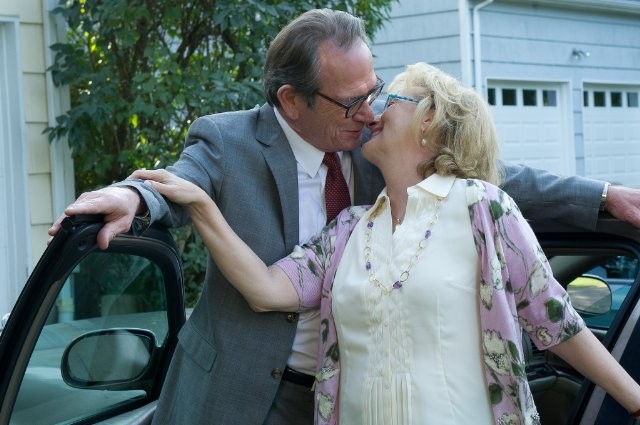
Meryl Streep is incredible, as always, flawlessly and effortlessly inhabiting the character of a repressed, unhappy Nebraska housewife, married to a removed, cantankerous Tommy Lee Jones.  She signs the couple up for a week of couples counseling in Maine under the tutelage of Steve Carell, during which their marriage is analyzed in order to fix it.

Most of their problems stem from intimacy issues.  They haven’t had sex for 4 years.  So that’s where Carell focuses.

The performances are uniformly good and the interplay between Streep and Jones is often genuinely affecting.  The film, however, becomes repetitive and ends in a cloying renewal of vows that is much too much.  The movie also features some of the worst, most intrusive and blaring pop songs to accompany emotional stretches.

Be prepared.  As I said, the central problem for Jones and Streep is sexual.  Which means frank talk about and between people I’d prefer not to think about in sexual situations.  It also has a scene of Streep trying to give Jones a blowjob in a theater, a failed endeavor. Sure, there is some humor in Streep purchasing “Sex Tips for Straight Women by Gay Men.” But watching her put those tips into practice?  Sorry, kemosabe.  Deal me out.

image

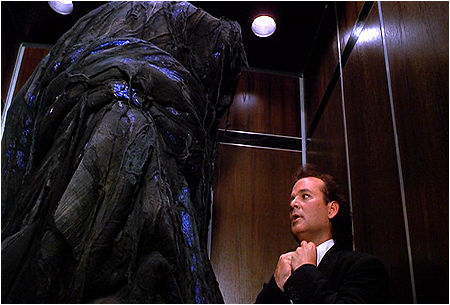
Bill Murray plays the Scrooge character, Frank Cross.  Cross, however, is not in finance, but television.   A child abandoned to the TV by uncaring parents, Cross has become a holy terror as the head of programming for a major network.  His newest achievement is a live broadcast of “A Christmas Carol” on Christmas Eve, with Buddy Hackett as Scrooge.  Cross is so cynical and mean he’s ordered the stapling of tiny antlers on to the heads of mice.  Soon, the ghosts appear.

This is a zany, funny version of the Dickens tale co-written by SNL alum Michael O’Donoghue (he communicated his loathing of the theatrical version before his death at 54) and directed by Richard Donner (who helmed all the Lethal Weapons and various and assorted dreck).  Donner has little skill save for making movies move, and this movie moves.  O’ Donoghue’s complaints aside, it’s also often very clever, propelled by Murray’s manic and humorous descent into madness and his joyous redemption.  It’s big, messy, all-over-the place, and excessive (which is kind of the point) but great fun.