Archive

Comedy

Photo Gallery - Inherent Vice - Inherent Vice Movie Poster

Paul Thomas Anderson’s (Boogie Nights, Punch Drunk Love) private investigator noir evokes Robert Altman’s The Long Goodbye, but instead of Elliot Gould as Phillip Marlowe-meets-Jeff Bridges’ “The Dude”, Joaquin Phoenix is all 1970 Southern California hippie, all the time, so “out there” he has to keep a notepad with one word reminders to stay focused. The result is a detective yarn, but through the eyes of a stoner, in parts scintillating and in parts frustrating. If you approach the picture traditionally, you’ll find yourself trying to connect the dots of a plot that seemingly fuses murder, real estate, the FBI, the Las Vegas mob and a drug trade that profits from its customers on the front end and back. However, Phoenix is our guide on this trip (there is no scene without him), and he is unreliable. Two couples walked out of the theater during this movie, and while the thought never occurred to me, I could see it occurring to others. Anderson has a nice cheat at work here: the byzantine plot has promise, but rigor is unnecessary when viewed through the eyes of a doper. When you shake your head, you’re a square and not in on the joke. When you go with the flow, it’s a little tiresome, and at 148 minutes, even boring.

Anderson’s movies look fabulous, and this is no exception. His sundrenched beach LA is almost mystical, and his re-creation of Manson-era, Southern California weirdness is vivid. The picture can also be very funny, with nice contributions from Josh Brolin as a straight-laced, psychologically fragile LAPD detective, and Martin Short as an electric, drug-snorting dentist.  Katherine Waterston, as the femme fatale and the only character who seems to ground the picture, is a revelation, mesmerizing and completely believable as the woman who could penetrate even Phoenix’s lazy, listless existence.

Rottentomatoes.com critics gave this picture a 70%, with only a 57% from the audience. There may be a lesson there.  Even though Anderson is an auteur commodity, he should consider getting back into traditional storytelling. His last two films –The Master and this – have been beautifully shot and acted yet uninvolving and disaffecting.  Phoenix is presented to us as an archetype in both films, without backstory or motivation. As such, it’s hard to care, and that’s a problem.

The Trip to Italy - Movies on Google Play

Michael Winterbottom’s The Trip was a charming buddy flick/travelogue through the north of Britain, though these buddies (Steve Coogan and Rob Brydon) are British comedians and master impersonators (I still can’t decide who does the best Michael Caine).  I couldn’t imagine the first film lending itself to a sequel.  I was wrong.  The Trip to Italy is derived from a TV show on BBC Two, like the first film, and it is every bit as funny.  Though the banter of Coogan and Brydon is a tad staler, what comes through in their uncanny ability to riff is a deep affection, all set in the beauty of Italy from Liguria to Rome to Capri to Naples.  Winterbottom also grounds the characters with occasional but insightful reference to their domestic lives.

I confess I laughed much harder than my wife, which reminded me of a funny scene from Knocked Up.

The back and forth between Coogan and Brydon is only a bit more highbrow, but what they are engaging in is not so much conversation as a mixture of shit-giving, competition, and entertainment comprised of variations on old themes and bits.  Their discourse eschews any quiet moment, rejects a detour into anything serious, is decidedly male and, I suspect, has a very short shelf life for females, who, let’s face it, are more highly evolved.

Still, this is funny shit . . .

image

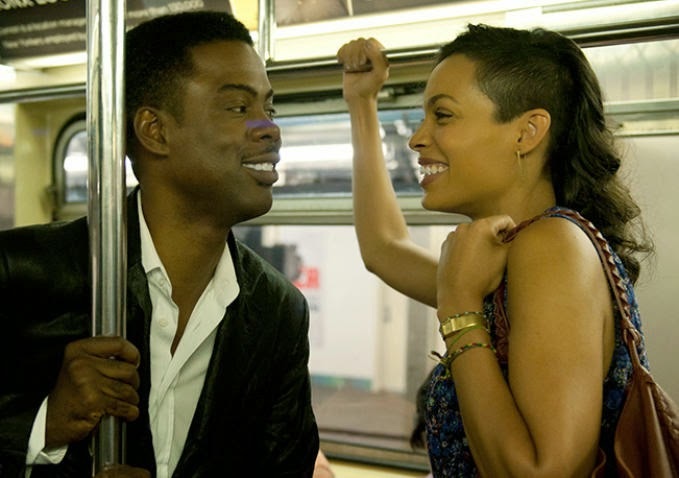
Very funny, very raw, often insightful comedy written and directed by Chris Rock. Rock stars as a facsimile of himself, a Hollywood success straight out of the mean streets of NYC, returned home on the eve of his made-for-Bravo wedding to a reality star (Gabrielle Union) and the opening of his shot at a serious film after making his fortune in broad comedies (the most successful of which is the Hammy the Bear series, which delivers a running joke, as everywhere Rock goes, you hear “hey, Hammy!”). Four years sober, Rock is accompanied on his return by a New York Times reporter (Rosario Dawson).  A convincing love story ensues as Rock opens up to her about his rise, fall, fears and regrets.

The film starts off a bit choppy, mainly due to the fact that Rock has to carry most if it. Rock has a winning smile and a wicked perceptivity, but he carries the armor and remove of a lot of comics, so his manner is a bit stiff, forestalling investment. But soon, Rock gets in his element, as he is surrounded by a dozen very good comics to play off. He loosens up in the second half, which allows him to reach deeper to connect with Dawson.

Rock borrows liberally from Judd Apatow’s Funny People and evokes Woody Allen’s chatty vibe (Rock’s back and forth with Dawson on the real reason for Martin Luther King’s assassination is alone worth the ticket and emblematic of their clever repartee) but he also writes strong, emotional moments which resonate stronger and longer than the gags, in particular, Rock’s reconnection with his father.

It’s difficult to resist a dissipated, alcoholic, and profane Billy Bob Thornton as a Santa Claus who works department stores to crack their safes, especially when he meets an eternally cheerful but clueless grade schooler (Brett Kelly) left alone with his addled grandmother (Cloris Leachman) in their tony Arizona suburban ranch home.  In true Christmas spirit, Thornton discovers the boy is essentially alone and defenseless, moves right in, raids the liquor cabinet, and trysts with a slutty barkeep (Lauren Graham) who has a Santa fetish.

Santa is so bad he rips open the kid’s Advent calendar to get at some chocolates.  He pisses himself on the job.  He beats up children.  He engages in sodomy in the dressing rooms of the Big & Tall Women’s section of the department store.  He looks in the cherubic faces of all those blessed children who revere him and  . . . well, see for yourselves.

Is there redemption for Bad Santa? Kind of. But Thornton is a character who could endure three Dickensian ghosts and conclude, “Eh. Fuck ’em.”

Bad Santa is the ultimate anti-Christmas flick and a holiday favorite.  Thornton is brutally acerbic (especially when dealing with a host of bratty kids on his lap), Graham is indescribably hot, and John Ritter and Bernie Mac (as mall security and management) contribute significantly to the humor (Ritter’s repulsion/fascination with Bad Santa is inspired; what a loss he was).

image

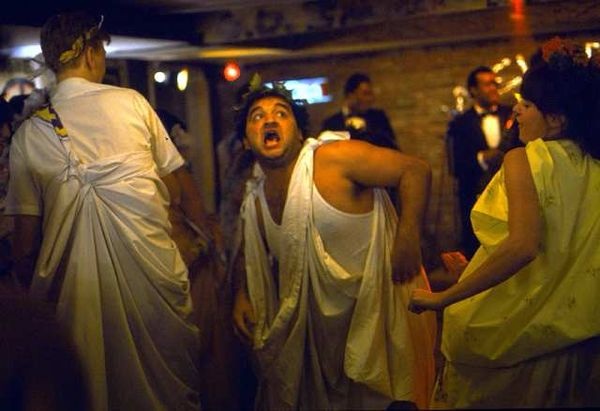
We were invited to the 50th birthday party of an old friend this weekend, and the theme was Animal House. In preparation of attending as Boon (Peter Riegert) and Katy (Karen Allen), my wife and I watched the movie to identify what they wore in the hopes of being identified as the characters. Our specific goal was delayed by our enjoyment of the movie, which neither of us had seen for twenty years or more.  It is sharply written, consistently inventive and enhanced by dozens of astute comic performances.  John Belushi’s physicality tends to get the lion’s share of accolades, but I’ve always been a bigger fan of Dean Wormer (John Vernon), who was chosen after Jack Webb turned the part down, and the pot-smoking Professor (Donald Sutherland), who took a $50,000 paycheck instead of the offer of 15% of the gross, a decision I’m certain haunts him to this day (the movie went on to gross $141 million).  His plaintive plea to his class is still one of my favorite moments of the movie:

Perhaps the greatest joy in these repressed, politically charged times is its dogged insistence on political incorrectness. Today, there would be a line of $46-an-article on-line ‘zine shitheads excoriating the film for its casual racism, sexism, insensitivity to the mentally disabled, and homophobia.   I can see the clickbait banners now:

“Animal House: The Genesis of the UVA Scandal”

“Nearly 40 Years Later, and We’re Still Laughing at Animal Cruelty”

“Animal House: A Frat Guy’s Birth of a Nation”

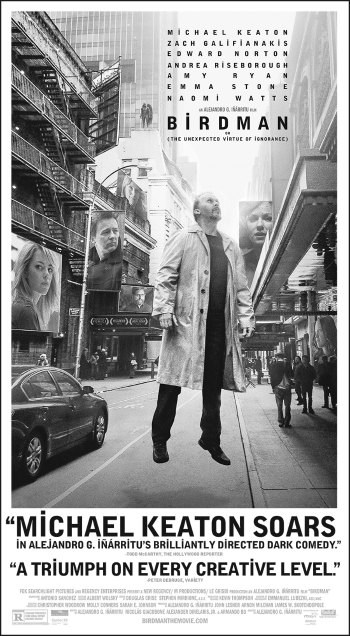
Birdman is so visually audacious you almost lose focus on its engrossing performances, cutting sense of humor and ambitious breadth. It is Rope on meth, tracking, almost hounding, with very few cuts, our tortured protagonist (Michael Keaton) in, through and around Broadway’s St. James Theater as he seeks to revive an acting career defined by his iconic role as a movie superhero. His fortune and name are on the line, and he is beset on all sides by family (fresh out of rehab daughter Emma Stone, ex-wife Amy Ryan), his jittery manager (Zack Galifianakis), his needy female co-stars (Andrea Riseborough, Naomi Watts), his antagonistic male co-star (Edward Norton) and a vicious and even more antagonistic New York Times reviewer (Lindsey Duncan).

One other character gives him some trouble as well.  His alter ego, who at first is a voice in his head but soon appears in person, telling him that all this stage acting bullshit is just that, he needs to get his ass back in a Birdman movie, and he must “shave off that pathetic goatee. Get some surgery. Sixty’s the new thirty, motherfucker!”

Director Alejandro Gonzalez Inarritu collaborated with three others on the play-within-a-play script, which is a satirical series of verbal jousts on the topics of sex, relationships, acting, the stage versus Hollywood, machismo, art versus commerce and the impact of social media.  The clashes between Keaton and Norton (sell-out v. artiste’) and Keaton and Duncan (the sell-out virus stinking up the hallowed stages of Broadway v. the Lord Protector of those stages) are particularly sharp, but the entire screenplay is chock full of gems.  My favorite is Keaton explain how he is holding up under the strain:  “”I’m broke, I’m not sleeping and this play keeps hitting me in the balls with a tiny little hammer.”

The frenetic, adrenaline rush style of the film heightens the tension (the cinematographer, Emmanuel Lubetzki, was the mastermind behind the dizzying tracking shot in Children of Men). The manic shooting makes the performances all the more impressive.  Keaton is superb.  His early trademark (ironically, before he became Batman) was a fevered, riffing style of acting, which could be spellbinding or just exhausting.  Older and more world-weary, Keaton internalizes his frenzy, struggling to bottle it in just as he struggles to keep Birdman at bay.  It’s a riveting turn.  Everyone else is excellent, and Norton deserves special mention.  As an actor with a history of being temperamental, Norton’s performance as a condescending, difficult, self-loathing actor is canny and knowing.  He damn near steals the film, which again, mirrors what is going on in the story.

Gonzalez Inarritu also gives the actors a great deal of space.  In Boogie Nights, Paul Thomas Anderson filmed a solid chunk of a drug deal going bad solely on the face of Mark Wahlberg.  The effect was powerful because in Wahlberg’s eyes, the audience could register the disaster unfolding before him.  Whenever I think of that classic film, I first remember that scene.  Of all the memorable parts of Birdman, there is a scene when Stone lashes out at her father, purposefully trying to hurt him.  In one of the few times the camera isn’t moving, Gonzalez Inarritu holds on Stone’s face as she delivers the cut and then as she sees its effect.  It’s a captivating moment in a film full of them.

Thus far, the best film I’ve seen all year.

image

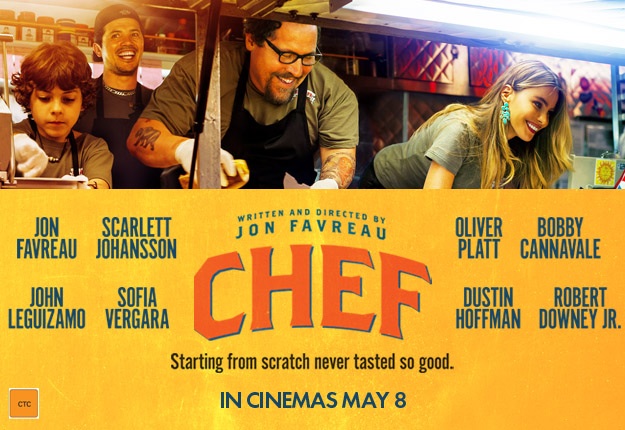
There’s not much to this Jon Favreau film, and it certainly doesn’t break new ground, but it is a charming, dare I say “feel good” comedy about a chef (Favreau) who stumbles spectacularly via the internet and Twitter (one of the funniest memes in the film is Favreau’s cluelessness about social media) and makes a comeback with a food truck. Favreau clearly has great fondness and respect for the subject matter and the loving depiction of cooking is one of several strengths of the film. Others include an enviable supporting cast (Scarlett Johansson, John Leguizamo, Sofia Vergara, Robert Downey Jr., Oliver Platt, Bobby Cannavale and Dustin Hoffman) and an unexpectedly moving but understated father-son dynamic between Favreau and his 10 year old, Percy (Emjay Anthony), worked out on a road trip.

image

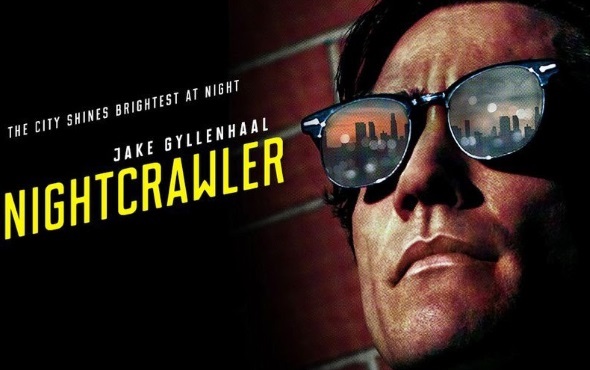
A clever black comedy that emphasizes story over a message (“if it leads it bleeds”), Nightcrawler works in large part to Jake Gyllenhaal’s riveting performance as an aspiring freelance videographer who haunts LA at night, capturing its brutality for sale to local TV news. Gyllenhaal is a mixture of King of Comedy‘s Rupert Pupkin, Rushmore‘s Max Fischer, and Jim Carrey’s Cable Guy, a driven cipher who spouts business motivational doctrine and relentlessly pushes further and further over the line of acceptable journalistic practices in capturing people in crisis or even death throes. You guiltily root for him because he is so compelling and his Dale Carnegie pitch, even unmoored from any concept of morality, comes off as an earnest entrepreneurial pitch. But by the end of the film, a series of tense crime scenes invaded by Gyllenhaal, his philosophy is both corrupting and lethal. He makes it bleed even more that it otherwise would, and as a result, he excels.

It’s a simple tale, well told, but there isn’t a lot to this picture other than Gyllenhaal, who exudes a real inner force (while his character is certainly different, I kept coming back to De Niro in Taxi Driver). He has two co-stars; Renee Russo, a hard-bitten struggling TV producer whose star rises with Gyllenhaal’s footage, and LA at night, which writer director Dan Gilroy shoots as a haunted ghost land of deserted streets and foggy canyons. Gilroy is a longtime writer of pretty bad films (Freejack, Two for the Money, Real Steel), but he directs this thriller with pace and verve.

image

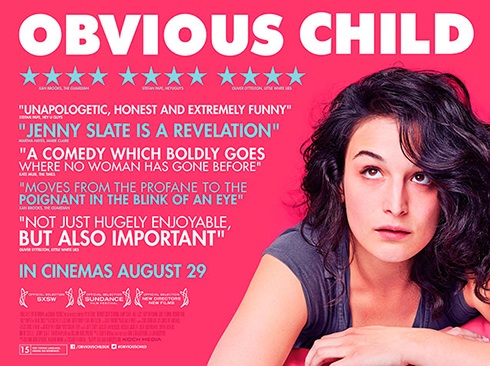
A romantic comedy set around an abortion requires a deft hand, and there are times when first time writer-director Gillian Robespierre navigates her lead, sweet but spoiled comedian and former SNL alum Jenny Slate, into some questionable waters. Slate is a comic, a regular at a Williamsburg club, who has a one night stand with seemingly buttoned up Jake Lacy. Her “thing” as both a stand up and as a potential mate is to be self revelatory and outrageous, and so we get a full helping of bon mots about vaginal yeast, farts and the like. That can be a little trying, as is Slate’s callous treatment of Lacy.

But it works. Slate is very good, exhibiting the in-between status of a grown woman trying to live her own life and the little girl still vulnerable and attached (financially and emotionally) to her divorced parents. Slate is very much modeled after Lena Dunham’s Hannah Horvath from Girls, with, thankfully, precious little of Horvath’s navel-gazing excess. But when Slate gives voice to her fear and confusion, she is natural and sympathetic.  Conversely, when Horvath is flat on her back on on the canvas, you most always feel pretty happy about it.  Lacy is also quite touching as the gentle and confused hook-up who warms Slate’s butter pats and brings flowers to Planned Parenthood.  He knows that among the smart set, the joke may be on him, but he’s game and his backhand is effective.

While I’m not sure if Robespierre meant for Slate to be only kind of funny, that works as well, because it feels real. She seems like a young comic, still working on material up until the moment she takes the stage, and that contributes to the verisimilitude of her circumstances.

This could have been arch and maybe even preachy. Gaby Hoffman, as Slate’s roommate, comes close to giving a stemwinder against the Supreme Court and society’s “patriarchy” but she is blunted by Slate’s giggles and a mild pushback from a gay friend who retorts, politics aside, that he would want to know if he got someone pregnant.

No matter the edgy subject matter, the end is syrupy sweet and hopeful, paying homage to the rom-com rules.

The Family Stone - Wikipedia

My August: Osage County review elicited an email from my friend and mentee, Xmastime:

worse than this steaming turd

My reply:  “Nothing is worse than that steaming turd.   Osage is a standard, Southern shoutfest, with as much authenticity as Hee HawThe Family Stone, however, is a pat-its-own-back paen to womyn, disabled homosexuals, showy profanity by people wearing flannel, and New England flintiness.  The cancer ravaging Diane Keaton couldn’t come fast enough.  I am pleased to say that its writer director didn’t get another project until 6 years after The Family Stone and that was a Selena Gomez joint.  Justice.”