Archive

Comedy

image

(Reporting from the Blizzard of ’16)

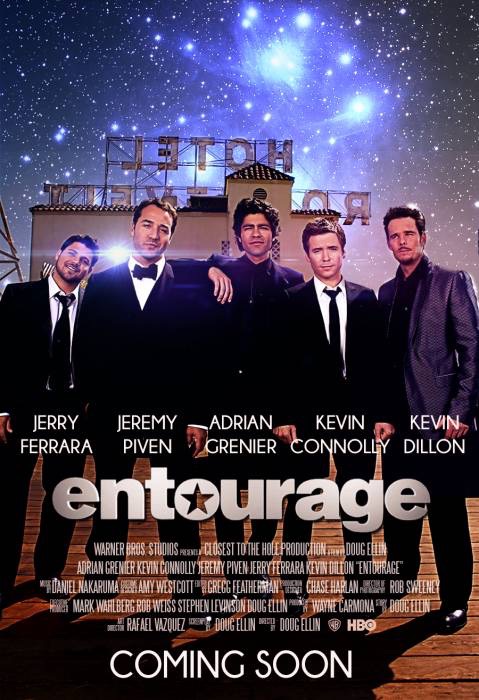
The TV show was two seasons too long but most always amusing, giving you a taste of what it might be like to be young, dumb, affable and famous in the candy dish that is Hollywood. The show’s greatest attributes were its locale, engine (the hyper, high-powered brutal agent Ari Gold played by Jeremy Piven) and length (a brisk 30 minutes). Entourage gave to men what Sex in the City gave to women, though the latter could often seem a conflicted and forbidding place for the female archetypes. Not the sandbox that was Entourage‘s Hollywood. Sure, the fellas had occasional relationship issues or fights with studios, but nothing that could not be wrapped up quickly and remedied by weed, easy sex with nubile ornaments, and kick-ass parties.

The film bollixes up all the critical elements of the TV show. The locale is used solely for a series of unfunny cameos and time-wasting sojourns. The likes of Liam Neeson, Mark Wahlberg (the show’s canny producer) and Armie Hammer (he’s someone?) just show up, which is just weird.

Worse, the Hollywood of now just seems tired and pedestrian. Piven, now a studio head instead of a mere agent, is less antagonistic and biting than weary and beleaguered, and his time is spent making sure the dream film of his pretty boy Eliza Doolittle/Vinnie Chase (Adrian Grenier; he directs!) is financed by mean old Billy Bob Thornton, a gun totin’ Texas kabillionaire and the studio’s primary financial partner. This leaves Piven in the role of supplicant most of the film, not aggressor, and as anyone who watched the series will tell you, Ari Gold is one entertaining combatant.

Two hours in and one gets the feeling that director, writer, and creator Doug Ellin was desperately looking for filler. He does a few pointless things with Vince’s gang, but it is not enough. Like a kid completing a term paper coming in short, we get a lot of driving and walking scenes.  If they are your thing, this is your flick.

The best part of the movie is one aspect of the actual story, which has Thornton’s spoiled son (played by Haley Joel Osment of The Sixth Sense fame, who now sees bored people) coming up to Hollywood and attempting to put the kibosh on Vince’s opus, a futuristic remake of Jekyll and Hyde, because Vince aced him out of a girl.

Even though they are excuses used to cover for being hurt over the girl, Osment’s criticisms are valid.  He explains that Vince’s brother (Johnny Chase, played by Kevin Dillon) is putrid in his four “pivotal scenes” and that Vinnie himself sucks as the lead, and you know he’s probably right. Hell, when Ari nervously screens the picture and we get 2 minutes of it, it has the look and feel of a high-end Sprite commercial.

Alas, Osment is sent packing, and the boys get Golden Globes (ha! Not a People’s Choice?).

Osment, however, gets the last laugh.  He was actually nominated for a real Academy Award.


Will Ferrell has seemingly gone to the well too often with his super clueless white dude schtick (as I write this, he dropped another one into theaters with Mark Wahlberg; Ferrell is the super clueless white stepdad to Wahlberg’s bitchin’ cool real dad). There’s nothing new to it, but I have to say, coupled with Kevin Hart, in Get Hard, you have the two hardest working men in show biz peddling standard physical, fish-out-of-water yuks. and they hit more targets than they miss. And by hardest working, I don’t mean they do a lot of movies (although they do), but that they work the ever-loving shit out of a bit, no matter how lame the premise or how Hindenburg-esque it feels. And I have to give them credit. Ferrell, as the super clueless white dude hedge fund manager set up by his boss, and Hart, as the man who washes his car and acts like an ex-felon to prepare Ferrell for hard time, create laughs on the sheer strength of their dedicated efforts. It’s almost as if they’re beating them out of you in their riffs, and it jumps this movie a full 2 stars. Interestingly, what murdered the movie with the critics was the constant refrain of Ferrell fearing forced sex (or otherwise) in prison; those halcyon days of making mirth of prison rape have passed (The Atlantic‘s Christopher Orr gave the film the “Gay Panic Award” and Salon took the time to provide a compendium of reviews deeming it “a racist, homophobic mess”). I’ll leave it to others more sensitive than myself to judge the film’s racism or homophobia, but I confirm it is a mess, albeit one that has some very funny bits (including some centered on Ferrell’s fear of gay sex), made funnier by the blood, sweat and tears of the leads.


image

When Noah Baumbach makes movies about miserable people, they tend to be miserable experiences. Ben Stiller was a depressed, egocentric bundle of nerves in Greenberg. In Margot at the Wedding, Nicole Kidman was a near hysteric mother, so casually cruel to her teen son it set your teeth on edge. And Jeff Daniels’ insecure, superior father in The Squid and the Whale was a textbook narcissist and a gasbag academic to boot. While talent is evident in these films, they are neither enjoyable or incisive. Rather, they are merely intricate portraits of unpleasant people doing awful things to themselves and those around them.

But Baumbach has a breezier side, one that was shown in his writing of Wes Anderson’s The Life Aquatic and Fantastic Mr. Fox, and of late, his films seem less like autopsies and more like entertainment. In Frances Ha and While We’re Young, Baumbach could not quite leave the realm of the neurotic, but at least we had characters to semi-root for. In Mistress America, we have an unqualified heroine, Greta Gerwig (who dates Baumbach and co-wrote the script), a whirling dervish of a climber, all idea and no follow-through, who latches on to a lonely college freshman (Lola Kirke), lifts her spirits and serves as her muse. What follows is a hilarious social and then drawing room comedy, which has a bit of a Whit Stillman nostalgia, but is decidedly more modern in its literate and canny observation of academia, money, status and success. Gerwig is truly a force of nature, and Kirke is genuinely touching as a child adrift in the cold realm of college and New York City. I laughed out loud throughout, one of the best films of the year.

 image

I’m not a big fan of the super hero flicks, and now that they are mixing and matching and packaging ad infinitum, I’m even less enamored.   For the most part, they are CGI Dramamine, and in the wrong hands (like those of Zach Snyder), they add a seriousness that is self-parody (the preview for the new Superman v. Batman, or whatever the heck it is called, is so dour you almost brighten up when Wonder Woman is inexplicably thrown in the mix).

And yes, they are going to pigeonhole Ant Man (Paul Rudd) into the franchise, which will mean we have another wiseacre to compete with Tony Stark, but still . . . I liked this movie very much.  Rudd is charming as an ex-Robin Hood con who is used by Michael Douglas to get miniaturizing technology out of the hands of his evil protégé (Corey Stoll) and the CGI for the transformation is both nifty and ladled out sparingly.  Ant Man seems a nice fella’, as if you dropped an Apatow character into a super hero guise, and he’s aided by a hilarious trio of bumblers, one of whom (Michael Pena) made me laugh out loud repeatedly.

image

A smart, kinetic re-imagining of Risky Business, except instead of Joel from the tony suburbs of Chicago, we get Malcolm, a geek from the decidedly tougher “the Bottoms” of Inglewood.  A lot of good laughs and a few inspired set pieces.  Unfortunately, it shoots itself in the foot at the end with some clunky, preachy Spike Lee homily.  Shame.

Spy (2015) – Jonesing For Films

Melissa McCarthy blew the doors off of Bridesmaids, and that was in a very strong ensemble. Since that time, she’s taken several whacks at a lead or co-lead role (Identity Thief, Tammy, The Heat) and the results have been blah. In the first two of those movies, McCarthy played up the grotesque, as if to say, “Yes, I know I’m fat, but wait until you see me fat and disgusting and humiliated.” It was a complete reversal from her character in Bridesmaids, who acted as if her weight was an advantage, an intriguing sexy charm, only to reveal to a self-pitying Kristen Wiig that her arrival at such self-confidence was no easy road. In this, McCarthy was hilarious and touching. In Tammy and Identity Thief, she was gross, charmless and, unsurprisingly, not funny.

McCarthy should thank the stars for writer-director Paul Feig, who also directed Bridesmaids, because he leads her back to her strengths. As CIA office minder for the James Bondian Bradley Fine (Jude Law), her secret agent exploits are limited to getting Fine out of jams while talking in his earpiece.  Of course, she’s in love with him, a love that is unrequited but deep nonetheless. When Fine is killed, McCarthy goes out into the field to avenge him, tangling with a fellow agent who is dismissive of her skills (a very funny Jason Statham), a horny Italian liaison on the ground (Peter Serafinowicz, who damn near steals the movie), and the arch villain Rayna Boyanov (Rose Byrne, who may be the hardest working woman in show biz). For each of these characters, Feig writes very clever bits, and McCarthy plays off of their barbs beautifully. The result is a bit of Austin Powers and a bit of Bond at its most campy, consistently interspersed with crisp and amusing banter and a few laugh-out-loud set pieces. It’s all held together because you like McCarthy and instead of reveling in her misfortune, she exhibits wit and pluck and you root for her to rise above each indignity (the worst of which are the increasingly disparaging “undercover” personalities she is assigned).  Great fun.

image

I loathe artistic political correctness in all its forms, be it the soul-sucking idiocy of demanding cultural authenticity in casting, the blanket condemnations of some “ism” by the cultural debt counters, or the wails of some grievance group as one of their own is skewered for comedic purposes (Robert Downey Jr.’s “retard” riff in Tropic Thunder comes to mind).  The effect is the same – to straightjacket creative endeavor so it presents like a PSA. The only good that comes of the p.c. influence are–

* the groveling apology (Cameron Crowe bootlicking because he cast Emma Stone as a quarter-Asian, quarter Hawaiian: “I have heard your words and your disappointment, and I offer you a heart-felt apology to all who felt this was an odd or misguided casting choice”);

* the unctuous backpedaling (Matt Damon, after having been caught on camera rejecting affirmative action and using the word “merit”: “My comments were part of a much broader conversation about diversity in Hollywood and the fundamental nature of ‘Project Greenlight’ which did not make the show. I am sorry that they offended some people, but, at the very least, I am happy that they started a conversation about diversity in Hollywood. That is an ongoing conversation that we all should be having”), and

* inane public proclamations (Viola Davis, who, when receiving an award for a TV drama, without a hint of irony or self-awareness equated her struggle to that of Harriet Tubman).

That said, Welcome to Me is an offensive film, and the heart of its offense is in how it portrays mental illness.   Kristen Wiig plays a sad shut-in, obsessed with Oprah, who wins the California lottery. She suffers from borderline personality and is off her medication, yet that doesn’t stop a local production company run by Wes Bentley and James Marsden from taking her millions so she can develop her own show. That show is a stage for Wiig to exhibit all the debilitating aspects of her un-medicated disease in a manner that at best is quirky and at worst is truly disturbing.

If done well, I don’t have a huge problem with making a dark comedy about a mentally disturbed person being taken advantage of.  I’ve gone down weirder, filmic roads.

So, to be clear, my objection is not to the premise nor do I advocate for the babying of any protected class in art.

But when you take this on, you can’t have your cake (using the disability as comedic tool) and then ask the audience to regurgitate it in shame after the eating.

Essentially, that’s what writer Elliot Lawrence does here. It’s not that the picture is poorly acted or directed or that there aren’t even a few funny scenes. Rather, the film is an exploitative movie about a sick person being exploited, and it wants to use mental illness for yucks while pretending to be brave in showing the true face of that illness.

You need a really deft hand for that kind of trick, and Lawrence and sophomore feature director Shira Piven do not have it.

Worse, the movie condescends with a throw-away lame anti-television theme, and in the end, Wiig is transformed into a “winner” with the help of a mere few pills.

The film has aspirations to Wes Anderson, but you’ll learn quickly, having Bill Murray in your cast isn’t enough. Murray plays an old Brooklyn codger, a man who drinks, smokes, and consorts with a pregnant Russian stripper/prostitute (Naomi Watts, sporting an accent so thick and implausible it would make Gary Oldman recoil and say, “no, no . . . too much”).  He also gambles at the track, is in deep with a bookie, and spits in the eye of anyone who might show him kindness. Yet, he’s cool because he listens to a Walkman that plays kitschy 70s pop or Dylan. So rest assured, this guy has a heart of gold. Naturally, when he gets new neighbors (newly divorced and fed up nurse Melissa McCarthy and her impossibly wise yet innocent son Jaeden Lieberher), he opens up a crack, takes the kid under his wing, and to the track, and to the bar, and in the vicinity of the prostitute.  Predictable hijinks ensue, but when the son gets the assignment at his Catholic school to find a saint here on earth, well . . . guess who?

It’s a testament to the effectiveness of first time writer-director Ted Melfi that he can get you to well up a little on occasion, but that doesn’t change the fact you want to punch him in his face for manipulating you so brazenly.  This is paint by numbers, hip treacle that might make even Zach Braff a little queasy.

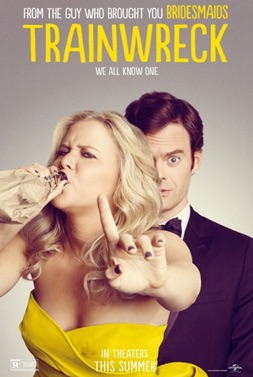
imageAfter the gruesome This is 40, it’s good to see Judd Apatow back.  He owes it to Amy Schumer’s crackling script and impressive breadth, as well as an unexpected Bill Hader as a rom-com lead and fantastic support, especially cameos by non-actors LeBron James and John Cena.  Schumer is a loose narcissist who shuns intimacy when she is given the assignment to write a magazine piece on Hader, surgeon to sports stars.  They click and he weans her off her casual cruelty, but, of course, she relapses and then . . .

Schumer is very funny, as evidenced by her Comedy Central sketch show, where she melds winning and loathsome, no small feat (Lena Dunham has mastered the same trick).  Schumer digs a little deeper here, showing some real depth in a few scenes of despair, so you’re rooting for her, a critical element for a rom-com.  As noted, she’s well-supported, and James is particularly memorable as himself, although I don’t know if he is notoriously cheap, into Downton Abbey, or so relentlessly competitive that he wouldn’t let up on the likes of Hader in a game of one-on-one.

There are some problems.  The film is too damn long at two hours, and the scenes that could be cut (an unfunny intervention, a scene where Schumer condescends to two stock, unhip suburbanites who don’t stand a chance, an overlong wacky seduction, one scene too many of an otherwise hilarious and barely recognizable Tilda Swinton as Schumer’s boss) are obvious.

Still, what’s funny is very funny and the picture sticks the landing.

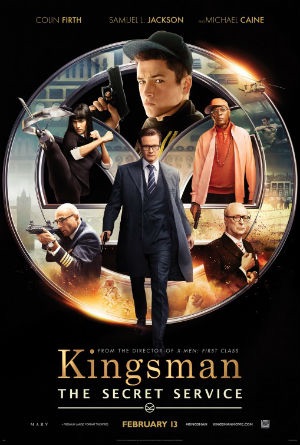
image This is a Roger Moore-era Bond flick, but with cheeky self-referential humor, first-rate, modern action sequences and a decidedly South Park sensibility. It features a budding, young James Bond from the wrong side of the tracks (Taron Egerton), his sophisticated mentor (Colin Firth), a megalomaniac, quirky villain (Samuel L. Jackson, with a lisp), his own Odd Job (Sofia Boutella, who slices you with her scythe legs instead of a hat) and a plan to destroy the world to save it from the menace that is man, much like Drax in Moonraker and Stromberg in The Spy Who Loved Me.

Spoilers follow. There’s no way to do the film justice without talking about the plot.

Jackson, a zillionaire, has decided, like his Bond forebears, that man is a virus. So, he enlists the upper reaches of society – prime ministers, royalty, heads of state (including President Obama) and the rich and powerful – to let him loose a transmitting signal that will make man kill man. And thus, the world will be saved from the global warming man has created through immediate, violent, hand-to-hand near self-extinction. Again, Jackson “enlists” the upper crust. But to ensure they stay the course, he implants a chip in all their necks so, if they do decide to balk, he can blow their heads up. But they don’t balk. The world’s leadership is mostly in on the gig.  They willingly and without reservation sign on to the plan that will have mankind wipe itself out, except for the rich and powerful.

This is a delightful, wildly politically incorrect “eat the rich” comic book, which just amps up the absurdity.  The Kingsmen not only thwart Jackson’s design, but we get to see it tested out on Westboro Baptist Church-types,  who dispatch each other out with gusto in a raucous church melee. Then, a Kingsman activates the implants, so we see the heads of state and the rest of their aristocratic collaborators, blow up.

Some world leaders do not collaborate, and they are jailed.  One is a beautiful Swedish princess, blonde and resolute, and when Egerton shows up to save her, as with Bond before, she offers him a kiss and more if he will free her and kill Jackson.  And if he saves the world?  His prize is enhanced.

That’s a couple of extra stars right there.