
Archive

Classic

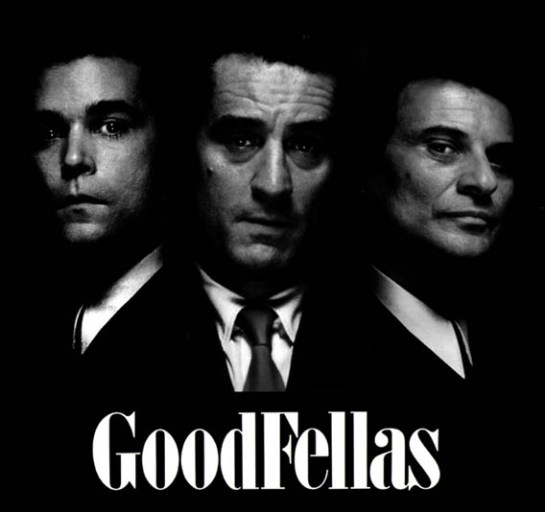
This movie is so good that AFI’s ranking of 94 is an embarrasment (Forrest Gump is rated almost 20 slots higher). From the moment of Ray Liotta’s first voice-over line (I don’t think there is more effective voice-over work in any film ever) to the maniacal, miserable fall, Scorsese chronicles the mob as fantasy to the crime as reality from Liotta’s boyhood to Witness Protection schlub. In re-viewing, here are my thoughts on what makes Goodfellas the greatest crime picture ever made.

The camera-work. The sheer audacity of Scorcese’s tracking shots make their counterparts in The Player and Boogie Nights seem gimmicky.  Scorcese goes on without an edit, not as flourish, but to introduce the cast of mob characters and their life  The uninterrupted trip of Liotta getting into a nightclub speaks volumes about the life – the excitement of his date (Lorraine Bracco) as they are being guided to the best table in the house is shared by the audience.  As we take the trip with Bracco, we are introduced to the glitz during a seemless dreamy waltz.  This is the difference between Spike Lee silliness (floating characters) and skill with purpose.

The Feel.  It looks and sounds right in every respect, from the kitschy Tiki bars to the outlandishly tacky apartments and home to the ghastly look of the mobster wives to the diners and late night drives.   Better, Scorsese, as always, picks the right song for each trip.

Liotta, Pesci and DeNiro, especially Pesci. Liotta, like us, is the outsider, though he is effortlessly conscripted.  Still, he plays Henry Hill as a shade removed from the crazy of DeNiro and Pesci.  He’s a brute but he is not an innate killer.  Thus we are capable of remaining empathetic.  Robert De Niro also keeps vestiges of humanity, though in fact, he is only one notch below Joe Pesci in terms of sociopathy. Pesci, however, is the most honest character and the heart of the picture.  He is a killer, his code is barbaric and his emotions uncontrolled. Which means that he can beat you near to death and comfortably have a meal right after.

Authenticity. The best example of this is not in the look or the sets or the music, but rather, in Scorcese’s portrayal of the easy violence, which one assumes he knows from his roots and/or from working with writer and former Mafia journalist Nicholas Pileggi. No better example is when Pesci comes back to kill the “made” guy (Scorsese and The Sopranos regular Frank Vincent) for busting his balls.  We know Pesci is going to snap, but the moment Pesci attacks him, De Niro jumps in viciously to assist, no hesitation. De Niro knows that killing the guy is stupid. In fact, De Niro was calming Pesci down earlier in the evening, trying to smooth things over. But the attack sets him off like a shark smelling blood, and he instinctively jumps in to rip the guy’s head apart. He’s an animal in a feeding frenzy.

Scorsese’s Casino is actually a deeper film about the Mob, but Goodfellas is the landmark, a precursor to the humor of The Sopranos and an obliteration of the operatic grandiosity of the life left to us by The Godfather.


The cynical Western of the 70s has a few decent entrants.  The Ballad of Cable Hogue and The Life and Times of Judge Roy Bean come to mind.  Butch Cassidy showed it in sleek form (though it was released in 1969), and The Wild Bunch was the birth. Richard Brooks’ Bite the Bullet is a lesser work, a film that doesn’t catch its stride until well into the last third, giving you precious little to savor until that point.

Essentially, the film is a turn of the century Cannonball Run. A disparate cast of characters comes to town to run a 700 mile race.  There’s the gambler looking for his last big score (James Coburn – in a nice touch, he is introduced kicking the boot of another character, just as he had his boot kicked in The Magnificent Seven), the wild young kid looking to make a name for himself (Jan Michael Vincent, pre-crack up), the mysterious ex-whore with a heart of gold (Candice Bergen), the proud and quietly suffering Mexican (some Mexican guy), the over-the-hill man looking for his place in the era (Ben Johnson), and the sporting English gentleman (some English guy).

Off they go, with Gene Hackman to round them out. Hackman is a pre World War I man of the ages; he loves animals (if this wasn’t the forerunner to Robert Redford in The Electric Horseman, I’ll eat my Willie Nelson records, an empty threat for I own none). He is kind to women and whores, treating them as equals. He is a civil rights advocate, and he even is a little anti-war.  This is the story, and the characters live and learn – and become better people for it – through the grueling marathon.

The script has some punch, but is mostly leaden.  You’ll find that Coburn quoted Bible verse well-ahead of Samuel L. Jackson in Pulp Fiction and someone punched an animal on film before Alex Karras in Blazing Saddles.  You’ll suffer through “I’ve forgotten how good a bad women feels” and “Killin’ a man don’t prove you’re a man” (delivered unconvincingly by fashion model Bergen) but you’ll also enjoy “Why don’t you tell me the story of your life.  Just skip everything until the last few minutes.”  Particularly good – the whore who asks Hackman pre-coitus, “How do you like it?” – to which he retorts, “Without conversation.”

Coburn and Hackman are fine, but they aren’t exerting themselves, and you see in their performances a defter Mel Gibson/Danny Glover tandem, with a bit more grit and dust.  Bergen is invisible, as should be expected. She is the Andie MacDowell of her age (Raquel Welch did better in Hannie Caulder and that’s saying nothing).

Brooks’ direction is workmanlike and uninspired (he is, after all, a workmanlike and largely uninspiring director, with credits from Cat on A Hot Tin Roof to Elmer Gantry to Looking for Mr. Goodbar).  That said, he reaches a few moments of renown.  In one sequence, he effectively uses slow-motion to depict a horse sprint between Coburn and Vincent.   Vincent is losing, and his horse is fading, so Brooks splits the screen for effect (not split by a bar, ala’ The Boston Strangler, but split so that Coburn and Vincent are side-by-side), but Brooks keeps Vincent in slow-motion, while Coburn remains in real time.

Alex North’s score was nominated for an Academy award.  I cannot see why.  It is a bad Aaron Copland copy, and in that Copland has been used rather freely, from The Magnificent Seven to Spike Lee’s He Got Game, the cheap facsimile (replete with orchestral diversions into standard American ditties) was hardly necessary.