Archive

90s

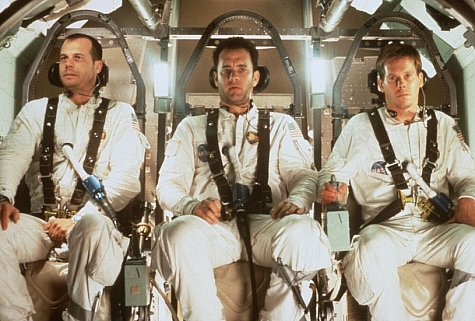
A thrilling and engaging piece of Americana and an homage to national ingenuity and purpose, this is the kind of film you hope your children watch (jocks and geeks and in-between alike, for they are all celebrated and shown as peers) and thereafter, become inspired.  I was surprised at how white-knuckle the re-creation of the near-doomed mission felt given I knew the outcome (Spoiler – the crew of Apollo 13 survived), but this is really edge-of-your-seat fare.

The performances are all excellent. Tom Hanks as mission commander Jim Lovell is hitting right in his sweet spot, the decent, measured everyman of Saving Private Ryan, Castaway and Philadelphia, and he is ably supported by Bill Paxton (a likeable but ever weakening Fred Haise) and Kevin Bacon (as Jack Swigert, added to the mission at the last minute, both defensive and independent). On the ground at home, Kathleen Quinlan is steely and vulnerable as Lovell’s wife, she underplays a role that is stock and often butchered by over drama (see Madeline Stowe as the suffering wife in We Were Soldiers), and she was deservedly nominated for Best Supporting Actress.  In Houston, it is a cast of seemingly thousands, led by Ed Harris as NASA Flight Director Gene Kranz, who work tirelessly to bring the crew back home to earth safely. At every moment, you recognize another character and/or commercial actor and say, “oh, yeah, he was in . . . .”

A year after the stunning visuals of Gravity, I expected the 20 year old Apollo 13 to feel dated. It does not.  But this is not a picture featuring aesthetics, but rather, the resourcefulness of all types of individuals engaged in a grand effort during a harrowing rescue mission, told without schmaltz or thick reverence.  The immediacy of the film comes in part from the fact that the dialogue between Houston and the astronauts is near verbatim from transcripts and recordings, and Hanks, Paxton and Bacon were all trained at NASA’s space camp in Huntsville, AL.  It’s Ron Howard’s best picture.
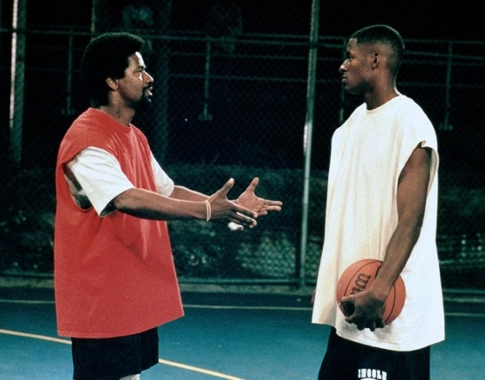
Image result for barton fink

There’s not a scene in this Coen Brothers film I don’t like, and the story of a Clifford Odets-esque playwright’s (John Turtorro) introduction to the oily world of Hollywood is both visually striking and thematically ambitious.  But no matter the film’s look or intriguing interpretations (the mind of the writer, the dangers of solitude, the corruption of money), by the end, you feel trifled with, as if you watched a parlor trick perpetrated by a cast of broad, comic actors (John Goodman, John Mahoney, Michael Lerner) for no greater purpose than the goof.  Like The Hudsucker Proxy and Miller’s Crossing, Barton Fink has its joys, but the feel is sterile and your investment unrewarded.

Good Will Hunting' Stars: Where Are They Now? Matt Damon and More

On the heels of Robin Williams suicide, I thought I’d review one his few films I liked. In Gus Van Sant’s drama, written by Matt Damon and Ben Affleck, Williams plays a community college professor and psychologist. With his MIT credentials, he could have been a big deal but was waylaid by love and is now stricken with grief at her passing.

When William is introduced to guide the damaged savant, Will Hunting (Damon), we know that when all is said and done, both characters will have taught each other something valuable about life.

A lot can go wrong here.

But Van Sant keeps it even. Williams is smartly subdued, with no hint of the manic persona that became more schtick and adrenaline than acting. He is patient, picks his spots and elevates much of the film’s schmaltz with real pathos. When he is riled, it feels authentic and raw.

As for the film itself, I’ve always been torn. The concept is smart. A working-class Boston kid is also a genius, sadly mopping floors at MIT, but he finds a way to shine and then falls in love and then, through therapy, grows out of his limiting, Southie world. Van Sant’s direction is inventive (the slo-motion rumble to Gerry Rafferty’s “Baker Street” is particularly nifty, and there are many such cool touches); the exchanges between the Southie pals (Damon, Ben Affleck – again, proving he can be very good in small doses – Casey Affleck and Cole Hauser) are believable, very natural, and often hilarious; there is actual heat between Damon and his romantic interest, Minnie Driver; and Elliot Smith’s musical contributions are hauntingly memorable.

On the downside, while Damon is quite good as the lead, his character is kind of one big cheat. Plagued by his own demons, we are supposed to empathize with Will, but he is a selfish, smug prick throughout, just about every assist you can give a modern protagonist – he’s lonely, he was shuttled from foster home to foster home, he was beaten as a child, his enemies are grotesque caricatures that lack only the villain’s mwahahahahahaha, and yet …

Here, Will goes toe-to-toe a snooty Harvard type:

Obviously, the Hah-vahhhd pony-tail is the bad guy (on the strength of the pony tail alone), but much of the film is sneering at the uptight folks who admire his genius and do him no injustice.

It reminded me of Walker Percy’s The Thanatos Syndrome: “There’s Hawkeye and Trapper John back in Korea. I never did like those guys. They fancied themselves super-decent and super-tolerant, but actually had no use for anyone who was not exactly like them. What they were was super-pleased with themselves. In truth, they were the real bigots, and phony at that. I always preferred Frank Burns, the stuffy, unpopular doc, a sincere bigot.”

So, as the music swells, and Will escapes the clutches of Southie to chase love, I’m pretty sure he’s going to revert to being a smug prick soon enough. Only now, Minnie Driver will be there to socialize him.

Louis CK pretty much nails it:

This is one of Spike Lee’s better films, an audacious picture of Americana (scored by Aaron Copland no less) that both mythologizes and indicts the sports culture while dramatizing the strained relationship between a convict father (Denzel Washington) and his son (Ray Allen), a prized high school basketball recruit. Washington is released from Attica with the promise of a lessened sentence if he can convince Allen to sign with the governor’s alma mater. He has one week to do it, and has to overcome several hurdles, the greatest of which is the fact that he is in jail for accidentally killing Allen’s mother in a domestic fight.

As in Summer of Sam, Lee’s appetite is enormous, and he typically tries to tackle too many issues in this sweeping story. He also includes a pointless subplot between Washington and a prostitute (Milla Jojovich) and indulges in his unfortunate penchant for speeches (Roger Guenveur Smith plays the local crime boss and delivers a PSA soliloquy on all the perils of fame that brings the picture to a screeching halt). But at the heart of the picture is Lee’s love for basketball, which he portrays as something truly majestic and unifying, skillfully interspersing old footage to punctuate the revered history of the game.

Washington is also commanding as the father who drove his son to succeed, and we see in him the love as well as the excesses of a parent who wants too much for his child. The scenes of a younger Washington pushing his little boy to be Jordan and their later one-on-one are beautiful and heartbreaking. Allen, an acting novice, does surprisingly well as the son, communicating the wonder of it all as the world opens itself for him.

This is a flawed picture, but Lee is working from the heart and shooting for the stars and it shows.

Not just historically inaccurate, but outright hostile to the facts, Mel Gibson’s Braveheart matches its puerile fantasy with cheezy romance, splatterfest battle scenes, and cartoonish characters (Patrick McGoohan plays King Edward Longshanks as Ernst Stavro Blofeld and Peter Hanley plays his son as if auditioning for La Cage Aux Folles). Then, there is the James Horner score that brings you back to the ye olde highlands of Busch Gardens. Naturally, like Robert Redford and Kevin Costner before him, the Academy honored an actor turned director with an undeserved Best Picture statuette. But Ordinary People and Dances with Wolves are merely pedestrian. Braveheart is bad through and through and often, excruciatingly so.

On the plus side, when you decide to rewrite history, you might as well give William Wallace a haircut straight out of Duran Duran.

Image result for braveheart

Hungry like the wolf for FREEEEEDOOOMMMMM!!!!!”

Blood Simple (1984) - Rotten Tomatoes

Al Pacino once explained his attraction to a project by tapping his finger to his temple and noting that the director had “a vision.” That director was Warren Beatty and the project was the bloated Dick Tracy.

The Coen Brothers’ first film demonstrates a true vision, one that has it flaws, but one that is unique and rich, through and through – a sun-drenched, steamy Texas noir potboiler that evokes Jim Thompson and James Cain, updated to include a very sly, dark humor. The plot takes numerous turns, but it is simple in its introduction.   A bartender (John Getz) runs off with the wife (Frances McDormand) of his boss (Dan Hedaya), who in turn puts a lethal private investigator (M. Emmett Walsh) on their trail. Walsh introduces the story in voiceover:

“The world is full of complainers. But the fact is, nothing comes with a guarantee. I don’t care if you’re the Pope of Rome, President of the United States, or even Man of the Year–something can always go wrong. And go ahead, complain, tell your problems to your neighbor, ask for help–watch him fly. Now in Russia, they got it mapped out so that everyone pulls for everyone else–that’s the theory, anyway. But what I know about is Texas…”

What follows is the twisted story of these four characters against the backdrop of a flat, unforgiving landscape. The photography is stunning, and the camera-work is assured, if sometimes a bit too film school flashy (as McDormand and Getz confront each other at his front door, a slo-motion newspaper crashes against it to startle us all). Composer Carter Burwell started his partnership with the Coens on this film, and his score is primarily solo piano, sparse and ominous.  Hedaya is the embodiment of the cowardly cuckold, but he seethes, almost a human pressure cooker. Walsh’s sleazy dick is repellant. He almost oozes, but he’s canny, using his “aw shucks” as a way to get the advantage. Getz and McDormand are weaker. Getz just doesn’t project and while I respect the Coens for eschewing the expected sultry, bored kept woman, McDormand’s character requires some charisma and sexuality to justify the risks taken on her behalf. She’s never been that kind of actress and here, she’s flat.

Still, this is a very good film, and as a debut, it’s all the more impressive, presaging the brilliance of Fargo.

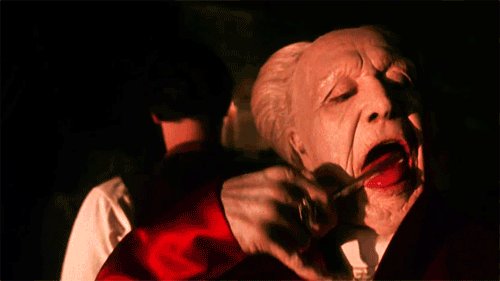
Francis Ford Coppola’s take on the Dracula story is wild, campy, and brisk.  It also has a few scares, but one gets the sense Gary Oldman’s operatic Transylvanian count is not to be taken too seriously.

After all, Oldman appears in, by my count, 7 guises, including a nifty pile of rats, and he is just short of hammy in all.  Not to be outdone, Anthony Hopkins’ Dr. Van Helsing is near giddy in his thirst for scene-chewing and vampire heads.

In its first half, the picture feels very Baz Luhrmann meets Saturday-at-the-movies serial. It settles into a more leisurely pace in the middle, as Dracula attempts to take root in London and his opposition grows.  The picture is a gas, and Coppola’s rejection of an overly serious, brooding vampire is welcome. Perhaps it is not quite a rejection, as Oldman tries so hard to be otherworldly and tortured, he may be the last one in on the joke.

The film is also surprisingly erotic, as is evidenced by poor Jonathan Harker’s seduction at the hands of Dracula’s babes and the complete, sensual overload delivered to Winona Ryder and Sadie Frost as they fall under Dracula’s sway and then use all of their wiles to get at necks.

Speaking of, Harker is played by Keanu Reeves, who was then fresh off of two Bill and Ted’s Excellent Adventure movies.  If you thought Kevin Costner had problems with an English accent in Robin Hood, you have to check out this performance (both Costner and Reeves are listed in the Top Five Most terrible British Accents, and rightfully so.  Reeves can hold his accent – barely – for one line, and then, he’s one syllable away from San Dimas and “duuuude.” Then, he’s back to a dramatic and unconvincing “Carfax Abbey” only to drop it again, as if he knows how silly he sounds. Ultimately, Reeves appears so uncomfortable, he retreats into the implacably unaffected stoner no matter what Oldman and Hopkins throw at him, a treat all in itself.

Great, grandiose soundtrack as well.

The Silence of the Lambs - July 11th, 2020 at Lefty's Drive In!

My son is headed off with his pals to see The Silence of the Lambs tonight, courtesy of AMC theaters’ occasional screenings of older films. I saw it with him a few weeks back and I think he’s looking forward to watching it again in the theater as much as witnessing the reaction of his friends.

Jonathan Demme’s masterpiece is one of the few films that focuses on the serial killer but doesn’t give way to excess. What we know about Hannibal Lecter (Anthony Hopkins) is simple: he is locked up for eating people; he is brilliant and fascinating; and he is lethal. When a serial killer, Buffalo Bill (Ted Levine) starts to plague the Ohio, Pennsylvania, West Virginia area, FBI profiler Jack Crawford (Scott Glen) sends a trainee, Clarice Starling (Jodie Foster), to elicit any advice from Lecter. Starling and Lecter use each other for their own ends, engaging in a thrilling psychological dance that is one part therapy and one part mental combat; she seeks to stop Buffalo Bill while he waits for a slip-up.

The Silence of the Lambs is so well-paced and taut that on occasion, you are near-breathless. There is only one pause in the film’s very serious, unrelenting tone (when Starling is “hit on” by two geek entomologists with whom she is consulting). The pressure is not only from Lecter and Buffalo Bill, but from Starling’s lack of experience, harrowing childhood, and even her gender and diminutive physicality.  The odds seem uncomfortably stacked against her.

The exchanges between Hopkins and Foster are electrifying. You can see just how dangerous Lecter is and near curse yourself for being charmed by him. Yet, you root for the seemingly overmatched Starling, and when she stumbles, you feel the sting of her awkwardness. When Lecter so easily assesses her background and her sexual desires, it is excruciating. Yet Starling comes up to speed and achieves a plausible parity.  Levine is also expert as the tortured, frightening Buffalo Bill, and his transformation to “normal” when he is questioned is a chilling addition to this “monsters among us” story.

The picture is one of only three to win Academy Awards in all the top five categories: Best Picture, Best Actor, Best Actress, Best Director, and Best Writing (Adapted Screenplay), and deservedly so.

Very much like Goodfellas, but with a broader palette and more compelling characters. In Goodfellas, Liotta, DeNiro and Pesci are sharks, swimming to survive and devour, and the peek Martin Scorsese gives us into their immoral, brutal world is such a dizzying kick, we tend to forget that these brutal archetypes are no more than that. In Casino, Scorsese aims higher. DeNiro’s Sam Rothstein is not just an Irish street thug, but instead, a wunderkind Jewish bookie who is handed the keys to the cash cow for the mid-West mob – the Tangiers hotel (funded, of course, by union pension money) in 70s Las Vegas. DeNiro finds his oasis in the desert and works to re-create himself as a solid citizen. His efforts are doomed to fail, however, because no executive title, country club membership, or professional success can sanitize the shit on his shoes. He’s still just a functionary effectuating the skim just like when he was picking Oklahoma, taking the points. But DeNiro’s self-deception is absolute. At one point, he even hosts a casino television show which he devotes to exposing the raw treatment he has received at the hands of the local politicians who have forsaken him, ala’ Lenny.

When DeNiro feigns respectability, his protector, Nicky Santoro (Pesci) is always around to puncture his pretensions. In one of my favorite scenes, Pesci accuses a silk robe wearing, cigarette holdered DeNiro of walking around like “fucking John Barrymore.” It is Pesci’s presence that ensures DeNiro’s success (he muscles out any competitor or threat) as well as his demise (every Pesci excess is linked to DeNiro). And DeNiro is incapable of truly weaning himself off of his criminal past. As he cannot reform or blunt Pesci, he uses him to bring his conniving wife (Sharon Stone) to heel. Stone was a working girl who DeNiro hoped to take with him on his journey to polite society, but she was no more malleable than Pesci. DeNiro is, rather strangely for a Nicholas Pileggi/Scorsese character, a romantic, opening the film with “When you love someone, you’ve gotta trust them. There’s no other way. You’ve got to give them the key to everything that’s yours. Otherwise, what’s the point? And for a while, I believed, that’s the kind of love I had.” So you invest in him. His inevitable tragedy is unsurprising yet moving.

Scorsese’s use of music is, as always, impeccable, and the fluid camera-work manages to convey not only the mechanics of Vegas but the exhilaration of the town. Moreover, the film’s ending lament about its corporatization is one of his few codas to a Scorsese film supported by what preceded it.

If there is a weakness, it is in the last third of the film, where the dissolution of the DeNiro-Stone marriage is exhausting and a bit tiresome.  That identified, this is a great film and certainly a top ten American crime picture.

Robert Altman’s send-up of Hollywood process and morality opens with an audacious 7 minute, no-cut scene that is a primer on economical, fluid exposition. We meet most of our characters, including the studio’s no. 2, the writer’s executive, Griffin Mill (Tim Robbins), and the tone is set.  Unfortunately, Altman cannot fulfill the promise of his introduction. Robbins’s star is falling and he is also being threatened via postcard by a writer he has brushed off. Unnerved, he sets up a meet with who he believes to be his stalker, accidentally kills him and then falls in love with the writer’s girlfriend (Greta Scacchi). The murder is implausible and the heat-of-the-moment relationship unconvincing (a love scene with Robbins and Scaachi is not so much hot as uncomfortable). Robbins is way too mannered and standoffish to elicit empathy, and the film swerves artlessly from suspenseful to broadly comic (Whoopi Goldberg is very funny as the investigating detective, but she’s too funny).

On the plus sides, we are treated to a whirlwind tour of LA, and Altman makes sure it is populated by just about every star, young or old, he can get his hands on. Also, the lingo of the pitch meetings can be very funny:

“It’s a TV star who goes on a safari.”

“A TV star in a motion picture?”

“A TV star played by a movie star.”

“A movie star playing a TV star.”

“Michelle, Bette, Lily.”

“Dolly Parton would be good.”

“I like Goldie.”

“Great, because we have a relationship.”

“Goldie goes to Africa.”

“She’s found by this tribe.”

“- of small people.”

“She’s found and they worship her.”

“It’s like The Gods Must Be Crazy.”

“except the coke bottle is an actress.”

“Right. It’s Out of Africa.”

“meets Pretty Woman.”

Still, the script is rather gentle on the town, and it never really succeeds as a thriller or a satire. In fact, the movie could have been done without any reference to the murder at all, which, ultimately, drags it down. The Player falls into the category of Movies You Thought Were Better at the Time (Altman was nominated as Best Director, as was Michael Tolkin for the script)