Archive

80s

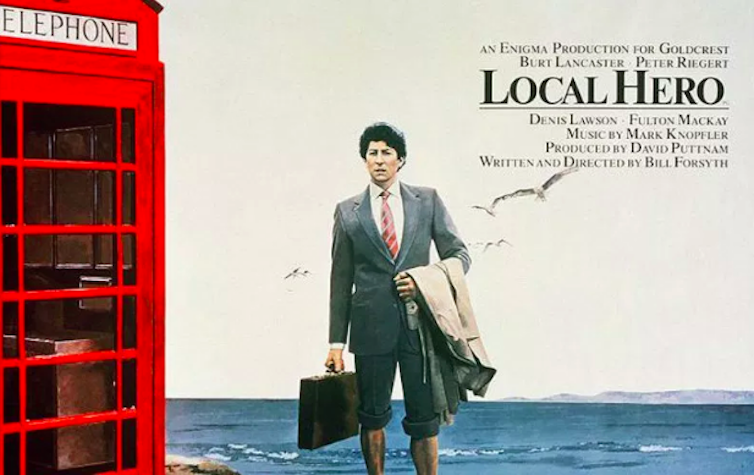
Local Hero at 35: turning Hollywood's greatest Scottish film into a musical

Writer/director Bill Forsyth was born in Glasgow so he was well-positioned to create this love letter to Scotland. Big oil executive Peter Riegert, who lives a precise, antiseptic and singular life in Houston (he prefers to do deals at arm’s length – “I’m a telefax man”) is sent to a small fishing community in Scotland to buy up the land for a new refinery site. Before his journey, the company’s quirky owner and amateur astronomer, Burt Lancaster, enlists Riegert to canvass the skies in search of a comet. Riegert finds a quaint, simpler life that slowly transforms him from uptight businessman to wistful boy, entranced by the scenery, pace and wonder of the coast.  The charm of the film is embodied in the village, in the film’s quieter moments, and as it infatuates Riegert, so too the audience.

There are so many good things about this picture it’s hard to catalogue them all. Riegert manages to be deadpan yet earnest, never once lapsing into sarcasm or condescension, and Forsyth writes him in a manner that never requires an explanation of or ode to his disquiet. The villagers are not schmaltzy local yokels, with a song in their heart and a lesson to impart.  Rather, they are a slightly cynical bunch who received intel on the purchase and they – like anyone – lust for the big payoff.  As Forsyth has acknowledged, “I don’t want you to think there was some deliberate message. You talk about the plot, but was there one? I mean, people can look back and say, oh, this was all an early one about the environment or whatever, but it didn’t happen that way, or if it did it was accidental. I’m not political, either in film or personally, and I don’t really do plot, and certainly don’t aim to broadcast a ‘message’. I suppose I like to tell stories. And if I’m writing a film, and don’t really have a plot, then you have to fill the screen with something, so I try to do so with characters, incidents.”

The picture features an impossibly young Peter Capaldi (In the Loop, World War Z), hilarious as Riegert’s liaison.  His high dudgeon when the town’s cook serves him an injured rabbit he has saved from a road injury is priceless.  Mark Knopfler also contributes a restrained, moody score that melds his guitar licks with a little-80s Vangelis synthesizer.

Apparently, Forsyth only got a few bites at the apple in Hollywood, the last one being a poorly reviewed Robin Williams vehicle, Being Human.  It’s a shame.  Forsyth was interviewed by The Guardian in 2008, which correctly called Local Hero “one of the quiet must-see little masterpieces of British cinema.” 
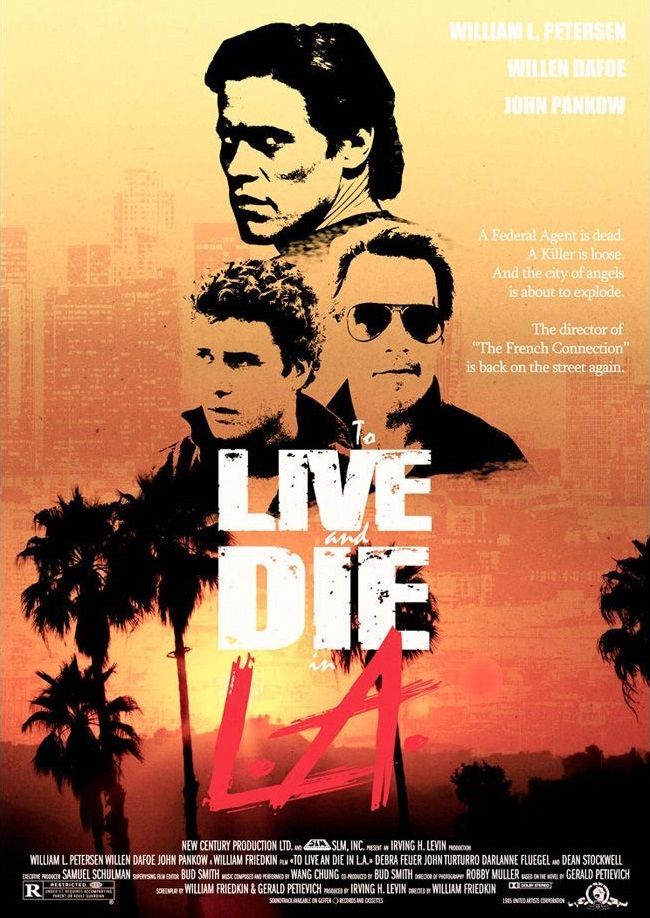
To Live and Die in L.A. - The Best Movie You Never Saw

During AFI’s recent LA Modern series, we were hoping to see William Friedken’s picture on the big screen, but schedules wouldn’t permit, so we settled for a Netflix rental.  Friedken’s modern crime noir tracks Secret Service agents William Peterson and John Pankow as they hurtle through a maelstrom in an effort to bag master counterfeiter and killer Willem Dafoe. Their zeal seals their doom.

It’s a more than competent thriller, with a few problems.  Peterson’s adrenaline junkie character is too one-dimensional, and the screenplay (written by a former Secret Service agent and Friedken) can be awkward in its reliance on hyper machismo, tough guy patter (“You want bread?  Fuck a baker!”) or even hackneyed (“I’m getting too old for this shit”).

But the second half of the movie overcomes a lot of the weaknesses of the first, as Peterson and Pankow are revealed to be screw-ups in the ultimate clusterfuck. As they dig deeper, Pankow enlists the aid of Dafoe’s own lawyer, a confident but slightly oily Dean Stockwell, and it is a revelation to see the portrayal of a cop who is probably took weak for the job. Meanwhile, Dafoe proves less efficient than his stylish demeanor suggests and his errors eventually become too much to bear. Dispensing with super cops and criminal masterminds results in a much more satisfying picture.

Friedken also includes a boffo car chase after a heist gone bad in homage to his own The French Connection, and all of his action scenes are non-stylized and immediate (my son observed that the flick has to hold the record for guys shot in the face at 3). Notably, and in keeping with its inclusion in the AFI series, the locations are almost exclusively sun-bleached and bleak industrial LA, a rarity.

Finally, if you were a Wang Chung fan, this is your movie.

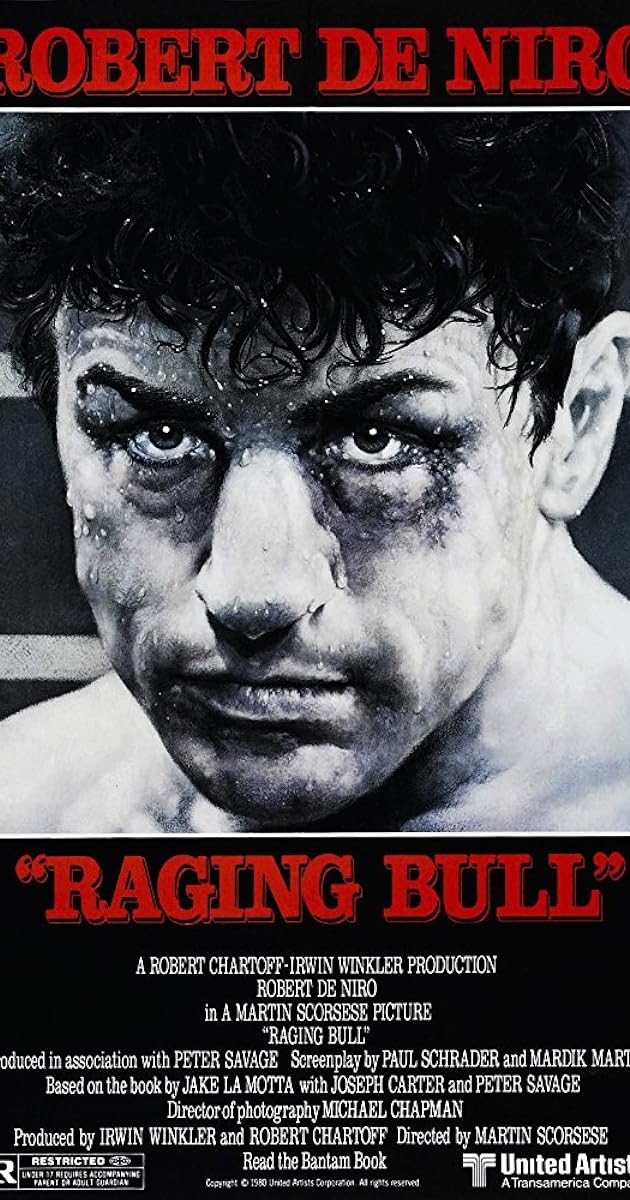
Raging Bull (1980) - IMDb

Martin Scorsese’s film is visually captivating and anchored by Robert De Niro’s mythic performance as the tortured pugilist Jake LaMotta. The feel of 40s and 50s New York is made more authentic by Scorsese’s use of black-and-white, and as boxing movies go, there is none better at conveying the bloody brutality of the sport. All these gifts, however, come with the stench of a major character who is, through and through, a dim, vicious brute. A recent film with a similar infirmity is Paul Thomas Anderson’s The Master, which had myriad other problems, but which also asked the audience to invest in Joaquin Phoenix, a jet fuel slurping, brainless, dypso thug who comes under the sway of a charismatic. Who cares? Similarly, in an otherwise brilliant film, Scorsese asks us to engage with an animal, a one-note beast. After the fourth scene of LaMotta becoming violent and/or obsessively compulsive over the fidelity of his blond bombshell of a wife (Cathy Moriarty), the yawns become harder to stifle. It’s a testament to the charms of the picture that you happily stick with it.

Few Stephen King books or short stories are successfully translated on screen, and only one is brilliant – The Shining (it speaks volumes about the author that he felt Stanley Kubrick got it wrong, so wrong he made another version, with one of the two leads from the sitcom Wings in Nicholson’s role).

Carrie, Salem’s Lot, and Misery are very good, and Stand by Me is competent, if treacly. Dolores Claiborne, 1408, Christine, and Silver Bullet are pedestrian, but have their moments.  The Shawshank Redemption is a wildly overrated, ridiculous film, but deserves mention because the great weight of authority deems it a near masterpiece.

Then you have a big pile of crap–

  • 1982 – Creepshow
  • 1983 – Cujo
  • 1984 – Children of the Corn
  • 1984 – Firestarter
  • 1985 – Cat’s Eye
  • 1986 – Maximum Overdrive
  • 1987 – The Running Man
  • 1989 – Pet Sematary
  • 1990 – Graveyard Shift
  • 1990 – It
  • 1991 – Golden Years
  • 1991 – Sometimes They Come Back
  • 1992 – Sleepwalkers
  • 1993 – The Dark Half
  • 1993 – Needful Things
  • 1993 – The Tommyknockers
  • 1994 – The Stand
  • 1995 – The Langoliers
  • 1995 – The Mangler
  • 1995 – Stephen King’s Nightshift Collection
  • 1996 – Thinner
  • 1998 – Apt Pupil
  • 1999 – The Green Mile (yes, this sucks)
  • 1999 – Storm of the Century
  • 2001 – Hearts in Atlantis
  • 2002 – Rose Red
  • 2003 – Dreamcatcher
  • 2003 – The Diary of Ellen Rimbauer
  • 2004 – Secret Window
  • 2004 – Riding the Bullet
  • 2006 – Desperation
  • 2006 – Nightmares and Dreamscapes
  • 2007 – The Mist
  • 2009 – Dolan’s Cadillac
  • 2011 – Bag of Bones 
  • 2013 – The Reaper’s Image
  • 2013 – Cain Rose Up
  • 2013 – Willa

So, where does David Cronenburg’s The Dead Zone fit in?  Three-fourths of this story in about a man who can see your future and your past after he touches you, I’d have ranked it just below The Shining.  Cronenberg creates a creepy atmosphere made even more unsettling by the unique performance of Christopher Walken, and the bleak misery of his existence as a crippled freak stuck in a small town is haunting.  Striking visuals add to the spooky feel:

Then, the damn thing falls apart due to two ridiculous storylines.  First, Anthony Zerbe plays a rich man who hires Walken to tutor his son, knowing full well Walken’s gift of second sight.  So, what does Zerbe do when Walken sees the boy and his friends crashing through the ice during hockey practice and warns him accordingly?  Wounded that his son has rejected his judgment about skating on the pond, Zerbe conducts hockey practice anyhow, and two boys die.  The decision is bananas yet in keeping with King’s low esteem for parents (the father in Stand By Me practically tells poor Will Wheaton, “the wrong kid died” like the father in Walk Hard: The Dewey Cox Story).

Second, Walken is introduced to senatorial candidate Martin Sheen and sees Sheen’s future as a messianic president of the United States, instigating a nuclear conflagration.  Sheen plays the character so oily and low it is hard to imagine anyone would vote for this cretin.  And when Walken thwarts his ambition, the manner in which Sheen self-immolates is so broadly stupid the film is near ruined.

Still, it coulda’ been a contender.

Image result for Trading Places

A funny, cynical 80s movie that holds up well, unlike, say Splash.  While Dan Aykroyd is obtrusive and over-the-top as the snooty Philadelphia financier who, in the service of a sociological inquiry/$1 bet, is framed as a thief and drug dealer by his financial titan bosses and replaced by the homeless Eddie Murphy, John Landis’ picture overcomes his scene-chewing.  Well, Murphy does.  He is electric and inventive, Jamie Lee Curtis voluptuous and winning, and as the scheming Wall Street chieftains Duke and Duke, Ralph Bellamy and Don Ameche are having such fun it is infectious.

A friend passed on a nifty oral history of Trading PlacesThe best bit:

LANDIS: The most remarkable story, casting wise: I thought, ‘Well, I need someone who was a movie star in the ‘40s, who never has never really played a villain, and I was thinking, ‘Hey, what about Don Ameche?’ And the casting woman said, ‘Don Ameche’s dead.’ And I said, ‘I don’t think so, I would know if Don Ameche is dead.’  And so we called the Screen Actor’s Guild, and his residuals were being sent to his son in Phoenix, Arizona. And I thought, ‘Well that’s not a good sign.’ And he didn’t have an agent, and I thought, ‘Shit, goddamm, who else could we get?’ when one of the  secretaries said, ‘I heard you’re looking for Don Ameche.’ We said ‘Ya.’ She said, ‘I see him all the time walking on San Vicente in Santa Monica.’

So I called information, and I said, ‘I there a Don or D Ameche on San Vicente in Santa Monica?’ And there was! So I called him. And you know he has that unmistakable voice, and you realize, Don was a huge star, in the late ’30s, definitely a big star in the ’40s — I mean he was Alexander Graham Bell for chrissakes! — a major star in the ’50s, Broadway star, radio star, movie star, television star.

And I said, ‘Mr. Ameche?’ ‘Yeeessss…?’ ‘My name is John Landis, I’m with Paramount Studios, and I’m making a film and I’d like you to consider a part.’ So I had a script sent over. ‘And could you please read this and can you come in tomorrow?’ And he said, ‘Yes.’ Would you like us to send a car?’ He said, ‘No no, I can drive.’ I said, ‘Great.’

And he came in and was prepared to read for me. I was so shocked. I said ‘You don’t have to read for me.’

He hadn’t made a movie in 14 years, he’d been doing dinner theater.

While we were shooting later in Philadelphia — he was so wonderful — I said, ‘Don, may I ask a question? How come you haven’t worked in 14 years?’ And he said, ‘Well, nobody called!’

The first half of Stanley Kubrick’s Full Metal Jacket, based on Gustav Hasford’s novel The Short Timers, is flawless. Marine privates Joker (Matthew Modine), Leonard Lawrence (Vincent D’Onfrio) and others are trained with their class at Parris Island by their Lord and Master, Marine Gunnery Sergeant Hartmann (R. Lee. Ermey). Kubrick depicts the indoctrination and transformation of Marines in a manner that is tragi-comic, lyrical and, at the end of training, deadly. Penned by Kubrick, Hasford, and Michael Herr (Dispatches), the dialogue has the stamp of authenticity (Hasford and Ermey were Marines and Ermey, first hired as a technical advisor, had actually been a drill sergeant at Parris Island during the Vietnam war). The process of creating cohesion and toughness is brutal and efficient, and its unsparing nature produces effective warriors, but it also damages the fragile D’Onofrio.

The second half opens with a concise commentary on the problems of an occupying army, memorably introduced by the sultry voice of Nancy Sinatra. Despite such promise, the film becomes less engaging. Modine is sent to Vietnam as a correspondent for Star and Stripes and he wants desperately to get in “the shit.” He does, during the Tet Offensive, and what he sees is the hard killers from Parris, broken, unmoored and wreaking havoc. The film plays out as a series of barely connected set pieces, which is in stark contrast to the single-mindedness of the first half.

I strongly recommend Matthew Modine’s diary and Herr’s Vanity Fair piece on Kubrick.

image

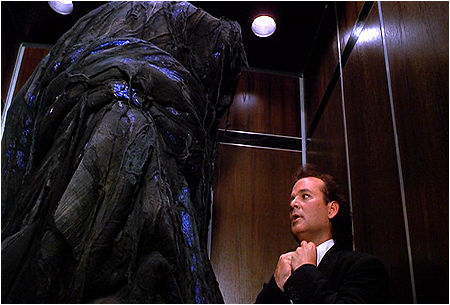
Bill Murray plays the Scrooge character, Frank Cross.  Cross, however, is not in finance, but television.   A child abandoned to the TV by uncaring parents, Cross has become a holy terror as the head of programming for a major network.  His newest achievement is a live broadcast of “A Christmas Carol” on Christmas Eve, with Buddy Hackett as Scrooge.  Cross is so cynical and mean he’s ordered the stapling of tiny antlers on to the heads of mice.  Soon, the ghosts appear.

This is a zany, funny version of the Dickens tale co-written by SNL alum Michael O’Donoghue (he communicated his loathing of the theatrical version before his death at 54) and directed by Richard Donner (who helmed all the Lethal Weapons and various and assorted dreck).  Donner has little skill save for making movies move, and this movie moves.  O’ Donoghue’s complaints aside, it’s also often very clever, propelled by Murray’s manic and humorous descent into madness and his joyous redemption.  It’s big, messy, all-over-the place, and excessive (which is kind of the point) but great fun.

https://i0.wp.com/ecx.images-amazon.com/images/I/51bfR0ArmlL._SL500_SS500_.jpg

A group of friends gets together to mourn the suicide of a contemporary. What is really being mourned, however, is their youth, which occurred during the 1960’s when they matriculated at college together.  What follows is a miasma of nostalgia, sound-tracked ironically by Motown (there is not a black, brown of tan face among them), as a group of super-successful people (even the drug dealer has a Porsche!) lament their transformation from their fantasy selves of the past (idealistic, war protesting, caring, would-be world changers) to what they have become (affluent, whiny, navel-gazing malcontents who rue their upper-tax brackets, nice homes and cars, and cushy lives).

Some offerings on their current state:

“Wise up folks. We’re all alone out there and tomorrow we’re going out there again.”

“It’s a cold world out there. Sometimes I feel like I’m getting a little frosty myself.”

“I’m sure we all think there’s a lot of good left in us.”

Only one character resonates, and then, but for a moment.  The drug dealer, William Hurt, eventually succumbs to the feel-good ooze and affirmation, but early on, as the unctuous Kevin Kline tries to connect, Hurt says one of the few adult things in the movie:

a long time ago we knew each other for a short period of time; you don’t know anything about me. It was easy back then. No one had a cushier berth than we did. It’s not surprising our friendship could survive that.”

This moment of lucidity is soon overwhelmed by gloppy, poofty, self-congratulatory schmaltz, forever to be prefaced by “the soundtrack for a generation.”

Peace and love is easy to dispense in a gorgeous, multi-million dollar mansion, owned by Kline and his angelic wife Glenn Close.  So, in the ultimate sacrifice of a suburban queen, she offers Kline’s sperm to her college buddy, Mary Kay Place, who is desperate to get pregnant.  Said sperm is to be delivered by Kline in the natural act, who is dispatched in Dick Van Dyke’s pajamas to inseminate.

Close even stands in the hallway after delivering her gift, so proud of her selflessness she positively beams.

Throwback: 'The Big Chill' | Decider

My kingdom for sounds of hard, headboard pounding sex emanating from the bedroom (“You like that?” followed by “Oh daddy, give it to me”).  Or Kline coming out into the hallway and saying to Close, “Do you mind?  We’re fu*&ing in here.”

And then Close the Good becomes the Glenn Close from Fatal Attraction, killing everyone in the house.

Alas, it was not to be.

The movie makes a virtue of overt explication of what every character is thinking.  The audience cannot be trusted to intuit their banal, narcissistic whining masquerading as some kind of higher truth.  They must be told!

The Big Chill is made worse by the fact that it isn’t even original, but rather, Lawrence Kasdan’s big-budget version of John Sayles’s The Return of the Secaucus Seven.  The picture spawned a worse copycat, even more cloying and self-satisfied, Peter’s Friends.  If you wondered what The Big Chill would be like with Brits, wonder no longer.


Th signature achievement of the reign of John Hughes.  During his run, Hughes wrote and/or directed the following teen dramedies– Pretty in Pink, Sixteen Candles, The Breakfast Club, Weird Science, Ferris Bueller’s Day Off, Some Kind of Wonderful, Uncle Buck and Career Opportunities.

Hughes offered a certain corporatized schmaltz and sentiment, and there are worse Hollywood epitaphs.  Hughes also provided a silly, devil-may-care ethos for affluent suburban high schoolers (Hughes grew up middle class in tony Grosse Pointe, Michigan) and he could deliver a bravura screwball scene, such as Ferris Bueller’s rock out during a Chicago parade or John Candy crashing a teen party in Uncle Buck. At the end of his films, a trite lesson was always learned, and opposites always came together for a hug of understanding.

Nestled in this treacle, however, was a bit of nastiness fully realized in The Breakfast Club.  A group of kids – the geek (Anthony Michael Hall), the jock (Emilio Estevez), the weirdo (Ally Sheedy), the hood (Judd Nelson), and the “it” girl (Molly Ringwald) – all must spend a Saturday in detention together.  It becomes a group therapy session, and the archetypes – initially hostile to each other – soon find solidarity in their hatred of the school administrator (Paul Gleason) and the fact that it appears they each have something in common – an oppression at the hands of their cretinous parents.  Nelson is burned by cigarettes (given the school, one presumes Dunhills); Hall is so pushed to succeed academically he has contemplated suicide; Estevez is also driven by his overbearing father, and his torture is so great he actually starts to punch himself ; and Ringwald explains her homelife thusly when asked if she can go to a party:

                            CLAIRE
I don’t know, my mom said I was [grounded] but my dad told me to just blow her off.
                           ANDREW
Big party at Stubbies, parents are in Europe.  Should be pretty wild…
                           CLAIRE
Yeah?
                          ANDREW
Yeah, can you go?
                           CLAIRE
I doubt it…
                         ANDREW
How come?
                           CLAIRE
Well ’cause if I do what my mother tells me not to do, it’s because because my father says it’s okay.  There’s like this whole big monster deal, it’s endless and it’s a total drag.  It’s like any minute… divorce…
                            BENDER
Who do you like better?
                            CLAIRE
What?
                            BENDER
You like your old man better than your mom?
                            CLAIRE
They’re both strict.
                            BENDER
No, I mean, if you had to choose between them.
                            CLAIRE
I dunno, I’d probably go live with my brother.  I mean, I don’t think either one of them gives a shit about me…it’s like they use me just to get back at each other.


Hall adds: “…I don’t like my parents either, I don’t…I don’t get along with them…their idea of parental compassion is just, you know, wacko!”

Then it is the jock’s turn:  “Um, I’m here today…because uh, because my coach and my father don’t want me to blow my ride.  See I get treated differently because uh, Coach thinks I’m a winner.  So does my old man.  I’m not a winner because I wanna be one… I’m a winner because I got strength and speed.  Kinda like a race horse.  That’s about how involved I am in what’s happening to me.”

Cue the tough, doing his own impression of his house:  “(as his father) Stupid, worthless, no good, God damned, freeloading, son of a bitch, retarded, bigmouth, know it all, asshole, jerk!  (as his mother) You forgot ugly, lazy and disrespectful.”

The jock rejoins, explaining that he taped a classmate’s ass together.  Why?  “I did it for my old man…I tortured this poor kid, because I wanted him to think that I was cool. He’s always going off about, you know, when he was in school… the wild things he used to do . . . it’s all because of me and my old man.  Oh God, I fucking hate him!  He’s like this…he’s like this mindless machine that I can’t even relate to anymore…’Andrew, you’ve got to be number one!  I won’t tolerate any losers in this family…Your intensity is for shit!  Win.  Win!  WIN!!!’  You son of a bitch!  You know, sometimes, I wish my knee would give…and I wouldn’t be able to wrestle anymore.  And he could forget all about me…”

Just to make sure we get the message, Gleason is the biggest prick in the world, an amalgamation of every insecure, bullying teacher in the continental United States.

There’s not a genuine moment in the picture nor a hint of deviation from its blame-shifting orthodoxy.

Hughes has always included some of this foolishness – the parents in Uncle Buck are too committed to their jobs, Alan Ruck’s father in Ferris Bueller’s Day Off cares more for his sports car than his son.

But The Breakfast Club’s attack on the cruel, neglectful parents is the primary theme of the picture and Hughes uses it to portray these five kids (three of whom do appear to be sh**heads of the highest order) as victims.

Look, children can be obnoxious, and teens doubly so, but there is perhaps nothing more unpleasant than encountering a self-pitying teen who bemoans his vaunted station just as he nears the age when lesser forebears were jumping into a hot LZ in Vietnam.

Hughes died recently of a heart attack.  He was a bit of a recluse in his later years.  I wonder if the stereotype of the suffering, whining rich kid he presented in The Breakfast Club contributed to his distress, either because he was prescient and had to live with it or he felt he had a hand in cementing the mold.

In a Vanity Fair piece after Hughes’s’ death, David Kamp wrote “As hoary as it sounds, The Breakfast Club spoke to a generation.”

Unfortunately, it appears they were listening.

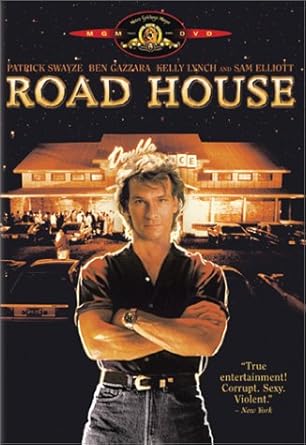
Image result for Roadhouse

A small town is run by the ruthless Ben Gazarra, who shakes down the local businesses to support his decadent lifestyle.  He lives in the gaudiest mansion, and he is surrounded by a thick, loyal squad of yokel goons.  He also has a few 80s trashy blondes in his coterie, like Julie Michaels–

Image result for Roadhouse Julie Michaels

Interesting note on Julie.  Roadhouse was her debut.  In her subsequent roles, these were the names of her characters:  Naran Anie, Professor, Professor (uncredited), Accident Victim, Accident Victim (uncredited), Sandy, Mom, French Patron (uncredited), California Blonde, California Blonde (uncredited), Pedestrian, Female Bar Patron #2, Barrista, Fashion Show Patron, Florist, Slutty Woman, Female Fan, Julie Mermaid mother, Harem Girl (uncredited), Groupie (uncredited), Female Club Goer, Maggie, Woman on Bike, Laundry Wife, Marilyn Monroe #2, Catherine Moore, Caitlin’s Sister, Frat Girl, Woman (uncredited), Vampire, Jane (uncredited), Catherine, Tami, Sillicate UC, Cage Dancer, Agent Elizabeth Marcus, Susan, Irene, Waitress, Waitress (uncredited), Amy Cutler, Freight Train, Susie Q, Cinnamon.

I digress.

One business won’t knuckle under to Gazarra – The Double Deuce.  Instead, bar owner Kevin Tighe calls in a zen master bouncer with a degree in philosophy (not joking – the script references that the professional bouncer has a degree in philosophy from NYU). That bouncer is Dalton (Patrick Swayze) who stands up to Gazarra, calls in a bouncer compadre (Sam Elliott), cleans up the bar and the town and says all of the following:

“Pain don’t hurt.”

“Nobody ever wins a fight.”

“My way… or the highway.”

“All you have to do is follow three simple rules. One, never underestimate your opponent. Expect the unexpected. Two, take it outside. Never start anything inside the bar unless it’s absolutely necessary. And three, be nice.”

“Take the biggest guy in the world, shatter his knee and he’ll drop like a stone.”

“You’re too stupid to have a good time.”

“It’ll get worse before it gets better.”

Roadhouse also features Kelly Lynch, the emergency room physician who patches Dalton up.

The year this picture came out, she was in Drugstore Cowboy. I wonder which film she is most proud of?  Regardless, I’ve had stitches like 5 times and there’s never a Kelly Lynch at the emergency room.  Ever.

By now, Roadhouse has become a cult classic, but when I saw it, I knew it was something special taken at face value, no sniggering. To this day, I can’t stop watching it.  It’s an awful film, and the inquiry should end there, but there is such earnestness in the effort that at 2 am, having just had 5 beers and a half bag of gummy bears, when Swayze says

“I want you to be nice until it’s time to not be nice.”

I’m like, “Hell, yea. Dalton. That’s some heavvy ass shi**!”

And now, every punch in the face in the movie!