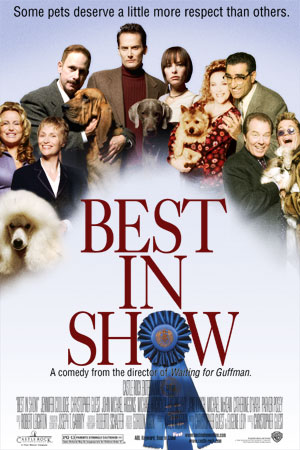
I caught this the other night and of the mockumentary films written and/or directed by Christopher Guest – This is Spinal Tap, Waiting for Guffman, A Mighty Wind, For Your Consideration – this is my favorite. Perhaps not coincidentally, it’s also the sweetest on its subjects, an assortment of purebread dog owners who are competing at The Mayflower Kennel Club Show. Catherine O’Hara and Eugene Levy stand out as the impoverished Florida couple who, unfortunately for Levy, run into O’Hara’s old lovers on their way north, but Jane Lynch shines as a driven, lesbian handler who has found a Sugar Mommy (Jennifer Coolidge) to fund her efforts, as well as the magazine American Bitch (“it’s a focus on the issues of the lesbian pure bred dog owner”).
But Fred Willard, as the disinterested but garrulous TV announcer, and Jim Piddick, who has to suffer him, steal the picture.
A film that got away from me, perhaps because it gave off such an air of discomfort, I watched There Will Be Blood this weekend. The movie is very good, but my instincts were correct. It is a very difficult movie to endure.
Daniel Day Lewis plays a Charles Foster Kane-esque Daniel Plainview in Paul Thomas Anderson’s sprawling tale of an oil man who rose from a single claim prospector to a wealthy oil magnate through sheer will and a ruthless brutality that destroyed everything in its wake. Whereas Welles’ Kane, obsessed though he was, could enjoy the taste of his success and the fruits of his labor, Plainview cannot. He is a tortured, singular man, made dangerously distrustful the moment he gets close to anyone for fear of what that person will take. Worse, he cannot abide a slight, and when a young preacher (Paul Dano) fences with Plainview, forcing him to endure a humiliating baptism in exchange for the rights to a critical tract of land, the incident burns in Plainview. As played by the spellbinding Day Lewis, it damn near appears to eat his insides out. Anderson’s representation of California – be it the barren oilfields or the lonely mansion Plainview inhabits at the end of the movie – becomes more forbidding and cruel as Plainview descends into madness.
All well and good, especially near flawlessly rendered, and yet, this is a cold, one-note film, devoted near completely to a terrible, monochromatic character. What is Anderson telling us about ourselves, or, is he telling us anything? Many cite the picture as an evocation of the American experience, a “portrait of a young nation struggling to find itself, torn between religious and business values” or “a harrowing cautionary warning to a country with oil pumping through its veins, clouding its judgment and coarsening its soul.”
If only. Anderson’s vision is too personal and too specific to Plainview, and it is a testament to the director’s gifts and Day Lewis’s skill that such a narrow focus remains compelling. The result is a lot of blood and guts but no real heart, which keeps it from being great.
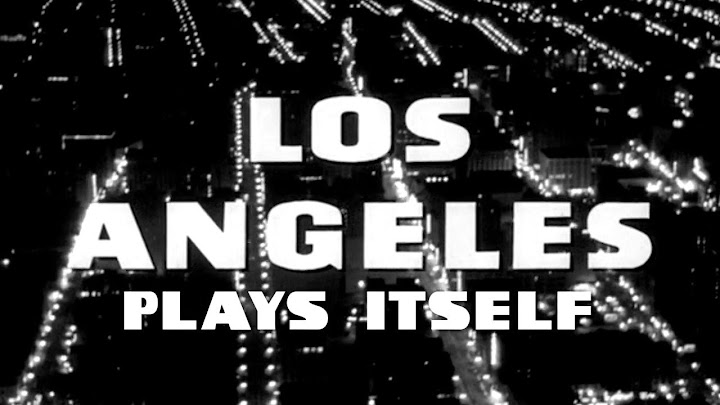
Currently available on Netflix streaming, this almost 3 hour documentary essay presents as both art exhibit and graduate course (it is written and narrated by the sleepy-voiced Thom Anderson, a filmmaker and film theory and history teacher at the California Institute of the Arts). Los Angeles Plays Itself is textually interesting, the visuals of the city’s depiction in film are always entertaining, and accompanied by Anderson’s incisive narration, often illuminating.
Anderson can also be very funny, in a dry “this is Carlton, your doorman” way. On a scene from Michael Mann’s Heat:
[In Heat, Neil McCauley (Robert DeNiro) is briefing two members of his gang. He tells them, “Saint Vincent Thomas Bridge, that’s escape route number one.“] Vincent Thomas was San Pedro’s representative in the state assembly for many years, but he hasn’t been canonized yet, not even in Pedro.
And on the perpetual destruction of LA in the movies:
Mike Davis has claimed that Hollywood takes a special pleasure in destroying Los Angeles, a guilty pleasure shared by most of its audience. The entire world seems to be rooting for Los Angeles to slide into the Pacific or be swallowed by the San Andreas fault. …In Independence Day, who could identify with the caricatured mob…dancing in idiot ecstasy…to greet the extraterrestrials? There is a comic undertone of ‘good riddance’ when kooks like these are vaporized by the earth’s latest ill-mannered guests. But to me the casual sacrifice of Paris in Armageddon seems even crasser. Are the French being singled out for punishment because they admire Jerry Lewis too much? Or because they have resisted Hollywood’s cultural imperialism too fervently?
Of course, if you let an academic talk long enough without interruption or query, he’ll eventually meander into overstatement and grandiosity, and as Anderson moves from LA’s history, architecture, sprawl and patterns in film to politics, race and class, we get poetic broadsides, against the cops and the modern Noah Crosses and skyscrapers. This is all part of the condescension of most any “true” city dweller who presumes to know the authentic heart that beats in his city, and for the most part, that’s part of Anderson’s charm. Anderson has a grievance, as he concedes at the outset: That’s another presumption of the movies: that everyone in Los Angeles is part of their industry or wants to be. Actually, only one in forty residents of Los Angeles County works in the entertainment industry. But the rest of us simply don’t exist. We might wonder if the movies have ever really depicted Los Angeles.
But doleful mouthfuls like “White America had declared a crisis of the black family as a cover for its campaign of incremental genocide against its expendable ex-slave population, rendered superfluous by immigrant labor power, so black film-makers responded by emphasizing families and children” are waiting at the end, so you have been warned.
Though it limps a little at the finish, I really dug this movie, and it is a must-see for any film buff.
A banana split, with two pounds of cane sugar dumped on top, followed by a generous ladling of chocolate syrup, dropped in a bucket of melted cotton candy and deep fried in maple butter, then placed on film. That is . . . Love Actually.
The only thing that recommends this monstrosity is Billy Bob Thornton playing an American president as an uncanny mix of Bill Clinton and George W. Bush. Even this brief treat is spoiled by his counterpart, British PM Hugh Grant, who apparently reverses relations with the U.S. solely because he caught Thornton feeling up his secretary.
It’s all too precious. Avoid the tooth decay and bellyache, even in the judgment altering season that is Christmas.
2022 Update: I took a few years off from my annual autopsy of this festering corpse, and lo and behold, the film celebrated a 20th anniversary. I must concede, it never occurred to me that this trite, candied, filmic effluvium could have been worse in an earlier incarnation, but it appears the editors exercised unknown restraint.
That cute kid who learned how to drum and fell in love? Liam Neeson’s darling little urchin? Turns out, as originally envisioned, he was a gymnast, and he was going ballet his way through the airport to greet his love.
This is akin to creating a highly toxic disease that infects the public but then announcing, “Well, before the lab leak, we did manage to contain the flesh-eating variant”.
Um . . . thanks?
Apparently, in test screenings, the mass retching created a significant liability issue, so they cut it.
Prior entries:
2015 Update: Look, this is a gruesome film, substituting true emotion and pathos with a staggering falsity. If you ever met anyone in your life anywhere near as quaint and darling as any of the characters in this bucket of marshmallow and melted gumdrops, it’s likely they are an enemy of the state infiltrating our ranks for a low purpose. Before you feel your heart swoon and your mouth say “awwwwwwww”, run. Run for your damned life.
2016 Update:
Think about how creepy it would be for a person who long-pined for you to show up at your door with cue cards (one of which has semi nude women on it) to reveal his long held love immediately after you have chosen another. Keira Knightley seems to think this is charming, but in point of fact, she should have called the cops. This weirdo is now going to do . . . what, exactly? Go off to Tahiti because mere proximity to his lost love is too much for him to handle? Go to his apartment thinking that his gambit may pay off, that Knightley might think to herself, “Hmmmmmm. He must really love me.” Hang around, quietly watching . . . waiting . . . hoping . . . tinkering with her husband’s brake lines.
This scene is emblematic of this stupid film because it trades a sentimental ball of goo moment for what should have been a larger and more generous gesture. The dude should have simply left Knightley to her new husband and their life, which would have been stoic and laudable.
But nooooooo. Let’s make this icky.
Married women, think of you, at home, newly betrothed for a few weeks, snuggling with your husband. Then, his best friend of decades comes to the door with cue cards and professes his long love for you. Now, remove the gloppy music, the cobblestones, and the holiday lights and Love Actually becomes . . . . Play Misty For Me? When the stalker says, “Enough. Enough now,” I sensed menace, crazy shit going on in his head like the dog haunting Son of Sam’s noggin. Had he gone back in the townhouse and killed them all, it still wouldn’t save this vile film, though it would have been an improvement.
Also, how dumb is the husband? The boom box is supposed to be a substitute for carolers, but it is a professional singer with some harmonists and an orchestra.
Sorry, Keira. The guy you chose is a moron and the one you did not is going to kill you.
Also, one of the loon’s cards says “And at Christmas, you tell the truth.”
Ludicrous. You no more tell the truth at Christmas than on Easter or Arbor Day.
2017 Update:
This year, let’s delve into this kid, so precocious, so darling, and just so articulate!
“Do you really want to know . . . even though you won’t be able to do anything to help . . . the truth is, actually, I’m in love?”
Couldn’t you just eat him . . . . . I mean, eat him up.
The only thing that could make this scene work is if a bunch of shady Eastern European thugs showed up, grabbed the boy, attempted to sell him into white slavery, and Liam Neeson started on the Taken series quite a bit earlier.
Then, this sweetums might know what is indeed worse than “the total agony of being in love.”
2018 Update:
Let’s talk about the secretary, Prime Minister Hugh Grant’s love interest. She is referred to as “chubby” by another aide and she herself explains that her boyfriend “said no one’d fancy a girl with thighs the size of tree trunks.”
First, I can’t believe this kind of fat shaming allows for enjoyment of this film by any decent person.
Second, I really don’t give a rip about fat shaming. But the woman is not in the slightest bit fat. It is a ridiculous conceit. It makes absolutely no sense. She is buxom, one of the few enjoyable aspects of this filmic turd pile.
So, the movie is abusive and retrograde, which I for one will not let stand even at the expense of your enjoyment. Perhaps worse, it doesn’t even know what a fat person looks like. Ridiculous.
2019 Update:
In this years’ entry, let us take up the Martin Freeman-Joanna Page story line. Apparently, these two meet while playing body doubles on the set of a porn flick. This seemed absurd, but I did my legwork. As confirmed by the screenwriterand much of the commentary, they are, indeed, supposed to be on the set of a porn flick.
I have learned about pornography solely for purposes of this review, and be it hardcore or arty soft core, one of the genre’s principal draws to a producer is the low to non-existent production costs.
Yet, by the looks of the sets and the crew and the fact that there are stand-ins for the actors who will be performing the actual sex act on camera, this appears to be a multi-million dollar production.
Worse, not only are Freeman and Page forced to endure an assistant ordering them to shift mechanical poses and pretend to be having sex, he has them do it in the nude, which would seem completely unnecessary, except, and this is a quote, “lighting and camera want to know when we will actually see the nipples”.
Apparently, the “real” actors are cooling their heels in the green room while the stand-ins work to make the shots just so.
So, for purposes of super cute chit-chat, we are presented with two of the most pathetic characters in film history. They won’t even be receiving wages for having actual sex on camera, but rather, the pay will be for standing in and simulating sex for other people who will be simulating or having sex on camera, i.e., the stars!
What could that amount be? A couple of quid?
This is a job . . . okay, it’s not a job, because this premise is so mind-boggling lazy and ridiculous, but were it a job, it is one for meth heads.
It’s difficult to resist a dissipated, alcoholic, and profane Billy Bob Thornton as a Santa Claus who works department stores to crack their safes, especially when he meets an eternally cheerful but clueless grade schooler (Brett Kelly) left alone with his addled grandmother (Cloris Leachman) in their tony Arizona suburban ranch home. In true Christmas spirit, Thornton discovers the boy is essentially alone and defenseless, moves right in, raids the liquor cabinet, and trysts with a slutty barkeep (Lauren Graham) who has a Santa fetish.
Santa is so bad he rips open the kid’s Advent calendar to get at some chocolates. He pisses himself on the job. He beats up children. He engages in sodomy in the dressing rooms of the Big & Tall Women’s section of the department store. He looks in the cherubic faces of all those blessed children who revere him and . . . well, see for yourselves.
Is there redemption for Bad Santa? Kind of. But Thornton is a character who could endure three Dickensian ghosts and conclude, “Eh. Fuck ’em.”
Bad Santa is the ultimate anti-Christmas flick and a holiday favorite. Thornton is brutally acerbic (especially when dealing with a host of bratty kids on his lap), Graham is indescribably hot, and John Ritter and Bernie Mac (as mall security and management) contribute significantly to the humor (Ritter’s repulsion/fascination with Bad Santa is inspired; what a loss he was).
My reply: “Nothing is worse than that steaming turd. Osage is a standard, Southern shoutfest, with as much authenticity as Hee Haw. The Family Stone, however, is a pat-its-own-back paen to womyn, disabled homosexuals, showy profanity by people wearing flannel, and New England flintiness. The cancer ravaging Diane Keaton couldn’t come fast enough. I am pleased to say that its writer director didn’t get another project until 6 years after The Family Stone and that was a Selena Gomez joint. Justice.”
The best sports movie ever made, a character-driven blend of sentimentality and tension that dramatizes the football culture on a small, poor Texas town. Every trope that is bandied about by lesser sports films is obliterated, yet, the film doesn’t reject the formula. There are gridiron heroes, strong women who stand behind them, racial undertones, father-son generational combat and an obligatory half time speech.
But compare the ridiculous grandiosity and easy message of most any sports film with the replication of the game in this picture and you’ll find there is no comparison. The women are actual characters, not noble support. The racial issues are genuine and near imperceptible, the blacks don’t exist to teach the whites to dance, and the whites don’t exist for the confession of absolution. The father son dynamic between Tim McGraw and Garrett Hedlund is incredibly moving and Billy Bob Thornton’s halftime speech is poetry.
This is a beautifully acted film, as much about a community as the players, and I’m moved every time I see it. Never more so than by Derek Luke’s work in this scene:
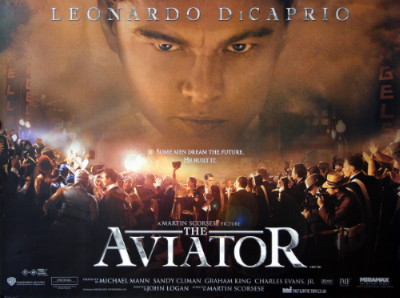
Martin Scorsese’s critically acclaimed biopic of the young-to-middle age Howard Hughes (Leonardo DiCaprio) has much to recommend it. It was the first role that established DiCaprio as a force, and in inhabiting the kinetic, driven and tortured character of Hughes, he was able to shuck off the callowness of his characters in Titanic (Jack London: Teen Wolf!), The Beach and Catch Me if You Can. His time to become a leading “man” had arrived (his attempt at a mature character in Gangs of New York was undermined by the garish nature of the picture, Daniel Day Lewis’s battering ram of a counter-performance and what appeared to be DiCaprio’s own discomfort in the role).
The film is also visually stunning. Scorsese is usually the king of movement in tight spaces, but the sky liberates his eye, and the scenes of flying (there are five) are vast and poetic, and for the ones that end in crashes, utterly thrilling.
When Scorsese is on the ground, the film does not suffer. His glitzy pre-war Los Angeles, where the parties are populated by the likes of Errol Flynn (a jaunty Jude Law) and Ava Gardner (a tough, motherly Kate Beckinsale), are eye-popping.
Finally, the choices of Scorsese and screenwriter John Logan (Gladiator, Sweeney Todd, Skyfall) are adept. Rather than focus on the breadth of Hughes’s life, they opt to show him at his most vibrant, while giving ever-increasing glimpses of the madness that would grip and eventually consume him later in life. For an almost 3 hour film, it’s clear they could have shot for Hughes in the 70s, surrounded by a Mormon coterie and the madness that it protected. By skillfully giving us the symptoms, they economically finish the story.
So, what’s not to like? While DiCaprio and Alan Alda (playing Hughes’s nemesis, the slimy Senator Owen Brewster) were rightfully nominated, though they did not win, so too was Cate Blanchett as Hughes’s love interest Katherine Hepburn, and she actually took home the Best Supporting Actress statuette.
To call her performance cartoonish is a gross understatement. It’s manic, ludicrous mimicry.
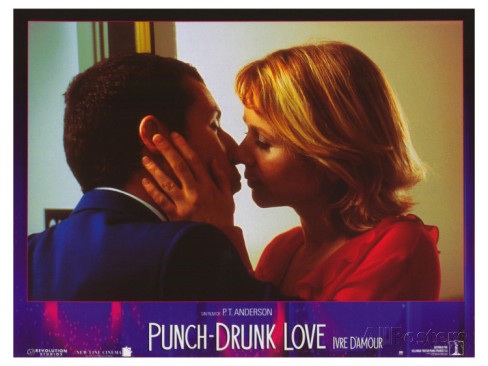
Paul Thomas Anderson’s follow-up to the sweeping, first-half brilliant, second-half excessive Magnolia could not have been more different, a love story between the closed-off, anger-ridden Adam Sandler and the co-worker of one of his sisters, Emily Watson. Sandler, a small business owner in LA, is clearly plagued by inner demons, exacerbated by his extroverted, intrusive and brutal sisters (he has 7 of them and when they are not calling him incessantly at work, embarrassing him in front of Watson, or blithely trading in his confidences, they are recounting humiliating stories from his youth). Sandler seeks connection and unfortunately, he does so via the use of sex call operation run by Phillip Seymour Hoffman that specializes in blackmail and harassment. This crisis comes down upon Sandler right as he has forged a true, real connection with Watson.
Sandler’s movies are almost all bad, but I’ve come to the conclusion that he’s running a welfare program for each and every one of his comedian compatriots, and for this, he should be commended. When he receives good material, such as this film, The Wedding Singer and Funny People, he suppresses his twin excesses – the goofy and the superior smart aleck amongst the goofier – and presents nuanced, multi-dimensional characters. Here, his character is immediately sympathetic, just this side shy of a man who has voices in his head, and I was reminded of Bradley Cooper’s more realistic character in Silver Linings Playbook. Both yearn for normalcy. The former almost appears to have wasps around his head, while Sandler has them in his insides. Watson calms his roil, and her presence allows him to use his anger management issues in a positive fashion.
As much as the film emphasizes Sandler’s struggle, the moments of peace he earns in his time with Watson are poignant.
Anderson’s visuals put Sandler’s torment under a glare, constantly stalking him, scoping him. Similarly, the music is a staccato of plinking piano, off-kilter horns and rolling drum, giving the viewer a sense of what it must be like to be in Sandler’s head. The shots and clatter only settle when Watson appears, and in those moments, Anderson re-creates the whirling, lightheartedness of a traditional romantic comedy from the 40s.
A truly unique picture, it’s unlikely you’ve seen anything like it.
As biopics go, this one is near the top, a sprawling, textured story of fame, fall, passion and redemption that can’t avoid cliche’ but never nears cheezy.
Joaquin Phoenix doesn’t embody Johnny Cash so much as incorporate him into his own personality. His performance feels roots deep rather than technically proficient (see Jim Carrey as Andy Kaufman in The Man in the Moon for an example of the latter), enhancing your investment in Cash’s plight. Phoenix does all his own singing and his vocals are deeper and more frenetic than those of Cash (his live version of “Cocaine Blues” at Folsom Prison is more fevered and angry than Cash’s performance), but they feel real, especially when matched with Reese Witherspoon’s brassy bid as June Carter. James Mangold’s film is ostensibly the love story of Cash and Carter, but his attention to the music is the glue to the picture. The supporting players in the roles of Jerry Lee Lewis, Roy Orbison and Elvis are all musicians also doing their own singing. And the scene of Cash’s audition is notable not only for the tension and the dissertation on what goes into music people want to listen to, but for the riveting turn of Dallas Roberts as producer Sam Phillips. Talk about making the most of your one scene.
If there are weaknesses, one is self-inflicted and one is a related injury. Cash’s demons stem from the childhood trauma of his brother’s death, after which he felt unworthy and guilty. His father (Robert Patric) didn’t help when immediately after the funeral, he yelled at a grieving little boy, “he took the wrong son!” Now, perhaps this happened. But even if it did, the screenwriter has to jettison historical accuracy for good sense. It’s too incredible, too jarring, to believe. Worse, it became the centerpiece joke of the Walk the Line spoof, Walk Hard: The Dewey Cox Story.
The effect is much like that of Austin Powers on the prior James Bond films, changing them in your mind from occasionally fun and campy to wholly ridiculous. Another nit is the unfair treatment of Cash’s first wife, who is portrayed as so shrill and shrewish it feels unfair.


 Original review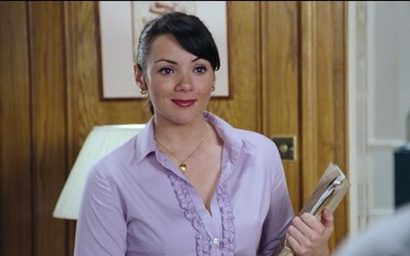



 filmvetter