Archive

2019

3FAD71C5-B170-4650-9B10-800F47532251

Awfully slow and occasionally deadly dull. It’s 3.5 hours, 1.5 hours of which is trying to get Jimmy Hoffa (Al Pacino) either to his senses or a meeting.

The length and pace, however, may be the least of the film’s problems.  The movie depicts the rise of mob killer and union boss Frank Sheeran (Robert De Niro) and his relationship with his mob sponsor (Joe Pesci) and Hoffa. The novelty is the technological ability Martin Scorsese uses to make his actors younger, but the effect is only so successful. They can only make them so young.  So, you have a 76 year-old man playing a 40 year old man who looks like a 56 year old man who has a six-year-old daughter. Worse, when they are rendered young in the face, they remain old in the body. One scene, where a digitally younger De Niro beats a man, emphasizes the point.  It looks like Bad Grandpa is delivering an ass kicking.

But perhaps the worst part of the film is the fact that there is simply no drama, no tension. Every single character is the exact same person he was from beginning to end. In Goodfellas, De Niro and Pesci were a constant force, but the drama came from watching Ray Liotta and Lorraine Bracco rise and then try to survive.  In Casino, the entire film centered around the significant changes to the personalities of De Niro, the bookmaker made casino king in fledgling Vegas, and Pesci, the enforcer who gets too big for his britches and in-over-his-head alone in the desert.  The history of those films was compelling, but it did not have to do all of the lifting.

Here, De Niro is the same throughout. Sociopathic, steady, soulless and somnambulant.  It does not make for enthralling viewing.  Your eyes will move to the IPhone more than once.

It looks good, though. Damn good. I’ll give it that.  And there are a few exchanges in Steve Zallian’s (Moneyball, A Civil Action) script that are subtly sharp. But it’s not nearly enough.

AA793056-C74F-4C1B-8F88-9ACBF5CB6B27

It’s fine. There is no need to see it in the theater, but this story of former driver and automobile designer Carroll Shelby (Matt Damon) and driver Ken Miles (Christian Bale) being subcontracted by Ford to take on Ferrari at LeMans is entertaining and fast-paced. Besides, Damon and Bale would be easy enough to watch grilling hot dogs, and Tracy Letts as Henry Ford II steals the picture in one scene.

That said, the movie is a tad too formulaic and cute and it has some thematic and structural problems. Bale’s overly precious relationship with his wife (Caitriona Balfe) is plagued by money woes and that seems to be the source of any dissension in theri union.  But then, all of a sudden, she goes bats because he apparently isn’t communicative enough, which comes out of nowhere (up until this point in the film, Bale is presented as aCockney loudmouth who can’t keep his trap shut about anything). Additionally, the relationship between Damon and Bale is unsupported, and we actually know little about either of them before their joint endeavor begins.  Some background, other than stoic and abrasive, respectively, would have helped.

But most problematic is the depiction of the Ford company, a corporate behemoth we are asked to loathe and root for at the same time.  The whiz kid who comes up with the idea of taking on Ferrari is Lee Iacocca, and as played by Jon Bernthal, he barely registers. Worse, as Ford’s no. 2, Josh Lucas is just this side of twirling a mustache. His treachery is over-the-top ridiculous.

The race footage is exciting and when you see this when it streams, you’ll be pleased, though Ron Howard’s Rush is a better racing film.

Image result for Yesterday movie

Great premise.  A failing singer-songwriter discovers he’s the only person who knows The Beatles music. They existed for him and him alone. And so, he pawns their songs off as his own on his way to superstardom.

So far, so good. Then, straight to the ditch, for so many reasons.

The “being the only person who knows the Beatles thing” happened because, well . . . we don’t know. There is some sort of worldwide electrical short and that’s that. Apparently, Coca-Cola and cigarettes never existed either.  Incredibly lazy.

The lead (Himesh Patel) is weak, uninteresting and one-note (confusion and skepticism are how he reacts to most everything) and as much as Lily James (his manager) tries, there is no connection, no chemistry. She’s been mooning after him since grade school and it is hard to glean why.  He’s kind of a drip.

His own music is bland.  They should have done more with this, with him struggling to accept that until he could cadge The Beatles catalogue, he was a pretty bad musician.

Kate McKinnon is funny. But as the slimy LA music exec, she’s way over-the-top and atonal, just this side of an SNL character. The music industry is, of course, portrayed as shallow and cynical, but in such a cartoonish way, it doesn’t work.

There is a “me or stardom” scene between James and Patel that is nonsensical. There was no need for the ultimatum, but it is given and then immediately reneged upon.

The film is surprisingly boring, with a lot of filler montage as Patel gets bigger and bigger.  However, we get none of the perils or glitz of stardom.  He could have met anyone in the industry, and the producers selected Ed Sheeran, a red-headed Ambien?  He doesn’t meet Jagger?  Come on.

The end is atrocious. Patel has an inexplicable visit to the real John Lennon (who became a sailor) and as a result, turns his debut performance into a confession to the crowd, followed by a rejection of riches (he releases all his Beatles tracks on line for free).  On the subject of riches, the real Lennon was quite eloquent:

PLAYBOY: “But that doesn’t compare with what one promoter, Sid Bernstein, said you could raise by giving a world-wide televised concert… playing separately, as individuals, or together, as the Beatles. He estimated you could raise over $200,000,000 in one day.”

LENNON: “That was a commercial for Sid Bernstein written with Jewish schmaltz and showbiz and tears, dropping on one knee. It was Al Jolson. OK. So I don’t buy that. OK?”

PLAYBOY: “But the fact is, $200,000,000 to a poverty-stricken country in South America…”

LENNON: “Where do people get off saying the Beatles should give $200,000,000 to South America? You know, America has poured billions into places like that. It doesn’t mean a damn thing. After they’ve eaten that meal, then what? It lasts for only a day. After the $200,000,000 is gone, then what? It goes round and round in circles. You can pour money in forever. After Peru, then Harlem, then Britain. There is no one concert. We would have to dedicate the rest of our lives to one world concert tour, and I’m not ready for it. Not in this lifetime, anyway.”

Now, how they should have done the film is as follows.

* The Beatles work is erased from the public consciousness

* Patel steals the songs and becomes famous

* He loves, loves, loves it but starts to fall apart from the fact that he knows he’s a fraud (and the cocaine and chicks and the loneliness)

* James comes to save him and then, he confesses

* The walls start closing in as four old men from Liverpool named Lennon, McCartney, Harrison and Starkey, who have all grown up to be different things, hold a press conference explaining that Patel must have stolen some of their songs because they wrote some of them (they have notes from their childhoods, some lyrics, but since they never coalesced, at best, it is old, Quarrymen stuff)

* The media treats the 4 men as jokes, because they seem ridiculous

* Patel becomes more unnerved

* After one of his shows, Lennon and McCartney corner him and beat him up

* At that point, James convinces Patel to make it right

* He does, by forming the band The Beatles with the real Beatles and holding his own concert on the roof

DARK ENDING

* They suck

* Patel says, “Sorry guys, I tried” and they thank him for the opportunity

HAPPY ENDING

* They’re awesome and they’re huge!

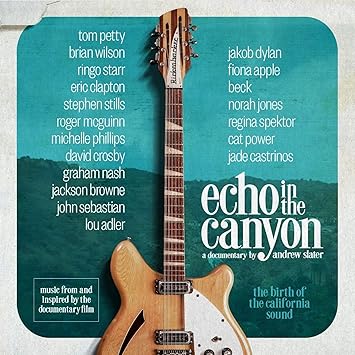
Image result for Echo in the canyon

Jakob Dylan’s enterprise (re-recording a lot of Laurel Canyon, jangly folk rock and putting on a show) is the heart of this documentary, which also features Dylan quietly listening to the usual suspects (David Crosby, Tom Petty, Roger McGuinn, Jackson Brown and many more) go on about what made the Laurel Canyon sound and scene what they were.  For the most part, the interviewees seem to have no idea, but man, they sure dug the vibe.

The documentary is pretty pedestrian, Dylan being a particularly inapt choice for interviewer (there are times he looks like he fell asleep, which is hard to do in front of the Gary Busey-esque Stephen Stills).  The narrative is also a bit of a mess – is this about the sound, the place or why The Byrds broke up?  is it the film of a tribute record/show?  or is it about Dylan’s seemingly excellent directional skills as he drives around LA?

The picture follows no line very long and when “old friends” like Michelle Phillips or Brian Wilson drop by the studio as Dylan works on their tunes, well . . . “awkward” would be understatement.  Wilson’s snippet in particular underscores the problem.  Hailed as a master of a golden age, when he comes in to see how Dylan is faring with one of his tunes, the only usable footage is Wilson asking what key they’re playing the song in.  Hoo boy.

It’s as if the musicians have been asked so often about “their time” that the answers are rote. All the pulp has been squeezed out, they realize it, and so they compensate with content-less emotion.  Such is their banality, the film uses up footage of Dylan driving in LA, or we get the obligatory Petty and Dylan walking into a guitar store, or Dylan strolling into a record store and appearing like a man looking for directions.

And the movie is only 1 hour 22 minutes.

The best parts are the snippets of song for the show, which includes Beck, Fiona Apple, Nora Jones, Jade Castrinos, Cat Power and others.   But, to be even more of a curmudgeon, Dylan is such a musical barbiturate, even those numbers feel a little lackluster.

Currently streaming on Netflix.

51515837-D519-4B3F-B49B-E4FBDB50A194

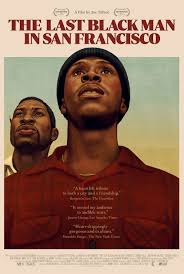
A beautiful, creative meditation on what home is, what your place is, and how both can become foreign, lost or taken right under your feet.  The picture is subversively political without one overt pronouncement. Writer-director Joe Talbot’s first time feature is also so assured and deeply thought out, it is astounding.

Jimmy, a native San Franciscan, reclaims his boyhood home in the city, which he has been surreptitiously tending to for years, after the owners vacate it in an estate dispute.  He just moves in. His bond is familial and aesthetic, as much to the house as the city, which has transformed right under his feet.  The house is a stand-in for the community which becomes fractured and fungible, but community is never what you thought it really was.

This is an art film, but it is linear and focused. Moving and audacious, Talbot is a massive talent. I hope they give him an Avengers franchise.

Yes, that may be against the grain and ethos of the film, but he can still do art films!

D260103B-ADF7-4B93-A350-ADECE08FD9C4

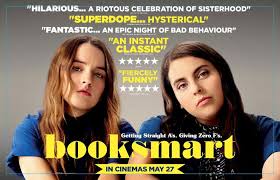
A gut-busting, loose re-make of Superbad, this time with girls (Beanie Feldstein and Kaitlyn Dever standing in for Jonah Hill and Michael Cera). It’s hard to overpraise the chemistry these two have, which enhances the laughter that comes in the set pieces as well as the seams.  This is their movie, and the bond and brilliance is evident form the first time we see them together.

They’re supported by a troupe of high school classmates so smartly drawn and crisply written, the whole “graduation night blowout” endeavor feels fresh. First-time director Olivia Wilde not only has an effortless command of pace and movement, but she also dazzles with three ingenious vignettes – a brief bad trip where the girls become Barbie dolls, Dever underwater in a pool (echoing both The Graduate and Boogie Nights) and Feldstein in a charming musical dance sequence.

The film is also very sweet and dare I say, uplifting. 

Masterful fun.  One of the best of the year.

E7F37A5D-79A5-4BD3-805B-E7F98B533CA4.jpeg

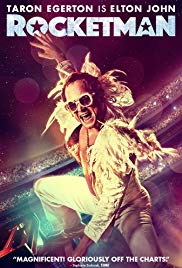
The first half is a blast. Following the model of Across the Universe, director Dexter Fletcher incorporates Elton John’s music into boffo biographical song and dance numbers (the movie takes the current model and reverses it; it is ready made for Broadway), and Taron Egerton is winning as our shy, brilliant, budding rock star. The depiction of his rise is light, whimsical and fun.

But the second half of the movie, much like the middle third of John’s life, is a bummer. The choreographed song and dance numbers give way to trippy, psychedelics that are not only a drag, but repetitive and tiring.  John drinks, drugs, orgies, wears more and more ridiculous outfits and goes lower and lower, much like your eyelids.

It ends precocious, as John confronts his annoyingly minor demons (overbearing mother, distant father, not-as-advertised first lover)  in a rehab group therapy.

Not quite where a film-goer wants to end up, even if it worked out for John.

Post image

Very, very long (6 hours in total for the two films), but not altogether terrible and without giving anything away, at least they put some bodies on the block, thus limiting later franchise movies solely to origin stories.  Quippy, and visually much more satisfying than a lot of these movies.  Also, Thor in a fat suit is pretty funny, and melding The Hulk and Bruce Banner (now, he can wear the right size pants all the time)?  Inspired.

Still, when all is said and done, the whole things turns on Superman reverse circling the earth to go back in time.  They just couldn’t use him because he’s not a Marvel character.  Also, the concept for the second film is the same as HBO’s The Leftovers.

Image result for Once Upon a A time in Hollywood [poster

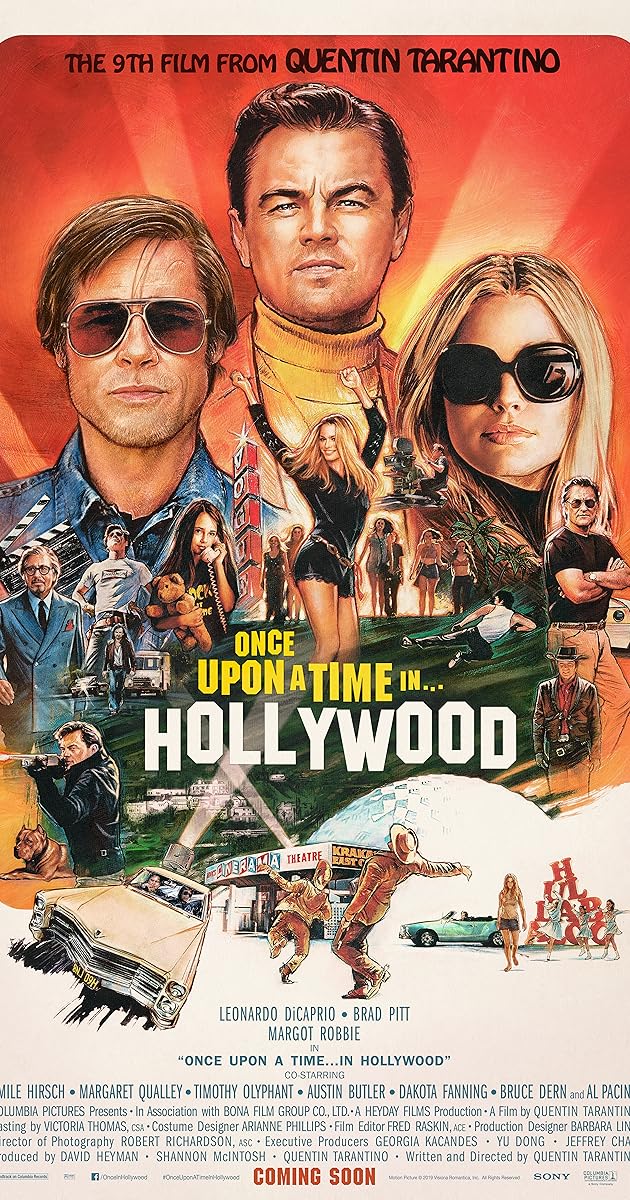
Twenty minutes in, my brother whispered to me, “I don’t know if this is going to be a good movie, but it’s a beautifully curated movie.”  He was dead on.  Quentin Tarantino doesn’t just re-create the look of 1969 Hollywood, he does it in a manner that somehow straddles classic homage and the hazy recollection of a local.  The town seems both wondrous and pedestrian.  Never were neon lights for Taco Bell or the Musso and Frank Grill so compelling.

Tarantino places a fading movie star and his stunt man/go-fer (Leonardo DiCaprio and Brad Pitt) in the midst of this mesmerizing visual portrait, the former playing an “almost made it” leading man reduced to working for cameos during “pilot season” and the latter his loyal companion.  And wouldn’t you know it, DiCaprio lives next to none other than Roman Polanksi and Sharon Tate, and hey, who was that scraggly hippie who skulked by the other day?

The film could have been cutesy or overly reverential, and when the likes of Steve McQueen, Bruce Lee and Mama Cass make appearances, I’ll admit, I was apprehensive.  But their scenes are both fun and important.  They assist in Tarantino’s portrait of Tinseltown as a much larger Mayberry, where everyone knows each other just to say howdy, but a lot of those everyones are someone.

Enmeshed in the slow-building run-up to the tragedy seared in our national consciousness (I don’t know about you, but when I was a kid I devoured Vincent Bugliosi’s “Helter Skelter”, and somehow, those white cut-outs of the bodies on Cielo Drive were more horrifying than any actual murder photo) are the stories of DiCaprio, who has lost his swagger and is negotiating his way down; Pitt, a man with a notorious reputation necessarily affixed to the fading star; and Tate (Margot Robbie), the ingénue representing the audience, agog at the magic around her and so excited about her future she can barely contain herself.  There is not a minute of their stories that isn’t engaging, and Tarantino leisurely walks them though the company town.

This is also Tarantino’s funniest film.  His dialogue has always been crackling, but he has moved on from bravura speeches and cool pop culture references, instead writing much more measured and subtle, with real heartfelt exchanges (his last film, The Hateful Eight, was a quantum leap in his maturity as a writer).  And while excess is Tarantino’s hallmark, and often his downfall, you may not believe me, but this picture is an exercise in restraint.

I would like to say more, but I don’t want to spoil anything or preview one of the more enjoyable movies I have seen in years.   Go now.

02B1BEE6-2DA4-4B9F-9402-1A9E8425D54F

A solid, slow potboiler of a crime caper, Mel Gibson and Vince Vaughn are cops suspended for excessive force (caught on IPhone) who, beleaguered by low pay and lack of support, decide to pull a heist of a heist. Their decision runs them smack into Tory Kittles, just out of prison and enlisted to be a wheelman, in over his head as a contractor for brutal thieves.

The film is expertly paced, if languorous, and engrossing.  Director-writer S. Craig Zahler can draw out the eating of an egg salad sandwich, the preparation for a bank job, and the tailing of a getaway vehicle with an exactitude and care that sucks you in to all three events.

The picture is also literate, sometimes too much so as the characters have a lot of time to jabber on stake out. There are some machismo clunkers as the officers weigh the morality of the endeavor, the unfairness of their lot and the contours of loyalty. But there’s mostly good in the script, particularly between Kittles and the boyhood friend (Michael Jai White) who hooked him into the heist as they reminisce and try and work themselves out of what becomes a hellish jam.  Zahler has a nice touch handling the easy banter of his characters.

The film has been slagged for its portrayal of allegedly racist characters and themes, which to your average movie reviewer means that the Gibson and Vaughn characters do not parrot ACLU pamphlets in discussion of their milieu or the tenor of the times.  I sense Zahler is in for the David Mamet treatment.

The criticism is a joke but what are you gonna’ do?  These folks are the types who lauded The Wire but likely understood none of it and are the progeny of Pauline “I live in a rather special world. I only know one person who voted for Nixon. Where they are I don’t know. They’re outside my ken” Kael.