This is a very funny parody of the unraveling of Richard Nixon, by this story, at the hands of two high school girls, one of whom lives at the Watergate and happens upon G. Gordon Liddy and the gang during the break-in. To shut them up, the girls are given jobs as dog-walkers at the White House and become seminal in our nation’s history.
Dave Foley (from “Kids in the Hall”) is hilarious as H.R. Haldeman, Dan Hedaya is a workable Nixon – not quite as sweaty as Anthony Hopkins and nowhere near the master of all Nixons, Frank Langella, but still, he’s appropriately shifty and skulking. Priceless is one girl’s fantasy about Nixon – she has fallen in love with “Dick”, who supplants Bobby Sherman in her world – and in one fantasy, Hedaya rides up on horseback on the beach to tell the girl “Pat understands”.
Bruce McCullouch (also from “Kids”) and Will Ferrell are laugh-out-loud as a fey and bickering Bernstein and Woodward.
Lasse Hallstrom’s film about a Maine orphanage and the maturation of one of its residents (Tobey Maguire) is a beautiful and sentimental picture notable for strong performances by Michael Caine and a score of child actors, and exceptional performances by Maguire and Delroy Lindo. Filmed in Maine and Massachusetts, the film’s score is as heart-tugging as its locale (in orphanages, children leave, die and undergo numerous ordeals, so be prepared). Nonetheless, with the exception of one or two scenes, Hallstrom is restrained in his depiction of the life of a Maine obstetrician and orphanage director who also performs illegal abortions (the film is circa 1940s).
Maguire, an orphan twice-returned, becomes Caine’s protege, but as with all young men, Maguire leaves the orphanage to see the world (or more of Maine) himself. Caine wants him back to carry on his work. Maguire wants to find out about life, and does.
Nothing happens here that you don’t expect to happen, but everything is so well-paced and finely acted, the film works even in the face of your foreknowledge. Maguire, whose unrelenting wistfulness and glistening eyes can seem manipulative, is an apt choice to play a young man who has always done rather than felt – he has not yet formed his own identity through experience. Such a role can be easily butchered. Think a young Robin Williams, the naif who stares at wonderment at all he sees. This is Maguire’s sweet spot and he nails it.
Delroy Lindo, as the crew boss of a group of migrant apple pickers, is commanding. Lindo has an ability to convey so much in one chosen look – violence, confusion, pride – that you find yourself studying rather than watching him. Caine won best supporting actor, and he is, as usual, very good. But Lindo was overlooked.
The film is unabashedly pro-choice in outlook. I did not find it at all preachy, but a significant thematic rift between Caine and Maguire centers on the issue, and there is no question as to where the filmmakers come down. This may not be the kind of thing you want in a film, but the forthrightness is not offputting.
Finally, while I was uplifted by the film, I was also completely undone and what I perceived as a beautiful but painful story, others may find schmaltzy and overt. Rachel Portman’s original score is almost unfairly touching.
Having seen The Avengers, I’m backtracking to the source movies. The first Iron Man was clever; the second near incomprehensible. Thor was above average. The Hulk movies will have to wait, be it the Ang Lee Hulk movie starring Eric Bana or the later version with Edward Norton. I still can’t get over how, if you have a mutation that makes you really big, your pants expand as well.
They didn’t do that in Watchmen.
Moving on. Captain America tells the story of a rail thin kid (Chris Evans) whose had plenty of sand kicked in his face. All he wants to do is go to Germany and fight Nazis, which is particularly pressing because one Nazi (Hugo Weaving) is fooling around with the supernatural to become even stronger and more diabolical than Hitler (seeRaiders of the Lost Ark, Hellboy). Stanley Tucci, the German-American doctor who sees the gentility in Evans, puts him in a machine and soon, Evans is buff and ready to take on Nazis. He has an inexplicable British gal minder, Hayley Atwell, and a gruff regular army foil, Tommy Lee Jones. All characters are boring and stock, particularly Evans, who has the face and demeanor of soft butter. A lot of stuff happens after his transformation, but full disclosure – we turned it off after an hour.
Is Will Ferrell ready for a dramatic role? As an alcoholic salesman fired from his job (typically, cruelly, as his boss has to get digs in during the termination meeting just so we know we’re on Ferrell’s side), for the most part, he seems just a spit-take away from breaking into Ron Burgundy or Frank the Tank. A thousand clown roles creates a hearty persona.
He’s fired, bullied at the convenience store, and when he gets home, his stuff is on the lawn, courtesy of his wife, who discovered he had an affair, changed the locks and left town. Ferrell then starts living on his lawn.
His neighbors are quirky, there’s a wise neighborhood child, and the moment I saw Michael Pena in the opening credits, I knew he’d be the Hispanic cop assigned the task of saying, “Dude. You can’t be living on your lawn.” There’s not a character in this who resembles a real person, and no amount of acoustic guitar/piano in the background can change that.
Ferrell is supposed to be endearing or at least sympathetic. For the most part, he’s neither. Rather, he’s bland, one note and when he tries to show depth of feeling, he just looks uncomfortable. He confesses his life and mistakes to an improbable pregnant new neighbor (Rebecca Hall) who, upon moving cross country to a new neighborhood ahead of her husband, naturally takes a shine to a weirdo drunk living on his lawn. Even his confession of what I think was an accused date rape only flummoxes her for a moment. You just keep hoping Vince Vaughn will show.
The film is also sloppy. Ferrell is able to blackmail his neighbor into giving him power from a cord, but in the deep throes of alcohol need, desperate for drink, he downs the backwash from old Pabst cans. With what he has on his neighbor, he’d certainly have been able to wrangle enough for a six pack. And when he’s desperately looking for beer, he checks his mini-frig, and it is empty. The next morning, however, he’s grilling bacon. Where did he get bacon?
Finally, there’s the insipid suburbia bashing as Ferrell decries the mother down the street who “blew her brains out because her daughter didn’t make cheerleading” and preaches, “I’m no different than any of you. I just don’t hide in my house.”
“I’m not a racist,” says Dave Brown. “I hate all people equally.” Dave Brown is a crooked, brutal, misogynistic L.A. cop who can turn a phrase now and again and, as is evident, can crib from Dirty Harry. Woody Harrelson plays Brown with a growing intensity. Just about every bureaucratic pressure is brought against him after he is caught on tape delivering a Rodney King to an unfortunate citizen. And in many ways, that’s the least of his worries. His ex-wives (Anne Heche and Cynthia Nixon) are sisters and he has a daughter with each, making for a challenging domestic life. He’s also an alcoholic and drug abuser, a thug, a sex fiend, and a murderer. And he’s going broke.
Similar to Bad Lieutenant, Rampart’s greatest virtue is the performance of its lead. There are also some well-written Wire lite exchanges, and director Owen Moverman (following up on his impressive The Messenger) films 1999 Los Angeles in a bleached, dreamy manner. But otherwise, this is a meandering, exhausting tale of the descent of a mildly interesting bully, made even longer by an utterly pointless relationship between Harrelson and a bar pick-up/defense attorney (Robin Wright). His exchanges with the bureaucrats hounding him (Steve Buscemi, Sigourney Weaver, and Ice Cube) are banal, his heart-to-hearts with ex-wives shed no light, and his discussions with his very bitter, uncommunicative older teen daughter are grating. Harrelson does a very effective job of conveying the importance and centrality of his home, especially in his moving scenes with the younger daughter, but that’s all Harrelson. The script offers little assistance (a personal disappointment because it was co-written by one of my favorite crime novelists, James Ellroy).
Not to mention, there is no street cop so well-connected or union protected that he could still be on duty after becoming front page news in a brutal beating and then involved in a deadly force shooting. Of course, were Harrelson suspended, Moverman would have to lose the cool shots of Harrelson in his police cruiser, contemplating his surroundings and his future.
It’s no shock the audience gave this a 38% and the critics gave it a 78% on rottentomatoes.
When dealing with race and the civil rights era, Hollywood is guilty of many sins. In Mississippi Burning, blacks were little more than props and corpses. Return of the Titans and Glory Road gave us treacle, with blacks ennobled and whites edified by the close quarters of the locker room, the baptism of sweat, and each race providing the other the lowdown on their versions of pop culture. Men of Honor presented Cuba Gooding Jr. not as a man, but as a superman, literally prepared to drown in order to establish his place. Ghosts of Mississippi was the story of Alec Baldwin’s dogged pursuit and Whoopie Goldberg’s shaming patience and little else. All of these movies were pat, uninvolving and blandly heart-stirring.
The depiction of ingrained societal racism in Conrack, the surprise of A Soldier’s Story or the depth of character of In the Heat of the Night is a rarity:
Even more rare are civil rights-era films that strike a fair balance between the protagonists yet still feel authentic. The Help continues the trend. A much lighter film than most of its ilk, ala’ Driving Ms. Daisy, most of the characters soon bust out of the broad and into the wildly cartoonish. Unsurprisingly, the center of the film is not really the help, but rather, the hysterical shrieking racist society queen Hily Holbrook (Bryce Dallas Howard). Hily is so odious as to appear sociopathic. But the film takes no chances, surrounding her with a coterie of henchwomen who fear her disapproval and endorse every initiative she proposes, including the creation of a separate household bathroom for the help of Jackson, Mississippi. Perhaps this was necessary because her character, literally, must be so vile as to deserve unknowingly eating sh**, but it doesn’t make for anything beyond grating when Hilly is not biting into that surprise of a pie.
We also have a newcomer to town, Celia Foote (Jessica Chastain). Celia is shunned by Hily because she’s of poorer West Virginia stock and she married Hily’s former beau. Celia is a character in the film solely to be ostracised, to wallow in it, and then, to be given strength by her sassy, powerful house maid, Minny Jackson (Octavia Spencer), who had also been abused by Hily. In Chastain’s big wet eyes of wonder, we see the dawning of racial understanding as she assesses her own station vis-a-vis Minny. The happy ending? Minny will be given a job for life, free use of any bathroom in the mansion, and, presumably, stock options. Both Chastain and Spencer give similar, over-the-top performances (Chastain’s suggests Priscilla Queen of the Desert; Spencer every sitcom housekeeper of the last 30 years). Both were nominated for best supporting actress. Spencer won.
But the true triumph of Minny and the rest of the help is the publishing of The Help, a book written anonymously by Skeeter Phelan (Emma Stone). The book exposes the secrets of Jackson’s households as provided by the maids who serve in them. At first, naturally, the maids are not interested in the project. But then Medgar Evers is shot and in a scene as inevitable as dawn, everybody signs up.
Stone is a terrible choice for this role. She’s an accomplished comedic actress, but she lacks any real depth – the best she can do is a screwed up face that is supposed to suggests emotion but looks more like a pre-sneeze.
Worse, we’re stuck with her uninvolving subplots, as the plight of the whites eventually takes precedence over the humdrum, silent suffering of their servant counterparts. Those trials include a deep, dark family secret — her mother (Allison Janney) ousted Skeeter’s childhood nanny (Cicely Tyson) in order to impress a local gaggle of racist women. The scene is provided in flashback and it is beyond ridiculous. Tyson is so humiliated you expect the women to start throwing cutlery at her for her menial offense. Add on Skeeter’s barely fleshed out love affair – her beau is standoffish, then smitten, then furniture, and then, he walks out after Skeeter is no longer anonymous for reasons unexplained. Granted, this has been deemed a woman’s picture, but I’m not sure the designation requires every male character to be shy of lobotomization. Regardless, Skeeter’s nonsense takes away from the film’s one good thing . . .
Viola Davis, who I first saw as the mother of a boy molested by a priest in Doubt. Davis was nominated for best supporting actress in Doubt though she appeared in just one scene, and what a scene it was (alas, she lost), and she was deservedly nominated for best actress in The Help, losing again to Meryl Streep’s Margaret Thatcher. Her performance as the first of the maids to work with Skeeter is moving and nuanced. She rises above stereotype and really comes across as authentic, something not one other character in The Help manages. This scene is an example, where Davis confronts Hilly, showing both rage, confusion and ultimately, compassion:
Other than Davis, there’s little to recommend this movie, a disappointing follow-up by Tate Taylor to his stark and cool Winter’s Bone.
Proof of Life is a competent but dull thriller/romance. Russell Crowe is the hot shot “negotiator” assigned to extricate Meg Ryan’s husband, David Morse, from the clutches of South American kidnappers.
Director Taylor Hackford tries to reprise the simmering steaminess he got from Jeff Bridges and Rachel Ward in Against All Odds and Richard Gere and Debra Winger in An Officer and a Gentleman. He has a harder road to hoe here. Crowe and Ryan rub against each other, as they apparently did in real life doing shooting, but sparks do not emit. Crowe is only offering a sly “mate” every now and again, and no matter how strong the effort, Ryan can never get too far from perky popsicle.
There are a few good things: David Caruso was actually built to be a supporting actor (his run as a post “NYPB Blue” movie lead – Jade and Kiss of Death – sent him quickly back to television for “CSI”) and he is sly and funny as Crowe’s number 2, an integral part of his professional extrication team (though he’s always been a strange choice for gritty physicality; he seems more ballet than brute).
This is also one of the last films before Meg Ryan finally succumbed to the excesses of plastic surgery and became
My boy Will got back from camp yesterday and while he was away, I DVRed Spielberg’s War of the Worlds (2005). I’d forgotten how scary the first half of this movie is. I’d also forgotten how effective Tom Cruise is as the “in over his head” father of two who must escape the aliens while protecting his children (Dakota Fanning and Justin Chatwin). Cruise has always infused a little of Risky Business in all his roles, hindering his ability to play period or even mature. That bright smile is too youthful and winning, and Cruise as a weathered or dispirited character seems both a stretch and a waste. Even his Ethan Hunt in the Mission Impossible movies is always kept running at full clip lest we realize he’s having too much fun to be such a serious international spy.
Here, however, Cruise plays weary, completely out of depth and even selfishly beleaguered in being stuck with his two children at a moment when the world is being ravaged and dominated by aliens. His performance is riveting and is enough to overcome some clunky father-son, “why weren’t you there for me?” dialogue with Chatwin.
As the family wends its way from New Jersey to Boston, where Cruise hopes to reunite the children with their mother, massive Imperial Walker-like monsters emitting ominous foghorn sounds vaporize some people, and collect others for extraction of their blood, for fertilization. I think. This is where the movie gets weaker. Since the alien invasion is so unexpected, we have no clue, no Jeff Goldblum scientist, to explain what is happening. Like Cruise, we can only guess. I respect the bravery of the decision with regard to the narrative, but after all of Spielberg’s set pieces are finished (the initial appearance of the aliens, the aftermath of the crash of a jumbo jet, the alien attack on a ferry crossing the Hudson), one starts to wonder why the aliens are so meticulous about finding Cruise and Fanning, who, after surviving the ferry attack, are hiding out in the root cellar of an unstable Tim Robbins. Thus far in the picture, the m.o. of the aliens had been indiscriminate and brutal, yet near the end, they send a snake-like probe into the basement, followed by an investigatory party of 4 aliens, followed by yet another probe. The only reason for this deviation in behavior is to create a very tense scene that seems out of place when, flushed out, Cruise and Fanning are merely scooped up. The extended sequence also allows for some tiresome back and forth between Robbins (let’s fight) and Cruise (let’s not).
The ending is also a let-down. The aliens get sick and die. Movie aliens have many of the same problems we do as an occupying force, but we look much better in comparison. If you thought it took us some time to get our footing in Iraq or Afghanistan, at least we figured out we could breathe the air in those places before undertaking the endeavors. The ultimate fault of the aliens in War of the Worlds seems a little rudimentary, though not so stupid as the aliens in Signs, for whom water was acid, making Earth a strange choice for colonization.
One other complaint. For all of Spielberg’s gifts and power, he can be gutless in his presentation of popcorn fare (see another Cruise vehicle, Minority Report, a film noir spoiled by Spielberg’s constitutional inability to have the audience walk away sad). There is no way Chatwin survives this picture. But not only does he survive, he beats Cruise and Fanning to Boston for a family homecoming and a stirring end.
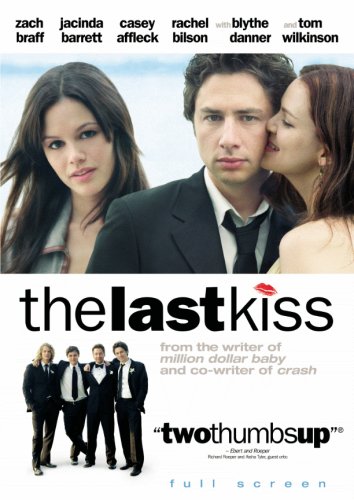
Zach Braff’s gruesome, false dramedy about a guy in his twenties who “has everything” but gets the jitters when his long time girlfriend (Jacinda Barrett) becomes pregnant. He then recklessly beds a college hottie (Rachel Bilson), and the audience is treated to the extended punishment of his shrieking girlfriend, his unctuous attempts to elicit forgiveness, and side-stories of friends and family similarly bollixed by love, which, as I understand it, reduces everyone to shrieking hysterics.
This indeed may be the way of love for many people, but I sure don’t want to watch it, even with an implausible, redemptive, happy ending. Braff’s responsibility is minimized. He only starred in and co-wrote this disaster, with, shockingly, Oscar-winning screenwriter and Scientology attacker Paul Haggis (perhaps this is an excess of Scientology?)
But a curse is a curse, and his post-TheLast Kiss, non “Scrubs” work is a cautionary tale — one Canadian movie (The High Cost of Living) and a cameo on a 2012 episode of “Cougar Town.” He played the pizza delivery guy.
David Mamet-speak is one thing. There is nothing quite like the staccato of the pitiable salesman in Glengarry Glen Ross, and Alec Baldwin’s thunderous sermon to those below him has become so ubiquitous that a generation of frat boys can now recite it – or parts (“coffee is for closers!”) – verbatim.
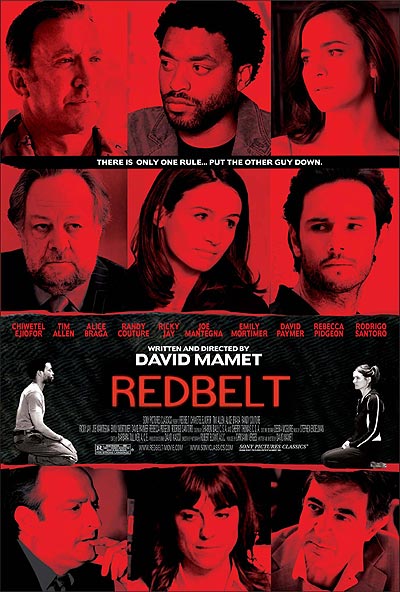
But Mamet-speak has it limits and when coupled with Mamet’s macho honor philosophy, the results can be toxic. And thus, we have Redbelt, a bizarre modern moral tale about a martial arts enthusiast (Chiwetal Ejiofor) who spouts a lot of Kung Fu b.s. while negotiating through a plot so byzantine and ridiculous that were I to attempt to encapsulate it, I’d have a stroke.
So, I’ll let Wikipedia do it for me:
While closing his Jiu-jitsu studio one evening, Mike Terry (Chiwetel Ejiofor) is approached by attorney Laura Black (Emily Mortimer), who is seeking the owner of the vehicle she accidentally sideswiped. Off-duty police officer Joe Collins (Max Martini), who was receiving a private lesson from Mike, sees that Laura is distressed and tries to take her coat. Startled, Laura grabs Joe’s gun and fires it; shattering the studio’s front window. To avoid having Laura charged with attempted murder, Mike and Joe agree to conceal the event.
Mike’s insurance, however, will not cover his act of God claim that the window was broken by a strong wind. Mike’s wife Sondra (Alice Braga), whose fashion business profits are the only thing keeping the struggling studio afloat, requests that Mike ask for a loan from her brother Ricardo (John Machado), a mixed martial arts champion. At Ricardo’s nightclub, Mike meets with Sondra’s other brother, Bruno (Rodrigo Santoro), and learns that Joe quit as the club’s bouncer because Bruno never paid him. Mike confronts Bruno about the situation but is rebuffed. Mike then declines Bruno’s offer to fight on the undercard of an upcoming match between Ricardo and Japanese legend, Morisaki (Enson Inoue), which could potentially pay out $50,000. Mike believes competitions with money as the incentive are not honorable and weaken the fighter.
Meanwhile, aging Hollywood action star Chet Frank (Tim Allen) enters the nightclub without security and is accosted by a man with a broken bottle. Mike intervenes and subdues three men in the process. The following day, Mike receives an expensive watch and an invitation to dinner from Chet. Mike gives the watch to Joe to pawn in lieu of his unpaid salary at the nightclub. At the dinner party, Chet’s wife Zena (Rebecca Pidgeon) arranges an informal business deal to buy a large amount of dresses from Sondra’s company. Chet, impressed by Mike, invites him to the set of his current film. As Mike and Sondra leave the dinner, Mike explains his unique training method to Chet’s business associate Jerry Weiss (Joe Mantegna). Before a sparring match, each fighter must draw one of three marbles, two white and one black; whoever draws a black marble has to fight with a handicap.
Mike uses his military experience to answer a few technical questions for Chet on the film set and is offered the role of co-producer. That evening, Mike faxes the details of his training methods to Jerry so they can be used in the film. Joe arrives at the studio and informs Mike that he was suspended from duty for pawning the watch, which turned out to be stolen. During their dinner that evening, Mike relays the information to Jerry who excuses himself to handle the matter, but never returns. At home, Mike learns that the phone numbers that Zena gave Sondra have been disconnected. Sondra is panicky, having borrowed $30,000 from a loan shark to order the fabric for the dresses. As he meets with the loan shark to discuss an extension, Mike notices Bruno and Marty Brown (Ricky Jay) on television using Mike’s marble-drawing method as a promotional gimmick for the undercard fights of Ricardo’s match.
Mike hires Laura to sue, but Marty’s lawyer threatens that if they do not drop the lawsuit, he will give the police an empty shell casing with Laura’s fingerprints, as proof that she attempted to kill an off-duty cop. He also threatens Mike as a witness who covered up the crime by bribing the cop with a stolen watch. When told of the situation, Joe feels responsible and kills himself. Mike feels obligated to help Joe’s financially struggling wife and, in desperate need of money himself, decides to compete as an undercard fighter in the upcoming competition.
At the arena, Mike discovers the fights are being fixed via a magician (Cyril Takayama) using sleight of hand to surreptitiously switch the white and black marbles. Disgusted by this revelation, Mike confronts the conspirators: Marty, Jerry and Bruno who confirm that unknown to the competitors, the fights are handicapped by the fight promoters so as to ensure winning bets. They also reveal that Ricardo is intentionally losing the fight to Morisaki so they can make money on the rematch. Jerry tells Mike that Sondra is the one who told them about Laura shooting the window and Bruno justifies her betrayal by explaining that his sister is too smart to stay with someone who cannot provide for her.
As Mike is exiting the arena, he meets Laura. Their conversation is not audible, but it ends with Laura slapping Mike. Mike then re-enters the arena. He incapacitates several security guards trying to stop him and is ultimately engaged by Ricardo. The audience and camera crews take notice as Mike and Ricardo face off in the arena’s corridors. Inspired by the Professor, an elderly martial arts master attending the match, Mike manages to slip a difficult choke hold and defeats Ricardo. He is approached by Morisaki, who awards Mike with his ivory-studded belt, previously referred to as a Japanese national treasure. Mike is then approached by the Professor himself, who awards Mike the coveted Redbelt.
As my Mom might say, “Jeez-o-flip!”
I am not a Mamet hater. Oleanna, Glengarry, Homicide, State and Main, House of Games, The Spanish Prisoner, these are all very good films, and Mamet displays an authentic American voice in their telling. His work on films he did not direct, or which did not come from one of his stage plays, such as The Verdict, The Untouchables, The Edge, Hoffa and Ronin, is vivid and accomplished.
Redbelt, however, came out in 2008, about the time someone needed to tell Mamet that his mystical machismo and rat-a-tat dialogue had not only reached their expiration date, but had become as embarrassing as a driver’s hat and leather gloves on a newly divorced man.
Since Redbelt’s release, and critical failure, Mamet has written a few shorts, and episodes for his TV show “The Unit.” He also wrote a very interesting book explaining his “conversion” from Hollywood liberal to a member of the right, “The Secret Knowledge: On the Dismantling of American Culture,” as fine a read as you’ll get if you want to understand the nuts-and-bolts philosophy and precepts of a modern conservative (beyond the human sacrifices of panhandlers and the ritual rape of the land). Perhaps he’s done with film writing, but if so, Redbelt is both Mamet’s pathetic coda and a testament to his loss of the gift.