Back in the Eisenhower administration, I was in a band blessed by a distinctive lead singer, a virtuoso guitarist and a very strong rock drummer. I was pretty much in awe of their playing (I was a passable rhythm guitarist converted to a fledgling bass player and mainly tried to stay out of the band’s way). Watching Beware Mr. Baker, a documentary on the life of legendary Cream and Blind Faith drummer Ginger Baker, his musicianship (a maniacal blend of jazz and African styles), reminded me of the fact that a crapload of really gifted players are drawn into pop music. Of those players, I’m most fascinated by the work of drummers, be it Keith Moon’s “lead” drumming or Ringo’s Starr’s apt choices on a few cuts (Rain, Tomorrow Never Knows), perhaps because it is an instrument I cannot even comprehend. Who the hell can move their arms and legs at the same time to a musical purpose? It’s witchcraft, I tell you.
Baker was shockingly adept and seemingly original (I say “seemingly” because my knowledge of the history of drumming is lacking). Yet, as the documentary points out, he was also mercurial, peripatetic and volatile, which is a nice way of saying he was a drug-addled dick who plagued his bandmates (Eric Clapton is interviewed and while kind to Baker, seems almost like a hostage survivor), tortured his family, pissed away any goodwill he may have engendered and split town when things got hairy.
Now, he is a cantankerous, chain-smoking recluse in South Africa, whinging on about the injustices delivered to him, or just generally shitting on all but a few folks he respects. This may have been a recipe for boredom, but documentarian Jay Bulger intersperses Baker’s snide reminiscing with impressive footage of his playing days, interviews with contemporaries and family that are refreshingly non-hagiographic, and inventive animation.
The result is an engaging, occasionally illuminating documentary about a talented asshole.
Another from the factory of producer Judd Apatow, director Nicholas Stoller co-wrote the script with star Jason Segal, which tells the story of Segal and Emily Blunt, he a San Francisco chef and she a would-be psychology professor at the University of Michigan. They fall in love but then endure the long stretch of pre-marriage, with its attendant insecurity, doldrums and misgiving. While the stretch can be a little rough on the viewer, Blunt is charming and as he did in Forgetting Sarah Marshall and Get Him to the Greek, Stoller wisely populates the story with supporting characters who offer varied, funny bits. In particular, David Paymer and Mimi Kennedy shine as Segal’s blunt, atypically private parents. Alison Brie (Trudy from Mad Men) is also strong as Blunt’s happily married sister and she and Blunt pull off a hilarious conversation/confrontation in front of her young children in the guises of Elmo and The Cookie Monster, thus masking the seriousness of their subject matter.
Still, there are glaring problems. Stoller and Segal over-rely on the easy laughs of adults using dirty words (though nothing quite so bad as Apatow’s embarrassing This is 40); the image of Segal’s bare ass or failing and/or harried while humping really isn’t all that funny; the replacement mates when Segal and Blunt break up (Rhys Ifans and Dakota Johnson) are gruesome, easy marks; and there’s nothing really new here.
There is also the problem of Segal, who is perhaps the only actor who makes Paul Rudd seem manly. From his awful sitcom How I Met Your Mother to just about every film in which he’s carried the load, Segal is a tiny variation on the same persona – aw shucks, hapless, sweet and prone to self-pitying outburst. Summed up, a huge pussy. I’m happy to defer, but in a romantic comedy, he’s a natural best friend, not the lead.
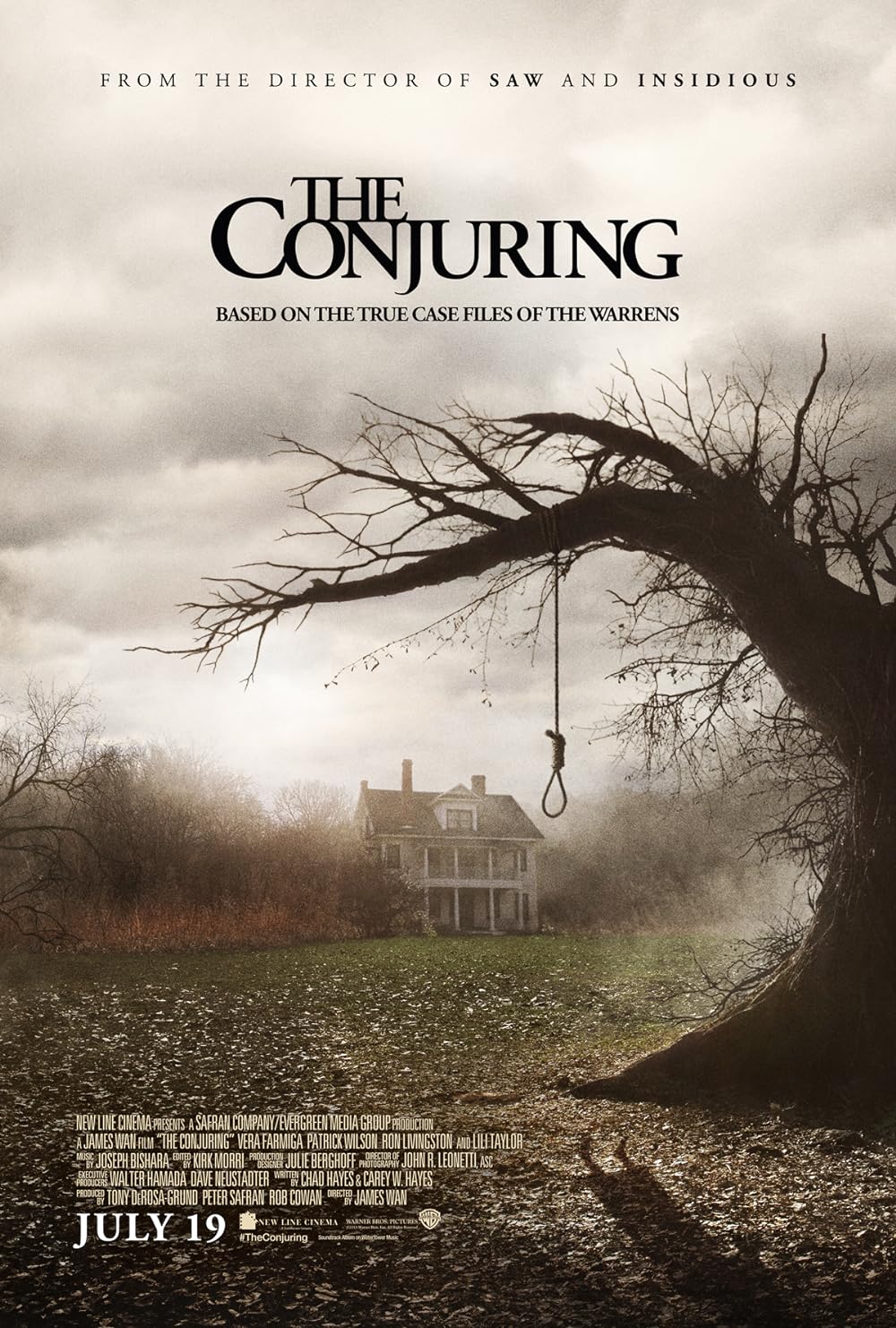
An old-fashioned, creepy mash up of The Amityville Horror and The Exorcist, the film opens with rare restraint, and it remains for the most part intelligent and taut. When it gets going, like director James Wan’s prior, impressive Insidious, it can freak you the hell out.
Two minor criticisms.
While Vera Farmiga (as the medium who, along with her demonologist husband Patrick Wilson, makes a living of studying/expelling ghosts) is very eerie and committed, the actual homeowners (Ron Livingston and Lili Taylor) seem a bit too calm and even dull. Livingston, of Office Space fame, is really no more than a smirk, a smaller budget’s Ryan Reynolds, and the haunting of his home and terrorizing of his children comes off as humdrum to him. Wilson is similarly uncommitted, and two characters included for presumably comic relief, a sheriff and student who assist in monitoring the house, make little impression.
The movie also seems rushed. 20 more minutes devoted to uncovering the history behind its malevolence would have been well spent. Instead, Farmiga has its entire history laid out like she Googled it. The movie, however, is set in 1971, when there were no search engines. Not even Ask Jeeves!
And then she was in some other stuff, including a surprising but undemanding role in Inglorious Basterds, and then she played a convincing Marie Antoinette in Farewell, My Queen. And on the strength of this body of work, she presumably got the lead in FX’s The Bridge. Based on the Danish/Swedish series Bron, Kruger plays a seemingly stand-offish El Paso detective, part emotionless, part awkward introvert, and she’s about to be drawn into the seemy world of Mexican drugs, American corruption, etc . . .
Strike one – the quirky character (Kruger’s detective has Asperger’s). Isn’t Homeland‘s wacko Carrie Mathison enough? Who is doing the hiring of our defense against domestic and foreign threats? When Kruger is detailed to inform a husband that his wife has been found dead and bi-sected, ala’ The Black Dahlia, her extreme unfeeling and offensive behavior underscores the idiocy of the premise. Next time, let’s send Dustin Hoffman in Rainman guise to pass on such difficult news. What could go wrong?
Strike two and three and infinity – if you’re going to give someone this challenging if stupid role, why Kruger? An El Paso detective? She’s a ballet dancer born in Lower Saxony, Germany. I didn’t stay to find out, but I suppose Armin Mueller-Stahl plays her toothpick chewin’ sheriff boss (actually, it’s Ted Levine).
It’s a hard role for someone who can act, and Diane Kruger cannot really act.
Full disclosure: I turned it off after 25 minutes, despite some decent notices.
This is a gripping, dystopian roller coaster ride, intelligent but not dense. Marc Forster, who showed action skill in Quantum of Solace, opens with an enthralling scene. Brad Pitt, wife Mireille Enos, and two daughters are stuck in downtown Philadelphia traffic as a fast-moving rabies epidemic sweeps the city, and by fast, I mean that people are transformed into frenetic, vicious predators 10 seconds after a bite. Complete societal breakdown follows, but Pitt, who has experience as a U.N. global crisis expert, is extracted and tasked with investigating the source in an effort to combat the epidemic.
There are some ragged connections as Pitt goes from the U.S. to South Korea to Jerusalem to Cardiff, but his journey is packed with thrills and terror. Better, there is none of the preaching and sophistry so typical in modern dystopian films. Screenwriter Matthew Michael Carnahan (State of Play), with an assist from a couple of the writers of Lost, stays focused on moving the story forward and avoiding cliche’, showing no interest in the standard “what have we done?” crapola. I kept waiting for the suits to show, explaining that things just got out of hand when the military tried to weaponize and/or the evil corporation tried to monetize. Thankfully, they did not.
Forster’s judicious use of CGI is also to be commended. While the digital monsters of I Am Legend became less terrifying the more you watched them up close, Forster only uses CGI in broad scope, to show the mass of humanity infected, moving almost as an ant colony. Up close, real people play these very gruesome zombies, and they are frightening.
Finally, the film embodies an “every man for himself” quality that is refreshing and eschews the hackneyed twin of “what have we done?”, the dreaded “what have we become?” When an 18 wheeler tries to make his escape from Philadelphia at high speed, crushing innocents left and right, Pitt pulls his car into the lane opened up to escape, marveling at his good fortune. When the authorities, ensconced in a naval ship, believe Pitt has died in his efforts, his family loses their most favored civilian status and are evacuated to the more dangerous site of a refugee camp in Nova Scotia. This is the moment when a bad screenwriter would have penned Enos’ “how could you?” speech to the chastened authorities. Instead, she stoically accepts the verdict.
Finally, the set piece, and there are several, are finely drawn. The scene in the airplane is particularly memorable.
I recently saw a “filmumentary” on Jaws and realized I had not reviewed the greatest summer movie ever made, an astonishing, deep blend of adventure, terror, and action, communicated by Stephen Spielberg’s great eye, the deft casting of three disparate principal actors, and a John Williams score that evokes fear and exhilaration.
Spielberg at the advent of Jaws was hardly a wunderkind. Like William Friedken before The French Connection, Spielberg had a pedestrian resume’ — a Columbo, a few TV movies and an okay feature (Sugarland Express). With a production plagued by everything from the mechanical failures of the shark to the tax problems of star Robert Shaw (if he spent more than a certain amount of time in the U.S. he would face a tax liability, so he was flown to Canada on his days off), Spielberg took Peter Benchley’s piece of summer pulp and fashioned a moving, ingenious film, evident from the opening scene credits, which give us a shark’s point of view in what is the still and peaceful deep, an image followed by the jarring, horrifying massacre of the shark’s first victim, alone, at night, where none of us ever want to be.
Like Friedken in The Exorcist, who prefaces the introduction of the demon in the child only after an hour of exposition, Spielberg waits quite some time to show us the shark in full, making what is happening beneath the water all the more frightening. Indeed, when we see the second fatality (a little boy on a raft), it is from the vantage point of a beachcomber lazing in his chair, a brief, violent act that immediately makes the viewer question, “what the hell was that?”
After Spielberg stuns the audience, he introduces them to poor Chief Brody (Roy Scheider), a landlubber from New York who marshals for the summer town of Amity, As the bodies pile up, it is Brody who succumbs to the pressure of the townsfolk dependent on summer dollars, only to be shamed by his malleability. Emboldened and in need of reclamation, Brody is assisted by the articulate and passionate wisecracker, oceanographer Matt Hooper (Richard Dreyfus) and old salt Quint (Robert Shaw). The former wants the scientific find of the century, the latter is a modern Ahab, seeking his white whale, as explained in the famous scene written not by screenwriters Benchley and Carl Gottlieb (a comic writer who presumably penned some of the very funny exchanges in the picture) , but John Milius (writer of Dirty Harry, Apocalypse Now and creator of HBO’s fantastic Rome).
The experience of the three men from their separate vantage points, with their different motives and backgrounds, is the fuel of this picture, not the shark. As good as Milius’ Indianapolis speech is, or Shaw’s monologue to the town leaders opened by his nails on a chalkboard, the scene where Shaw’s grit runs up against Dreyfus’s privilege and Scheider’s quiet authority is better:
HOOPER You’re going to need an extra hand…
Quint turns to see this new voice, and starts walking towards him.
BRODY This is Matt Hooper…
QUINT I know who he is…
BRODY He’s from the Oceanographic Institute.
HOOPER I’ve been to sea since I was 12. I’ve crewed three Trans-pacs —
QUINT Transplants?
HOOPER — and an America’s Cup Trials…
QUINT I’m not talking about day sailing or pleasure boating. I’m talking about working for a living. Sharking.
HOOPER And I’m not talking about hooking some poor dogfish or sand shark. I’m talking about a Great White.
QUINT Are you now. I know about porkers in the water — (throws him some rope) Here. Tie me a sheepshank.
Hooper ties the knot effortlessly.
HOOPER I don’t need to pass basic seamanship.
QUINT Let me see your hands…
He takes Hooper’s hands in his own big bloody fists, and feels them as he talks.
QUINT Ha. City hands. You been counting money. If you had a $5000 net and $2000 worth of fish in it, and along comes Mr. White, and makes it look like a kiddy scissors class has gone to work on it and made paper dolls. If you’d ever worked for a living, you’d know what that means.
HOOPER Look, I don’t need to hear any of this working class hero crap. Some party boat skipper who’s killed a few sharks…
BRODY (interrupting) Hey. Knock it off. I don’t want to have to listen to this while we’re out there…
QUINT What do you mean ‘We…?’
BRODY It’s my charter. My party.
QUINT All right, Commissioner. But when we’re on my ship, I am Master, Mate and Pilot. And I want him… (indicates Hooper) …along for ballast.
BRODY You got it.
During shooting, Shaw rode Dreyfus very hard, making fun of everything from his star status, stature and his ethnicity. Any hostility was used to great effect on-screen.
As good as these three actors are, they are more than ably supported by Lorraine Gary (as Brody’s wife), Murray Hamilton (as the oily mayor) and a boatload of locals who lend the film a great air of authenticity. Again, kudos to the script, because it allows dignity for Hamilton in the aftermath of his grave error, when, shaken at the hospital, he says to Brody, “Martin . . . my kids were in that water too.”
Finally, Williams’ score is a mixture of dread and adventure, the simplicity of dark repetition (“duh, nuh . . duh, nuh . . . dun dun dun dun dun dun dun”) followed by a near-swashbuckling romp as the men seek their quarry.
I never tire of this film and always find some new marvel or nuance when I watch it. If only the Hollywood shit that is shoveled in summer these days could sport 1/10 of the chops of Jaws, the town wouldn’t be losing its shirt.
It’s the height of audacity to incorporate your name into the title of your film. Imagine High Plains Clint or Reservoir Quentins? Eastwood and Tarantino aren’t exactly shrinking violets, but there are limits and there is etiquette.
Will Larroca dispenses with both in his sophomore feature, Will Will Kill.
The title not only suggests hubris, but an homage to Tarantino. He’s not quite there yet.
Still, this is leaps and bounds above Larroca’s first feature, The Monster. For several reasons.
First, The Monster provided us the chilling visage of Reid Brown as a crazed ghost. Here, he’s criminal mastermind Rico Brown, and he is again pretty damned chilling. Something about that shock of red hair makes it easy for you to put your guard down.
Second, the acting is generally first-rate, and Larroca smartly casts actors who look distinct.
Third, on a shoestring budget, I was impressed by the low-tech approach. It felt real. Visceral.
Finally, I was intrigued by the approach, derivative as it was.
Still, there are problems.
Why do Larroca’s characters always wear hoodies? Is this some kind of Trayvon Martin deal?
Why the finger in the camera? Is it amateurism or something else?
Why is Larroca’s vision of a clone-infested future so mundane? Is the future really as bad as all that? Does everyone wear shorts?
Why would a clone engage in a samurai fight with a hand in his pocket?
Who rides a train to Las Vegas?
Would Rico Brown really have a tag coming out of his shirt?
Again, the word is that Larroca is working with a bigger budget and should have a fall release of his third picture.
It better be special or he may go the way of David Caruso.
Martin Scorsese’s sprawling, excessive period piece, set in The Five Points of Civil War era New York City, is almost punishing in its immoderation. A directionless Leonardo DiCaprio works his way up the ladder of nativist gang chieftain Bill “the Butcher” Cutting (Daniel Day Lewis) to avenge the death of his father, Liam Neeson, who died at Cutting’s hand when DiCaprio was a boy. Scorsese sought to offer a steamy, vibrant and bloody portrait of the slum that was lower central Manhattan, but the feel is inauthentic and verisimilitude is overcome by the garish. The opening scene – the gang fight resulting in Neeson’s death – plays as a mash up of Walter Hill’s The Warriors and a really violent version of West Side Story. You almost expect Neeson to sing, “The Dead Rabbits are gonna’ get their way, toniiiiiight!” as he brings his crew to battle.
If only. The story is deathly dull, duller even than the featured Cameron Diaz, horribly miscast as an Irish lassie/grifter (her accent comes and goes like the viewer’s interest).
Day Lewis’s performance is widely lauded and he was nominated for a best actor Oscar, but he is so over-the-top as to appear foolish. Still, scene-chewing is bound to garner easy accolades, and Day Lewis is voracious. More surprising are the nominations of the phlegmatic script and Scorsese’s aimless helming. The film meanders, half-heartedly committing to DiCaprio’s vengeance but then veering into historical re-creation, such as the machinations of Boss Tweed and the draft riots. The former plot line is marred by DiCaprio’s sullen, disinterested performance, the latter by pat conclusions (including a pretentious morphing of old and new Manhattan that closes the film and nearly induces the gag reflex).
By the time Gangs of New York was released, Scorsese had suffered the indignities of having his classic Raging Bull lose to the tepid Ordinary People and Goodfellas go down to the overpraised and politically acceptable Dances with Wolves and certainly, the Academy felt bad about that. But guilt is a bad adviser, and this is Scorsese’s worst film (though the dull and similarly overpraisedHugoand the bruising Shutter Island are close seconds).
Who would have expected this creepy gem to have come from Ryan Murphy and Brad Falchuk, writers and producers of Glee? Available on Netflix streaming, this 12 episode ghost story is frightening, well-paced, extremely well-acted and on occasion, darkly funny.
The set-up is familiar. Husband and psychiatrist Dylan McDermott and wife Connie Britton flee Boston for LA with their teenage daughter (Taissa Farmiga) after McDermott’s long-term affair with a younger woman (Kate Mara) is revealed. They, of course, find the perfect home at the perfect price, save for an overbearing neighbor (Jessica Lange) who is more than a little tied to the house. It is soon revealed the home is the resting place of numerous decidedly restless ghosts. It’s even a stop on an L.A. “Murder House” tour.
The writers overcome the central problem of any haunted house yarn by first emphasizing the financial duress of the inhabitants (they don’t have the resources to live elsewhere) and then, when anyone in their right mind would live in a cardboard box rather than stay, credibly demonstrating that each family member is possessed in different ways by the ghosts who haunt the place. It sometimes feels like too much of a stretch, and all the balls in the air can be an obvious distraction, but these are nits.
The series is also graced with a plethora of strong character actors, too many to name, but a few notables include Eric Stonestreet (Modern Family), Zachary Quinto (Star Trek), Frances Conroy (Six Feet Under), Dennis O’Hare (Michael Clayton, True Blood), Morris Chestnut (Boyz n the Hood) and Mara (House of Cards). These characters – tied to the house but with differing agendas – provide the backbone of the series.
It’s also clever. For example, Frances Conroy plays the housekeeper, and to Britton, she appears as a stern but reliable partner in the bitter war she is having with her husband.
But to McDermott, the housekeeper presents as a much younger Alexandra Breckenridge, posing a larger problem for the straying husband
An example of the perverse humor – when Farmiga catches her father in a compromising position with the cleaning lady, she sees Conroy, not Breckenridge.