I recently devoured Quentin Tarantino‘s Cinema Speculations, wherein he recounts his childhood and the succession of films his mother’s boyfriends would take him to see when he was a kid. Most of the films he discusses are ones you probably shouldn’t take a kid to see.

When my mother and father got divorced, I was six years old and my father was supposed to take us every other weekend for two nights. That arrangement became a little less frequent over the years, and by later grade school, he was taking me and my brother on a Saturday day and an overnight. We would spend the weekend with him at his apartment and pretty much do the same thing every time: go shopping, do his errands, look for stereo equipment, maybe spend an hour or two at his law office, go Putt Putt golfing, and then to Shakey’s Pizza in Rockville or The Charcoal Grille in Bethesda. Dinner was from Swanson’s, so you got a entree’, two sides, and a dessert.

And movies. We went out to the movies a lot. Or, we stayed in Dad’s apartment, where he had a special key that was hooked up to some kind of internal cable system, and we could watch close to first-run movies there instead of going out. Or just catch what was on TV.

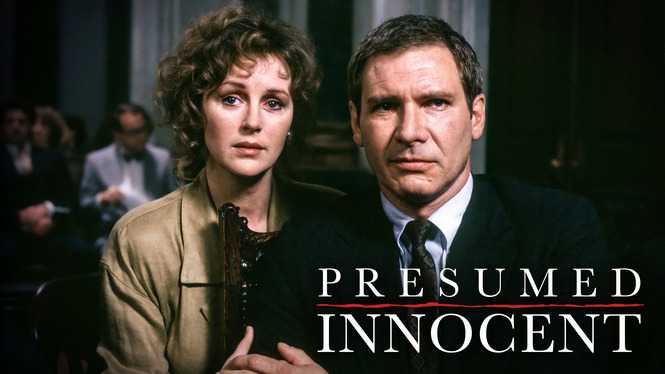
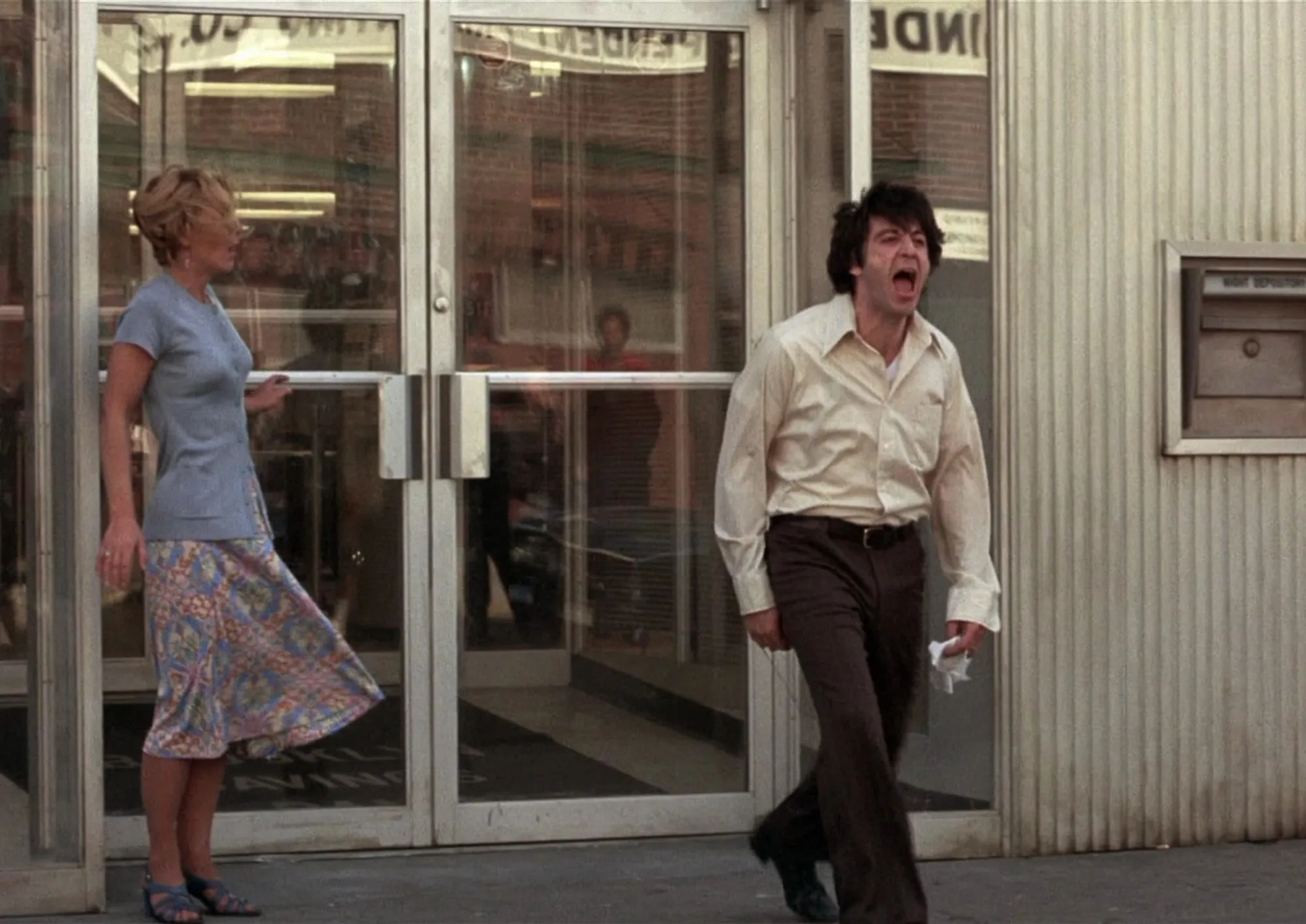
My father loved movies, he loved to talk about movies, he lived for movies. So much so that he would go through a certain kabuki with me where he would let me take a look at The Washington Post and ask what I wanted to see. I would pick a Herbie the Love Bug and he would say, “Nah. I heard about this good movie.” And then, like Quentin Tarantino with his mother’s boyfriends, you went to see a lot of dark, heavy, violent flicks, like The Laughing Policeman, The Silent Partner, Death Wish, or The Taking of of Pelham One Two Three. Or the remake of Farewell My Lovely, Night Moves, or The Eiger Sanction.

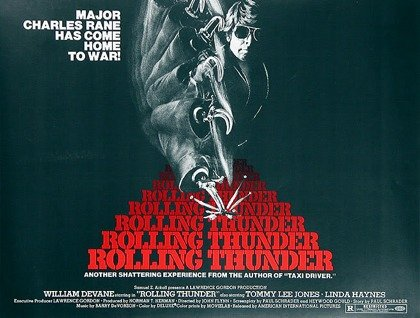
And Rolling Thunder. Which I noticed was available, and, as I couldn’t sleep anyway, I watched last night

Tarantino’s book has an entire chapter on the film, one of Paul Schrader’s first screenplays after Taxi Driver. Major Charlie Rane (William Devane) and Sergeant Johnny Vohden (Tommy Lee Jones) return to Texas after seven years of brutal captivity in a North Vietnamese prison camp. The adjustment is fraught, and even greater tortures are brought to bear on Devane, who is being treated by an Air Force psychiatrist (the just recently deceased Dabney Coleman) in his attempt to readjust. Tragedy ensues. Devane snaps. What follows is a classic 70s revenge flick.

The film travels wonderfully. There is a crisp foreboding to Devane’s return. While San Antonio welcomes him with marching bands and celebrations, and he is reunited with his long suffering and loving wife and the son who he last saw as a baby, Devane is damaged, and beneath the cheery gleam of a welcoming Texas, there is rot and danger. His son has anxiety issues. His wife has found another man (Devane says to her evenly, “you’re not wearing a brassiere” to which she replies, “oh, no one wears them anymore”). He cannot sleep in the house, preferring a cot in the garage.

So much is done well in the lead-up to the Death Wish-ian payoff, it goes unnoticed because, after all, this is a shoot ’em up, just desserts pic. Per Tarantino: ““This opening thirty minutes is a grippingly detailed character study, and by the time it’s over the audience doesn’t just sympathize with Charlie Rane, we really do understand him. Apparently better than anybody else in the film. It’s a much deeper depiction of the casualties of war than the [other movies of that era].”

I remember watching the film with my father. It is engrossing, both subtle and visceral, like a lot of pictures we saw together. It is also wildly inappropriate, also like a lot of pictures we saw together. I had trouble wrapping my head around something horrible that happens to Devane; not a spinning, vomiting Linda Blair kind of visual, but a brutality so smartly connected to a mundane part of the household, it just traveled with me, and probably not in a good way. Even last night, I fast-forwarded.

But on Sundays, when we were dropped off, I would not tell my mother about any of these movies, because I felt me and my Dad had this thing, this bond, and it was cemented in our little secret, Jujufruits and Junior Mints in hand.  And perhaps we did, although I’m probably mythologizing it. After all, my father needed to have something to talk to me about. Or at a minimum, just a two hour break from my babbling.

The picture is currently on Amazon Prime. Nostalgic for me but it really holds up.

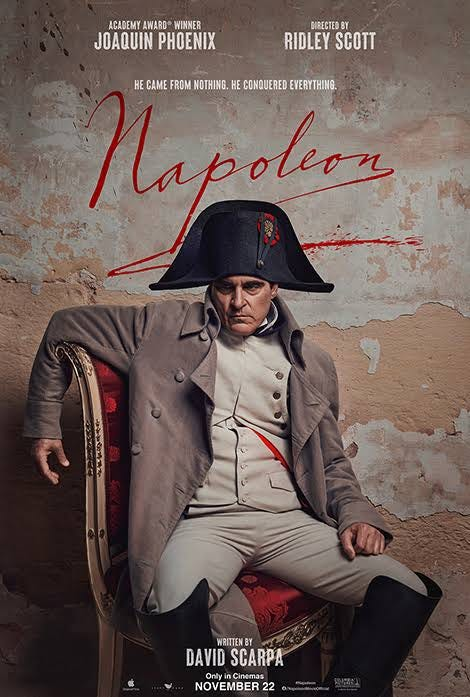
What can one say? Ahistorical, pointless, very near to spoof, it feels like an expensive practical joke. Napoleon is just . . . there.  Quiet, behatted, very dull, and you have no inkling as to what makes him special.

His torrid love for Josephine is perplexing – she spreads her legs to give him a look see, and he is forever entranced, even after he has to divorce her because she is barren.

That was the first half, before I took a gummie and got to The Battle of Austerlitz, and then, the film was more of a gas. Still terrible, but better attuned to my state.

Joaquin Phoenix gives one of the funniest, most wretched performances I’ve ever seen, defensible only because it seems justified, given director Ridley Scott’s recounting:

 “He’ll come in, and you’re fucking two weeks’ out, and he’ll say, ‘I don’t know what to do,’” Scott said about Phoenix. “I’ll say, ‘What?!’ ‘I don’t know what to do.’ Oh God. I said, ‘Come in, sit down.’ We sat for 10 days, all day, talking scene by scene. In a sense, we rehearsed. Absolutely detail by detail.”      

I kind of doubt there was any rehearsal.  Phoenix did not bother with a generic classical accent, nor Brit nor, God forbid, a French lilt, so he sounds like an assistant manager at the Petaluma Best Buy.

He is either heavy-lidded to the point of napping or he’s gonzo.

Destined to become a cult classic.

I was not a big fan of Yorgos Lanthimos. He is clearly talented, but he also revels in the ugly. The Lobster was inventive, but also, masochistic, even abusive. The Favourite was evocative but also grotesque. Lanthimos traffics in the absurd, but he luxuriates in meanness and the darkly visceral, with all its bleeding, flatulence, fluids, and muck. Yet, here, in this hilarious and charming re-telling of Frankenstein, he allows himself whimsy and some gut-busting hilarity.

The time is Victorian London. Emma Stone (Bella Baxter), a fully grown drowning victim fished from the Thames, is brought back to life by none other than a Dr. Frankenstein (actually, Dr. “God”win Baxter, Willem Dafoe) and given life via the insertion of her own unborn baby’s brain. When we meet her, she’s a mere child, eating like a infant, urinating where she stands, stubborn and defiant. But she grows, quickly, and when she happens upon sexual pleasure, she is out and free, with the assistance of a dandy (Mark Ruffalo) who haughtily acts as her tutor even as he is slowly enslaved. Soon, Bella becomes worldly, and learns a few hard lessons, but she quickly masters (speaking of absurd – this word was tagged by spell check as problematic) the ability to make her own destiny in a world that would normally relegate her to docility and subservience. To see her eat, to come, to dance, it is hard not to be as captivated by Stone’s gifted performance as Bella is by the world. And Ruffalo’s foppish moth to her carnal flame is riotous. Bella’s journey is wondrous, funny and beautifully shot, deftly lifting from the best artistic visions of both Tim Burton and Wes Anderson.

I laughed uproariously and sat in wonderment at Lanthimos’ ingenious world.

Two nits. First, I never really thought I’d say, “Hey, there’s just too much of Emma Stone naked” but the film is 20 minutes too long, and there’s just too much of Emma Stone naked. I think Lanthimos became entranced by Stone’s moxie, but soon, all of the sex seems less like a revelation, and more like an obstacle course.

Second, Jerrod Carmichael makes an appearance and there is no other way to put it – he’s terrible. Stilted, clunky, confused, and aggravatingly amateurish. You kind of feel bad for him, but you brighten when you realize he is gone.       

Otherwise, great, smart fun.

Seven down, three (Past Lives, Killers of the Flower Moon, The Zone of Interest), to go.

A man falls from a window and dies. Was he pushed?

Like HBO’s The Staircase, this is a courtroom drama about one spouse accused of murdering the other, but this film is like nothing you’ve likely ever seen before, simply because half of it is in a French courtroom, where as near as I can tell, a criminal trial is-

  • Nothing but a series of closing arguments between the prosecutor and defense counsel.
  • A venue where they let anything in as evidence, including absolute, groundless conjecture.
  • A therapy session.     

As someone steeped in both American and British procedurals, the picture is fascinating. Think about a prosecutor who elicits, “Well, I think she did it because I was the victim’s therapist” from a witness, and then the prosecutor turns to the defendant and basically says, “Well??? What say you to that!” And all other witnesses get to hang out and watch.

Also, if there were ever a cautionary tale that French and German people should not marry, this is the one.

This is edge of your seat stuff, a film that jams in a flashback of a fight between the spouses on the day before the murder, an exchange that far eclipses the tension of the courtroom.

I am somewhat burdened by the “whodunnit?” aspect of the picture to get deep into analysis, so I’ll focus on the performances, which are stellar.  Sandra Huller has the misfortune of coming up against Lily Gladstone (Killers of the Flower Moon) and Emma Stone (Poor Things), so, no chance. But her turn as the accused is riveting.    

It’s a bit long, and ambiguity has its limits, but a great picture nonetheless.

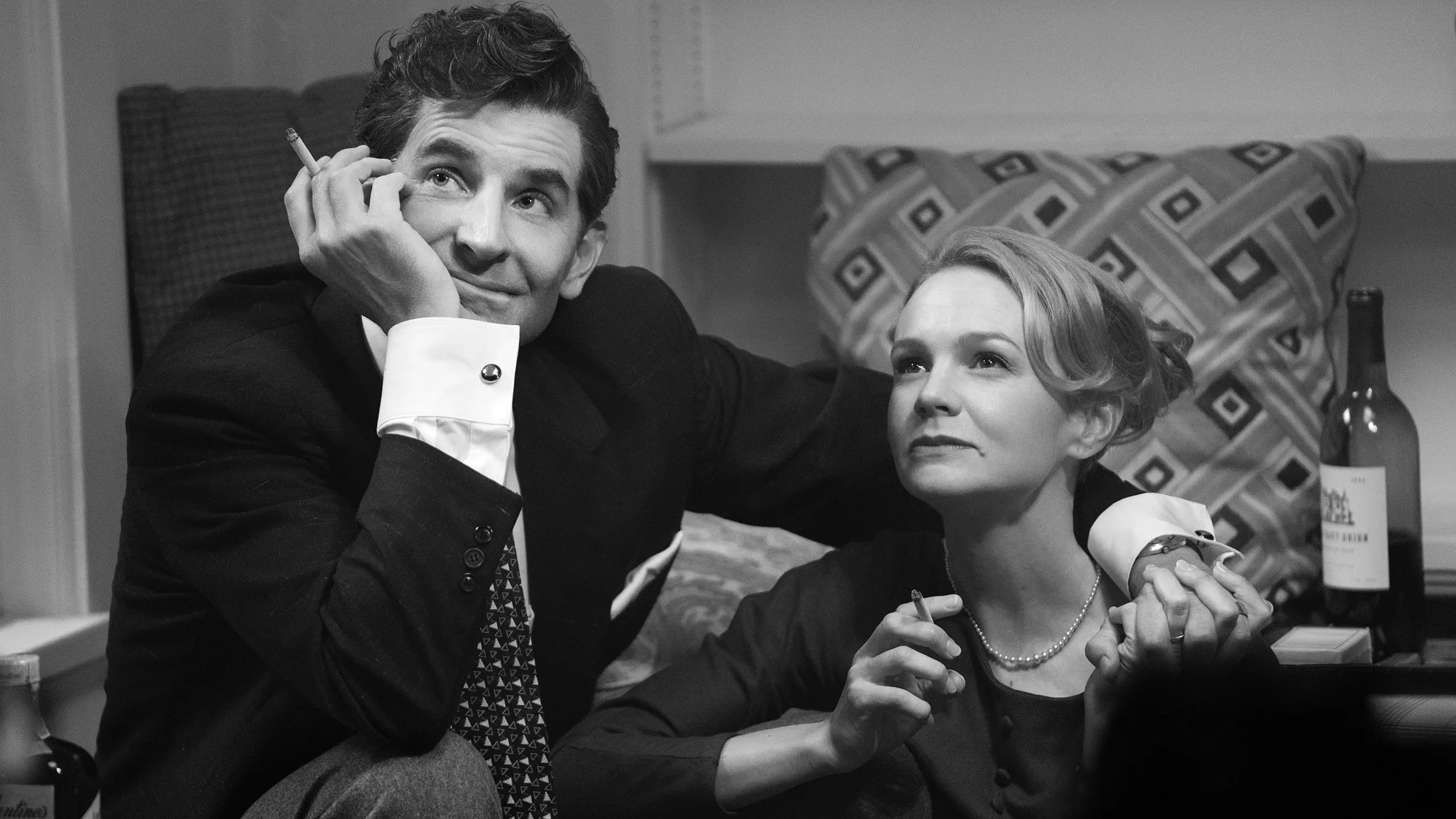
Leonard Bernstein was a significant man. But you wouldn’t know it from this film. Bradley Cooper’s labor of love makes Bernstein seem rather humdrum, and as the film progresses, Cooper certifies that reality, eventually discarding Bernstein’s story for that of his wife (Carey Mulligan).

Look, it is clear Cooper reveres Bernstein, but too much is too much. Think of when someone you know introduces you to someone they love. They are already in thrall, and they have explored every nook and cranny of their idol so, in your introduction, you don’t come to your appreciation organically, the way your friend did. You start with, “He is the greatest.” And then, after that, your friend just keeps saying, “Isn’t he? Told you!”

Here, Cooper is so entranced, he glosses over what makes Bernstein Bernstein – his music. Sure, there’s tons of scenes of Cooper directing with the panache and flourish of Bernstein, but Cooper is more interested in having mannerisms down pat than exploring why we’re here. Cooper’s meticulous impersonation cannot substitute character.

Worse, since Cooper has little interest in Bernstein’s craft, we focus on his domestic struggles, which are pedestrian, even for a famous man living a barely disguised double life. He is not denied his pleasures, nor is he punished for them. Rather, they create some marital strife. And that’s what we get to see until cancer closes the story out. No war time concert in Israel in 1948. No silly cocktail party for the Black Panthers (sent up so wonderfully by Tom Wolfe). No concerts after the assassinations of JFK and RFK. No philanthropy for AIDS as it decimated his profession (and killed his longtime lover Tom Cothran, for whom he left his wife). 

We learn very little about what Bernstein should be remembered for.  Hell, he could have been a periodontist.

A well shot chore. On Netflix.


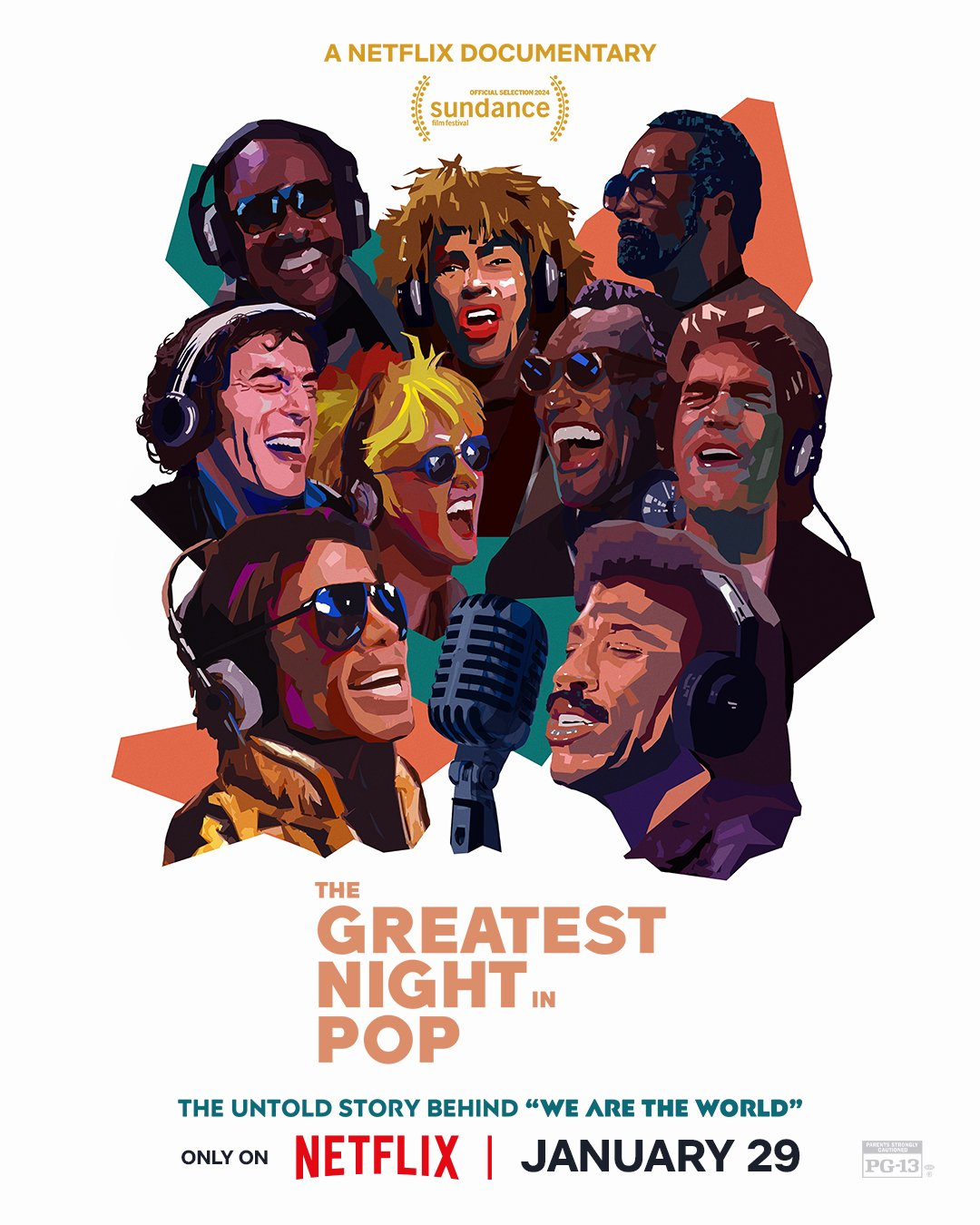
The best part of this documentary is the beginning, where the famine in Ethiopia is juxtaposed with the difficulty of wrangling stars who might alleviate such monumental, global suffering. But it must be done the night of The American Music Awards, because, you know, they all have busy schedules.

That, and when someone observes that had Michael Jackson not participated, it would have been “one of the biggest mistakes of his career.”  Well sure. One of them.

Also, Cyndi Lauper almost bails because “I was so punch drunk tired” after the awards show. Oh, and her boyfriend didn’t think it was a hit.

This is, unknowingly, pretty funny, clueless shit.

There are, however, some genuinely cool moments that aren’t fully mockable.

I liked how Kenny Rogers drove his own shitty car to the studio amidst the fleet of limos.

I liked how Steve Wonder wanted to sing a made-up Swahili line and Waylon Jennings just split.

I liked how Bob Geldof saved the project, torpedoing Wonder’s stupid idea by explaining that the song was not for Africans, as they would likely not be hearing it, but rather, eating because of it, and further, Ethiopians don’t speak Swahili.

I liked Bob Dylan on whatever drug he was on looking like a dude who does not know what portal he fell through to be amongst these people. And it was very sweet to see how Quincy Jones and Wonder got this addled fool thru his part.

I liked how Kim Carnes’ solo was reduced to two lines in favor of a Huey Lewis harmony, which she handled better than Sheila E, who sussed out that she was only invited as Prince bait, whereupon Sheila pulled a Waylon.

But, ultimately, as perhaps preordained, this documentary must fail, because it does not explain the presence of Dan Ackroyd.   He is inexplicably back there in certain scenes, doing absolutely nothing. Like Bigfoot.

On Netflix.

My mother tells people that The Boys in the Boat is a book “every young man must read.” In point of fact, the book has been on the New York Times bestseller list for quite a long time. But I am not a young man, so I settled for taking her to the picture.

She was rightfully disappointed. I was bored to tears or underwhelmed. For the following reasons.

1. The actual boys in the boat were supposed to be destitute, desperate, and worn down from the Depression, lean, hungry, rough boys who found rowing as a way to eat. Unfortunately, they all look like this:

2. The lead, Calum Turner, has all of the character and nuance of a Nilla Wafer.

3. Rowing does not lend itself to film. We don’t learn much about the mechanics of it, so it’s difficult to discern the issue when the boys falter (they just start to bicker at each other and their stoic, forgettable coach merely shakes his head). In races, they start out slow, and through grit, pluck and determination, the boys pick up the pace and win. That’s it.

4. Hitler shows up. But he looks like Charlie Chaplin as The Little Dictator, and I’m not sure that was the effect Director George Clooney was aiming for. 

5. Jesse Owens also shows up. He says one line that is impactful and wise, with the effect being one’s own rumination: “Damn, I wish this movie were about Jesse Owens.”

The film looks classic, but presents as inauthentic. It has a hazy, postcard visage that feels both obligatory and unnatural.

Ultimately, the film is not terrible, but it is instantly forgettable, of no real moment, and about as safe a production as you’ll find.

Very similar to The Talented Mr. Ripley, but without any of the care, build, patience, intelligence, or style of that flick. In Ripley, we are wary of yet sympathetic to Tom (Matt Damon), the working class nobody who insinuates himself into the shine of the rich and beautiful. When the tanned god Dickie (Jude Law) casts him aside, we feel for Tom. We don’t endorse the sociopath’s actions, but as Tom grows closer to capture, we guiltily root for him. When Tom’s desires draw him into greater malfeasance, against our judgment, we thrill to see if he will actually get away with it.

Here, our new Tom Ripley is Oliver Quick (Barry Keoghan), a modern day loser at Oxford who gloms on to his own Dickie, Felix (Jacob Elordi), a rich kid whose monied and titled family lives in a castle on Saltburn estate. After ingratiating himself with Felix, Oliver is invited to Saltburn where he negotiates Felix’s ridiculous caricature of an upper-class family, his own increasing desire for Felix, and the fact that he is disposable to these people when, like Ripley, he is trying to make himself indispensable.

Unlike Tom, however, we don’t root or care for Oliver. He’s a furtive creep. Even when he overhears the rich kids at school or Felix’s family malign him, our natural pang of sympathy immediately gives way to caution. The guy smells of wrong from the get-go and because of it, we have no skin in the game, either about Oliver’s fate or the cartoon characters around him.

What follows is a wretched flick infatuated with its own provocativeness. It’s not very funny, though it is labeled a black comedy. It’s not very edgy, though it is sexually perverse. It’s not very smart, unless rich people one level removed from The Howells on Gilligan’s Island saying grotesque things is your idea of smart. In Ripley, the rich were dazzling. Any condescension was barely perceptible, and accordingly, all the more cutting to Tom. You can see why Tom wants in and how much it stings. Here, Oliver yearns for a world populated by dolts and cretins, so, who cares?

The picture is also repetitive in the extreme. Basically, every scene is Oliver made uncomfortable until he becomes morose. When Oliver gets a win, another cliché rattling his/her jewelry reminds him for the umpteenth time that HE DOES NOT BELONG.

After running the tired plot into a very tight and boring corner, the end lapses into inanity (SPOILER: Oliver kills them all in a manner a mall cop would suss out as foul play inside of a minute; apparently, the British police force is trained by Magilla Gorilla).

But no one is on to Oliver because it’s a shit screenplay so far up its own ass that it need not deign to generate interest, draw characters, or construct a sensible narrative.

The near-end, where we flashback to Oliver’s machinations previously hidden to us, ala’ M. Night Shymalan, is such a clumsy and pathetic attempt at bringing order to this mess I almost felt for the creator.           

But then, I realized Saltburn is from the writer director of Promising Young Woman (Emerald Fennell), another infantile, impossible crapfest which got the critics to swooning.

On Amazon Prime.

When I saw the preview for Alexander Payne’s latest picture, I thought, “Okay. Older father figure. Private New England boys school. Some Christmas break bonding. Not the Baird school, but Barton. It’s Scent of a Woman, with a couple of tweaks.” I was right and also very wrong.

Now, I like Scent of a Woman. It’s occasionally moving, impressively manipulative, and entertaining as hell. Chris O’Donnell is vulnerable and empathetic. And even in a small part, a young Phillip Seymour Hoffman (poor George, “sitting in Big Daddy’s pocket”) resonates.

But the picture is near-obliterated by Al Pacino’s roar and Martin Brest’s complete lack of restraint. Hey, folks, not only are we going on a last hurrah with a blind depressive and his young charge, but let’s make the blind depressive a) do a flawless tango with a complete stranger; 2) have such a “fix-is-in” fight with his family that you feel for the bad guy, Bradley Whitford, the sneeriest of nephews; and 3) drive a race car in the Big Apple!

Hoo-ah!!!!!!

Still, like a Whopper Jr., the flick delights until the inevitable dyspepsia.

Now, the differences. First, without Pacino sucking up all the oxygen, The Holdovers has room not only for a Paul Giamatti as a strict, sneakily populist professor, and newcomer Dominic Sessa, the poor rich boy abandoned to staying over at school for the holidays under Giamatti’s thumb, but Da’Vine Joy Randolph, the school’s cook, who must endure the Christmas break and her own recent tragedy. I can’t commend her performance enough – restrained, clever, surprising, and then heartrending without a hint of stereotypical sass and easy schmaltz. Her sharing of the ins-and-outs of The Newlywed Game with Giamatti is primo.

But Pacino could not have allowed it. There was simply no space.

Second, Giamatti and Sessa actually grow, and bond, primarily through conversation, revealing a beautifully rendered mutually protective nature. Whereas, Pacino and poor O’Donnell simply pinged from situation to situation, each increasingly absurd, because they were confronted with two legitimate threats.

Third, again, whereas the scorching flames from Pacino’s engine disallowed any real growth, space or time for others, Payne depicts important interplay between or including secondary characters. The heartbreak and frustration of a bullied kid and his mitten choked me up, and after another poor holdover from Korea breaks from homesickness in the middle of the night and is comforted by Sessa, the job was nearly finished. Indeed, the kids in The Holdovers run the gamut – the dumb bully is there, but so too the clueless but tender-hearted jock and the poor youngsters. In Scent, with the exception of O’Donnell, every kid at Baird seemed to be some form of generic, shit heel carnivore or mere prey. Here, Payne delves a little deeper and produces some truly poignant moments.

Last, Pacino had one change to make, from bigger-than-life suicidal howler to a man who wants to live for himself and others. Conversely, Giamatti is seemingly a martinet, but in fact, turns out to be multi-layered. Rather than merely having Giamatti overcome his condescending and authoritarian nature, writer David Hemingson explores several aspects of his personality and past, all of which fill in the puzzle. And Sessa isn’t the only contributor to his growth, which fleshes him out even more fully,

The end of the film is a bit of a surrender to Scent’s need for big dramatic closure, and in particular, one Giamatti zinger is off-kilter and completely out of character. But the sin is venial.

If they are still holding the Academy Awards, I see a slew of nominations, and if you can get some juicy early odds on Da’Vine Joy Randolph for supporting actress, go heavy.


The previews suggest an unrelenting, biting send-up of the idiocy of the so-called black experience as represented in the arts. On that front, the film delivers, though with a stiletto rather than a cleaver.  But while the social satire of the film is paramount in its marketing, in presentation, the picture is a sweet and moving story about a family whipsawed by tragedy. It is not lost on the viewer that the dramedy is refreshingly devoid of the stereotypes punctured by the picture. Writer-director Cord Jefferson practices what he preaches, delivering on the traditional at the expense of a caricature he effectively obliterates.

We meet Monk (Jeffrey Wright), a college professor and author in California, as he is confronted by an entitled white undergrad who objects to his having written the title of a Flannery O’Connell short story on the blackboard. Monk explains that as a black man, if he can get over the word that shall not be said, surely, so can she. Our Precious, however, stands in for every vapid girlchild who haunts the modern university, likely cheering for Hamas though they would throw her and her heightened sensibilities off the nearest roof. So she complains. Monk is summarily placed on sabbatical and forced to reunite with his upper middle class family back in Massachusetts and, as with all “going home” movies, things get messy. 

Monk is also going through a professional slump, his books fewer and farther between, and not very popular. While attending a book fair, he notices the crowds at another black writer’s (Issa Rae) event, and when she reads a passage from her novel, a tale of domestic hardship told in the patois of the street (“Yo, Sharonda! Girl, you be pregnant again?”), Monk winces. The crowd, however, swoons and applauds the bravery, grit and authenticity.

Furious, Monk writes his own ghetto tale, My Pafology, as a joke and a rebuke.  He also creates a pseudonym, and soon, the big publishing houses and Hollywood come calling. He is stunned yet seduced, and in aid of his scam, must adopt the mien of the inner city thug, a character so “real” that he cannot make public appearances because, of course, he is wanted by the law.  He negotiates his double life in the midst of rapprochement with his family, with varying levels of success.

I laughed out loud in the theater at least a dozen times, and was thoroughly amused throughout. No one is unscathed, and nothing feels cheap or gratuitous. Most jibes are nuanced, and when Rae and Monk finally go at it, there is no dawning, no lesson. Just an insoluble conundrum that thankfully is not laid at the feet of whitey or oppression or the usual suspects that are part of the grievance mill Jefferson has in his crosshairs. 

The script crackles. Not only in Monk’s hilarious attempts at playing street, but in the familial slings and arrows between Monk and his siblings and the interplay between Monk and his colleagues. When Monk is solicited by a tony literature award contest to be one of the judges, the courter explains that they needed to add some diversity to the panel.  Monk responds, “I’m honored you’d choose me out of all the black writers you could go to for fear of being called racist” to which he receives the oblivious reply, “Yeah. You’re very welcome.”

If it has any flaws, it may be a bit top-heavy on family melodrama over the social satire. But it’s one of best movies of the year.