Haven’t even seen it. But it’s going to be that good.
Ghost Tits – 5 stars
Leave a comment

Haven’t even seen it. But it’s going to be that good.
Two dumb Southerners vie for a North Carolina congressional district, one a Democrat (Will Ferrell), a randy Bill Clinton wannabe, and one a Republican (Zach Galifinakis), who is essentially Ned Flanders. But they are of the same bent, using appeals to God, country, morality, patriotism and the like to sway the voters, who, being Southern, are borderline mentally retarded. After an unscrupulous campaign that features baby punching, grudge wife screwing and near-maiming, we are all served a lesson in civics.

There are a few very funny gags — Ferrell accidentally leaves a message for his mistress on a phone answering machine while an unsuspecting family is having dinner; Galifinakis uses a book (“Rainbowland”) Ferrell wrote in the second grade to suggest Ferrell is a socialist because, in Rainbowland, everything is free; the baby punching; and Ferrell’s tortured rendition of The Lord’s Prayer at a debate. But much of it is derivative, either of earlier Ferrell vehicles or the fim itself. Worse, Ferrell so over-relies on his own brand of wild man antics that you can feel the air release from the movie. Quite something when it clocks in at a mere 90 minutes or so. When Ferrell engages in the gibberish-spouting freakout scene, I’m reminded of the story about the late Chris Farley, who once shoved a pool cue up his own ass to get yucks. Ingenuity or desperation? You make the call.
To compensate, we get some political instruction, presumably from producer Adam McKay, who must actually believe that vehicles created for the delivery of fart jokes will also suffice for ideological lessons (he did the same thing in the seminal Ferrell pic The Other Guys, which ended with a primer on the evils of TARP). In this movie, the Citizens United Supreme Court case is actually cited, and stand ins for the Koch brothers (John Lithgow and Dan Aykroyd reprise the roles of Ralph Bellamy and Don Ameche from Trading Places) are wasted when provided with no funny material. There’s also much that is not funny, including a gag where an Asian housekeeper is made to talk black . . . again and again.

Downfall, but instead of Hitler and his bunker, it is Versailles and the French Revolution. Marie Antoinette (Diane Kruger) is pampered by a coterie of attendants, including her reader and our protagonist (Lea Seydoux) a quiet but determined girl who adores her queen. Her adoration never wanes, even after the queen asks her to take flight and pose as a more favored courtier, Gabrielle de Polignac (Virginie Ledoyen) with whom the Queen has developed a near romantic attachment. Seydoux knows this could be her head, but out of a childish need to please, a desire for purpose, and ultimately, the chance to at least play both above her station and the queen’s favorite, she agrees.
Shot at Versailles, the film is beautiful, even as it deglamorizes its locale (mosquitos, rats, vicious gossip, heat, and dank cellars take precedence over finery and gold). The depiction of life at court from the vantage point of rank-and-file staff has an “Upstairs, Downstairs” feel. Kruger plays Marie with the right mixture of caprice and entitlement. Seydoux is a bit tedious, however, because she is written as little more than a teen with a crush. Though her scene in the carriage as she pretends to be Polignac is moving (she waves to the peasants, one of whom makes a throat-slitting motion and even that does not dissuade her from fully indulging in her moment of glory), following a teen with a crush for an entire film can be a little boring. At its most dour, I yearned for Sofia Coppola’s dizzying and silly Marie Antoinette.

“I’m not a racist,” says Dave Brown. “I hate all people equally.” Dave Brown is a crooked, brutal, misogynistic L.A. cop who can turn a phrase now and again and, as is evident, can crib from Dirty Harry. Woody Harrelson plays Brown with a growing intensity. Just about every bureaucratic pressure is brought against him after he is caught on tape delivering a Rodney King to an unfortunate citizen. And in many ways, that’s the least of his worries. His ex-wives (Anne Heche and Cynthia Nixon) are sisters and he has a daughter with each, making for a challenging domestic life. He’s also an alcoholic and drug abuser, a thug, a sex fiend, and a murderer. And he’s going broke.
Similar to Bad Lieutenant, Rampart’s greatest virtue is the performance of its lead. There are also some well-written Wire lite exchanges, and director Owen Moverman (following up on his impressive The Messenger) films 1999 Los Angeles in a bleached, dreamy manner. But otherwise, this is a meandering, exhausting tale of the descent of a mildly interesting bully, made even longer by an utterly pointless relationship between Harrelson and a bar pick-up/defense attorney (Robin Wright). His exchanges with the bureaucrats hounding him (Steve Buscemi, Sigourney Weaver, and Ice Cube) are banal, his heart-to-hearts with ex-wives shed no light, and his discussions with his very bitter, uncommunicative older teen daughter are grating. Harrelson does a very effective job of conveying the importance and centrality of his home, especially in his moving scenes with the younger daughter, but that’s all Harrelson. The script offers little assistance (a personal disappointment because it was co-written by one of my favorite crime novelists, James Ellroy).
Not to mention, there is no street cop so well-connected or union protected that he could still be on duty after becoming front page news in a brutal beating and then involved in a deadly force shooting. Of course, were Harrelson suspended, Moverman would have to lose the cool shots of Harrelson in his police cruiser, contemplating his surroundings and his future.
It’s no shock the audience gave this a 38% and the critics gave it a 78% on rottentomatoes.

Wes Anderson’s Moonrise Kingdom is the best film of the year and the best of Anderson’s career. Anderson writes and directs fables, where child-like adults attempt to grapple with the expectations of a grown-up world. In Bottle Rocket, Owen Wilson’s Dignan wants to be a mythical man of the big heist, not a Texas service worker. In Rushmore, Bill Murray wants to be young again, to erase his choices and capture a tenth of the wonder and promise of Jason Schwartzman’s Max Fischer. Gene Hackman’s Royal Tenenbaum won’t grow up but demands the fealty of a family he has abandoned and when it is not forthcoming, he fakes a fatal illness to win them back. In all of Anderson’s films, the protagonists are stubbornly fleeing from responsibility while demanding the respect accorded responsible people, creating funny and bittersweet scenarios.
Anderson also creates beautiful love stories between those who cannot be together. Luke Wilson falls immediately in love with the motel worker in Bottle Rocket, yet she cannot speak English. In Rushmore, neither Murray or Schwartzman can have the love of their life, as Murray is too old and Scwartzman too young, and in The Royal Tenenbaums, Gwyneth Paltrow is loved by childhood friend Owen Wilson, who aspires only to be a Tenenbaum; stepbrother Luke Wilson, who exiles himself to lessen the pain; and her husband, Murray, who can only analyze her. In The Life Aquatic, Murray cannot be with Cate Blanchett, as she sees his b.s. and realizes he can never shed it. In all his films, Anderson shows us the absurdity of love but he never mocks it or gives in to cynicism.
At root, all Anderson’s films are children’s films for adults, up to and including The Fantastic Mr. Fox. Moonrise Kingdom is similar but has as its leads two children who meet in the summer of 1964, fall in love and defiantly plan an escape from the confines of their New England island in the summer of 1965. The girl (Kara Hayward) is the troubled daughter of emotionally estranged lawyers Frances McDormand and Murray. The boy (Jared Gilman) is an unpopular orphan attending scout camp under the supervision of Edward Norton. In pursuit are McDormand, Norton and Murray as well as the entire scout troop (a moveable, hilarious “Lord of the Flies” troupe), island police chief Bruce Willis, Tilda Swinton (who has come to retrieve the boy so he can be sent to reform school) and Schwartzman, who is helping the young lovers on the lam (he’s the King Rat of the scout camp). The film is charming, comic, and often beautiful. It brings back the childhood moments of a first kiss, escape and adventure. The scenes between Hayward and Gilman are poignantly funny and then almost heartbreaking, but Anderson also gives us tender scenes between Murray and McDormand as they confront their distance; Willis and the boy as the former explains his loneliness; and Norton and his tape recorder, as he confesses his inadequacies in scoutmaster logs.
The picture features many of Anderson’s touches, including an inspired soundtrack (courtesy of Devo’s Mark Mothersbaugh), a set that presents as a stage play (as in Rushmore, the movie contains an actual stage play), and a narrator (Bob Balaban), though unlike Alec Baldwin in The Royal Tenenbaums, Balaban is on-screen delivering a funny turn as a documentarian.
What transpires is an exciting children’s adventure that will have the same effect on you the adventure book you read under covers with the aid of a flashlight and may transport you to some magical moment in your childhood. It speaks to those who had a backwoods fort, summer camp spook stories, a secret love to whom you sent letters without a single “LOL” or “OMG”, hidden treasure or, if you were lucky, all of the above.

A successful parody of both high school teen flicks and buddy-cop movies (ala’ Hot Fuzz). A blast of a picture, made better by strong chemistry between Jonah Hill and Channing Tatum. Hill was the high school geek, Tatum on the top of the social totem pole, but after graduation, they both ended up on the police force, with dreams of car chases, shoot-outs and slo-mo explosions. Instead, they are assigned as bike patrolmen, and after they screw that up, they are shipped off to the Jump Street division, where their youthful faces land them back in high school, undercover, to break up a drug ring.
So far so good, though not much beyond the formula. But the material is elevated during their second stint in high school, where Tatum finds himself the geek. Aggressive jocks, immediate put-downs and a hierarchy are out; tolerance and peace are in; and the main drug dealer (played by James Franco’s brother, Dave, in a very funny, emo/enviro turn) cleaves to the cooler Hill, leaving Tatum as the odd man out. Hill basks in a high school popularity he always craved, leading to a great exchange where Tatum screams at Hill, “You’re in too deep” after he finds that Hill is filling out college applications in the hopes of matriculating at Berkeley with Franco.
Which brings me to Tatum, who I had unfairly classified as a graduate of the Josh Hartnett school of lobotomized acting. Indeed, to watch Tatum play Roman period, as he attempted in The Eagle, was cringe-inducing. But as Clint says, “A man has got to know his limitations.” Tatum redeems himself and steals this picture with great timing and unexpected sensitivity. He is also getting very good reviews for Steven Soderbergh’s Magic Mike.
Ridley’s Scott’s prequel to the Alien series fares much better than troubled installments 3 and 4 (which were not directed by Scott). It does so without reliance on the now famed Alien monster or creation of another “haunted house in space” where the crew is picked off one-by-one. Instead, Scott’s film opens with an ambitious recreation of the demise of our creators (or, at least, our forefathers). In 2089, two scientists (Noomi Rapace and Logan Marshall-Green) deduce that disparate human societies with no connection and at different intervals in the world’s history communicated with another species (or is it?) from space. So off they go, with another crew on an epic journey to discover from whence we came. A cool Charlize Theron is in charge of the vessel Prometheus, but the ship is helmed by the down-home Idris Elba and it is guided by an android, David (Michael Fassbender). They find what they are looking for but it is not what they thought, and Alien is born.
For what could have been a ponderous big idea picture, this movie is very tight, and if never quite as horrifying as Scott’s first movie, it is tense, scary and moody. The feel is enhanced by a brooding, foreboding Marc Streitenfeld score. Moreover, the characters feel gritty and realistic and each adds nice touches to roles that could otherwise have been stale. Elba’s Stephen Stills-liking captain of the ship is an old soul; Theron’s corporate master hides a sense of humor; and Fassender, to whom one of the scientists makes a Pinnochio-reference, is half-boy in wonderment and half-efficient, emotionless machine, a worthy addition to the fine line of Alien androids who came before:
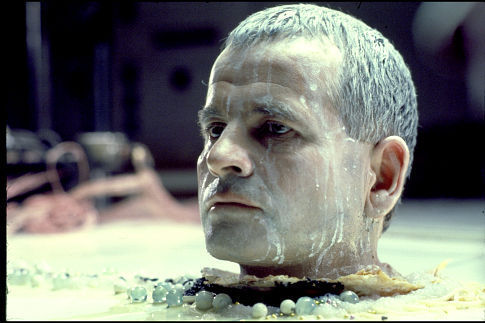

Ian Holm

Lance Henriksson
Scott also cleverly borrows from his own Blade Runner in the portrayal of David, who doesn’t possess Rutger Hauer’s maniacal desire to find his creator but does show more than a passing interest in the subject matter.
The script provides some explanation for why we started creating androids who are more than automatons:
Charlie Holloway: David, why are you wearing a suit, man?
David: I beg your pardon?
Charlie Holloway: You don’t breath, remember? So, why wear the suit?
David: I was designed like this, because you people are more comfortable interacting with your own kind. If I didn’t wear the suit, it would defeat the purpose.
Charlie Holloway: Making you guys pretty close, huh?
David: Not too close I hope.
Scott bites off a little more than he can chew by adding an unnecessary twist at the end, and thereby rushing some scenes that could have been better developed. It also has a few silly notes, like throwing in Rapace’s inability to get pregnant and having Rapace tell a crewmember he can’t bring a weapon because the mission is scientific . . . and he complies. Come on! Doesn’t he know that in space, no one can hear you scream?
Otherwise, it’s a very good picture, enhanced by the 3D.
The pushback on the gore porn of Saw, Hostel, etc . . . is in full swing. The Paranormal Activity flicks, The Woman in Black, Trick ‘r Treat, The Last Exorcism, and now, The Innkeepers all fall in a sub-genre that emphasizes pace, suspense and the little things that do not require splatter, chunks of flesh and no possible hope of escape.
The Innkeepers is about a haunted Connecticut inn on its last legs. Two slacker employees (there are 3 guests and the workers can’t manage to have clean towels for any of them), one of whom is working on a website trying to trumpet the inn as a haunted locale, do 12 hour shifts on the inn’s last weekend in operation. Bored, and stoked by a guest (Kelly McGillis) who is some sort of amateur medium in town for a convention, the duo pass the time filming and recording the inn in an attempt to engage its ghost. They succeed, and the patience director Ti West exhibits in getting to a truly scary payoff is impressive.
It’s not flawless. The principals are a bit stilted, though they warm to their roles; the humor is not always humorous; the character development is not super; and I wish we were given a little bit more on the history of the ghost. But the strength is the feel and that feel is well-represented in the trailer.
Also, one caution – remember Kelly McGillis from Witness?

This is McGillis from The Innkeepers

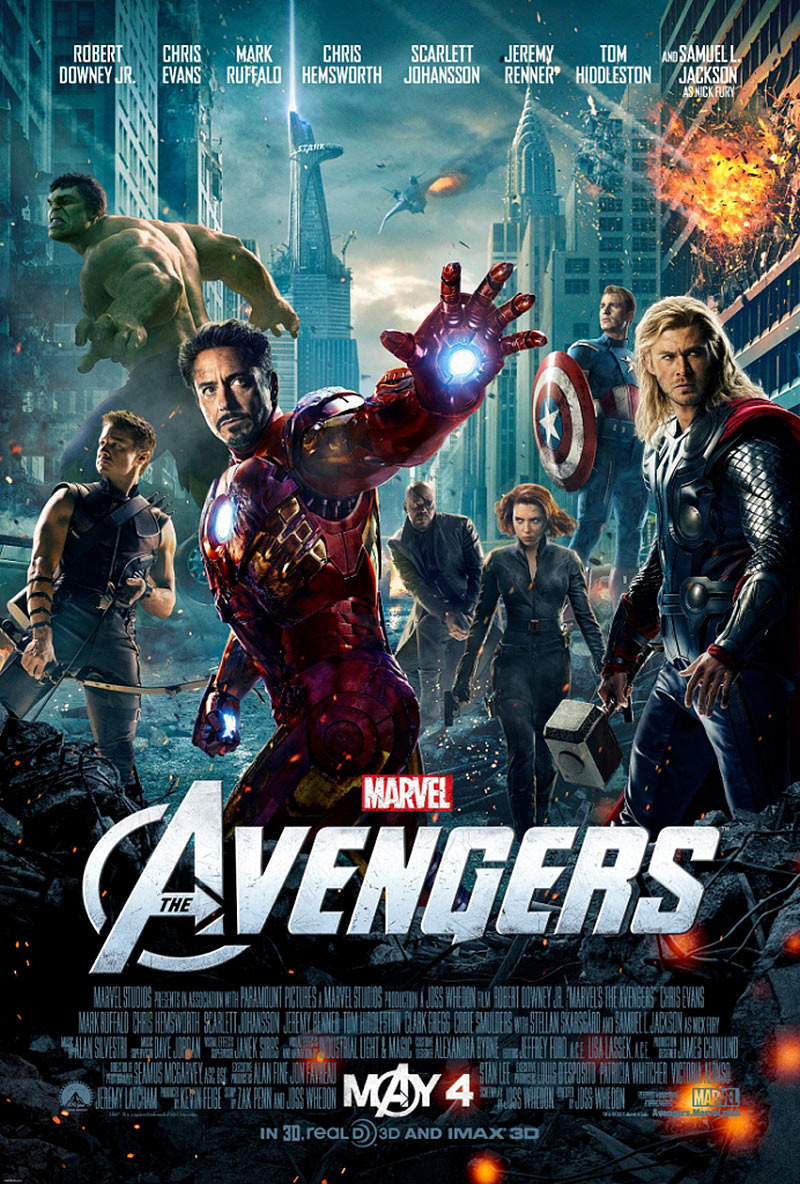
With the exception of the upcoming Dark Knight picture, The Avengers is of the same stripe as the films previewed before it (Spiderman, Battleship) – loud, visually thrilling, punctuated by the wisecracks of people in a maelstrom, and … loud. The Avengers includes a slew of Marvel characters, almost all of whom have had their own loud, visually thrilling films: Iron Man, Captain America, Thor and The Hulk join The Black Widow, Nick Fury and Hawkeye to fight Thor’s power-hungry brother Loki. Since they are a varied group of personalities, they bicker, trade philosophy (Fury would be the Dick Cheney of the group; Iron Man the Barack Obama), and crack wise (Robert Downey’s Iron Man/Tony Stark gets almost all the nifty lines).
Loki comes to rule and it takes the Avengers fighting his flying army of space creatures in NYC to demonstrate that Earth is not some defenseless denizen of sheep.
Really though, he is not nearly scary enough (he looks like the second banana in Wham!) and you never get the sense he’s that big a threat.
The picture is dizzying, occasionally funny, well-paced but really, really long and immediately forgettable.

I took my daughter and her friends to see this chiller. Daniel Radcliffe graduated from Hogwarts and has attained a position as a turn-of- the-century barrister in England. He’s recently widowed and is tasked with the unenviable assignment of winding up the estate of a recently deceased woman in the English countryside. The moment he gets in to town, he starts seeing creepy things and children start dying.
The plot is thin but serviceable, Radcliffe has some range (his recent stint hosting Saturday Night, Live was very good) and he’s helped by Ciaran Hinds, but most importantly, this movie scared the crap out of me. There is one creepy and/or jarring visual after another, a constant sense of dread, and many inventive ways to get your skin to crawl. The Woman in Black is half ghost story, half haunted house ride. Best of all, no gore porn torture, just good, clean spooky fun. More of a ride than a film. We had a blast.
 filmvetter