Big Daddy. Better than The Waterboy, but it is no Happy Gilmore.
Big Daddy – 1.5 stars
Leave a comment

Big Daddy. Better than The Waterboy, but it is no Happy Gilmore.
Hamlet. I know when I think of Hamlet, Ethan Hawke comes immediately to mind because if there is one character who needs added slacker sensibility, it is Hamlet.
Actually, Ethan Hawke captures Hamlet as he would be were Elsinore a Manhattan hotel, Denmark a corporation, and Sam Shepard the ghost of a corporate titan now deposed. All the performances are very good, with special note to Liv Schreiber’s riveting Laertes and Bill
Murray’s effortless update of Polonious. You might think the modern, New York City locale would make this Hamlet clunky, but it does not.
The End of the Affair. Ralph Fiennes plays the same brooding, angry, obsessed pain-in-the-ass pathetico he played in The English Patient, only
this time, he’s mooning over the icy Julianne Moore, not the icy Kristin Scott Thomas. Neil Jordan’s film is as grim as WWII era England, Moore nudity is regular but oddly uninspiring, and Stephen Rea steals the picture with his stoic yet growing turn as Moore’s cuckolded yet loving husband. Still, we are stuck with the disturbed Fiennes bemoaning the loss of his love over and
over and over again.

M. Night Shymalan is the Dr. Frankenstein of movies. He created the monster of “bet you didn’t see that coming” and since The Sixth Sense, he has had to keep upping the ante, each plot more preposterous than the last.
The Black Dahlia. Right at mid-point, you realize that Brian De Palma actually makes the Elizabeth Short murder, one of the most sensational in American history, humdrum. Worse, the entire film is spent with Josh Hartnett, who is attempting a medium cool but merely achieves dull. His weak performance doesn’t really matter, because you don’t know what the hell is going on anyway. The film is grotesque, confusing and embarrassing. Based on the first of author James Ellroy’s L.A. quartet, its only value is as a crappy comparator to the classic L.A. Confidential.
Blood Diamond. A gripping political thriller that does not over-preach to us about the poor, misused Third World (unlike the tendentious The Constant Gardener). It could have been 20 minutes shorter, but the last 45 minutes is white-knuckle. Leonardo DiCaprio and Djimon Hounsou give fantastic performances (this film and The Aviator showed DiCaprio moving beyond peach fuzz) and there is great chemistry between DiCaprio and the stunning Jennifer Connelly.
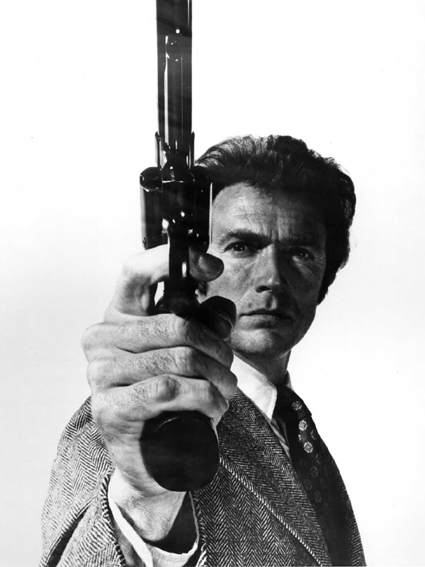
Harry Callahan (Clint Eastwood) is a no-nonsense detective in 1970s San Francisco, where the political correctness is thick, Miranda-warning era sensitized bureaucrats rule, and crooks are coddled (every thug in Dirty Harry has the sneering, arrogance of a punk who knows that the law is on his side). The baddest guy in a sea of bad guys is the film’s facsimile of the Zodiac Killer, a vicious beatnik with Woodstock hair, an army fatigue jacket and a peace symbol on his belt buckle. Callahan is called in to help with the case. He is immediately accosted by the D.A. for his excessive brutality.
District Attorney Rothko: You’re lucky I’m not indicting you for assault with intent to commit murder.
Callahan: What?
District Attorney Rothko: Where the hell does it say that you’ve got a right to kick down doors, torture suspects, deny medical attention and legal counsel? Where have you been? Does Escobedo ring a bell? Miranda? I mean, you must have heard of the Fourth Amendment. What I’m saying is that man had rights.
Harry Callahan: Well, I’m all broken up over that man’s rights!
In fighting with the mayor – who wants to give in to the killer’s demands – Callahan is blunt and dismissive.
Mayor: I don’t want any more trouble like you had last year in the Fillmore district. Understand? That’s my policy.
Harry: Yeah, well, when an adult male is chasing a female with intent to commit rape, I shoot the bastard. That’s my policy.
Mayor: Intent? How did you establish that?
Harry: Well a naked man is chasing a woman through an alley with a butcher’s knife and a hard-on, I figure he isn’t out collecting for the Red Cross.
Even in his ultimate scene, where he mocks one of three hold-up men, Callahan embodies the rugged conservative fantasy of turned-tables and frontier justice.
Harry: Ah Ah, I know what you’re thinking. Did he fire six shots or only five? Well, to tell you the truth, in all this excitement, I’ve kinda lost track myself. But being as this is a .44 Magnum, the most powerful handgun in the world, and would blow your head clean off, you’ve got to ask yourself one question: ‘Do I feel lucky?’ Well, do ya punk?
Punk. He’s a punk. Not a suspect. Not a person. Not a downtrodden, misunderstood product of an uncaring society.
Paul Newman was offered the film, but legend has it he was nervous about its politics, and suggested Eastwood for the part. Great suggestion. Eastwood has commented on Dirty Harry that “It’s not about a man who stands for violence, it’s about a man who can’t understand society tolerating violence.” Pauline Kael called the film “fascist.” This is, however, the same Pauline Kael who was stunned when McGovern lost in 1972, saying “I live in a rather special world. I only know one person who voted for Nixon.”
Politics aside, this is an excellent picture. Eastwood is mythic, the story moves, the San Francisco locale is used to great advantage, and the killer is truly frightening.

A mystical period piece about the stupidest looking animal ever – a big cat or wolf in a metal suit that ravages the French pre-Revolution countryside, eating only women and children. Lots of slo-mo, stop action, about 5 Jackie Chan-Matrix-like fight scenes, many exploding pumpkins, and a lot of frilly costumes. Zzzzzzzzzzzzzzzzzzzzzzzzz.
\Quentin Tarantino’s debut picture has weaknesses, and it is in some ways showing its age, but many of the things that are good about it remain very good. The dialogue remains vivid, fetishizing pop-culture via tough guy patter. The conversations are irresistible, trading in on the vulgar, racist, homophobic pitch-and-catch of the red-blooded American male killer. Tarantino’s explanation of “Like a Virgin” (“It’s all about this cooze who’s a regular fuck machine, I’m talking morning, day, night, afternoon, dick, dick, dick, dick, dick, dick, dick, dick, dick”); Steve Buscemi’s theory on tipping; the back-and-forth “he’s trying to fuck me in front of my Daddy” between Chris Penn and Michael Madsen – it all crackles.
The machismo is undercut, however, when they get their aliases:
MR. PINK
Why am I Mr. Pink?
JOE
Because you’re a faggot, all right?
(Mr Brown laughs, Mr Blonde smiles)
MR. PINK
Why can’t we pick our own colors?
JOE
No way, no way. Tried it once, it doesn’t work. You get four guys all fighting over who’s gonna be Mr. Black. But they don’t know each other, so nobody wants to back down. No way, I pick. You’re Mr. Pink. Be thankful you’re not Mr. Yellow.
MR. BROWN
Yeah, but Mr. Brown, that’s a little too close to Mr. Shit.
MR. PINK
Mr. Pink sounds like Mr. Pussy. How about if i’m Mr. Purple? That sounds good to me. I’ll be Mr. Purple.
JOE
You’re not Mr. Purple. Some guy on some other job is Mr. Purple. You’re Mr. Pink.
MR. WHITE
Who cares what your name is?
MR. PINK
Yeah, that’s easy for you to say. You’re Mr. White. You have a cool sounding name. All right look, if it’s no big deal to be Mr. Pink, you wanna trade?
JOE
Hey, nobody’s trading with anybody. This ain’t a goddamn fucking city council meeting, you know. Now listen up, Mr. Pink. There’s two ways you can go on this job– my way or the highway. Now what’s it going to be, Mr. Pink?
MR. PINK
Jesus christ. Fucking forget about it. It’s beneath me. I’m Mr. Pink. Let’s move on.
The dialogue is even given its own soundtrack; Steven Wright’s droning as the “Super Sounds of the 70s” dee jay is our comic relief.
Until Gerry Rafferty’s “Stuck in the Middle With You” accompanying a torture becomes one of the scarier songs ever.
Tarantino also does so much with very little. No big action sequences. No big money. Economical and still impressive.
Two things I didn’t like about the film. First,
You’re not to make a move till Joe Cabot shows up. I was sent in to get him. All right? Now you heard me. They said he’s on his way. Don’t pussy out on me now, Marvin. We’re just going to sit here and bleed till Joe Cabot sticks his fucking head through that door.
The idea that the cops are parked around the corner a block away waiting for mastermind Joe Cabot while two of their own are in the place as hostages (one actually dying, one being mutilated) is absurd.
Second, Tim Roth was bad. He was fighting his accent and he lost. I never bought him. Still don’t.

There is a natural order to the jungle. Animals routinely slaughtered by lions accept their fate in the circle of life and, in fact, trek miles to bow at the birth of one who will one day be their new chief slaughterer – Simba. But Simba has an uncle, Scar, who has been passed over by Simba’s birth. So Scar implicates the son in the death of the father (Mufasa), while making a pact with the rapacious, vicious hyenas. The father is killed. Simba must flee after he is designated for murder. Scar rules, ravishing the land. The land dies, not because of the slaughter – that’s the natural order of things – but because Scar is lazy and a glutton and he allows the hyenas to kill without economic management. The lions respect the royal line, and do their hunting, however unhappily, at Scar’s command.
And Simba? He leaves, finds a warthog and a meerkat, and lives the bohemian lifestyle. He becomes a vegetarian. He lives a life bereft of responsibility. He is away from weighty decisions. He is personally, individually, happy. Hakuna matata, is his “Turn on, tune in, drop out.”
But soon, his old love (to whom he was promised to be betrothed in an arranged fashion as a cub) finds him, and asks him to return. Simba refuses. He is angry. She has intruded upon his summer of love. “You don’t know anything about me or what I’ve been through” he snarls, as only a self-possessed individualist/narcissist can snarl.
Next, Rafiki, the religious leader of the tribe, finds Simba, and conjures up the ghost of Mufasa, who reminds Simba that he is more than some San Francisco hippie- he is royalty. “Remember who you are” the ghost intones. Simba returns to the pride, confronts Scar, and gives him a choice – be banished or die. Scar blames the hyenas, feigns cowardice and lunges at Simba. Simba dashes Scar over a cliff, to his death (Scar does not die, but injured, is set upon by the hyenas who overheard his attempt to foist responsibility for the coup and ensuing disaster on them).
Simba assumes the throne. His well-placed meerkat and warthog pal are exempted from slaughter as they now sit in his court. He is served by the same majordomo bird who served his father. The films ends with the birth of a new king, and the same animals traveling to give that king – their soon-to-be killer in the great circle of life – their fealty.
Oh, were Disney thus today!


