The other day, my son bemoaned people who couldn’t just enjoy the silly movies from their childhood, like Star Wars or Indiana Jones, because they had to find a reason to justify the continuation of their early filmic love into adulthood. So, they create a form of criticism that makes their adoration of juvenilia acceptable, even erudite, elevating simple, fun movies to high art or of great social import (which then naturally leads to a concomitant acceptability of their living at home in the basement amongst their toys well into their 30s).
To be fair, I added the parenthetical.
I thought about what he said when I was watching Barbie. Of course, it will be the subject of Gender Studies papers for the next 20 years, and has already spawned reviews of great seriousness (“a searing social critique”; “An earnest feminist manifesto inside a barbed social satire”; an “existential exegesis on what it means to be a woman, and a human”).
There are indeed very smart things in Greta Gerwig and Noah Baumbach’s script, including some clever, contemporary touches and social observations. Some land and some elicit a groan.
However, the movie works best as a series of jokes and physical humor encased in a startlingly resonant set design and an energetic commitment to unbridled fun.
That it lightly lampoons patriarchy, consumerism, wokeness, feminism, bro’ culture, capitalism, and much more is undeniable. But that is icing. The cake is the yuks, and Gerwig offers an endless parade of laugh-out-loud lines and sight gags and rousing musical dance numbers, almost all of which land and charm.
A few nits.
I am sick of Will Ferrell. He’s the same schtick, every single time, and he is lazy and boring.
Also, there’s an inspiring speech that screeches the flow to a halt. A rousing feminist speech. To dolls. It’s a bit like watching a character in Star Wars give a soliloquy about colonialism. To Wookies.
The picture is also a bit repetitive and long in its syrupy, maudlin end (though it lands on a great crack to close out).
But these are annoyances. The film opens wondrously, as we are introduced to Barbieland, where everything is perfect; what is not perfect is plainly identified as such (aka, “Weird Barbie” and “Pregnant Barbie”); girls rule; and the Kens serve and bicker amongst themselves, vying for the attention of their masters. But the perfect world of one Barbie (Margot Robbie) begins to crack (her arches fall, she thinks of death), the real world beckons, and she answers the call with a besotted Ken (Ryan Gosling) as a stowaway. There, she finds sadness, men in power, and her own obsolescence. When she is gone, an empowered Gosling returns to Barbieland, and the Kens rise, in hilarious fashion.
After checking its social responsibility box with indelible ink, the picture ramps up as the Barbies use their superior intellects and, interestingly, their feminine wiles, to overthrow the dum dum Kens during their short-lived reign.
This allows for Gosling’s musical numbers, which are worth the entire movie. There is no way around it. He steals this picture. It crackles in every frame in which he appears, and his resume’ as a strong comedic actor (The Nice Guys, Crazy Stupid Love) has expanded.
And “I’m Just Ken” is undeniably the best musical number EVER!
David Fincher could grippingly film a Frosted Flakes commercial.
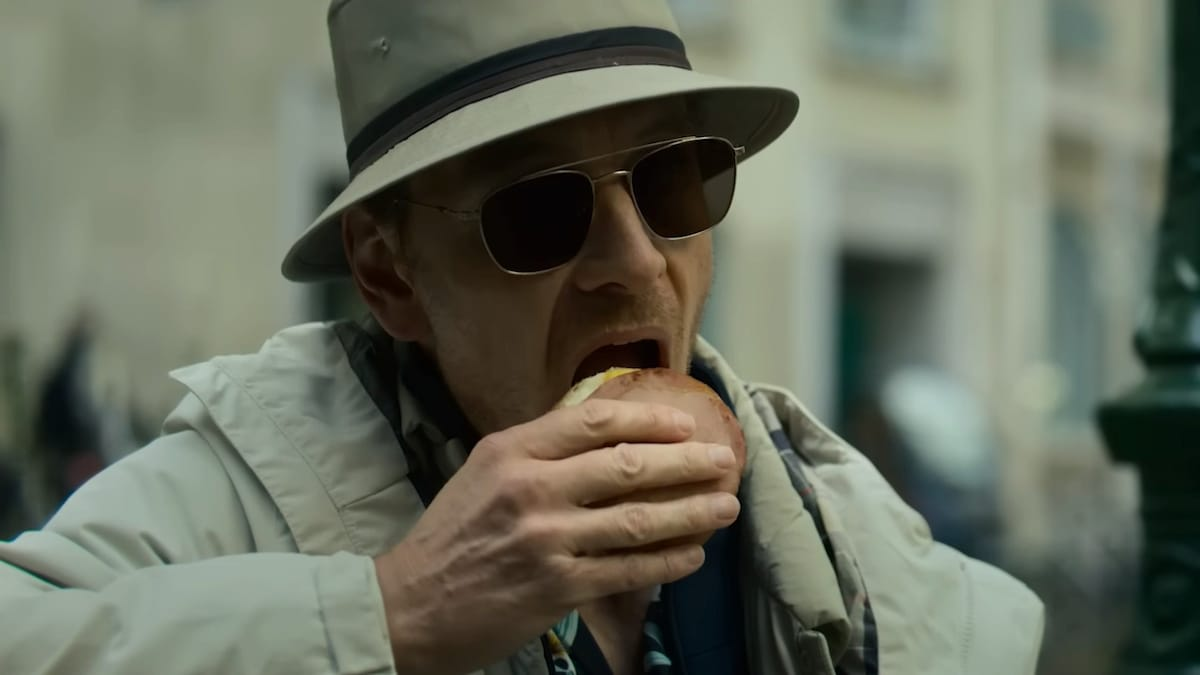
Fortunately, he has more to work with here, with Michael Fassbender as a lonely, meditative, assassin embarking on his own city-to-city retribution against his employers and their henchpeople.
We learn about the business, a grim primer without the dark humor of Grosse Pointe Blank, the panache of the John Wickfranchise, or the earnestness of The Accountant. The work is drudgery and rote, until it isn’t, and things go tits up. Even then, though, there is no glamour. Just the racking up of air miles that cannot be utilized, the eating of fast food on stakeouts of dumps, and boring trips to any number of storage units.
Fincher’s picture is very easy and assured, occasionally inventive, never stalling, and yet, the endeavor feels beneath his gifts. The comedy is often too dark to resonate. Though the ending is refreshingly, thought-provokingly anticlimactic.
I took my 93 year old mother to see this flick, thinking it was up her alley. As it stands, the picture is beautiful, the presentation slick, and the intrigue, such as it is, acceptable. But the acting is very weak. In the end, for an Agatha Christie, you know the “reveal” is in the offing and it may or may not be ingenious. It is the dramatization getting to the reveal that is most of the fun.
As Poirot, Kenneth Branagh is overly reliant of the gravitas of the character as played by others. As played (and directed) by him, he’s bored, even diffident. If Poirot doesn’t seem roused or energized, why should I be?
As an Agatha Christie mystery writer on the downslope, Tina Fey is her normal self – blasé’, genderless, and snarky. Liz Lemon and “Weekend Update” were her pinnacles.
As for the rest of the cast, they all seem to be straining for airtime, each more bombastic than the next when given the baton. Jamie Dornan and Kyle Allen take the cake in histrionics.
At its worst, the acting is community theatre-esque. At best, it is tolerable.
I asked Mom if she liked it after a week (we are unscientifically testing her memory). She said she had no real recollection of the picture, so the results are inconclusive.
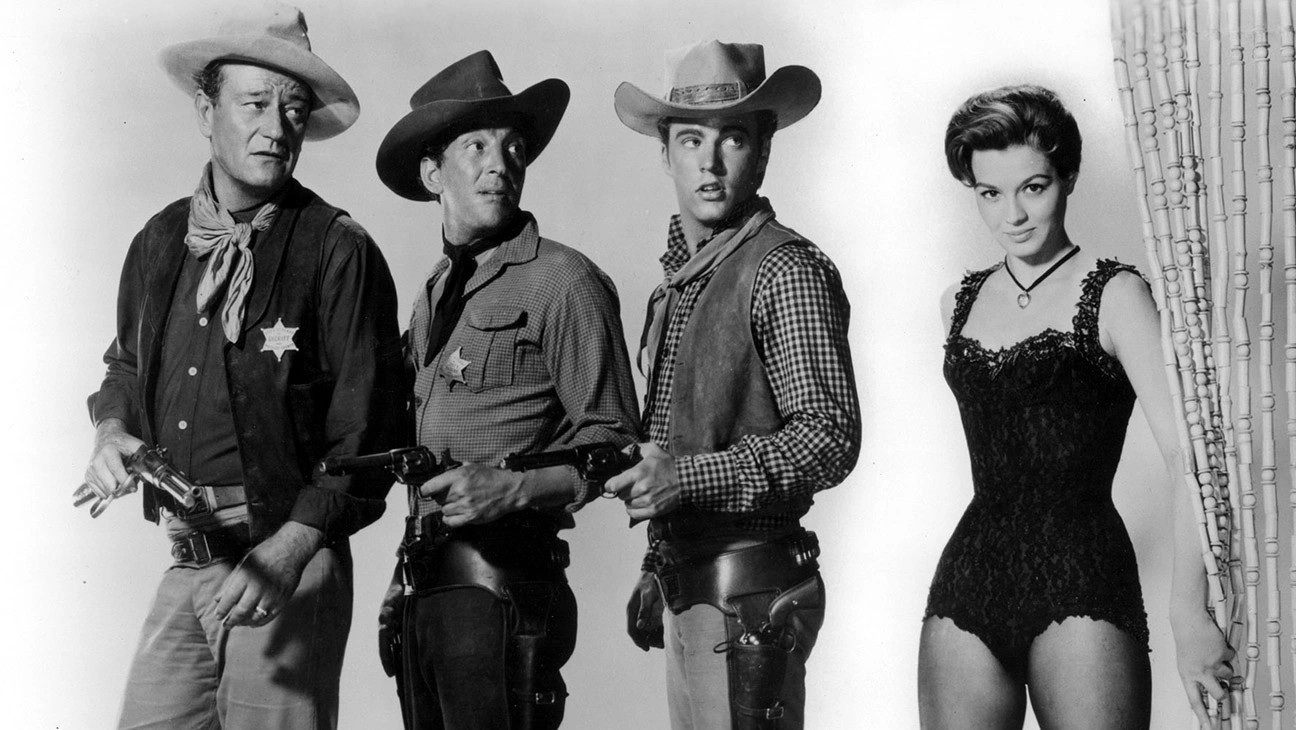
Howard Hawks’ western is competent, light, entertaining, and currently on MAX. The film also sports a few surprises, the most enjoyable of which is the performance of Dean Martin as the shaky alcoholic deputy trying to go cold turkey. It’s a hell of a dark and moving turn from a guy who you normally think is all easy-breezy, no heavy lifting.
Other notes.
1) If you have Dean Martin and Ricky Nelson in a movie, they’re going to sing, and while it’s a little bit clunky when they do, the tunes are still a lot of fun. It would’ve been better if they just had Nelson playing guitar and Martin and Nelson singing together in the live shoot, but I presume the sound obstacles were too great, so they used a studio track and lip-synched instead. The dissonance between the music and the normal soundtrack is dramatic, but I imagine audiences in 1959 didn’t give two hoots.
2) I laud Martin’s performance, but Nelson is pretty damn good too as a youthful medium cool gun hand. He’s not asked to do much, but what tasks are given, he fulfills well.
3) Wayne made the picture in part as a rebuttal to the more cynical High Noon. Per Wayne, “A whole city of people that have come across the plains and suffered all kinds of hardships are suddenly afraid to help out a sheriff because three men are coming into the town that are tough. I don’t think that ever happens in the United States.”
4) Other than The Quiet Man, this is the only film I can remember where John Wayne is a romantic lead. It half works. Wayne smartly plays flummoxed, and Angie Dickinson’s magnetic performance nearly carries the day (when she kisses Wayne the first time, and he is stunned, they kiss again, and she says to him, “it’s even better when two people do it”). Romance works a little better in The Quiet Man, because Wayne was not asked to woo Maureen O’Hara so much tame her, an endeavor that seemed a lot like breaking a colt.
5) If my recollection is correct, Kevin Spacey modeled his performance in L.A. Confidential on Martin’s here. You can see it.
6) Trigger warning. Back to Angie Dickinson – va va voom!
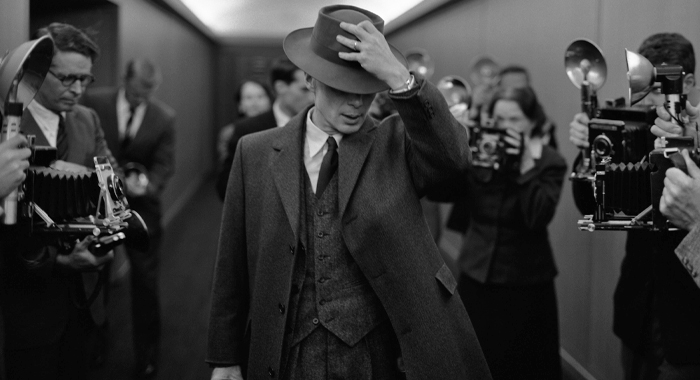
Obviously, I am overwhelmingly pleased to see a three hour film about a historical figure (and to think, Ridley Scott’s next picture is … Napoleon!) Just the other night, I was having drinks with younger colleagues (I am the last year of the baby boom, I estimate that these folks are late 20s), who were excited to see the movie. I took a pull from my pipe and asked them, “what do you know about Oppenheimer?“ One answered, “the atomic bomb.“ Then I thumbed my tweed jacket and said, “what else do you know about Oppenheimer?“ Neither knew anything further, which makes sense. Yet due to the cachet of Christopher Nolan and the buzz about the film, they couldn’t wait to go see it. One was teaming it up with Barbie for a Barbenheimer, which sounds both intriguing and daunting. But to each their own.
They should not be disappointed. Nolan’s first two acts are so fully realized and lovingly shot, they are nothing less than stunning. And his narrative-hopping from time period to time period is not just for show. Nolan captures the important vignettes that underscore what you will see later. His rendition of the first atomic test is gripping and fraught. I was on the edge of my seat knowing full well that for the denizens of Hiroshima and Nagasaki, it was not a good day.
Alas, the third act is a bit clunky. In the end, a bureaucratic and personal feud between Oppenheimer and Robert Downey, Jr. eclipses some of the larger themes of the picture. It just struck me as a little bit beneath what preceded it, as if Oppenheimer’s undoing stemmed from a mere misunderstanding or snit.
I read the book upon which the film was premised, American Prometheus, years ago (and had the honor of being taught a course entitled “Nuclear War Crises” by the book’s co-author, Martin Sherwin). The real Oppenheimer was a bit of a mess. His views on the efficacy, wisdom and impact of the bomb matured, but also wavered, and he could speak with confident enthusiasm and also wary trepidation. He could be thoughtful and also, cooly lethal (he once rejected a poisoning scheme with, “I think we should not attempt a plan unless we can poison food sufficient to kill a half a million men, since there is no doubt that the actual number affected will, because of non-uniform distribution, be much smaller than this”).
Cillian Murphy does a beautiful job of working it out in front of us with an internal, searching performance. We see him struggle, not by soliloquy, but by discussion and quiet deduction. Murphy is, rightfully, a lock for best actor (if the Oscars are still a thing next year).
Murphy is ably complemented by Emily Blunt (wife), Florence Pugh (lover), Matt Damon (the glue guy, still Hollywood’s best and least heralded actor, as General Groves), and a slew of others, all solid (Josh Hartnett? Yes, Josh Hartnett has grown up) and of whom you invariably remark, “Damn. Where have I seen him?”
As Oppenheimer’s bureaucratic nemesis, Downey Jr. crackles, though, as mentioned, he is seminal to the weakest aspect of the movie.
Talky, meticulous, massive, yet chock full of the little things, Nolan has made a grand, intelligent epic. I hope it spawns more to come.
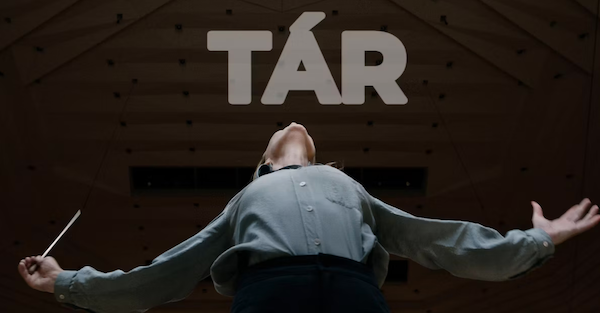
When Todd Field’s picture was lauded and criticized by conservatives and liberals alike, I knew it had to be different in a fruitful way. For some, the film is a clear and direct rebuke of privilege and abuse of power (“The film does tell its story in an elliptical, at times confounding way, but that stylistic choice shouldn’t be mistaken for moral indecision”). For others, the director is an apologist (“Field views identity politics as a zero-sum game that seeks to destroy true art”). It’s a shame it took me so long to see it, because no matter where you land, the film is a masterpiece, the best picture of last year.
Strangely, I was reminded of Apple TV’s foray into prestige television, The Morning Show, the first season of which delved deeply into the #MeToo movement and tackled it with nuance and intelligence – until the end, when the show naturally had to bow to more conventional norms, transforming a multi-layered, canny drama into a chest thumping lecture that naturally relegated women to perpetual victims in order to “celebrate“ them. But 90% of that show is grand entertainment that eschews the easy answers and bumper sticker mentality so explicit in drama “ripped from the headlines.”
Field is under no such pressure or expectation here, and the world he portrays could not be further from the vacuous wasteland of network television. His protagonist, Lydia Tár, is a celebrated orchestra conductor and scholar in the mold of Leonard Bernstein. She is kinetic, committed, urbane and refreshingly unburdened by the fetishization of status and injury so prevalent in modern times. When Tár guest lectures at Juilliard and a student explains to her that he is uncomfortable with the music of Bach given the composer’s status (“Nowadays, white, male, cis composers—just not my thing”), she responds, “Don’t be so eager to be offended. The narcissism of small differences leads to the most boring conformity.” The exchange is tense, edifying and epitomizes the generational clash of substance versus fad.
Soon enough, the incident is released to social media, edited to make Tár look as bad as possible, and she must confront the fallout.
Comparatively, it is the least of her concerns. Because in the midst of what should be a minor kerfuffle, a former student kills herself, one with whom Tár had a romantic relationship and then subsequently blackballed. Then, Tár withholds a coveted elevation from her primary assistant, another woman with whom it appears Tar (and maybe the deceased) had been intimate. Soon, all sorts of compromising texts and emails are released. Litigation naturally follows. Dangerously, Tár becomes infatuated with a third young woman, a brilliant young Russian cellist, who she favors with opportunity, losing her the support of her musicians and her wife, Sharon, who is also her concertmaster. Anybody mildly acquainted with the times can see what’s going to happen, except for Tár, who while intensely controlling, is also unsurprisingly unsophisticated (she asks the assistant to delete all of the emails to and from the deceased student, thinking, “well, that’s that!”) What follows is near horror film, as Tár is tormented by omens and assaults both real and possibly imagined.
Her fall is inevitable and painful. In the telling, we are confronted with a person of brilliance who is now being held to account for the excessive exercise of her own power. And while the viewer recognizes the inappropriate nature of what Tár has done, this is not a comeuppance or morality play. Nor is it an expose’ on the indiscriminate butchery of cancel culture.
Rather, the film is a case study of a destroyed career from forces within and without in the context of our modern, rather fevered times, and nobody gets off easy. The student at Juilliard is, of course, silly to be under the compulsion of such a limited worldview, but that is what young people do. Field smartly makes him attractive, a sort of wounded fawn (he clearly has some kind of physical tic as he repeatedly taps his leg in nervousness). Is Tár abusing a weakling? Or is she exactly the kind of person you want your child to learn from? Yes, she pushed back, but in the doing so, there is more caring – for the art and for the student – than derision or triumph. She is trying to get through to him, lest he imperil his own education and love of music in service of a dunce’s worldview. It is not mere coincidence that when he is rebutted by Tár, he casts a misogynistic slur. Old school in the young belly.
Similarly, the student who commits suicide was mentally shaky, as reflected in her increasingly hysterical email and text missives, while the current assistant is also star-struck and needy, always spookily, jealously hovering. Certainly, with intent or not, Tár takes advantage. Not that it would be hard. Dazzled, would-be acolytes would naturally be drawn to greatness. Hell, old Baby Boomers like Filmvetter are equally susceptible.
But in current discourse, the power imbalance is such that Tár has impermissibly utilized her privilege in a manner that is blah blah blah blah blah, blah blah. We’ve all undergone the training and endured the mantras. Like Miranda warnings, they need not be recited here.
Field is clearly interested in more. For example, are individuals who are soft naturally drawn to Tar for less emotional reasons? In the film, these individuals have absolutely no problem in the exchange as long as they are receiving favor. When it is withdrawn, they crumple. And strike. And let there be no doubt, Field certifies the fact of the bargains. In a break-up scene with Sharon (who is also portrayed as more fragile than Tár: when we meet her, she thinks she’s having a heart attack), the latter states that she always explicitly understood the quid pro quo, and only takes offense when Tár violates the negotiated terms of their relationship regarding other women.
Or, does brilliance excuse excess? I mean, fame often does, and Tár is famous, if only in the rarified circles of the classical music community. But she is also demonstrably and uniquely talented, what one might call an international treasure. The powerful and gifted don’t get a pass, for sure, but the loss of her gift is nothing to be sneezed at. And will Tár’s contributions be tarnished in history, like those of Bach, because of her personal failings? Whither the output of so many artists who turned out to lechers, perverts and worse? Must one separate the work from the creator? Isn’t the alternative an obliterative Manichean mindset that fuels the dip-shittery of fundamentalists, right and left? Or must we do everything in our power to exorcise Chinatown from our artistic memory because of the criminality of its creator so as to warn other miscreants of the consequences? And oh, how times have changed!
It’s not just the driven control of her career and others that damns Tár. Field also shows her desire for intimacy, her insistence that the beauty of wanting and being wanted can be replicated and perpetual, and the fear that soon it may not be so, as seminal to her fall. When Tár, who clearly lusts after the new ingenue both physically and artistically, is left in the hotel hallway to dine alone as the cellist goes to meet a young man, your heart almost breaks.
Blanchett is a wonder, confidently grounded yet hunted and haunted, not only by encroaching mores, but her desire for unfettered autonomy. Field portrays her as beset at all sides, and Blanchett gives the performance of a generation (in three different languages, I might add).
A meticulous, thought-provoking modern tragedy, which Paul Thomas Anderson summed up beautifully: “Every detail matters in this film. Nothing is not deliberate or full of intention. It’s directed with such perfectly controlled mayhem and glee by Todd, it’s really hard not to drool as another director. He made a film which for some years was considered a very dirty word, he made an art film. But it’s art that’s not fussy or pretentious. Just razor-sharp, pitch black, and hilarious. A very focused mirror held up to some of the worst of our human behaviors. It’s also a blast.”
In a year when Andrew Dominik thudded with a Hollywood fable, Blonde, Damian Chazelle, who was on a three picture heater for the ages (Whiplash, La La Land, First Man – yes, people, that’s three 5 star pictures), also crashed and burned, bigly and badly. But where you can see that Dominik’s failure was easier to hide in the making, Chazelle’s epic expanse of shit seems so obviously terrible in its awful construction that you hold everyone involved responsible, for any of them could and should have struck Chazelle hard across his face and said, “What the fuck are you thinking!”
The film, set in Hollywood in the silent to sound era, mistakes bloat as grandeur, Looney Tunes-level excess as glory, and crassness as knowing cynicism. Chazelle’s monstrosity has nothing to say or offer though what the picture does provide is a lot, and loudly. Then, unforgivably, it closes with paeans to the magic of the movies, gaudy testaments as they live in the hearts and hearths of the little people. Chazelle has the audacity to attempt to transform two sybaritic simps (up and coming ingenue from the wrong side of the tracks Margot Robbie and drunken leading wreck Brad Pitt, who fared poorly from the silent to the talkie) into the nostalgic wreckage of TinselTown. And if that wasn’t enough, a racial parable is tacked on in the story of a jazz trumpeter who crosses over to the screen (Jovan Adepo). He is given just enough of a story to feel both insufficient and patronizing.
The movie is not a takedown of old Hollywood or an homage or even a madcap celebration of the hedonistic heyday. It’s just a boring, overlong freight train that supplants story and motivation for one spectacle after another, mainly in distractingly dizzying and ostentatious tracking shots. Then, after treating the characters as little more than CGI, they are destroyed amidst an ill-considered lecture about the perils of fame, the fakeness of it all, and the fact that Hollywood, as a Hedda Hopper type (Jean Smart) relays to Pitt, “is bigger than you.” But, she promises, you will … live on … forevah, on celluloid, “with angels and ghosts.”
Retch.
The performances are necessarily cartoons. Robbie, in particular, is obscenely over-the-top and nearly abused. As I said, you don’t care about her, you don’t care about anyone. Unless you care about Wile E. Coyote.
So bad you feel a little sick at the end, following a grotesque foray into the truly seamy underbelly of the town (think Freaks-meets-Carnival of Souls).
This was all done better by the Coens inBarton Fink and a heckuva lot better in Hail, Caesar!
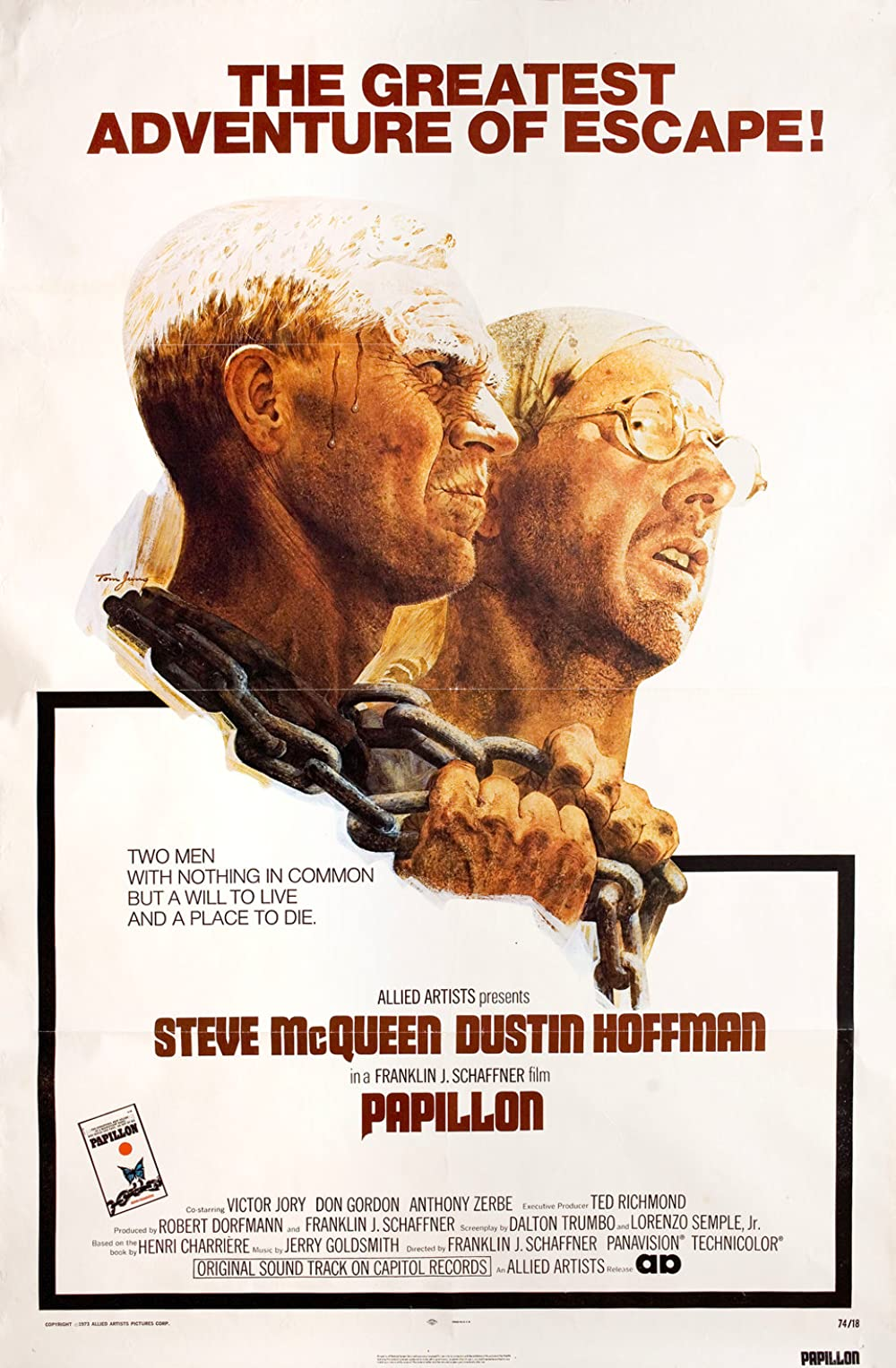
Franklin Schaffner’s (Patton) big-budget adventure/escape flick is competent, professional, well-acted (even if Steve McQueen and Dustin Hoffman have no interest in playing French people) and occasionally imaginative, particularly McQueen’s dream sequences as he fights solitary confinement and near-starvation. McQueen is the title character, sent to French Guiana for killing a pimp, where he meets the bespectacled Hoffman, a forger whose only protection is the ability to bribe officials. Their relationship deepens as McQueen, the Cooler King of The Great Escape, naturally attempts escape again and again here.
You may like the flick or not, but it is noteworthy for one scene, below. That crocodile has its snout wired shut and sure, it is drugged to the gills, but those are two massively bankable stars messing with a real crocodile. Nuts!
Perfectly pleasant, adept, and without a moment of originality, a very nice 2 hours delving into Michael Jordan and his first sneaker contract. You will likely enjoy the movie, and then you’ll never think about it again.
Of note is the easy charm of Ben Affleck as Nike founder Phil Knight, the dogged everyman turn by Matt Damon playing Nike basketball scout Sonny Vaccaro, the wry Jason Bateman (Nike Marketing manager Rob Strasser), and the steely resolve of Viola Davis playing Michael Jordan’s mother. All give superb, professional, wholly unchallenging turns that complement both each other and Alex Converey’s tight, predictable script. Marlon Wayans playing Jordan coach and confidante George Raveling also contributes in a poignant scene where he advises Vaccaro on how to approach the budding star.
On the minus side, this is a movie about signing a basketball player to a shoe deal, and the film doesn’t really find anything particularly insightful about this mundane negotiation, other than Damon’s dawning that Jordan will be a God amongst men. So godly is His Airness that while he is present, inexplicably, we only see the back of his head. Jordan never speaks, which both reinforces the picture’s theme that he is near-deity and serves as a tremendous cop-out and missed opportunity.
I mean, don’t we all want to know what God thinks when negotiating a shoe deal?
Mind you, the script is larded with b.s. Nike’s underdog status in the competition to sign Jordan is poppycock, as is the fact that his agent David Falk (a hilariously entertaining Chris Messina) was hostile to the deal. The dollar amount the young upstart company was allotted to go after Jordan is also understated by half. And Vaccaro never made the decision to breach negotiating etiquette by going over Falk’s head to visit Jordan’s parents in North Carolina, a fiction seminal to the movie.
The mushy camaraderie of this band of Nike visionaries may also have been a bit much. Worse, the truth may have made for a more interesting picture. Per Slate, “Vaccaro, as might be expected, disputes all these other versions of events robustly, saying “Phil Knight’s lying, Michael’s lying more than Phil, and Raveling is insane. All three of them need to destroy me to live happily ever after. Everyone’s trying to rewrite history. It goes beyond Jordan. I am the savior of Nike.’ It seems that Vaccaro, far from being the easygoing, collegial guy the film depicts, had a tendency to burn bridges. He fell out with Raveling in 1991 and was fired by Nike without explanation that same year.’” Now, that’s a guy I want to see a movie about, not the milk-and-cookies, faux cynical but really schmaltzo character Damon cooks up.
Okay. It’s not a documentary – enough of my curmudgeonly nitpicking. There is certainly greater appeal here for others. When I watched Winning Time on HBO – the laughably ridiculous rendition of the Lakers ascent in the late 70s/early 80s at the advent of Magic Johnson – it was hard to stifle a laugh throughout, and my wife and daughter joined in. But they also liked the series more than me. It was set in a milieu and about a subject they knew nothing about and they were more than happy to enjoy it without worrying about accuracy or any hackneyed presentations. Here too, though she found if “Hallmarky,” my daughter dug Air and noted that she didn’t really know much about any of it before seeing the movie.
Also, if you pine for all things 80s, from Cyndi Lauper to Tecmo Bowl to skateboards, run, don’t moonwalk, to Amazon Prime, because this thing is loaded with “Let’s Get Physical” Reagan-era montages.
Treacle and cornpone to its very core, an exercise in nostalgic tedium. Reese Witherspoon loved the book, a story of murder and mystery and coming of age in the swamps of a North Carolina small town. So the movie got made, in exactly the vein and manner of this vacuous and generic interview with the producer.
Daisy Edgar-Jones (Normal People, Under the Banner of Heaven) is Kaya, one of a kabillion kids living in the marsh with her abusive father and helpless mother. Soon, the mother ups and leaves (Kaya yells “Mommy, Mommy” but as is the style in this type of Southern gothic turdpile, Mom sleepwalks down the misty driveway, never looking back). Kaya’s siblings soon follow (one of whom basically tells 9 year old Kaya “stay low” to survive just before he abandons her). Then her father splits, and Kaya is consigned to a life alone as the spooky swamp girl. Mind you, for the rest of her life (and when we leave her, she is in her mid-twenties), not one of her siblings circles back to see if, maybe, their little sister is ok. Her serviceman brother does a perfunctory drop-in later, when she is on trial for murder, meaning he was an adult for 12 or so years and couldn’t be bothered.
The film’s version of 1960s rural poverty is to the real McCoy what the Disney ride is to actual pirates in the Caribbean. You soon suspect the swamp girl is derided by the locals not for her foreign and mysterious ways, or any class condescension, but rather, for her stunning cheekbones, luminous skin, and pearly white teeth.
The entire feel is inauthentic, as if brought to you by Loew’s or Home Depot. The swamp feels more like a fern bar, the town like Smallville, the characters every single archetype you’ve seen before.
We even get Kaya’s ponderous voiceover telling us things we can plainly see, half Marlin Perkins, half Judy Blume.
Kaya grows up and is caught in a tepid love triangle between two disinteresting homogenous actors with the mien of reality tv star brothers who macrame.
Could this be a double murder? Oh to dream!
Sadly, no. Kaya goes on trial for the murder of only Siegfried, not Roy, and perhaps the most boring legal drama in filmic history ensues. The case is so weak, you expect the actor playing the prosecutor to turn to the camera and shrug in apology. Kaya’s defense attorney (David Strathairn) shreds all witnesses with easy politeness, stopping just short of patting them on the head at the conclusion of his cross examination.
With the verdict a foregone conclusion, the reveal (she did/did not do it!) is anticlimactic in the extreme, made worse by the filmmakers’ decision to withhold “how” she did or did not do it.
It’s all clearly too much for director Olivia Newman, who had some TV episodes on her resume’, to handle. She can’t settle in on any one aspect of the story (the disconnect between town and swamp, the thriller, the abandonment and solitude, the love stories) with any depth so we get a steamed, soggy pu pu platter of platitudinous porridge. The fact that the dull screenplay was written by Beasts of the Southern Wild co-writer Lucy Alibar is both confounding and depressing.
In the end, Kaya becomes a big star. Music swells. Crawdads sing. Cursing of Reese Witherspoon’s reading habits follows.






 filmvetter