Archive

Rating

image

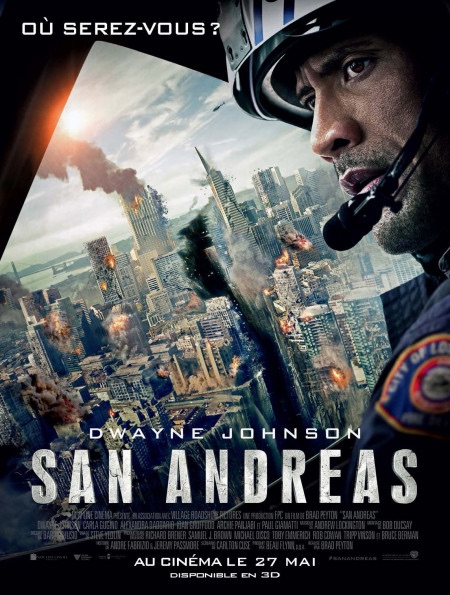
I have an affinity for “the world is ending” movies. None of them are very good and they follow the same model, be it Earthquake, The Day After Tomorrow, Independence Day, Armageddon, 2012, Godzilla and now, San Andreas.  Disaster strikes, the warnings of smart, nebbishes notwithstanding. Heroes arise, but family comes first, so Charlton Heston, Dennis Quaid, Randy Quaid, Bruce Willis, John Cusack, Aaron Taylor, and The Rock brave the catastrophe to find and/or save their loved ones. It is in these ordeals that frayed relationships are cemented, so much so that often, new and old spouses have to be dispatched. The children are always saved and mankind perseveres. But their surroundings are ravaged. And as they witness the destruction, they say “oh my God” (twice in San Andreas).  Just like Leslie Neilsen in The Poseidon Adventure. Well, not exactly. No one says “oh my God” like Neilsen playing it straight.

It’s the ravaging I love most. The cyclones of The Day After Tomorrow thrillingly rip Los Angeles apart, the same city where those moony hippies with their “we love you, aliens” signs get satisfyingly incinerated and Genevieve Bujold’s house on stilts slides into the canyon below. Godzilla quickly stomped Honolulu and Vegas and nearly took down the Golden Gate Bridge, which – in one of the few cool moments – does not survive San Andreas. Armageddon disappoints for any number of reasons, but foremost is the fact that Willis, Affleck and company save the day. That’s no fun and its best moment is when the pre-meteors obliterate Paris.

Same story, same devastation here, but somehow, San Andreas is worse than the others. It’s as if The Rock decided to use this film as his first true test playing sorrow, and boy is that uncomfortable. So uncomfortable that Carla Gugino, playing his wife, appears to be averting her eyes. While The Rock, recalling the pain of losing their daughter white water rafting, tries to squirt a few out, Gugino plays it rather lightly, as if to say, “hey, The Rock, this is just filler until the next shot of a building collapsing. Don’t be so glum.”

And here we are in San Francisco, but for the most part, the stuff we know is left alone. Instead, most of what gets shredded are office buildings, one of which is not even a real building. Give me Coit Tower! Give me some careening cable cars! Give me Alcatraz or at least the Transamerica Pyramid! Nope. Just nondescript skyscrapers falling listlessly into each other.

Finally, the movie has no sense of humor. None. Not an aside, or an inside joke, or even the thrill of watching something cool, like Paris obliterated. It’s dead straight, serious as a heart attack, except when The Rock and Gugino sky dive into second base at AT&T Field and he says, “it’s been a long time since I got to second base with you.” And then you appreciate the film’s dull seriousness.

A final note. The daughter who The Rock and Gugino cover hill and dale to save (Alexandra Daddario, who played Woody Harrelson’s impossibly beautiful mistress in the first season of True Detective) is so buxom and model-like that it feels exploitative. Yes, parents have daughters that grow up to be busty bombshells, but the first time we meet her, she’s splayed out on a chaisse lounge by the pool, Kardashian-like, and you kind of want her to die. Of course, she doesn’t.
When my grandmother started to lose it, she was ingenious in masking it. If you asked her who was president, she’d say, “that fool in the White House.” If you asked her about something topical, she’d reply, “Who has time for such things?” It was her game face as her memory began to fail her.

At the beginning of I’ll Be Me, this is where we find Glen Campbell, recently diagnosed with Alzheimer’s. He is vague, folksy and stubborn in attempting to defend himself from a world ever more foreign to him. He leans heavily on his wife, who acts as his lifeline to his past, but we see his true state when he watches old home movies, and asks “who is that?” It’s achingly painful to hear his wife’s reply, “That’s you, silly.”

Campbell’s diagnosis came on the eve of his final tour, and in an effort to increase awareness about the disease, he went public and allowed a documentary crew along for the ride. The result is a bittersweet retrospective of his work (I had no idea just how big a star he was) and an examination of what it is to suffer this disease through the eyes of his family (three kids are in his touring band). I feared that this might become exploitative and was heartened to see that not only was it not, but that Campbell’s wife acknowledged the concern, explaining that they weighed the costs and benefits and decided to go forth. I also feared that it would be altered to create a “triumph of the spirit” vibe, but director James Keach (an actor in his own right and Stacy’s brother) presents Campbell and the disease in sober fashion; when Campbell’s issues become acute, it is almost too much to bear, and when they evince on stage (as is shown on the clip above), it is not sugar-coated. But the audience is with him, so are we and the fact that his music is so ingrained in him it triumphs over the disease, for a time, is a wonder to watch.

Currently on Netflix Streaming.

image

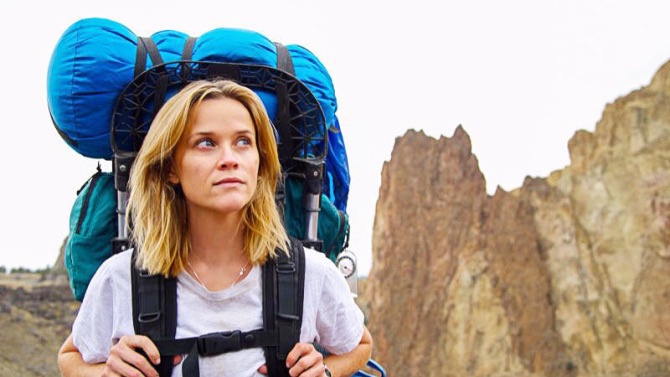
This story of one woman’s journey – a 1000 mile hike along the Pacific Crest Trail – is unfortunately marred by unconvincing dialogue, inconsistent pacing, and an actress not quite up to the task. Reese Witherspoon’s best actress Oscar came after her portrayal of June Carter Cash, a performance that took advantage of her quick wit, common sense instincts, and sunny disposition. She was also able to sing, no mean feat.  As the distraught daughter of a mother who died young (Laura Dern), Witherspoon cannot sing her way to our hearts, and de-glamorization and nudity do not sell the fact that she is supposed to have lapsed into a downward spiral of promiscuity and heroin addiction after Dern’s death. There is still too much of Ellle Woods and Tracy Flick in Reese Witherspoon. She doesn’t even curse authentically, much less play a waitress who has sex with two customers in the alley behind her restaurant just because it feels good. The role required an actress with more gut and greater reserves. Meg Ryan, another plucky can-do lead, tried to toughen up later in her career in In the Cut with similar results.

Even with another actress, this film still has real problems. Everyone becomes depressed upon the death of a loved one, but there is no basis to suggest why Witherspoon’s character became so self-destructive. Rather than elicit our sympathy, Witherspoon at times threatens to evoke our scorn. Her choices are presented to us in flashback, in the bedrooms of strange men, with her long suffering friend, in the heroin dens of Minneapolis, or in conversations with her mother, scenes that are supposed to give us insight into how she ended up here. They don’t. Rather, they are too disjointed to tell us much of anything, and we are left wondering “how the hell did she end up there?”

Finally, the film is too new-agey and pat for its own good. Witherspoon reminisces along the trail while inscribing the words of poets at its various check-in stations. She is followed by a mystical fox. She meets people who say wildly unrealistic things (her discussion with a little boy in particular) that are supposed to reflect her singularity and the momentous nature of her trek (she is even dubbed queen of the trail by other hikers). She finishes and tells us in an ego-centrism that lacks any self awareness that it all worked out in the end. Heck, she informs us in voiceover – she even has two lovely kids.

To the good, it is beautifully shot and the beginning of the film, when Witherspoon is starting on the trail wholly unprepared and over-fortified, had promise. I thought she might even get an appendage stuck in between some rocks.

You won’t fall asleep in this picture, and it has a few nice moments (plus very good performances by Rory Cochrane and W. Earl Brown, as henchmen), but at root, this is a hackneyed crime saga that celebrates the dreary over all else.

Sure, it offers a bonanza of Boston accents. There’s the “Downtaaaaaaaaahhhhhhhn Abbey” (Benedict Cumberbatch, as Whitey Bulger’s more respectable brother), the “all-in” (Australian Joel Edgerton, as the FBI agent who utilizes Bulger as a confidential informant), and even the “Robin Hood Costner” (Corey Stoll, as the U.S. Attorney who brings the Bulger crew down; sometimes he does a Boston and sometimes he says, “Eh, fuggedaboutit”), all of which, mind you, are better than the “Kennedy Costner” from 13 Days, which, while we’re talking, was execrable, yet better than the Cajun Costner in JFK.

As fun as it is watching everyone extend there “aaahhhhrrrrrrrrrrrrrrrrrrrs”, they ahhhhhhhrrrrrrrrrrrrrren’t saying anything worth hearing. We are introduced to Whitey Bulger (played by a monochromatic, cloudy-eyed Johnny Depp) on his way up, and that trip is blindingly dull. He is kind to the old women of the neighborhood, he loves his Mommy, he tells his son “if no one sawwwwr it, it didn’t happen” and if you cross him, he comes at you in a gray, humorless, inexorable way.  When he does joke, it’s in the Joe Pesci manner of Goodfellas, by which I mean this movie actually has him bully a guy after the guy says something innocuous, only to say, “I had you going there, didn’t I.” It’s hard to say if Bulger was even that good a criminal. They keep telling us he’s mythic and runs all the dirty deeds in Beantown, but as far as I can tell, he made enough dough to live in a shitty house and occasionally go to Florida to watch Jai alai.

Bulger’s way up was paved by the FBI agent, played by Edgerton, so perhaps he’s the story? He turns out to be not much of one. He wants fancy things and he wants them badly, and he’s loyal to Bulger from his Southie days, so we suffer countless scenes of him defending the protection of Bulger as a source of information at FBI headquarters. Kevin Bacon, who plays Edgerton’s boss, pops in repeatedly to say the same things, awkwardly accompanied by Adam Scott sporting a porn ‘stache (Scott’s presence is jarring; you almost expect the rest of the Anchorman gang to follow behind him).  As Edgerton grows more desperate, Edgerton’s Boston mugging gets worse.

With accent wars and a story bordering on the torpid, at least we get Boston, no? Not really, Director Scott Cooper (Out of the Furnace) has a fondness for bad 1970s kitchens and office buildings. We get it. Even interior design was ugly in the 70s.

Pointless.

Director-writer John Maclean has crafted a hypnotic fable, an ingenious tweak on the western that bundles the innocence of Wes Anderson, the sly cynicism of the Coen Brothers, and the quiet, stunning visuals of Terence Malick. Maclean has us follow a Scottish naif (Kodi Smit-McPhee, presenting more Australian than Scottish, but no matter) as he travels through the Colorado territory, clueless and not long for the world until he is taken under the wing of an experienced gunman (Michael Fassbender). Smit-McPhee is on a quest to find his true love and Fassbender is in it for the cash, but as they wend their way through an expanse that is vast, surreal and sporadically lethal, they develop a bond that seals their fates. The cinematography is stunning, and Maclean’s confidence and patience are all the more impressive given this is his first feature. There are times you feel the scene has near been painted, until Maclean shatters it with violence. I was surprised to see many critics hail the picture as a revisionist western or an action film. It dabbles a little in both, but the heart of the picture is in the dreamy world of child’s myth and unrequited love. This is a beautiful, patient picture, to be watched on a large screen with no interruption. Available on Amazon Prime streaming.

image

I loathe artistic political correctness in all its forms, be it the soul-sucking idiocy of demanding cultural authenticity in casting, the blanket condemnations of some “ism” by the cultural debt counters, or the wails of some grievance group as one of their own is skewered for comedic purposes (Robert Downey Jr.’s “retard” riff in Tropic Thunder comes to mind).  The effect is the same – to straightjacket creative endeavor so it presents like a PSA. The only good that comes of the p.c. influence are–

* the groveling apology (Cameron Crowe bootlicking because he cast Emma Stone as a quarter-Asian, quarter Hawaiian: “I have heard your words and your disappointment, and I offer you a heart-felt apology to all who felt this was an odd or misguided casting choice”);

* the unctuous backpedaling (Matt Damon, after having been caught on camera rejecting affirmative action and using the word “merit”: “My comments were part of a much broader conversation about diversity in Hollywood and the fundamental nature of ‘Project Greenlight’ which did not make the show. I am sorry that they offended some people, but, at the very least, I am happy that they started a conversation about diversity in Hollywood. That is an ongoing conversation that we all should be having”), and

* inane public proclamations (Viola Davis, who, when receiving an award for a TV drama, without a hint of irony or self-awareness equated her struggle to that of Harriet Tubman).

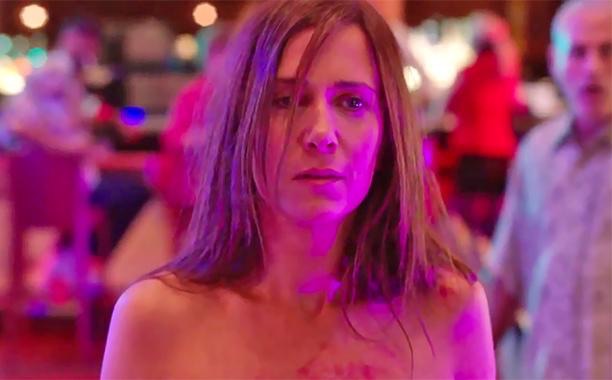
That said, Welcome to Me is an offensive film, and the heart of its offense is in how it portrays mental illness.   Kristen Wiig plays a sad shut-in, obsessed with Oprah, who wins the California lottery. She suffers from borderline personality and is off her medication, yet that doesn’t stop a local production company run by Wes Bentley and James Marsden from taking her millions so she can develop her own show. That show is a stage for Wiig to exhibit all the debilitating aspects of her un-medicated disease in a manner that at best is quirky and at worst is truly disturbing.

If done well, I don’t have a huge problem with making a dark comedy about a mentally disturbed person being taken advantage of.  I’ve gone down weirder, filmic roads.

So, to be clear, my objection is not to the premise nor do I advocate for the babying of any protected class in art.

But when you take this on, you can’t have your cake (using the disability as comedic tool) and then ask the audience to regurgitate it in shame after the eating.

Essentially, that’s what writer Elliot Lawrence does here. It’s not that the picture is poorly acted or directed or that there aren’t even a few funny scenes. Rather, the film is an exploitative movie about a sick person being exploited, and it wants to use mental illness for yucks while pretending to be brave in showing the true face of that illness.

You need a really deft hand for that kind of trick, and Lawrence and sophomore feature director Shira Piven do not have it.

Worse, the movie condescends with a throw-away lame anti-television theme, and in the end, Wiig is transformed into a “winner” with the help of a mere few pills.

image

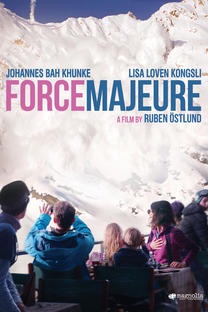
This is a disquieting look into how a single failure, even one that is in no way fatal, can fray the bond of an entire family. Tomas, Ebba and their two young children are on a ski vacation. While having lunch at the resort’s outdoor patio restaurant, at the base of the slopes, a controlled avalanche gets a little out of control and for a moment, threatens to engulf them.

How Tomas and Ebba react, and the aftermath, reveals a great deal about fear, commitment, gender expectations, the frailty of masculinity, the dangers of self denial and the ability of people ostensibly in love to casually, cruelly gut each other.  I know that seems a mouthful, but it’s all there in this literate, intelligent picture. See it with spouse, boyfriend/girlfriend, and/or friends, and you’ll be chatting deep into the night.

The film was rightly bandied as a potential Best Foreign Film nominee, but it did not make the cut,  perhaps because it never takes a strong stand. It is as gray as gray gets.

Remade, horribly, as a Julia Louis Dreyfus/Will Ferrell picture.

The film has aspirations to Wes Anderson, but you’ll learn quickly, having Bill Murray in your cast isn’t enough. Murray plays an old Brooklyn codger, a man who drinks, smokes, and consorts with a pregnant Russian stripper/prostitute (Naomi Watts, sporting an accent so thick and implausible it would make Gary Oldman recoil and say, “no, no . . . too much”).  He also gambles at the track, is in deep with a bookie, and spits in the eye of anyone who might show him kindness. Yet, he’s cool because he listens to a Walkman that plays kitschy 70s pop or Dylan. So rest assured, this guy has a heart of gold. Naturally, when he gets new neighbors (newly divorced and fed up nurse Melissa McCarthy and her impossibly wise yet innocent son Jaeden Lieberher), he opens up a crack, takes the kid under his wing, and to the track, and to the bar, and in the vicinity of the prostitute.  Predictable hijinks ensue, but when the son gets the assignment at his Catholic school to find a saint here on earth, well . . . guess who?

It’s a testament to the effectiveness of first time writer-director Ted Melfi that he can get you to well up a little on occasion, but that doesn’t change the fact you want to punch him in his face for manipulating you so brazenly.  This is paint by numbers, hip treacle that might make even Zach Braff a little queasy.

I Am Chris Farley - Rotten Tomatoes

Slapdash, clunky and almost obstinately uninteresting, this 90 minute documentary (of which I watched about 64 minutes) tells us nothing about the comedian that we didn’t already know. He was funny, crazy, sweet, insecure and had a large appetite for drugs and alcohol, which led to his untimely death. He was also surrounded by family, friends and colleagues who I am sure had much more interesting things to offer about him than what was presented here, which comes off as generic or even dull. Some amusing childhood remembrances and cuts of some great Saturday Night Live clips don’t make the effort a total disaster, but it’s a tough slog nonetheless. There is not one anecdote that meets the quality of the dozens reported in Live from New York: An Uncensored History of Saturday Night Live. Worse, the quality of the documentary is shoddy. There is a persistent and annoying background musical track, interviewees are filmed in unnatural poses (Farley’s sister gets a side view that is both unflattering and bizarre), and when we see Adam Sandler, the filmmakers find it necessary to remind us in writing the next time he is shown that, in fact, it is still Adam Sandler.  Poorly done all around.

image

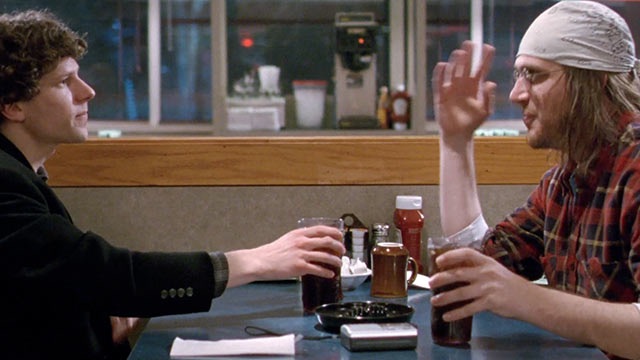
The film is a flawless meander over a few days with an enigmatic and at times debilitatingly insecure novelist.  Jason Segal’s turn as author David Foster Wallace is soul-deep, a particularly impressive performance given that it is from a light comedian. As a film about a doomed man (Wallace hung himself 12 years after the events depicted), the picture is also refreshingly light on foreboding. We are not here to observe the clues that led to Wallace’s demise.  Rather, we are here to enjoy the mind of the author, while being made privy to some of the demons within him, as he is interviewed by a Rolling Stone writer, played by Jesse Eisenberg. We are allowed to hang out with two writers as they discuss their craft, their fears, and America; fence over their different viewpoints and goals through the interview process; and eventually, form a fleeting friendship. Thankfully, the movie is so self assured it doesn’t feel the need to provide the expected big reveal or the emotional paroxysm.

But perhaps what is best about this film – a film about a writer where we do not hear him recite his prose – is the fact that you’ll become affected enough to go read his work after the movie is over. I generally do not read fiction, I have never read Wallace (with the exception of a few magazine pieces), but on the strength of this very personal and intriguing film will read one of his novels.