Archive

5 stars

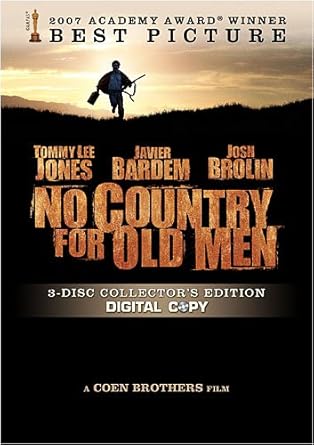
The Coen brothers’ finest film, a gritty, nerve-wracking crime story and an existential horror movie set in the harsh and desperate environs of dusty, bleak Texas.  Josh Brolin takes the wrong money from the wrong drug dealers, victims of a cocaine buy gone bad, after he happens upon their slaughtered bodies while hunting.  Javier Bardem is dispatched by the higher-ups to get it back, killing most everyone he encounters along the way (including rival bounty hunters sent by his employer).  The pacing is taut, the terror near-asphyxiating.   But interwoven in the story is a sense of generational disconnect, rot and the utter bewilderment of an older generation at the brutality and senseless violence of the new.  An observation from a friend is also spot on: “I thought the most important theme in the movie was that older men gradually lose contact with their country, and that this sad fact has nothing to do with the objective reality of what’s happening but is the natural consequence of getting older.”

Set in 1980, the young are depicted as callous and corrupt.  Brolin, shot and desperate to get to Mexico, encounters kids on the border bridge returning to the U.S. after a night of carousing.  He offers to buy a shirt from one of the trio to cover his bleeding, but they quickly demand money, and when he asks for a beer, they want more.  Similarly, at the end of the film, two boys encounter a wounded Bardem and bicker over the share of what he has given them for a shirt.

The Vietnam generation is represented by Brolin and Woody Harrelson, the latter sent to bring Brolin in before Bardem gets to him.  Brolin is not exactly honorable but he still maintains a tie to some principles.  He literally awakes with guilt because he can’t let a dying drug dealer go to his end without water, and it is that charity that brings Bardem his way.  Harrelson, also a Vietnam vet, has a similarly flexible code (he is a killer), but at least there is some code there.  As he says to Brolin about Bardem: “You can’t make a deal with him.  Let me say it again.  Even if you gave him the money he’d still kill you.  There’s no one alive on this planet that’s had even a cross word with him.  They’re all dead.  These are not good odds.  He’s a peculiar man.  You could even say that he has principles.”  When Brolin returns from Mexico, still hobbled but intent on stopping Bardem, a border guard lets him through on the strength of Brolin’s Vietnam service.

Then, there are the old men for whom there is no longer a country.  Tommy Lee Jones and his law enforcement contemporaries just don’t get it.  It’s all gone to hell and a hand basket and while they understand violence, they don’t understand the new violence.  As Jones says, bewildered, reading the paper: “Here last week they found this couple out in California they would rent out rooms to old people and then kill em and bury em in the yard and cash their social security checks.  They’d torture them first, I don’t know why.  Maybe their television set was broke. And this went on until, and here I quote… ‘Neighbors were alerted when a man ran from the premises wearing only a dog collar.’ You can’t make up such a thing as that. I dare you to even try.”

It is not Jones’ world anymore (my favorite Jones musing was from Cormac McCarthy’s book – “She kept on, kept on. Finally told me, said: I don’t like the way this country is headed.  I want my granddaughter to be able to have an abortion.  And I said well ma’am I dont think you got any worries about the way the country is headed.  The way I see it goin’ I dont have much doubt but what she’ll be able to have an abortion.  I’m goin’ to say that not only will she be able to have an abortion, she’ll be able to have you put to sleep.  Which pretty much ended the conversation”).

The film ends with Jones driven to retirement, talking to other older lawmen about what it all means:

Roscoe: It’s all the goddamned money, Ed Tom. The money and the drugs. It’s just goddamned beyond everything. What is it mean? What is it leading to?

Jones: Yes.

Roscoe: If you’d a told me twenty years ago I’d see children walkin the streets of our Texas towns with green hair and bones in their noses I just flat out wouldn’t of believed you.

Jones: Signs and wonders. But I think once you stop hearin’ sir and madam the rest is soon to follow.

Roscoe: It’s the tide. It’s the dismal tide. It is not the one thing.

And the end of the film, Jones has retired (he’s done, “overmatched,” he says) and he sits with an older retired lawman, Barry Corbin, who observes, “All the time you spend tryin to get back what’s been took from you there’s more goin’ out the door.  After a while you just try and get a tourniquet on it.”

And the coda:

Corbin: You’re discouraged.

Jones: I’m… discouraged.

Corbin: You can’t stop what’s comin.  Ain’t all waitin’ on you.

Bardem is what is waiting on us all. Certain, unstoppable, arbitrary death.

This is a beautiful, unrelenting movie, deservedly winning Oscars for best picture and supporting actor for Bardem.

Enough Said is an engaging, touching semi-romantic comedy for adults in the target market of 40 to 60. The trials of Julia Louis-Dreyfus, a middle aged masseuse, do not include keeping the sex drive hot with the advent of a new baby, or struggling with the fact that all of her friends are married while she is not. Rather, she is divorced, working, plagued by her daughter’s move from LA to NY for college, and the hunt for a man has been reduced to a mere occasional flare. But she meets a man, and his ex-wife, and develops a romance with the former and a friendship with the latter, initially ignorant of their connection. She is soon wise and makes the calamitous decision to use intelligence gathered from the ex-wife to evaluate her new partner.

Enough Said is a beautiful epitaph for James Gandolfini as the love interest, who plays a portly middle-age loner in angst over the departure of his own daughter to college with a subtlety and nuance that may well have freed him from the shackles of Tony Soprano once and for all (the Lord works in mysterious ways, and there is no greater example than having Enough Said released after The Incredible Burt Wonderstone).

Louis-Dreyfus is also impressive. There is no questioning her comedic chops (HBO’s Veep shows how effortless she moves in that milieu), but here, she draws deeper, and slowly reveals repressed fear and insecurity. Not in the paroxysm of a self-revelatory banner speech or after undergoing the withering but “true” dressing down of a gal pal in the penultimate act, but in ascending scenes of awkwardness, comfort, quiet resignation as to her actions toward Gandolfini, and then need.

The film also handles secondary characters with maturity. They err and recover, but we are not let off the hook by cartoonish villains or easy marks. This is a bit of a departure for writer-director Nicole Holofcener (Lovely and Amazing, Friends with Money), who was previously very tough on her protagonists and supporting characters in a manner that bordered on condescending. Still, in Friends with Money, Holofcener zeroed in on the casual iciness of an outwardly happy marriage between Catherine Keener and Jason Isaacs and her skill depicting the dynamics of couples has not eroded.

One of the, if not the best film of the year.

Rear Window, or the World's Scariest Bottle Episode – Scriptophobic

I just engaged in a donnybrook of a discussion with a few friends over this film, the primary contention being what it was actually about. It was the kind of exchange only the participants could enjoy, but the spirited debate about the film and Hitchock in general led me to re-watch Rear Window this weekend.

Jimmy Stewart is an adventurous photographer who has a broken leg (but he got the shot of the crashing motor car before it hit him). Cooped up in his New York City apartment, he spends the time peeping on his neighbors across the way (he has a splendid view of their windows and courtyards), and in the process, he begins to suspect one (Raymond Burr) of murdering his wife. He enlists his socialite girlfriend (Grace Kelly), whose marriage entreaties he is fending off, in his investigation, leading to a thrilling conclusion.

The film succeeds on three levels. First, it is a witty comedy, with sharp exchanges between Stewart (the confirmed bachelor and super snooper) and Kelly, as well as Stewart’s health care attendant, the brusque Thelma Ritter. The women are pro-marriage and anti-peeping. As these discussions develop, Stewart enlists them in his monitoring of Burr, and thereby, Kelly “proves” herself to Stewart as something more than a rich, pampered girl. At its best, it plays like a David Ogden Stewart or Ruth Gordon battle of the sexes script.

It is also a love story, initially very light, but when Kelly is in harm’s way, Stewart evinces true passion. Stewart has been lampooned so often (“Zu Zu’s petals!”) that one forgets his ability to communicate depth of emotion, but before those petals, there was his haunting breakdown in Martini’s bar. Also, given the 21 year age disparity, it is surprising Stewart and Kelly manage chemistry, but it’s there.  Indeed, the insane idea of rejecting Grace Kelly is made more comprehensible by Stewart’s cranky maturity.

Finally, this is a meticulous thriller with a few dark overtones. Stewart peeps as a lark, but soon, he is obsessed and a little ashamed.  He sheepishly admits to Kelly that they’re viewing “pretty private stuff going on out there.”  She retorts, “We’re two of the most frightening ghouls I’ve ever known.”  And what they see is generally pretty depressing: a suicidal Ms. Lonelyhearts, a composer in despair, newlyweds from shine to routine. And, of course, a killer, nagged by his wife and driven to extremes. It’s not a happy place, as is shown by one neighbor whose dog, sniffing in the wrong garden, meets an untimely end.

I’ll end with the thoughts of someone more distinguished, David Thomson, from his book The Moment of Psycho: How Alfred Hitchcock Taught America to Love Murder:

Hitchcock knew that a system locked into watching and seeing can misread its surroundings and can even lose its identity and ordinary human sympathies because of the pressure of voyeurism. The voyeurism is so heavy, so forceful, it can smother real human nature. Psycho is the conclusion to a set of films beginning with Rear Window, and for me that is Hitchcock’s best film in that the smile of satisfaction at the end covers without hiding the loneliness that affects real people. Rear Window is a romance, a comedy and a thriller, but a portrait of alienation too. The apartments and windows are screens, of course, but they are traps, or cells – in that entire courtyard no one seems to “know” anyone else; neighborliness has not been invented.

This BBC 5 part mini-series is a taut crime story, lovingly detailed, and anchored by a powerful, understated Gillian Anderson performance. A serial killer is loose on the streets of modern day Belfast and he is targeting professional women of a particular physical type, who he tracks, monitors and then strangles in an elaborate, almost artistic ritual. Stella Gibson (Anderson) is brought in from London to perform a review. When the killer strikes again, she is assigned the case.

This is not a whodunit, as we are introduced to the killer in the first few moments. Instead, The Fall is a meticulous police procedural with a distinct take on Belfast.  Be it the ways of a tough neighborhood, the politics of the investigation or specifics of a crime scene, the feel is assured and authentic.  The characters are also very strong, in particular, the killer (Jamie Dornan).  While he is in no way sympathetic, he is unique in that we see him not only planning and executing his gruesome acts, but as a seemingly loving father and husband, and a conscientious civil servant (of all things, he is a grief counselor). 

The Fall was created by Alan Cubitt, who has credentials as a writer for the Helen Mirren series, Prime Suspect, and at first blush, Anderson’s Gibson and Mirren’s Jane Tennyson have some similarities. They are both Detective Chief Inspectors in a male-dominated profession and they both do not have a significant male others. There is where the similarity ends, as Gibson is in a new environment (the last Prime Suspect was almost a decade ago), one that is more friendly to women, but also one where male expectations and bias evince themselves in a subtler fashion. Anderson’s Gibson is also clearly more reserved and in-control than Mirren’s Tennyson, who was rock-solid on-the-job, but more vulnerable in her private life. Gibson is not vulnerable at all, but she is not brittle or overtly righteous. In many ways, she is a “first” for a female police lead, as male as any officer, certainly stronger and smarter than most, and emotionally detached without lapsing into copycat or bitch. When a married detective with whom she has casually slept with is investigated, and she is questioned as to the liaison in a manner different than a man would endure, she suffers the double-standard with a certain patience before matter-of-factly telling the investigator that the detective’s wife was her lover’s problem, not hers. She also has somewhat of a sexual kink. Not Clint Eastwood in Tightrope kinky, but a kink nonetheless, a true rarity for a female lead.

It’s a great character and Anderson has left a lot to develop.    BBC Two has renewed the series for a second season and I hope Gibson becomes the next Jane Tennyson, who carried us through 7 Prime Suspects.

Available on Netflix streaming.


John Woo is an action hack, a Chinese director of minor renown who came to America and never looked back, making several big concept explosion-fests, like Broken Arrow, Mission Impossible II, Windtalkers (a Pacific theater World War II film that looks as if it was filmed in the Hollywood Hills) and Paycheck, which was once thought to be the coda to Ben Affleck’s career. You can only lose people so much money before you get benched, and Woo’s Windtalker‘s had a worldwide gross of $70 million on a budget of $115 million. Paycheck merely broke even domestically and appears to have signalled the end of the line for Woo.

But Woo left something for us, a ridiculous, giddy gem, to show that he had come to America and contributed. Face/Off stars Nicholas Cage as master terrorist Castor Troy. John Travolta is his Javert, Agent Sean Archer. Archer catches Troy, and puts him in a coma, which is fair play given that Troy murdered Archer’s young son. But Troy planted a bomb somewhere in LA before sleeping his deep sleep, and only Troy’s brother Pollox (Alessandra Nivola) knows the location of the bomb.

What to do?

Well, you surgically remove the face of Castor Troy, put it on Sean Archer, Archer goes into the super-max prison where Pollox is housed and elicits the whereabouts of the explosive. Duh.

Except, when Archer is in prison with Troy’s face, Troy wakes up from his coma, forces the doctors to give him Archer’s face, kills everyone who knows about the whole “face/off” plan, keeps Archer in prison, and then reinstates “date night” with Archer’s wife (Joan Allen).

Furious, Archer escapes prison, and then . . . slo-motion doves:

This is an absurd, dizzying, very funny movie, tailor-made for two of the greatest over-actors of our generation. Great film. Road House great.

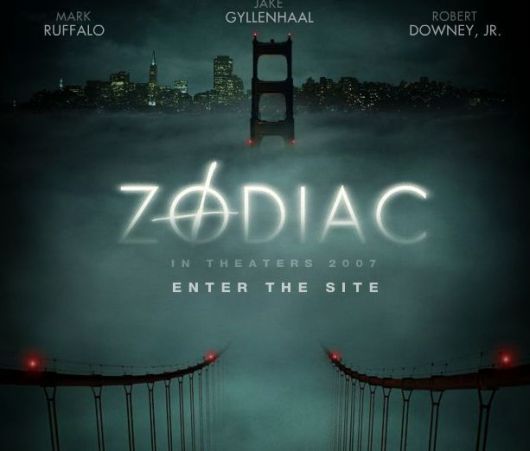
I would have given a great deal to have been at the studio screening of David Fincher’s Zodiac. I wonder who said first, “You mean, this movie is almost 3 hours and we never definitively learn whodunnit?”

The 1969-1970 Zodiac killings are unsolved and at least by serial killer standards, the Zodiac racked up a meager body count (only 5 victims are confirmed as by Zodiac’s hand).  Nonetheless, these narrative infirmities are more than compensated for by the killer’s panache.  Zodiac taunted the police departments of four different Northern California communities with letters to newspapers, including ciphers to be broken which promised to reveal his identity and wild threats (including one to shoot San Francisco kids as they left school buses). Like Jack the Ripper, the Zodiac wanted to lord his superiority over his pursuers.

Fincher takes the Zodiac case and uses it to dramatize exactly how such a crime burrows itself into the marrow of people, altering them profoundly. Jake Gyllenhaal is The San Francisco Chronicle cartoonist Robert Graysmith, who becomes obsessed with the killer the day his first letter to The Chronicle appears. Graysmith would eventually write the definitive book on the Zodiac, and as played by Gyllenhaal, he is sucked into the mystery to the near exclusion of all else. Robert Downey, Jr. plays Paul Avery, the Chronicle crime reporter who covered the case and received a threatening letter from the Zodiac. Avery had labeled the Zodiac a latent homosexual and the Zodiac wrote him a Halloween card warning, “You are doomed” (which resulted in the staff of The Chronicle creating buttons emblazoned with “I Am Not Paul Avery”).  Downey’s Avery is driven from The Chronicle, to drink and drugs and despair, exacerbated by his fear of the Zodiac. The two police officers assigned to the case are also damaged. William Armstrong (Anthony Edwards) eventually transfers to another division while Dave Toschi (Mark Ruffalo) is at one point accused of forging a Zodiac letter (he was cleared of all charges).  There are also the survivors. The Zodiac attacked 3 couples while they were alone and vulnerable, but two men survived, one of whom was the only living person to see the Zodiac. He is a shell, having escaped the country, found at the end of the film to provide one final clue.

The psychological study is encased in a meticulous yet accessible procedural. Screenwriter James Vanderbilt keeps myriad threads intertwined without sacrificing pace, no mean feat given a multi-jurisdictional crime reverberating in the worlds of the police and journalism.

Fincher re-creates those crimes in a manner that communicates their terror and the vulnerability of the victims without being sensationalist or gratuitous. Indeed, the most frightening scene is one where no violence is done. Five months after his last killing, the Zodiac killer pulled over a woman with her baby on a highway, letting her know her back tire was wobbly. He feigned assistance by tightening the lugnuts, but the wheel fell off immediately after she got back on the road. The killer came back, offered to bring her to a service station, but instead drove her around until she was able to escape into a nearby field with her baby (the connection to the Zodiac was made after he referenced the encounter in a letter to The Chronicle a few months later).

It’s hard to imagine that the director of the gruesome Seven made this picture, which is restrained, methodical and to my mind, infinitely scarier. Having to turn away and shut your mind off has less of an effect than when you cannot do so and you’re required to think.

This film has just recently been offered for streaming on Netflix so take advantage.

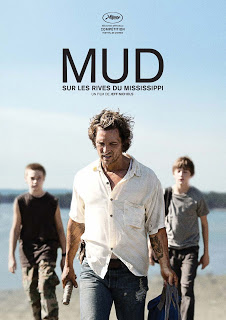
The excellence of writer/director Jeff Nichols’ Mud lies in its authenticity, confidence and reserve. As I watched this coming-of-age story about two boys, Ellis (Tye Sheridan) and Neckbone (Jacob Loffland), both of poorer Arkansas stock, and their involvement with a fugitive (Matthew McConaughey), I couldn’t shake what the film wasn’t – maudlin, simplistic or heavy-handed (i.e., like the template for so many “coming-of-age” stories about young boys, Stand by Me). While those two films have the Huck Finn story in their DNA, that’s where the comparison ends. Stand by Me needed a narrator to tell you what was of import and what was not in the adventures of their young male characters, and by the end of it, you felt thoroughly manipulated. Mud, however, requires no such crutch. The symbol of what is a man and father, what the divorce of his parents means to a boy, what young love is, and the heart of friendship, is depicted in a lifelike, piercing way. There is a wonderful scene where Loffland’s uncle, played by Michael Shannon, tries to impart some wisdom to Ellis, explaining in a deft but allegorical manner how Ellis needed to stay out of trouble and the nature of his responsibility to Neckbone, who is both a rock and a natural born follower. When Neckbone asks Ellis what they were talking about, Ellis shrugs and replies, “I don’t know.”

The performances are almost completely spot on, and Sheridan and Loffland should be shoo-ins for best actor and best supporting actor, but I’m certain they will be overlooked. That’s a shame, because they are at the ages where pure naturalism (for example, Quvenzhane Wallis in last year’s Beasts of the Southern Wild) cannot carry the day. These boys are making intuitive choices. Their interplay alone is mature and steady, and Sheridan’s scenes with a would-be girlfriend are heart wrenching. They will evoke your best friend from childhood, and you won’t need Richard Dreyfus intoning, “he was my best friend from childhood.”

McConaughey, who has bouts of phoning in roles with a quick smirk and a lazy drawl, delivers a much deeper performance here as the outlaw, desperate not only to escape the law but to reconnect with his true love (Reese Witherspoon). Nearly every other supporting character – from the rigid, recluse Sam Shepard to Ellis’s parents (Ray McKinnon and Sarah Paulsen), to Shannon (whose three scenes damn near steal the movie) – contributes in an effective, understated manner. If there is a weakness, it is Witherspoon, and she was not bad, she was just a little outclassed.

Nichols (Take Shelter) shoots the Mississippi River as a dream, and when the boys are on or traveling to and from the island where McConaughey is holed up, the feel is very Terence Malick. But when the boys are back home or amongst the townies, the look is bleached and tacky, further emphasizing the juice they get from their adventure.

Another kudo – when Hollywood deals with the non-urban, at its worst, you get a grotesque caricature, and at best, you merely get a sort of condescending ennobling, the hick version of “the magical negro” (usually wrapped up in a “you’re better than this place, Willie!”). There is none of that here. Instead, Nichols has written rounded, grounded, real characters.

It is perhaps unfair to use this picture as a club against Stand by Me. To the positive, it ranks up there with the equally excellent Sling Blade and One False Move and is thus far the best film of 2013.

I recently saw a filmumentary” on Jaws and realized I had not reviewed the greatest summer movie ever made, an astonishing, deep blend of adventure, terror, and action, communicated by Stephen Spielberg’s great eye, the deft casting of three disparate principal actors, and a John Williams score that evokes fear and exhilaration.

Spielberg at the advent of Jaws was hardly a wunderkind. Like William Friedken before The French Connection, Spielberg had a pedestrian resume’ — a Columbo, a few TV movies and an okay feature (Sugarland Express). With a production plagued by everything from the mechanical failures of the shark to the tax problems of star Robert Shaw (if he spent more than a certain amount of time in the U.S. he would face a tax liability, so he was flown to Canada on his days off), Spielberg took Peter Benchley’s piece of summer pulp and fashioned a moving, ingenious film, evident from the opening scene credits, which give us a shark’s point of view in what is the still and peaceful deep, an image followed by the jarring, horrifying massacre of the shark’s first victim, alone, at night, where none of us ever want to be.

Like Friedken in The Exorcist, who prefaces the introduction of the demon in the child only after an hour of exposition, Spielberg waits quite some time to show us the shark in full, making what is happening beneath the water all the more frightening. Indeed, when we see the second fatality (a little boy on a raft), it is from the vantage point of a beachcomber lazing in his chair, a brief, violent act that immediately makes the viewer question, “what the hell was that?”

After Spielberg stuns the audience, he introduces them to poor Chief Brody (Roy Scheider), a landlubber from New York who marshals for the summer town of Amity, As the bodies pile up, it is Brody who succumbs to the pressure of the townsfolk dependent on summer dollars, only to be shamed by his malleability. Emboldened and in need of reclamation, Brody is assisted by the articulate and passionate wisecracker, oceanographer Matt Hooper (Richard Dreyfus) and old salt Quint (Robert Shaw). The former wants the scientific find of the century, the latter is a modern Ahab, seeking his white whale, as explained in the famous scene written not by screenwriters Benchley and Carl Gottlieb (a comic writer who presumably penned some of the very funny exchanges in the picture) , but John Milius (writer of Dirty Harry, Apocalypse Now and creator of HBO’s fantastic Rome).

The experience of the three men from their separate vantage points, with their different motives and backgrounds, is the fuel of this picture, not the shark. As good as Milius’ Indianapolis speech is, or Shaw’s monologue to the town leaders opened by his nails on a chalkboard, the scene where Shaw’s grit runs up against Dreyfus’s privilege and Scheider’s quiet authority is better:

                                     HOOPER
                         You’re going to need an extra hand…

               Quint turns to see this new voice, and starts walking towards
               him.

                                     BRODY
                         This is Matt Hooper…

                                     QUINT
                         I know who he is…

                                     BRODY
                         He’s from the Oceanographic Institute.

                                     HOOPER
                         I’ve been to sea since I was 12.

                         I’ve crewed three Trans-pacs —

                                     QUINT
                         Transplants?

                                     HOOPER
                         — and an America’s Cup Trials…

                                     QUINT
                         I’m not talking about day sailing or

                         pleasure boating. I’m talking about
                         working for a living. Sharking.

                                     HOOPER
                         And I’m not talking about hooking

                         some poor dogfish or sand shark. I’m
                         talking about a Great White.

                                     QUINT
                         Are you now. I know about porkers in

                         the water —
                              (throws him some rope)
                         Here. Tie me a sheepshank.

               Hooper ties the knot effortlessly.

                                     HOOPER
                         I don’t need to pass basic seamanship.

                                     QUINT
                         Let me see your hands…

               He takes Hooper’s hands in his own big bloody fists, and
               feels them as he talks.

                                     QUINT
                         Ha. City hands. You been counting

                         money. If you had a $5000 net and
                         $2000 worth of fish in it, and along
                         comes Mr. White, and makes it look
                         like a kiddy scissors class has gone
                         to work on it and made paper dolls.
                         If you’d ever worked for a living,
                         you’d know what that means.

                                     HOOPER
                         Look, I don’t need to hear any of

                         this working class hero crap. Some
                         party boat skipper who’s killed a
                         few sharks…

                                     BRODY
                              (interrupting)

                         Hey. Knock it off. I don’t want to
                         have to listen to this while we’re
                         out there…

                                     QUINT
                         What do you mean ‘We…?’

                                     BRODY
                         It’s my charter. My party.

                                     QUINT
                         All right, Commissioner. But when

                         we’re on my ship, I am Master, Mate
                         and Pilot. And I want him…
                              (indicates Hooper)
                         …along for ballast.

                                     BRODY
                         You got it.

During shooting, Shaw rode Dreyfus very hard, making fun of everything from his star status, stature and his ethnicity.  Any hostility was used to great effect on-screen.

As good as these three actors are, they are more than ably supported by Lorraine Gary (as Brody’s wife), Murray Hamilton (as the oily mayor) and a boatload of locals who lend the film a great air of authenticity.  Again, kudos to the script, because it allows dignity for Hamilton in the aftermath of his grave error, when, shaken at the hospital, he says to Brody, “Martin . . . my kids were in that water too.”

Finally, Williams’ score is a mixture of dread and adventure, the simplicity of dark repetition (“duh, nuh . . duh, nuh . . . dun dun dun dun dun dun dun”) followed by a near-swashbuckling romp as the men seek their quarry.

I never tire of this film and always find some new marvel or nuance when I watch it.  If only the Hollywood shit that is shoveled in summer these days could sport 1/10 of the chops of Jaws, the town wouldn’t be losing its shirt.

Image result for Assassination of Jesse James

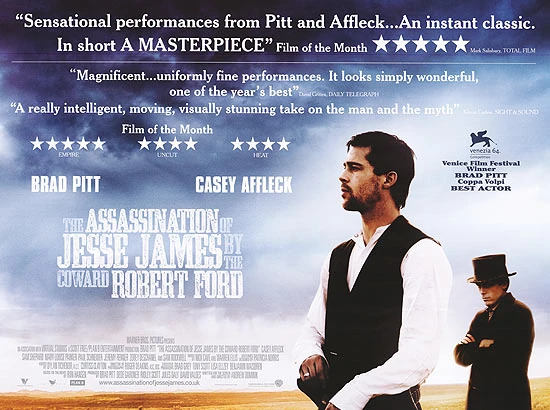
Andrew Dominic’s moody, elegiac picture melds Terence Malick’s imagery from Days of Heaven and Walter Hill’s sense of time in The Long Riders. As Ford, Casey Affleck is mesmerizing, and Brad Pitt’s depiction of James as a manic-depressive sociopath is chilling. Their performances are enhanced by Dominic’s sweeping, beautiful vistas (the film drew an Oscar nod for best cinematography) and a mournful score courtesy of Nick Cave and Warren Ellis.

A $30 million western without a single shootout (at least, one involving Jesse James) is destined to make a mere $3 million back domestic, but this film is more about hero worship, fame-seeking and insecurity than the violent exploits of the James gang. Affleck, who was nominated for best supporting actor, subtly communicates living in the shadow of Jesse James, traversing the path from awe for a legend, to anger over his idol’s coldness and indifference, to maturation and resolve as James becomes more suspicious, mercurial and dangerous. Ford’s likening of himself to James in the great killer’s presence, which can be found below, is startling in its honesty and vulnerability.

Affleck and Pitt receive strong support, including Jeremy Renner and Paul Schneider as feuding gang members, but as ever, Sam Rockwell near steals the picture as Charlie Ford, playing dumb but in truth, whipsmart and canny. Garret Dilahunt (Deadwood) is also resonant as a doomed and dim Ed Miller.

Upon first review, I wrote, “a glaring fault is an unnecessary voice over narrative, the voice being similar to that of David McCullough. The effect is redundancy and a PBS/History Channel vibe.”  I also gently criticized the picture on its length.  I recently saw it again and I was wrong on both counts.  The voice over is not obtrusive nor is it merely aping what is happening on screen.  Rather, it enhances the film’s tragic nature (this is a ghostly western and a movie about one of the first celebrity screw-ups) with an explanation as to how it fits historically and personally.  And I was sorry to see it end no matter how long it ran.

This is a unique, accomplished period piece.