Archive

4 stars

Liam Neeson works in Alaska as a sniper protecting workers from wolves.  He’s at the end of his tether, trapped in a faraway hell where all around him, the dregs do the hard work in a barren wasteland, drinking, drugging and fighting at night.  Near suicidal, Neeson grabs a flight to Anchorage, which goes down in a part of the frozen tundra controlled by a marauding wolf pack. Neeson leads a group of men in their attempt to survive the elements and the wolves.

At first blush, The Grey seems a drearier, heavier The Edge, without the sharpness of a Mamet script or the tension born of a romantic entanglement.  Surprisingly, given the director’s track record, this story of men turns out to be a great deal more than a thriller.  We learn a little about each of the survivors, and Neeson, who was ready to throw his life away, draws purpose from and provides comfort to men suddenly facing death.  There is a beautiful scene after the crash, where Neeson consoles a gravely injured passenger, tells the man he is dying and asks him to think of one he loves to walk him out of this world.  What follows is indeed very thrilling, but also deep and even elegiac.  As characters meet their fate, you find yourself empathizing strongly with them, not only because of their plight but because you have invested in them.

Neeson is strong as a lost man reconnected to humanity through this nightmare. He should be nominated for an Oscar, but given the vehicle, it cannot be. The ensemble cast is also formidable, with special mention to Frank Grillo as an ex-con survivor who naturally resists Neeson’s leadership.

The Grey was directed and co-written by Joe Carnahan, who helmed the excessive and stupid Smokin’ Aces and The A Team, so things are looking up.

image

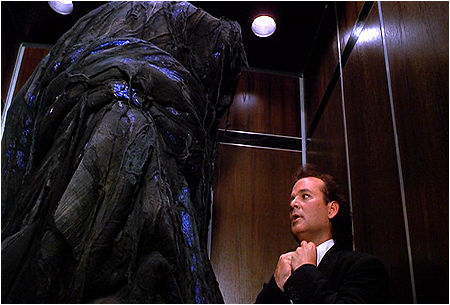
Bill Murray plays the Scrooge character, Frank Cross.  Cross, however, is not in finance, but television.   A child abandoned to the TV by uncaring parents, Cross has become a holy terror as the head of programming for a major network.  His newest achievement is a live broadcast of “A Christmas Carol” on Christmas Eve, with Buddy Hackett as Scrooge.  Cross is so cynical and mean he’s ordered the stapling of tiny antlers on to the heads of mice.  Soon, the ghosts appear.

This is a zany, funny version of the Dickens tale co-written by SNL alum Michael O’Donoghue (he communicated his loathing of the theatrical version before his death at 54) and directed by Richard Donner (who helmed all the Lethal Weapons and various and assorted dreck).  Donner has little skill save for making movies move, and this movie moves.  O’ Donoghue’s complaints aside, it’s also often very clever, propelled by Murray’s manic and humorous descent into madness and his joyous redemption.  It’s big, messy, all-over-the place, and excessive (which is kind of the point) but great fun.

Late Roger Moore Bond films, with the cornball quips and the hideous 80s fashion, obscure the fact that Moore used to be a pretty cool James Bond.  After the confusion of George Lazenby’s bizarre withdrawal from the series having only done one film (On Her Majesty’s Secret Service) Sean Connery was hurried back to woo Jill St. John in Diamonds are Forever for a then-astronomical $1 million.  But Connery was finished, so Moore was signed up (he’d already played a secret agent – Simon Templar – on television’s The Saint) .

Live and Let Die has Bond tracking Dr. Kananga (Yaphet Kotto), the dictator of a small Caribbean nation, after MI6 agents start dropping like flies.  Kananga is into drugs and voodoo, using Solitaire (Jane Seymour) and her gift with tarot cards to his advantage (until Bond deflowers her and she loses her “sight”).  Paul McCartney and Wings produced a rollicking theme (ranked number two here), there is a tremendous cigarette boat race, and Bond effectuates one of his better escapes from a Florida crocodile farm.

The new Bond presents as unflappable, as well as perpetually amused.  He’s also the horniest of the Bonds.  Moore, who just wrote a book on his time as Bond, articulated both his admiration for current Bond Daniel Craig and his own ethos:  “Now they’ve found the Bond—Daniel Craig…. I always said Sean played Bond as a killer and I played Bond as a lover. I think that Daniel Craig is even more of a killer. He has this superb intensity; he’s a glorious actor.”

Moore also identified his principal weakness as Bond: “Quite honestly, I do everything the same and I think everything comes out the same, whether I’m flinching as James Bond or raising my eyebrows as Simon Templar.”  His casualness often borders on disinterest and a certain “mailing it in” approach results.

As for the film, it has two primary faults.  First, an annoying Louisiana good ole’ boy, Sheriff Pepper (Clifton James), brought in for broad, Jerry Lewisesque comic relief.  Second, a very poor finale, with the delightful Kananga dispatched in a manner way beyond the special effects capabilities of the time.  He deserved better.

Daniel Craig’s second turn as Bond is moodier, not as brisk and bracing as Casino Royale.  Coming off the loss of the love of his life (pretending, of course, that George Lazenby and Pierce Brosnan never lost their hearts to Diana Rigg and Teri Hatcher),* Bond is bitter and ultra-violent, and he is made more so after an attempt on M’s (Judi Dench) life.  As he investigates, M upbraids him for killing all his leads, but Bond is driven, uncovering a sophisticated plot by faux-environmentalist Dominic Greene (Mathieu Amalric) to corner the market on a precious resource.

The plot is serviceable, and the film sports three exciting and audacious action sequences – car chase, boat chase, plane chase – and a thrilling shootout finale.  Amalric is also an interesting villain, not quite charming or brilliant, but casually efficient and super-creepy.  And of all the secondary Bond girls, Quantum features my favorite, Gemma Arterton as

Image result for Quantum of Solace Strawberry Fields sexy

Strawberry Fields

There is also a virtuoso surveillance scene during a performance of Tosca at the open air Opera building in Bregenz, Austria, as well as intriguing backstabbing between British surveillance and the CIA, which brings in my favorite Felix Lighter (Geoffrey Wright).

On the downside, after the death of Vesper (Eva Green) in Casino, Bond is perhaps too brooding in this flick, and the angst-level is often very high.  But you could have easily predicted the charge of excessive-seriousness, as if there were some bizarre nostalgia for the bonhomie of Roger Moore and Pierce Brosnan.   Given that director Marc Forster (Monster’s Ball, Finding Neverland, The Kite Runner) doesn’t come from action stock, it is easy to conclude that was perhaps taking itself too seriously.

Phooey.  This is one of the stronger Bonds.  It’s also distinctive.  Especially impressive is Foster’s filming of Bond’s escape from the opera.  There is no jacked-up Bond score, but rather, a dreamlike flight as Tosca dominates the soundtrack.

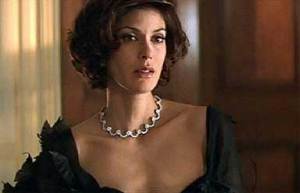
*  By the way, when Bond becomes emotionally involved with a woman, it’s hard to fault his choices:


Skyfall' sends Bond franchise soaring again

In his third turn as James Bond, Daniel Craig is close-cropped, weathered (think a better-tailored Steve McQueen in Papillon) and dispirited.  M (Judi Dench) put him in his funk.  She made a tough call without batting an eye and as a result, Bond was shot and presumed dead. He survived the bullet but left the job to drown his sorrows. Another former 00 agent (Javier Bardem), however, harbors a much nastier grudge against M, bringing Bond back to life and service.

There are weaknesses.  Skyfall is merely a revenge flick.  All of Bardem’s efforts are directed at killing M, which is not all that interesting. Moreover, Bardem not only wants to kill M, but he wants to do it face-to-face (early in the film, he proves how vulnerable she is by blowing up her London offices via computer).  So, his master stroke (a hit on M as she testifies before a board of inquiry) seems unnecessarily elaborate given that if successful, he’s probably going to shoot her in the back in a confused firefight.

The film is also heavy on exploring Bond’s psyche. We learn he is an orphan (thus, his wounds from M’s callousness are all the deeper).  We also see his psychological interview (to determine his fitness for duty) and even the crawl space where he hid as a lad upon hearing of the death of his parents. The interview has funny moments (including a clever word association; the psychologist says “murder” and Bond responds “employment”) but it also reveals Bond’s “Rosebud.” The revelation of the childhood hideout and trauma feels too close, too modern.

Bond’s generational clash is another theme, one better delivered. We meet a new Q (a twenty something played by Ben Whishaw, who was impressive in BBC’s “The Hour”). Q fences with Bond about the utility of having live agents searching for intel. Meanwhile, forces all around Bond and M are telegraphing it is time to pack it in.   Even the villain, Bardem, positively winces at the rigor of field work. He can do it, but he elegantly expresses his preference for the click of a mouse.

Bardem is perfect. He’s psychotic, charming and empathetic. His opening speech on what to do with rats on an island is riveting and his playful sexual come-on to Bond is surprising and convincing.  He steals the show.

The Bond women are distinct and sexy.  The first is a lithe, capable agent (Naomie Harris) who is given the order by M to take her shot in the opening scene (she misses the bad guy and plugs Bond, resulting in some clever repartee’ upon his return).  The second (Bérénice Marlohe) is a doomed beauty, in mortal fear of Bardem, latching on to Bond as her salvation.

The action sequences are up to snuff, if not dazzling. The finale is an old fashioned shootout where Bardem and his army attempt to get at Bond and M at his childhood home, an ancient Scottish manor house. They are assisted by the property’s game keeper, Albert Finney, which could have been cutesy but works out fine.  It also introduces shotguns. Shotguns are cool.

Sam Mendes (American Beauty, Road to Perdition, and the ghastly Revolutionary Road) seemed a strange choice to helm. But he proved capable of action in Road to Perdition, and he puts his stamp on the franchise. Mendes is patient and methodical, comfortable with a moody but chattier Bond, where the discussions are not rushed.

Perhaps indicative of a future lighter touch, Skyfall closes with not only a Bond lightened by catharsis, but the introduction of a captivating new Moneypenny (Harris) and a report to his new boss, Ralph Fiennes.

Almost Famous - Movies on Google Play
Based on writer/ director Cameron Crowe’s experiences touring with rock bands like Poco, The Allman Brothers and Led Zeppelin,
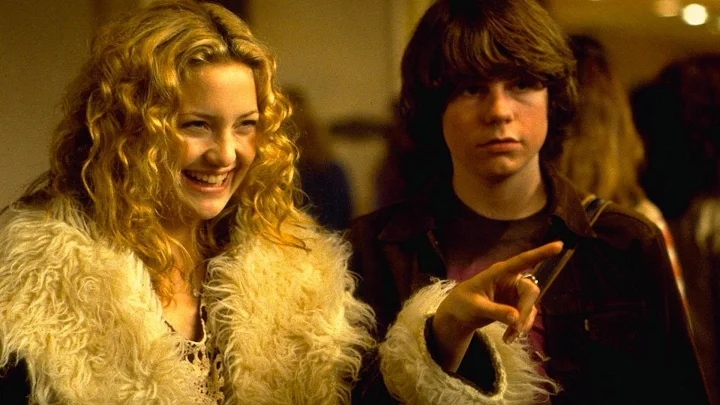
Almost Famous gives us Crowe stand-in Patrick Fugit, a 15 year old rock fan who writes for his school newspaper and a San Diego alternative mag.  His work garners the attention of Creem magazine and its famed rock critic Lester Bangs (Phillip Seymour Hoffman).  Bangs tutors Fugit, who gets an assignment from Rolling Stone to cover rising band Stillwater, fronted by the suspicious and bloviating Jason Lee and the more talented and enigmatic guitarist Billy Crudup.  As Fugit is ensonced with the band on the road, he is charmed by groupie (or, Bandaid) Kate Hudson while his mother (Frances McDormand) monitors his trip via regular phone calls.  Fugit falls in love with Hudson, who is in love with Crudup and considers herself a muse to both.

The film is unabashedly nostalgiac, particularly the scenes of McDormand allowing and then regretting letting her son go on the road with the band.  McDormand is a conflicted personality, half free spirit, half overbearing “DON’T DO DRUGS” nag.  But her affection for her child is undeniable and as she sees him grow up, their distance becomes more painful.  Worse, she intuits he has found a new family (all of whom assure her when she calls that she has raised a wonderful boy while raising the specter that he is being plied with sex, drugs and rock and roll).

This is a fan’s movie, interspersing great 70s rock with a coming of age tale.  Fugit evokes the awkward, sweet nature of a 15 year old lovestruck boy and his performance is beautifully sentimental.  Crowe shows no fear of the maudlin which is for the most part to the film’s advantage.  When the band and its coterie, breaking apart due to various strains on the road, spontaneously sing Tiny Dancer on the tour bus, you can imagine eyes rolling after reading the scene.  But it works perfectly, all part of Crowe’s love letter to rock.

This is not to say that the film never missteps.  It is occasionally too cute, a Crowe weakness.  At one point, Hudson tells Fugit, “You’re too sweet for rock and roll” as if it needed to be said.  Crowe then makes him prove it.  Hudson, despondent over Crudup’s rejection of her, overdoses on Quaaludes.  Fugit saves her and as she gets her stomach pumped before his eyes, he remains starstruck, mooning as she vomits (Stevie Wonder’s “My Cherie Amour” plays in the background).   In another scene, the band plane appears to be going down, and the members all trade simmering accusations and long held secrets, which feels pat and forced.

But by and large, the film’s tone is just right, evoking the memories of your first LP and the moments when your mother actually read the lyrics on a record sleeve and took it away.

There are also laugh out loud moments, my favorite being Lee’s first interview with Fugit, where he waxes poetic on rock:  “Some people have a hard time explaining rock ‘n’ roll. I don’t think anyone can really explain rock ‘n’ roll. Maybe Pete Townshend, but that’s okay. Rock ‘n’ roll is a lifestyle and a way of thinking… and it’s not about money and popularity. Although, some money would be nice. But it’s a voice that says, ‘Here I am… and fuck you if you can’t understand me.’ And one of these people is gonna save the world. And that means that rock ‘n’ roll can save the world… all of us together. And the chicks are great. But what it all comes down to is that thing. The indefinable thing when people catch something in your music.”

When the quote makes the article, his response is priceless:  “Rock ‘n’ roll can save the world”? “The chicks are great”? I sound like a dick!”

There are precious few good movies about making movies  Tropic Thunder is uproariously funny, a brutal send up of dozens of Hollywood tropes, which get a less raucous going over in Get ShortyThe Player reveals a Hollywood machinery that routinizes art, creating a war of sorts between the suits (Tim Robbins) and the creativity.  A Cock and Bull Story and Adaptation are examples closer to Seven Psychopaths, in that you don’t necessarily know where the movie and the “movie in a movie” begins and ends.

Writer/director Martin McDonagh’s In Bruges was a surprising dark comedy about the philosophical doubts of hitmen as they tracked each other in the beautiful Belgian city.  In  Bruges marked McDonagh as a Quentin Taranatino disciple, but his dialogue was meatier, more complex and less reliant on pop culture diversions.

In Seven Psychopaths, the setting is LA, where McDonagh veers deeper into Tarantino-country.  His characters, however, retain the penchant for discussing deep moral and meditative matters as they negotiate an increasingly circuitous plot.  An actor (Sam Rockwell) tries to motivate his screenwriter friend (Colin Farrell) who is listlessly working on a script entitled “Seven Psychopaths.”  Farrell, despondent over the exploitative, repetive crap of violent pictures, has taken to drink at the thought of writing another.  Rockwell, however, is a proponent of the genre Ferrell seeks to escape, creatively urging a shoot ’em up with a blazing guns finale.  To that end, he puts out an ad in the “LA Weekly” inviting real psycopaths to come see Farrell and provide their stories.  Concurrently, Rockwell and an older gentleman (Christopher Walken) run a scam where they steal dogs and return them for rewards.  When they steal the beloved shih tzu of a real psycopath (Woody Harrelson). the script and reality meld.

I first took note of Sam Rockwell in Galaxy Quest, a very funny ensemble comedy which he completely stole.  He has the face of a supporting player, not quite Steve Buscemi odd, but one is often reminded of a rat gnawing on cheese.  Looks aside, which probably deny him leading status, Rockwell is a kinetic yet soulful actor, either riffing or expressing a heartfelt need to be understood.  Walken brings his trademark quirkiness, Harrelson his jovial menace, and Farrell, playing the straight man, his increasing frustration.  But the movie belongs to Rockwell, who blends psychoses with the LA surface cool of an aspiring actor/writer.  His performance is hilarious.

The preview portrays  the film as zanier than it really is.  There are a bunch of funny set-ups and coincidences, but McDonagh provides a sharp commentary on movies and contemporary LA.  He has also written some clever scenes where the characters toss around their screenplay ideas and in the process, write the movie before our eyes.  It’s a neat, meticulous trick.

If there is a weakness, it is the part of the film where the characters appear to suffer writer’s block, and in response, run off to Joshua Tree National Park to reflect (Walken takes peyote). The movie drags a bit at this point, but not for long.

Midnight Screaming: Dawn of the Dead (2004) | The Long Take

AMC’s The Walking Dead is successful in part for its visceral presentation of a dystopian United States where calamity has not only brought the dead to life, but those dead have pretty much overrun the country.  Even more disturbing, our cast of characters has learned that all living people carry the virus that will make them zombies hungry for flesh after they die, and that only a post-zombification destruction of the brain can stop their lust for humans.

Still, zombies in The Walking Dead are slow, near catatonic (though, like me passing a Chick-fil-A, they get more animated when near a meal).  If you stay in an open space or avoid them in bunches, you should be fine.  These zombies are like the walking dead in George Romero’s Dawn of the Dead (1978).  Don’t get in an elevator without knowing what’s on the other side of the door and you should be okay.

This is a trial for the show’s writers, who have to continually come up with scenarios where the protagonists and the zombies must come to close quarters (i.e., the group just wrangled with hundreds trying to clear them out from a prison that, if habitable, will be the perfect fortress).

No such problem for Zack Snyder’s (300, Watchmen) unappreciated remake of Romero’s film.  Nurse Sarah Polley and her husband wake up to see a little neighbor child at the foot of their bed.  Awww.  Sally is sleep walking again. Nope.  She’s a zombie and she’s fast and she strikes like lightning.

And away we go.  The zombies are like bullets, carbon copies of the victims of “the rage” in Danny Boyle’s 28 Days Later.  The decision is brilliant, because now, it becomes plausible that zombies actually took over the world (a ridiculous notion if, to become zombies, they had to die, and then get up and move about at the speed of latter years Andy Griffith).  A motley crew of survivors, including Polley, Vingh Rames as a cop, Mekhi Phifer as a hood, Jake Webber as the conscience, and an impressive Michael Kelly as the security guard who traverses from self-interested and greedy to semi-heroic, hole up in the mall.  All is well until they try and help a man they can see from their binoculars and it goes poorly, to say the least.  What follows is a harrowing escape from a their breached fortress.

First time director Snyder makes his mark at the outset with an introduction showing the breakdown of society as scored by Johnny Cash

It’s a helluva a ride and has numerous touches that elevate the material.  I’ll list three.  First, the film has the guts to show us what happens to a baby in the womb if that womb belongs to a zombie.  Second, it can be very funny, one such moment being target practice on the top of the mall that becomes a competition to shoot Burt Reynolds:

Third, it features my favorite zombie ever

Ty Burrell of Modern Family.


image

Tim Burton goes back to his roots (this is a remake of  Burton short film from 1984) with this clever and sweet story of a boy whose beloved dog is killed by a car.  Inspired by his science teacher, the boy brings the dog back to life, but does so in the midst of a heated science fair competition.  His classmates use his same scientific methods, and soon, the town is overrun by monsters brought back to life by the irresponsible kids.

Burton uses stop action animation, the same technique used for Coraline, and Burton’s own Corpse Bride and The Nightmare Before Christmas.  The process is well tailored to the macabre, old-timey haunting and rich in texture, especially in black-and-white, which evokes classic horror films.

I have two minor criticisms.  First, there is a subplot where the science teacher is run out of town because of his influence on the children. It’s a little too contemporary and feels a bit like an unfair shot in the culture wars, especially off putting when, in fact, the neanderthal townsfolk who feared the teacher are seemingly vindicated – the kids damn near destroyed the town.

Second, the ending feels forced, as if the test audiences couldn’t bear the downer of a dead pet.  So, the dog lives, which is pleasing, but contrary to what I thought was a well-developed theme about love and loss and the limits of science. In that way, I suppose Frankenweenie is hopelessly, sadly modern.

Cabin In The Woods - Room Pictures & All About Home Design Furniture

Five college kids – the jock, the stoner, the brainiac, the slut and the virgin – go away for a party weekend at a remote cabin in the woods.  They are warned off by a creepy hick who runs the nearest gas station, but they are young and confident and will have none of his superstitious guff.  In the cellar of the cabin, they find a diary, unlock a mystery, unleash a trio of zombified monsters, and . . . Well, you know the rest.

You don’t know the half of it.  I thought the good reviews were the result of a reprise of Sam Raimi’s creepy, zany approach in Evil Dead and Evil Dead 2, with maybe some clever Kevin Williamson (Scream) thrown in.  I was way off, though the picture does feel as fresh as those movies when they came out.  Certainly, some of the lines are slyly self-referential, but wrapped around the standard “don’t go in the woods” approach is a whole different twist.  I can honestly say I’ve seen nothing quite like it in the horror genre.

Producer/co-writer Joss Whedon is after my own heart in his summation of the plot:  “On another level it’s a serious critique of what we love and what we don’t about horror movies. I love being scared. I love that mixture of thrill, of horror, that objectification/identification thing of wanting definitely for the people to be alright but at the same time hoping they’ll go somewhere dark and face something awful. The things that I don’t like are kids acting like idiots, the devolution of the horror movie into torture porn and into a long series of sadistic comeuppances. Drew and I both felt that the pendulum had swung a little too far in that direction.”

Again, I can’t say much, but of particular note are the contributions of Richard Jenkins (the ghost father in “Six Feet Under” and the beleaguered one in Step Brothers) and Bradley Whitford (Josh, from “The West Wing”).  ‘Nuff said.