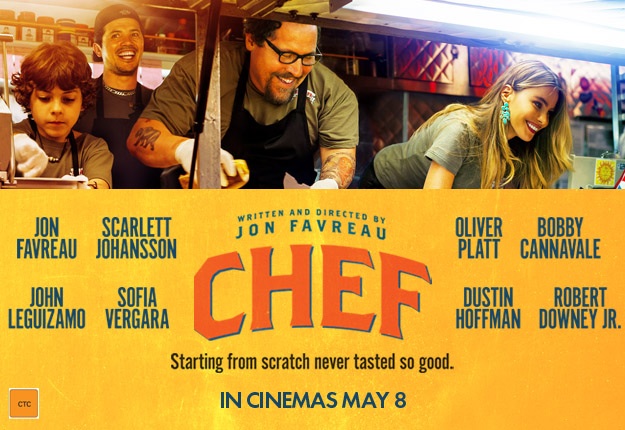
There’s not much to this Jon Favreau film, and it certainly doesn’t break new ground, but it is a charming, dare I say “feel good” comedy about a chef (Favreau) who stumbles spectacularly via the internet and Twitter (one of the funniest memes in the film is Favreau’s cluelessness about social media) and makes a comeback with a food truck. Favreau clearly has great fondness and respect for the subject matter and the loving depiction of cooking is one of several strengths of the film. Others include an enviable supporting cast (Scarlett Johansson, John Leguizamo, Sofia Vergara, Robert Downey Jr., Oliver Platt, Bobby Cannavale and Dustin Hoffman) and an unexpectedly moving but understated father-son dynamic between Favreau and his 10 year old, Percy (Emjay Anthony), worked out on a road trip.
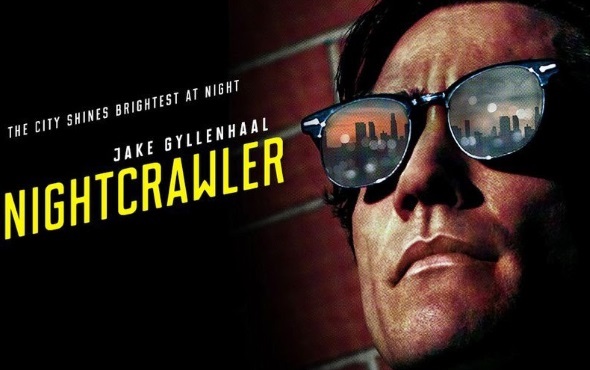
A clever black comedy that emphasizes story over a message (“if it leads it bleeds”), Nightcrawler works in large part to Jake Gyllenhaal’s riveting performance as an aspiring freelance videographer who haunts LA at night, capturing its brutality for sale to local TV news. Gyllenhaal is a mixture of King of Comedy‘s Rupert Pupkin, Rushmore‘s Max Fischer, and Jim Carrey’s Cable Guy, a driven cipher who spouts business motivational doctrine and relentlessly pushes further and further over the line of acceptable journalistic practices in capturing people in crisis or even death throes. You guiltily root for him because he is so compelling and his Dale Carnegie pitch, even unmoored from any concept of morality, comes off as an earnest entrepreneurial pitch. But by the end of the film, a series of tense crime scenes invaded by Gyllenhaal, his philosophy is both corrupting and lethal. He makes it bleed even more that it otherwise would, and as a result, he excels.
It’s a simple tale, well told, but there isn’t a lot to this picture other than Gyllenhaal, who exudes a real inner force (while his character is certainly different, I kept coming back to De Niro in Taxi Driver). He has two co-stars; Renee Russo, a hard-bitten struggling TV producer whose star rises with Gyllenhaal’s footage, and LA at night, which writer director Dan Gilroy shoots as a haunted ghost land of deserted streets and foggy canyons. Gilroy is a longtime writer of pretty bad films (Freejack, Two for the Money, Real Steel), but he directs this thriller with pace and verve.
A romantic comedy set around an abortion requires a deft hand, and there are times when first time writer-director Gillian Robespierre navigates her lead, sweet but spoiled comedian and former SNL alum Jenny Slate, into some questionable waters. Slate is a comic, a regular at a Williamsburg club, who has a one night stand with seemingly buttoned up Jake Lacy. Her “thing” as both a stand up and as a potential mate is to be self revelatory and outrageous, and so we get a full helping of bon mots about vaginal yeast, farts and the like. That can be a little trying, as is Slate’s callous treatment of Lacy.
But it works. Slate is very good, exhibiting the in-between status of a grown woman trying to live her own life and the little girl still vulnerable and attached (financially and emotionally) to her divorced parents. Slate is very much modeled after Lena Dunham’s Hannah Horvath from Girls, with, thankfully, precious little of Horvath’s navel-gazing excess. But when Slate gives voice to her fear and confusion, she is natural and sympathetic. Conversely, when Horvath is flat on her back on on the canvas, you most always feel pretty happy about it. Lacy is also quite touching as the gentle and confused hook-up who warms Slate’s butter pats and brings flowers to Planned Parenthood. He knows that among the smart set, the joke may be on him, but he’s game and his backhand is effective.
While I’m not sure if Robespierre meant for Slate to be only kind of funny, that works as well, because it feels real. She seems like a young comic, still working on material up until the moment she takes the stage, and that contributes to the verisimilitude of her circumstances.
This could have been arch and maybe even preachy. Gaby Hoffman, as Slate’s roommate, comes close to giving a stemwinder against the Supreme Court and society’s “patriarchy” but she is blunted by Slate’s giggles and a mild pushback from a gay friend who retorts, politics aside, that he would want to know if he got someone pregnant.
No matter the edgy subject matter, the end is syrupy sweet and hopeful, paying homage to the rom-com rules.
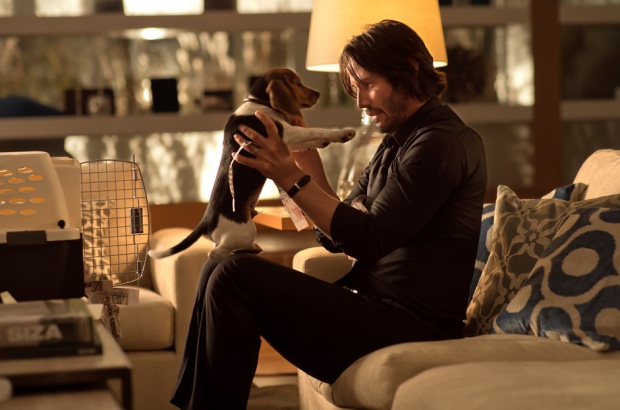
Terrific shoot ’em up, mindless yet smart, thrillingly violent yet tasteful. John Wick (Keanu Reeves) is a retired hitman, at least until the snot-nosed son of New York City’s crime boss steals his car and destroys the last gift given to him by his beloved, deceased wife.
Oh, and then it’s on. The film sports sixty to eighty beautifully choreographed deaths (the co-directors are seasoned stunt coordinators), a few funny lines, and a clever depiction of a criminal underground with its own rules, parlance and neutral Switzerland. Reeves plays Wick straight and dead serious, so we are not tormented by smirks, tag lines or witty asides. And the bad guys are, as they should be, the most interesting characters in the film. If there is a criticism, it’s this: whatever the final count, it’s about 20% over the killings the film should have. Nobody can employ that many henchmen in this economy.
I avoided this film because of an aversion to dramas about viruses and plagues and because I was still shellshocked at the total crappiness of the 1995 Dustin Hoffman vehicle Outbreak (guess what? The military did it!). Unless the eventual outcome of a filmic plague is zombies, 21 Days Later-esque “rage” victims or altered humans ala’ The Omega Man, count me out.
But you’ll watch most anything in a hotel, and Contagion had three extra things going for it – it was the $4.99 special, a few friends recommended the picture and it was directed by Stephen Soderbergh. Despite my reticence, I was treated to an engrossing, intelligent and moving drama about what a 1918-like worldwide plague (where the entire world lost 1% of its population) would look like today. The answer through Soderbergh’s eyes is — not pretty, but not hopeless.
The films starts with poor Gwyneth Paltrow, who is the second carrier of an infection transmitted by touch. Once she is identified as Patient 1 (a Chinese cook is actually Patient 0 – he touched the pig who ate the bat got that started this whole mess, and then he shook Paltrow’s hand), we follow her from China through Chicago and to Minneapolis, where she has touched at least a dozen people And an epidemic starts.
Soon, the government (Laurence Fishburne at the CDC, Bryan Cranston at Homeland Security) swings into action, regular CDC folk (Kate Winslet, Jennifer Ehle) act heroically, an internet crackpot become a messiah (Jude Law), and Paltrow’s husband and many other regular folk have to deal with a paralyzed world. Lawlessness increases because law enforcement is sparse; fear runs rampant; trash piles up in the street; and people hole up waiting for aid and/or a vaccine.
This is a gripping, sober thriller, thankfully bereft of the normal tropes of the genre. The government did not create the virus for military purposes; almost every character is doing the best they can under difficult circumstances; and while society does break down, it also holds up.
All the actors are very good and very believeable. Special kudos to Matt Damon, who continues to be the least-appreciated American actor of his generation. He had the misfortune of being outshined by Jude Law in The Talented Mr. Ripley and Jack Nicholson and Mark Wahlberg in The Departed. They got the nominations and Damon, who carries both films with decidedly more difficult roles, got squat. Here, he serves as the father who has lost a wife and son and seeks to ensure his surviving daughter is not affected while at the same time giving her some life of normalcy. The scene where he is told his wife is dead is particularly moving.
Final note: Gwyneth Paltrow gets the Lifetime Achievement Award for Actress Who Allows Herself to Be De-Glamorized to Best Serve the Role (you’ll know what I mean when you see it).
Martin Scorsese’s surreal nightmare of one man’s (Griffin Dunne) ill-advised late-night trip into lower Manhattan is painfully funny and, at times, genuinely unsettling. Dunne is beset by a quintent of quirky, if not outright dangerous females (Roseanna Arquette, Linda Fiorentino, Teri Garr, Catherine O’Hara and Verna Bloom), a fact that will one day be Exhibit X in his anticipated trial for misogyny. His torture is lovingly photographed by Michael Ballhaus, giving SoHo’s grimy exterior a dream-like quality (and there is no greater horror than being hunted by a mob that has commandeered a Mister Softee truck).
Dunne is very good and much like Steve Carell, except he’s not burdened at all by the imprint of a long-running character, and where Carell is childlike and vulnerable, Dunne is sympathetic, but sexually opportunistic.
Bonus: if anyone asks you, “What movie casts the parents from Home Alone, one of whom went to filmvetter’s high school?”, now you know.
Today, William Friedken’s 1971 Academy Award winner seems better-than-standard cop fare, but this is an extremely influential film, notable for its verisimilitude, grit and movement. Shot on the mean streets and ugly haunts of decrepit New York City, Friedken follows two detectives, Popeye Doyle (Gene Hackman) and Buddy Russo (Roy Scheider), as they try and take down a huge heroin shipment. No prior American film seemed as immediate or aggressive. Friedken’s camerawork is frenetic and edgy, and his virtuoso car chase scene is still one of the best in all of film. Here is Friedken on the chase, which took 2 weeks to shoot.
Friedken’s insistence on visual authenticity extends to Ernest Tidyman’s script. Doyle is a casual racist and a simplistic bully, Scheider a slightly more pleasant accomplice. They are neither archetypes or anti-heroes. They’re just dogged, unremarkable cops. What is a little mystifying is the Best Actor win and Best Supporting Actor nomination for, respectively, Hackman and Scheider. These performances are almost 100% sweat, the equivalent of thespian calisthenics. There is no arc or development, and I don’t believe there has been this much running in any film save for Chariots of Fire, The Gods Must Be Crazy and any film about Steve Prefontaine. Roger Ebert disagrees about Hackman’s performance, writing: “As Popeye Doyle, he generated an almost frightening single-mindedness, a cold determination to win at all costs, which elevated the stakes in the story from a simple police cat-and-mouse chase into the acting-out of Popeye’s pathology.”
Interestingly, Friedken didn’t want Hackman (they fought constantly and as Friedken writes in his memoir, “His outbursts [onscreen] were aimed directly at me… more than the drug smugglers”). But Paul Newman and Steve McQueen were too pricey, Peter Boyle objected to the film’s violence and Friedken’s first choice – Jackie Gleason! – was deemed unsuitable by the studio.
On the heels of Robin Williams suicide, I thought I’d review one his few films I liked. In Gus Van Sant’s drama, written by Matt Damon and Ben Affleck, Williams plays a community college professor and psychologist. With his MIT credentials, he could have been a big deal but was waylaid by love and is now stricken with grief at her passing.
When William is introduced to guide the damaged savant, Will Hunting (Damon), we know that when all is said and done, both characters will have taught each other something valuable about life.
A lot can go wrong here.
But Van Sant keeps it even. Williams is smartly subdued, with no hint of the manic persona that became more schtick and adrenaline than acting. He is patient, picks his spots and elevates much of the film’s schmaltz with real pathos. When he is riled, it feels authentic and raw.
As for the film itself, I’ve always been torn. The concept is smart. A working-class Boston kid is also a genius, sadly mopping floors at MIT, but he finds a way to shine and then falls in love and then, through therapy, grows out of his limiting, Southie world. Van Sant’s direction is inventive (the slo-motion rumble to Gerry Rafferty’s “Baker Street” is particularly nifty, and there are many such cool touches); the exchanges between the Southie pals (Damon, Ben Affleck – again, proving he can be very good in small doses – Casey Affleck and Cole Hauser) are believable, very natural, and often hilarious; there is actual heat between Damon and his romantic interest, Minnie Driver; and Elliot Smith’s musical contributions are hauntingly memorable.
On the downside, while Damon is quite good as the lead, his character is kind of one big cheat. Plagued by his own demons, we are supposed to empathize with Will, but he is a selfish, smug prick throughout, just about every assist you can give a modern protagonist – he’s lonely, he was shuttled from foster home to foster home, he was beaten as a child, his enemies are grotesque caricatures that lack only the villain’s mwahahahahahaha, and yet …
Here, Will goes toe-to-toe a snooty Harvard type:
Obviously, the Hah-vahhhd pony-tail is the bad guy (on the strength of the pony tail alone), but much of the film is sneering at the uptight folks who admire his genius and do him no injustice.
It reminded me of Walker Percy’s The Thanatos Syndrome: “There’s Hawkeye and Trapper John back in Korea. I never did like those guys. They fancied themselves super-decent and super-tolerant, but actually had no use for anyone who was not exactly like them. What they were was super-pleased with themselves. In truth, they were the real bigots, and phony at that. I always preferred Frank Burns, the stuffy, unpopular doc, a sincere bigot.”
So, as the music swells, and Will escapes the clutches of Southie to chase love, I’m pretty sure he’s going to revert to being a smug prick soon enough. Only now, Minnie Driver will be there to socialize him.
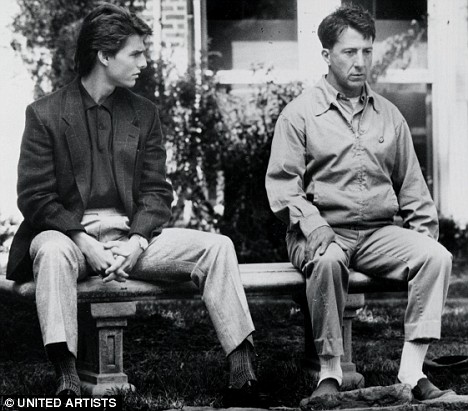
When Rain Man came out, I enjoyed it, but soon came to sour on the film for its easy emotional manipulation and an affected star turn by Dustin Hoffman. I didn’t credit Hoffman the prescience of Robert Downey Jr. in Tropic Thunder (“never go full retard”) and found Hoffman’s portrayal of an autistic adult unsubtle and obvious. Perhaps had I waited until Al Pacino’s blind rampage in Scent of a Woman, I would have been more forgiving.
Pauline Kael called it “a piece of wet kitsch” and I can’t say I could have disagreed. Rain Man has always maintained a spot in the pantheon of overpraised domestic drama Oscar winners that, I assumed, would age very ungracefully (see Forrest Gump, American Beauty, Crash).
Rain Man has hit the schedule on my pay movie channels, and yes, it is emotionally manipulative and yes, it does sport some of the more annoying hallmarks of the 80s (a Hans Zimmer synthesized score that would put him on the map, a few too many montage scenes, a gorgeous and pointless female lead, Valeria Golino, who came and went). But Hoffman’s performance as a hidden older brother to Tom Cruise (Cruise learns of him upon their wealthy father’s death and “kidnaps” him to have an edge in getting his share of the will) is very strong. What unfortunately became represented by cute catchphrases (“I’m an excellent driver”, “10 minutes to Wapner”) is actually a canny, deep portrayal of a tortured soul, and director Barry Levinson never really lets you forget the dangers that lie therein. Much like Bradley Cooper in Silver Linings Playbook, Hoffman is endearing until he is terrifying, and at exactly the moment Spielberg would have inserted treacle, Levinson has Hoffman explode again.
Tom Cruise is even better in his role as Hoffman’s wheeler-dealer, LA smooth brother, Ray. His frustration with Hoffman is communal. His entire performance is a study in anger at Hoffman, not for being denied his loving company or for being shut out by his father, but because Hoffman is an annoying lunatic. “I know you’re in there somewhere,” he screams, and while he undergoes change in his time with the afflicted Hoffman, he does not become redeemed so much as educated.
The film is also very, very funny, perhaps too much so for our times. I can imagine grievance groups objecting to the use of an autistic adult for chuckles, but the screenwriters’ (Barry Morrow and Ronald Bass, the former of whom, like Golino, pretty much disappeared after this film) don’t pull many punches and the exchanges between Hoffman and Cruise are often brutally comic:
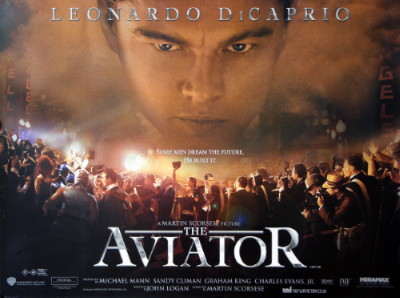
Martin Scorsese’s critically acclaimed biopic of the young-to-middle age Howard Hughes (Leonardo DiCaprio) has much to recommend it. It was the first role that established DiCaprio as a force, and in inhabiting the kinetic, driven and tortured character of Hughes, he was able to shuck off the callowness of his characters in Titanic (Jack London: Teen Wolf!), The Beach and Catch Me if You Can. His time to become a leading “man” had arrived (his attempt at a mature character in Gangs of New York was undermined by the garish nature of the picture, Daniel Day Lewis’s battering ram of a counter-performance and what appeared to be DiCaprio’s own discomfort in the role).
The film is also visually stunning. Scorsese is usually the king of movement in tight spaces, but the sky liberates his eye, and the scenes of flying (there are five) are vast and poetic, and for the ones that end in crashes, utterly thrilling.
When Scorsese is on the ground, the film does not suffer. His glitzy pre-war Los Angeles, where the parties are populated by the likes of Errol Flynn (a jaunty Jude Law) and Ava Gardner (a tough, motherly Kate Beckinsale), are eye-popping.
Finally, the choices of Scorsese and screenwriter John Logan (Gladiator, Sweeney Todd, Skyfall) are adept. Rather than focus on the breadth of Hughes’s life, they opt to show him at his most vibrant, while giving ever-increasing glimpses of the madness that would grip and eventually consume him later in life. For an almost 3 hour film, it’s clear they could have shot for Hughes in the 70s, surrounded by a Mormon coterie and the madness that it protected. By skillfully giving us the symptoms, they economically finish the story.
So, what’s not to like? While DiCaprio and Alan Alda (playing Hughes’s nemesis, the slimy Senator Owen Brewster) were rightfully nominated, though they did not win, so too was Cate Blanchett as Hughes’s love interest Katherine Hepburn, and she actually took home the Best Supporting Actress statuette.
To call her performance cartoonish is a gross understatement. It’s manic, ludicrous mimicry.






 filmvetter