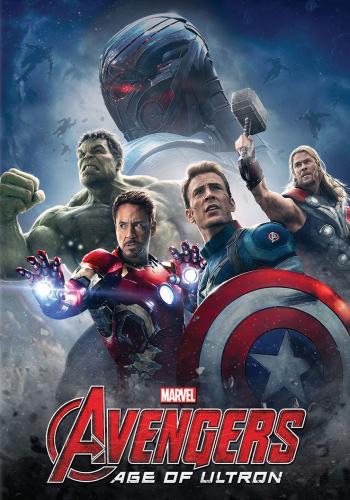
Oof. The first scene demonstrates everything wrong about the movie. Forced patter straight out of How I Met Your Mother, nauseating CGI, dozens of violent acts but no deaths, and not for a minute do you sense that any of the Avengers, outnumbered as they are, are in the slightest bit of danger. Good for kids; good for a parent or adult with a kid who needs a nap; soul-rotting juvenilia for anyone else.
Best part. A friend of Captain America asking if he’s found a place to live in Brooklyn yet and Captain America responding that he doesn’t think he can afford it. Because what’s missing from these films is the Avengers at a cocktail party.
About halfway through this dour documentary about Nirvana front man Kurt Cobain, his widow Courtney Love reveals that at the advent of their courtship, “I had already done heroin, beat the thing, had a rule. I loved it still, but I didn’t have a fantasy that he had. He had a fantasy. His fantasy was, ‘I’m gonna get to $3 million and then I’m gonna be a junkie.'” Nirvana bassist Krist Novoselic echoes Love, observing that drug use was “all part of the package of building a home” for Cobain.
So, halfway in, you learn that the subject of the documentary is a putz, and much to your dismay, he took a crapload of home video in the last few years of his life demonstrating his putzitude. What follows is a lot of dismal footage of a bedraggled, strung out Cobain and Love spouting banality (either under the influence of heroin or not; it’s hard to tell) while holding their baby, which is like watching two winos toss a crystal vase.
Director Brett Morgen does his best to jump up the material, creatively using all of the detritus of Cobain’s life (scribblings, drawings, home movies, cassettes, paintings) to tell his story, but the story is just not that compelling. Troubled kid, broken home, hates “the man”, puts it all into his angry band, big sound, superstardom which is near immediately resented, and then, the repellent creation of a sneering, condescending persona that presents as tortured and deep only by the efforts of rock critics who use phrases like “voice of a generation” (a moniker lobbed up solely to be spit upon by the acid Cobain) and a shotgun. And at the end, Nirvana really was about a sound. It was a helluva sound, I will grant that, but Cobain only made one record that lyrically matched that sound (Nirvana’s last, In Utero).
For the most part, a whole lot of nothing, though for fans, there’s a lot of good early footage.
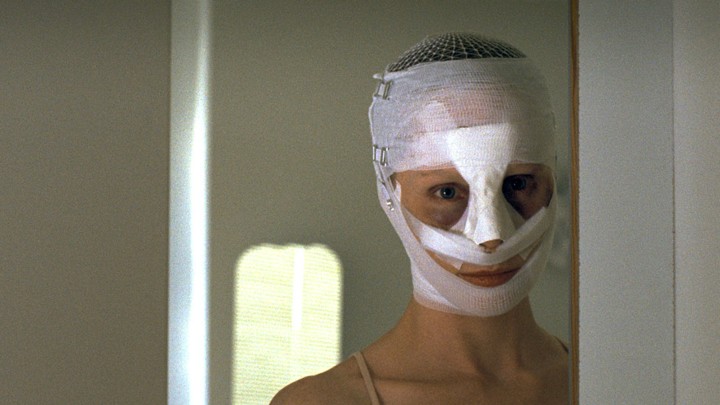
A psychological thriller from Austria that pits two young boys against their mother, who has been in a car accident, undergone facial reconstruction surgery and who, as time passes and the bandages come off, they suspect is not their mother. The critics hailed this (82% on rottentomatoes.com) as rising above genre, both terrifying and revolutionary, but the audience, who scored it at 67%, is closer to the mark. The film starts intriguing (if a bit obvious in it’s The Sixth Sense twist), but soon becomes monotonous, artily sterile, and then simply cruel. I turned it off.
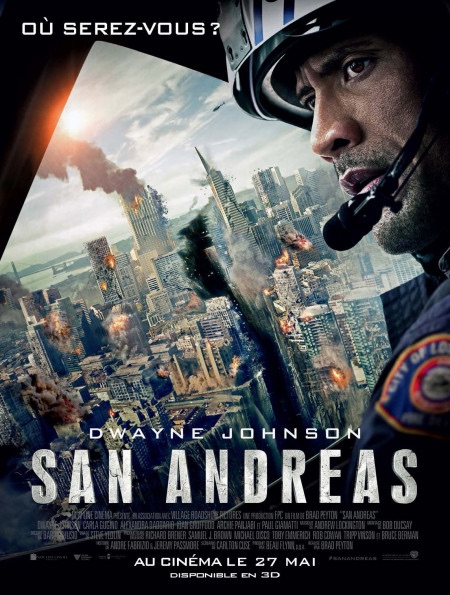
I have an affinity for “the world is ending” movies. None of them are very good and they follow the same model, be it Earthquake, The Day After Tomorrow, Independence Day, Armageddon, 2012, Godzilla and now, San Andreas. Disaster strikes, the warnings of smart, nebbishes notwithstanding. Heroes arise, but family comes first, so Charlton Heston, Dennis Quaid, Randy Quaid, Bruce Willis, John Cusack, Aaron Taylor, and The Rock brave the catastrophe to find and/or save their loved ones. It is in these ordeals that frayed relationships are cemented, so much so that often, new and old spouses have to be dispatched. The children are always saved and mankind perseveres. But their surroundings are ravaged. And as they witness the destruction, they say “oh my God” (twice in San Andreas). Just like Leslie Neilsen in The Poseidon Adventure. Well, not exactly. No one says “oh my God” like Neilsen playing it straight.
It’s the ravaging I love most. The cyclones of The Day After Tomorrow thrillingly rip Los Angeles apart, the same city where those moony hippies with their “we love you, aliens” signs get satisfyingly incinerated and Genevieve Bujold’s house on stilts slides into the canyon below. Godzilla quickly stomped Honolulu and Vegas and nearly took down the Golden Gate Bridge, which – in one of the few cool moments – does not survive San Andreas. Armageddon disappoints for any number of reasons, but foremost is the fact that Willis, Affleck and company save the day. That’s no fun and its best moment is when the pre-meteors obliterate Paris.
Same story, same devastation here, but somehow, San Andreas is worse than the others. It’s as if The Rock decided to use this film as his first true test playing sorrow, and boy is that uncomfortable. So uncomfortable that Carla Gugino, playing his wife, appears to be averting her eyes. While The Rock, recalling the pain of losing their daughter white water rafting, tries to squirt a few out, Gugino plays it rather lightly, as if to say, “hey, The Rock, this is just filler until the next shot of a building collapsing. Don’t be so glum.”
And here we are in San Francisco, but for the most part, the stuff we know is left alone. Instead, most of what gets shredded are office buildings, one of which is not even a real building. Give me Coit Tower! Give me some careening cable cars! Give me Alcatraz or at least the Transamerica Pyramid! Nope. Just nondescript skyscrapers falling listlessly into each other.
Finally, the movie has no sense of humor. None. Not an aside, or an inside joke, or even the thrill of watching something cool, like Paris obliterated. It’s dead straight, serious as a heart attack, except when The Rock and Gugino sky dive into second base at AT&T Field and he says, “it’s been a long time since I got to second base with you.” And then you appreciate the film’s dull seriousness.
A final note. The daughter who The Rock and Gugino cover hill and dale to save (Alexandra Daddario, who played Woody Harrelson’s impossibly beautiful mistress in the first season of True Detective) is so buxom and model-like that it feels exploitative. Yes, parents have daughters that grow up to be busty bombshells, but the first time we meet her, she’s splayed out on a chaisse lounge by the pool, Kardashian-like, and you kind of want her to die. Of course, she doesn’t.
This story of one woman’s journey – a 1000 mile hike along the Pacific Crest Trail – is unfortunately marred by unconvincing dialogue, inconsistent pacing, and an actress not quite up to the task. Reese Witherspoon’s best actress Oscar came after her portrayal of June Carter Cash, a performance that took advantage of her quick wit, common sense instincts, and sunny disposition. She was also able to sing, no mean feat. As the distraught daughter of a mother who died young (Laura Dern), Witherspoon cannot sing her way to our hearts, and de-glamorization and nudity do not sell the fact that she is supposed to have lapsed into a downward spiral of promiscuity and heroin addiction after Dern’s death. There is still too much of Ellle Woods and Tracy Flick in Reese Witherspoon. She doesn’t even curse authentically, much less play a waitress who has sex with two customers in the alley behind her restaurant just because it feels good. The role required an actress with more gut and greater reserves. Meg Ryan, another plucky can-do lead, tried to toughen up later in her career in In the Cut with similar results.
Even with another actress, this film still has real problems. Everyone becomes depressed upon the death of a loved one, but there is no basis to suggest why Witherspoon’s character became so self-destructive. Rather than elicit our sympathy, Witherspoon at times threatens to evoke our scorn. Her choices are presented to us in flashback, in the bedrooms of strange men, with her long suffering friend, in the heroin dens of Minneapolis, or in conversations with her mother, scenes that are supposed to give us insight into how she ended up here. They don’t. Rather, they are too disjointed to tell us much of anything, and we are left wondering “how the hell did she end up there?”
Finally, the film is too new-agey and pat for its own good. Witherspoon reminisces along the trail while inscribing the words of poets at its various check-in stations. She is followed by a mystical fox. She meets people who say wildly unrealistic things (her discussion with a little boy in particular) that are supposed to reflect her singularity and the momentous nature of her trek (she is even dubbed queen of the trail by other hikers). She finishes and tells us in an ego-centrism that lacks any self awareness that it all worked out in the end. Heck, she informs us in voiceover – she even has two lovely kids.
To the good, it is beautifully shot and the beginning of the film, when Witherspoon is starting on the trail wholly unprepared and over-fortified, had promise. I thought she might even get an appendage stuck in between some rocks.
You won’t fall asleep in this picture, and it has a few nice moments (plus very good performances by Rory Cochrane and W. Earl Brown, as henchmen), but at root, this is a hackneyed crime saga that celebrates the dreary over all else.
Sure, it offers a bonanza of Boston accents. There’s the “Downtaaaaaaaaahhhhhhhn Abbey” (Benedict Cumberbatch, as Whitey Bulger’s more respectable brother), the “all-in” (Australian Joel Edgerton, as the FBI agent who utilizes Bulger as a confidential informant), and even the “Robin Hood Costner” (Corey Stoll, as the U.S. Attorney who brings the Bulger crew down; sometimes he does a Boston and sometimes he says, “Eh, fuggedaboutit”), all of which, mind you, are better than the “Kennedy Costner” from 13 Days, which, while we’re talking, was execrable, yet better than the Cajun Costner in JFK.
As fun as it is watching everyone extend there “aaahhhhrrrrrrrrrrrrrrrrrrrs”, they ahhhhhhhrrrrrrrrrrrrrren’t saying anything worth hearing. We are introduced to Whitey Bulger (played by a monochromatic, cloudy-eyed Johnny Depp) on his way up, and that trip is blindingly dull. He is kind to the old women of the neighborhood, he loves his Mommy, he tells his son “if no one sawwwwr it, it didn’t happen” and if you cross him, he comes at you in a gray, humorless, inexorable way. When he does joke, it’s in the Joe Pesci manner of Goodfellas, by which I mean this movie actually has him bully a guy after the guy says something innocuous, only to say, “I had you going there, didn’t I.” It’s hard to say if Bulger was even that good a criminal. They keep telling us he’s mythic and runs all the dirty deeds in Beantown, but as far as I can tell, he made enough dough to live in a shitty house and occasionally go to Florida to watch Jai alai.
Bulger’s way up was paved by the FBI agent, played by Edgerton, so perhaps he’s the story? He turns out to be not much of one. He wants fancy things and he wants them badly, and he’s loyal to Bulger from his Southie days, so we suffer countless scenes of him defending the protection of Bulger as a source of information at FBI headquarters. Kevin Bacon, who plays Edgerton’s boss, pops in repeatedly to say the same things, awkwardly accompanied by Adam Scott sporting a porn ‘stache (Scott’s presence is jarring; you almost expect the rest of the Anchorman gang to follow behind him). As Edgerton grows more desperate, Edgerton’s Boston mugging gets worse.
With accent wars and a story bordering on the torpid, at least we get Boston, no? Not really, Director Scott Cooper (Out of the Furnace) has a fondness for bad 1970s kitchens and office buildings. We get it. Even interior design was ugly in the 70s.
The film has aspirations to Wes Anderson, but you’ll learn quickly, having Bill Murray in your cast isn’t enough. Murray plays an old Brooklyn codger, a man who drinks, smokes, and consorts with a pregnant Russian stripper/prostitute (Naomi Watts, sporting an accent so thick and implausible it would make Gary Oldman recoil and say, “no, no . . . too much”). He also gambles at the track, is in deep with a bookie, and spits in the eye of anyone who might show him kindness. Yet, he’s cool because he listens to a Walkman that plays kitschy 70s pop or Dylan. So rest assured, this guy has a heart of gold. Naturally, when he gets new neighbors (newly divorced and fed up nurse Melissa McCarthy and her impossibly wise yet innocent son Jaeden Lieberher), he opens up a crack, takes the kid under his wing, and to the track, and to the bar, and in the vicinity of the prostitute. Predictable hijinks ensue, but when the son gets the assignment at his Catholic school to find a saint here on earth, well . . . guess who?
It’s a testament to the effectiveness of first time writer-director Ted Melfi that he can get you to well up a little on occasion, but that doesn’t change the fact you want to punch him in his face for manipulating you so brazenly. This is paint by numbers, hip treacle that might make even Zach Braff a little queasy.
Slapdash, clunky and almost obstinately uninteresting, this 90 minute documentary (of which I watched about 64 minutes) tells us nothing about the comedian that we didn’t already know. He was funny, crazy, sweet, insecure and had a large appetite for drugs and alcohol, which led to his untimely death. He was also surrounded by family, friends and colleagues who I am sure had much more interesting things to offer about him than what was presented here, which comes off as generic or even dull. Some amusing childhood remembrances and cuts of some great Saturday Night Live clips don’t make the effort a total disaster, but it’s a tough slog nonetheless. There is not one anecdote that meets the quality of the dozens reported in Live from New York: An Uncensored History of Saturday Night Live. Worse, the quality of the documentary is shoddy. There is a persistent and annoying background musical track, interviewees are filmed in unnatural poses (Farley’s sister gets a side view that is both unflattering and bizarre), and when we see Adam Sandler, the filmmakers find it necessary to remind us in writing the next time he is shown that, in fact, it is still Adam Sandler. Poorly done all around.
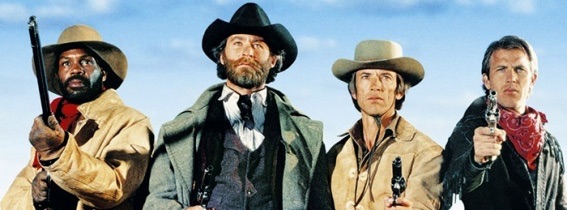
Lawrence Kasdan sought to revive the western, and thank God his vision of it failed. We owe it to better filmmakers who rejected sweeping camera shots, Aaron Coplandesque scores, and stories where you have heroes, villains, and a town that appears both sterile and old-timey. Like a Disney ride.
The film has a few inspired moments. Scott Glen’s opening shootout rising above White Rock, New Mexico is memorable and the final Kevin Kline/Brian Dennehy gunfight in the middle of the windy town rises above the hackneyed. Kevin Costner also showed real personality as Glen’s wild younger brother.
Other than that, it’s pretty awful, made even more silly by the gritty realism that followed in Unforgiven and HBO’s Deadwood. Nobody misses when they shoot, even with a pistol from hundreds of yards away. The town of Silverado also has the best and quickest dry cleaners around, because everyone looks so damn fine in their cowboy get-ups.
“Ladies and gents, The Village People!”
The language and attitudes are as new as the fashion. Danny Glover is enlisted as the proud, honorable messenger of racial tolerance; Roseanna Arquette is the feminist landowner; and Kline is a gunslinger with a sweet disposition towards animals and women (Kline’s casting is peculiar; he seems too nice to be the town barber much less a desperado). It’s all very clean, and for each of our enlightened characters, there are ten chaw-spitting, sneering henchmen to assure us of their goodness (including Jeff “Evil Eyes” Fahey).
Downton Abbey is a hugely successful period British soap opera that is anachronistic, predictable and overwrought. The Imitation Game is Downton Abbey for the movies. Alan Turing (Benedict Cumberbatch) is the Sheldon Cooper of World War II; brilliant, odd, effeminate and humor impaired, and he is tasked with cracking the Nazi Enigma code. He does so, with the help of Keira Knightley and Matthew Goode and an actor from Downton Abbey, all the while struggling with his sexuality, his anti-social personality and a race against the clock.
There is not much in the film that isn’t expected. After alienating his colleagues, Turing wins them over. After being quirky, we are charmed and in his corner. After connecting with a teen friend in boarding school in flashback, the boy dies. After that boy tells Turing, “Sometimes it is the people who no one imagines anything of who do the things that no one can imagine,” that line is delivered again and then again. After the team cracks the code, they immediately pinpoint the location of every ship in the Atlantic and deduce that a passenger ship is in danger, but they can’t save it, because it would give their achievement away to the Nazis, and then, it turns out the brother of a team member is on the ship in danger, and he tells Turing he can’t be God.
Cumberbatch is good in parts, but it is a mannered, tic-laden performance, one that eschews every one of the relationships he is supposed to develop. You don’t believe he has bonded with his co-workers and you sure don’t believe he and Knightley have established an intellectual kinship. Curiously, Turing’s homosexuality is successfully used against him – when he discovers a Soviet spy in his midst, the spy threatens to reveal Turing’s sexual orientation and Turing clams up. And how did the spy come to learn Turing was gay? When Turing became engaged to Knightley to keep her on the team, after treating his sexuality as a state secret, he rather comfortably tells the spy his personal business.
Another problem is the insistence on establishing a suffering symbol for homosexuality, a dramatic decision that has plagued African American characters in historical films for eons. The real Turing was pretty openly gay with his co-workers, even coming on to several male colleagues. Now that is interesting. But we need a noble victim here so, let’s just forget the stubborn and inconvenient facts. It is one thing to amp up Turing’s role in creating the device that breaks the German code. It’s another to change his very essence to deliver us our important lesson.
But its British, it’s topical, it has sweep and it is a tragedy anchored by Cumberbatch’s Oscar bait tears and quivers. So, it is heralded. But when it is not being ridiculous and ahistorical, it is pedestrian.







 filmvetter