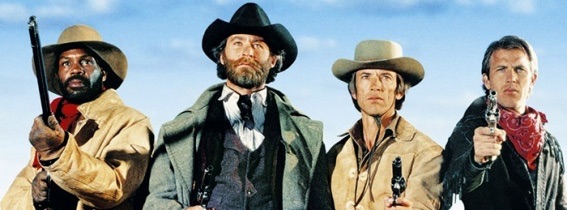
Lawrence Kasdan sought to revive the western, and thank God his vision of it failed. We owe it to better filmmakers who rejected sweeping camera shots, Aaron Coplandesque scores, and stories where you have heroes, villains, and a town that appears both sterile and old-timey. Like a Disney ride.
The film has a few inspired moments. Scott Glen’s opening shootout rising above White Rock, New Mexico is memorable and the final Kevin Kline/Brian Dennehy gunfight in the middle of the windy town rises above the hackneyed. Kevin Costner also showed real personality as Glen’s wild younger brother.
Other than that, it’s pretty awful, made even more silly by the gritty realism that followed in Unforgiven and HBO’s Deadwood. Nobody misses when they shoot, even with a pistol from hundreds of yards away. The town of Silverado also has the best and quickest dry cleaners around, because everyone looks so damn fine in their cowboy get-ups.
“Ladies and gents, The Village People!”
The language and attitudes are as new as the fashion. Danny Glover is enlisted as the proud, honorable messenger of racial tolerance; Roseanna Arquette is the feminist landowner; and Kline is a gunslinger with a sweet disposition towards animals and women (Kline’s casting is peculiar; he seems too nice to be the town barber much less a desperado). It’s all very clean, and for each of our enlightened characters, there are ten chaw-spitting, sneering henchmen to assure us of their goodness (including Jeff “Evil Eyes” Fahey).
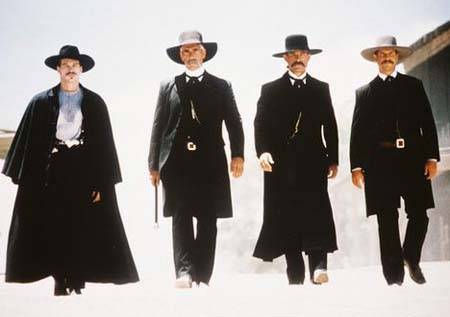
I only thought of this film because of Deadspin’s ode to Val Kilmer’s Doc Holliday, and on reflection, Kilmer’s performance is not only the best thing about this western, it’s the only good thing about it. Thus, to have one performance account for 2.5 stars – that’s really something. But Kilmer’s languid, dissipated Holliday is a treat to behold. He is having a blast with the role, and while everyone else is somber or uncomfortable (or both), he chews and chews and chews.
Unfortunately, no one else (except perhaps Powers Boothe, who actually twirls his mustache as the evil leader of the redlegs, Curly Bill) is having any fun. The Earps (Kurt Russell, Sam Elliot, Bill Paxton) are dull as dishwater, particularly Russell as Wyatt, who decides that fury and blue eyes will see him through. The villains, and there are scads of them from any number of sitcoms, look like they’re at cowboy camp. In fact, this whole movie has a certain slipshod, Eagles photo-shoot for Desperado quality to it.
The women are weak as well. As Kilmer’s moll, Joanna Pacula is just a hair shy of the cartoon Natasha, and Dana Delaney as Wyatt’s love interest lacks the lustful lure necessary to break down a rigid lawman. Delaney is a school marm, not a vamp; she doesn’t sizzle so much as reach room temperature.
Director George Cosmatos’ best efforts besides this leaden dog are Stallone vehicles, Cobra and Rambo: First Blood Part II. After Tombstone, he got one more feature (a Charlie Sheen vehicle) and that was that (he died in 2005). After Tombstone, which is a pedestrian, forgettable, script, writer Kevin Jarre penned The Devil’s Own and The Mummy and, again, that was that.
But oh what Kilmer does with what he’s given:
The charms of the character are legion. As explained by Kilmer in a recent interview:
So Bob Dylan loves “Tombstone”, It turns out. I found out he was in New York so I called my friend and I said you know, I’d love to meet him, is there any chance and he says, “I don’t know, I’ll find out.” And the next call I got I thought was going to be my friend, but it wasn’t, it was Bob.
I was real excited, like a crazy fan, like a child; it was so great. Basically it was like nothing. It was like we were old friends, it was like “you want to come over?” and he was like, “yeah.” So, hangs up the phone, I was newly married and we had a baby and I went in and said “I think Bob Dylan’s coming over…I’m not sure, it could be a hoax…”
He shows up and sits down and he wants to talk about “Tombstone”, but I just can’t, you know, nor can I talk about any of his stuff. Eventually he says, ‘ain’t you going to say anything about that movie?’ and I said, “do some ‘Blowing in the Wind’ and I’ll…”
That’s what I said to him, basically I said no. I get like that sometimes. So I turned him down and, I thought, no one turns this guy down. Anyway, I felt like an idiot afterwards, well, yeah I could have said a few lines. They’re fun lines too, like people still ask me to say lines and now I’ll tell any schmo in the airport, I’ll say “I’m your huckleberry”, but I wouldn’t say it Bob Dylan!
I felt so bad about it. I was like how could I make it up to him? So what I did was, I recorded “It’s Alright Ma, I’m Only Bleeding” but as Doc Holiday and I put in all of the big lines from the movie into the song and made him a little tape
Was John Wayne being an old Green Beret stick-in-the-mud when, after seeing High Plains Drifter, he wrote to its director and star Clint Eastwood, “This isn’t what the West was all about. That isn’t the American people who settled this country”?
Wayne was never a lover of nuance, and he had little patience for depicting the darker side of the American psyche, as is evident from his evaluation of another film: “High Noon was the most un-American thing I have ever seen in my whole life. The last thing in the picture is ol’ Coop [Gary Cooper] putting the United States marshal’s badge under his foot and stepping on it. I’ll never regret having run [screenwriter Carl Foreman] out of this country.”
Eastwood second directorial effort was released in 1973, and he wasn’t interested in Wayne’s myth. It was a time of callous selfishness and a vicious appraisal of the institutions so revered by Wayne, hardly the environment for an uplifting Western about the strong stock of the frontier.
Eastwood’s story of a drifter returning incognito to the town that ran him out via a brutal whipping is assured (he was clearly taking mental notes when directed by Sergio Leone and Don Siegel with this bizarre, even trippy revenge flick). It is also supremely cynical. Nearly everyone in the town is guilty of either directing the whipping or standing by when it happened, frauds and cowards all, and these villains unwittingly give Eastwood a run of the place so he’ll protect them from the very same thugs (newly released from prison) the town set on Eastwood. Eastwood enjoys the power, as well as sticking it to townsfolk for their hypocrisy, per this exchange with a preacher upbraiding Eastwood for evicting people from the town hotel:
PREACHER You can’t turn all these people out into the night. It is inhuman, brother. Inhuman!
EASTWOOD I’m not your brother.
PREACHER We are all brothers in the eyes of God.
EASTWOOD All these people, are they your sisters and brothers?
PREACHER They most certainly are!
EASTWOOD Then you won’t mind if they stay at your place, will ya?
PREACHER All right, folks, let’s go. Put your bags here. Friends, don’t worry. We shall find haven for you in our own homes… and it won’t cost you one cent more than regular hotel rates.
But let’s not dismiss that old fuddy duddy Wayne out of hand. High Plains Drifter is also groundbreaking in a different, uglier way. Eastwood’s character rapes a woman in the first 15 minutes of the film, yet his status as the anti-hero is none the worse for wear. While she was a complicit bystander in his whipping, even cheering, when she tries to shoot Eastwood (and misses), he asks, “I wonder why it took her so long to get mad?” to which a character replies, “Because maybe you didn’t go back for more.”
Compare and contrast Wayne: “I want to play a real man in all my films, and I define manhood simply: men should be tough, fair, and courageous, never petty, never looking for a fight, but never backing down from one either” and you can better understand his distaste.
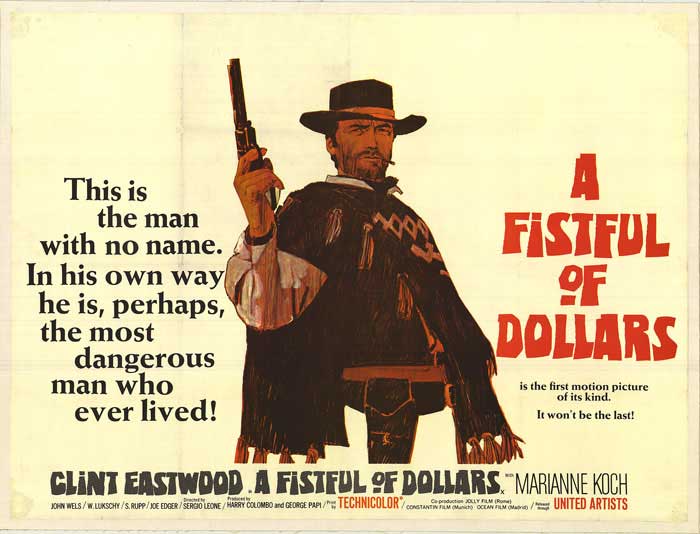
The first of Sergio Leone’s “Spaghetti Western” trilogy with Clint Eastwood’s “Man with no Name”, A Fistful of Dollars was actually shot in Spain.
I guess “Paella Western” wasn’t an option.
Eastwood comes to a town at war. Two families seek the upper hand, and Eastwood shuttles between one and the other for the cash.
As fun as it can be, the movie is stilted. Leone’s visuals are ambitious but his sweep is not yet broad, and like Sean Connery as James Bond in Dr. No, Eastwood is still working on his persona and lacks gravitas (interestingly, Eastwood was Leone’s eight or ninth choice, behind Henry Fonda, Charles Bronson, James Coburn and others). The entire cast, Eastwood excluded, is foreign and the dubbing is spotty (in the case of a crying child, I was immediately reminded of the dubbing in the Japanese animated series, Speed Racer).
This film ends up being a critical warm-up to the better For a Few Dollars More and its classic follow-up, The Good, the Bad and The Ugly.
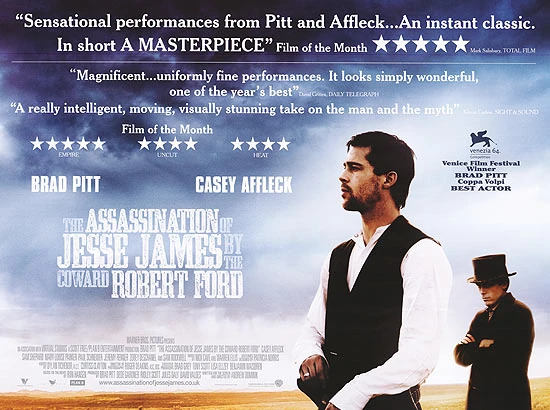
Andrew Dominic’s moody, elegiac picture melds Terence Malick’s imagery from Days of Heaven and Walter Hill’s sense of time in The Long Riders. As Ford, Casey Affleck is mesmerizing, and Brad Pitt’s depiction of James as a manic-depressive sociopath is chilling. Their performances are enhanced by Dominic’s sweeping, beautiful vistas (the film drew an Oscar nod for best cinematography) and a mournful score courtesy of Nick Cave and Warren Ellis.
A $30 million western without a single shootout (at least, one involving Jesse James) is destined to make a mere $3 million back domestic, but this film is more about hero worship, fame-seeking and insecurity than the violent exploits of the James gang. Affleck, who was nominated for best supporting actor, subtly communicates living in the shadow of Jesse James, traversing the path from awe for a legend, to anger over his idol’s coldness and indifference, to maturation and resolve as James becomes more suspicious, mercurial and dangerous. Ford’s likening of himself to James in the great killer’s presence, which can be found below, is startling in its honesty and vulnerability.
Affleck and Pitt receive strong support, including Jeremy Renner and Paul Schneider as feuding gang members, but as ever, Sam Rockwell near steals the picture as Charlie Ford, playing dumb but in truth, whipsmart and canny. Garret Dilahunt (Deadwood) is also resonant as a doomed and dim Ed Miller.
Upon first review, I wrote, “a glaring fault is an unnecessary voice over narrative, the voice being similar to that of David McCullough. The effect is redundancy and a PBS/History Channel vibe.” I also gently criticized the picture on its length. I recently saw it again and I was wrong on both counts. The voice over is not obtrusive nor is it merely aping what is happening on screen. Rather, it enhances the film’s tragic nature (this is a ghostly western and a movie about one of the first celebrity screw-ups) with an explanation as to how it fits historically and personally. And I was sorry to see it end no matter how long it ran.
A barely competent remake, James Mangold’s follow-up to Walk the Line pits brutal and charming highwayman Ben Wade (Russell Crowe) against desperate and pitiful rancher Dan Evans (Christian Bale). Bale is scratching a living out of the barren Arizona earth, debilitated by a war injury, harassed by a businessman who wants his land for the railroad, and scorned by a 14 year old son (Logan Lerman) who thinks his father is a coward. When his path crosses with Crowe, Bale takes the high-paying gig of joining a crew ferrying Crowe to town and on the train to justice, harried the entire way by Crowe’s gang, led by Charlie Prince (Ben Foster). Unfortunately, Bale is so stolid he borders on dull, and Crowe’s lethal charm is in short supply, though he does have a moment seducing a local barmaid.
Mangold keeps the story crisply moving and his action sequences are first-rate. While the leads don’t shine, the support is strong. Foster’s serpentine, scary right hand is matched by the crusty and seemingly indestructible Pinkerton subcontractor Peter Fonda and the precise Dallas Roberts as the main Pinkerton and leader of the endeavor.
The film, however, is nearly undone by an implausible ending wherein Crowe and Bale bond through a series of mutual confessions (Crowe’s mom abandoned him, Bales was shot by his own man in the war, and Bales’s son is sick with tuberculosis) and Crowe repents, assisting Bale in his own ferrying to the hangman’s noose.
Quentin Tarantino’s Achilles heel is his immaturity and obsession with genre. Be it Japanese ninja films or 70s drive-in schlock, his bad pictures (and the Kill Bills and his contribution to Grindhouse are bad pictures, “fear of not being hip” critical acclaim notwithstanding) are foreordained by his choice of an homage to shit, which merely produces higher caliber shit.
Hence, my trepidation walking into Django Unchained. Fortunately, spaghetti westerns are stronger source material than Japanese ninja crap and American drive-in crap, and Tarantino doesn’t become engulfed by this particular genre. Sergio Leone is ever present, but the picture does not attempt to ape or glorify his work. Tarantino also adds humor with a very modern sensibility. Finally, Christoph Waltz, who electrified Inglorious Basterds and collected a well-earned supporting actor Oscar for his work, and Leonardo DiCaprio, who embodies oily, smooth charm and venom, elevate the material, so much so that when they are absent from the film, you can hear it leaking air.
Django (Jamie Foxx) is a slave freed by a bounty hunter (Waltz) who needs Django to identify some targets. A partnership develops and soon, the duo endeavor to retrieve Django’s wife (Kerry Washington) from Mississippi slavemaster DiCaprio and his conniving house master (Samuel L. Jackson). Cartoonish, bloody, often wildly funny, and fast-paced, Django would have scored higher save for a tacked-on ending that adds a wholly unnecessary 25 minutes to a film that was satisfyingly concluded. Worse, it is in these 25 minutes that Tarantino the actor appears, with a befuddling Aussie accent, to jerk the picture to a standstill. From there, surreal becomes outrageous and outrageous becomes boring.
Still, what precedes the unsatisfying ending is a blast, part blaxploitation revenge fantasy, part loving tribute to Italian westerns, and part sly, broad comedy (the scene where a posse of pre-Klan night riders argue over the utility of their white sheet hoods is more Blazing Saddles than Once Upon a Time in the West). Best, professional scold and Knicks fan Spike Lee, who I understand used to have something to do with filmmaking, is not amused by the melding of a slave story and a western When Lee is up in arms, it is a strong endorsement indeed. Lee’s criticism is almost as stupid as the Village Voice‘s defense of Tarantino’s use of the word “nigger” (over 100 times) on the grounds of historical accuracy. Even if that word hadn’t been used in the Mississippi of 1858, Tarantino would have used it nonetheless, for two reasons. First, he loves that word, and he loves it most when uttered by Samuel L. Jackson. Second, just to spite Spike.
Walter Hill is a workmanlike director. He makes some decent and intriguing films (The Warriors, Southern Comfort, Geronimo), and a fair amount of bad ones (Red Heat, Last Man Standing, Extreme Prejudice) and good or bad, the pictures are little more than macho shoot ’em ups where brawn and bullets win the day. Hill’s commercial pinnacle was probably 48 Hours, the buddy-cop film that vaulted Eddie Murphy into the stratosphere.
The Long Riders is his masterpiece. The story of the James-Younger (and Miller) gang, Hill cast the Keaches as Frank and Jesse James, the Carradines as the three Youngers, and the Quaids as the Millers (he also throws in the Guest brothers as the duo who eventually shoot Jesse). It comes off not in least bit gimicky. Hill comfortably alternates the mythic and the mundane about the brothers, and there is a naturalness to the interplay between the men that makes every scene easy and true. Brothers in life portray convincingly as brothers in film.
Hill also provides a rich facsimile of Peckinpah-style screen violence, while setting forth a keen depiction of rural tradition and family loyalty . His scenes in the Missouri woods, while the gang hides out, are well-crafted and authentic, his Texas bar fight by Bowie knife is inspired Western legend, and the Northfield, Minnesota bank debacle is unforgettably haunting. Hill shoots high speed escape by horse interspersed with slow-motion shots of the gang being shot up, commensurate with an eerily slow-soundtrack that purports to track the actual bullet and its impact above the slooooooow distorted sounds of hoof beats, screams, horse whinnies, and thuds. The scene is bravura, a milestone in action filmmaking.
The tensions between the gang, and the brothers, are summed up in the woods outside of Northfield, where Frank and Jesse -w who can move – and the Youngers, who are too shot up to escape, say their bitter yet still faithful farewells, most of it non-verbally.
The best feature is Pamela Reed as Belle Starr. She steals the movie from the brothers, presenting as of the time. Reed is not beautiful by a long shot, but her strength is undeniably alluring. Her exchanges with Robert Carradine are memorable, especially the second one, as she sits, dressed to the nines on her carriage in the street, uninvited to a Younger wedding.
I love this picture because it has one foot in the myth of the West and another in its grimy, brutal reality, it is at once entirely unsentimental and yet, through the understated depictions of the family, moving.
The cynical Western of the 70s has a few decent entrants. The Ballad of Cable Hogue and The Life and Times of Judge Roy Bean come to mind. Butch Cassidy showed it in sleek form (though it was released in 1969), and The Wild Bunch was the birth. Richard Brooks’ Bite the Bullet is a lesser work, a film that doesn’t catch its stride until well into the last third, giving you precious little to savor until that point.
Essentially, the film is a turn of the century Cannonball Run. A disparate cast of characters comes to town to run a 700 mile race. There’s the gambler looking for his last big score (James Coburn – in a nice touch, he is introduced kicking the boot of another character, just as he had his boot kicked in The Magnificent Seven), the wild young kid looking to make a name for himself (Jan Michael Vincent, pre-crack up), the mysterious ex-whore with a heart of gold (Candice Bergen), the proud and quietly suffering Mexican (some Mexican guy), the over-the-hill man looking for his place in the era (Ben Johnson), and the sporting English gentleman (some English guy).
Off they go, with Gene Hackman to round them out. Hackman is a pre World War I man of the ages; he loves animals (if this wasn’t the forerunner to Robert Redford in The Electric Horseman, I’ll eat my Willie Nelson records, an empty threat for I own none). He is kind to women and whores, treating them as equals. He is a civil rights advocate, and he even is a little anti-war. This is the story, and the characters live and learn – and become better people for it – through the grueling marathon.
The script has some punch, but is mostly leaden. You’ll find that Coburn quoted Bible verse well-ahead of Samuel L. Jackson in Pulp Fiction and someone punched an animal on film before Alex Karras in Blazing Saddles. You’ll suffer through “I’ve forgotten how good a bad women feels” and “Killin’ a man don’t prove you’re a man” (delivered unconvincingly by fashion model Bergen) but you’ll also enjoy “Why don’t you tell me the story of your life. Just skip everything until the last few minutes.” Particularly good – the whore who asks Hackman pre-coitus, “How do you like it?” – to which he retorts, “Without conversation.”
Coburn and Hackman are fine, but they aren’t exerting themselves, and you see in their performances a defter Mel Gibson/Danny Glover tandem, with a bit more grit and dust. Bergen is invisible, as should be expected. She is the Andie MacDowell of her age (Raquel Welch did better in Hannie Caulder and that’s saying nothing).
Brooks’ direction is workmanlike and uninspired (he is, after all, a workmanlike and largely uninspiring director, with credits from Cat on A Hot Tin Roof to Elmer Gantry to Looking for Mr. Goodbar). That said, he reaches a few moments of renown. In one sequence, he effectively uses slow-motion to depict a horse sprint between Coburn and Vincent. Vincent is losing, and his horse is fading, so Brooks splits the screen for effect (not split by a bar, ala’ The Boston Strangler, but split so that Coburn and Vincent are side-by-side), but Brooks keeps Vincent in slow-motion, while Coburn remains in real time.
Alex North’s score was nominated for an Academy award. I cannot see why. It is a bad Aaron Copland copy, and in that Copland has been used rather freely, from The Magnificent Seven to Spike Lee’s He Got Game, the cheap facsimile (replete with orchestral diversions into standard American ditties) was hardly necessary.
It’s hard to explain the kind of bad that Appaloosa is, but it is cemented at the end of the film, during the credits. First, we get a nifty Tom Petty song. Then, a warbling, low, off-key Johnny Cash rip-off sung by none other than Appaloosa star, writer and director Ed Harris. Much is explained.
Harris has essentially made Kevin Costner’s Open Range, but a very bad version (and Open Range ain’t no masterpiece). Whereas Costner and Robert Duvall were authentic and had chemistry, Harris and his partner, Viggo Mortenson, are all about studied cool (Harris actually tells Mortenson that he is not as fast as Harris because he is “emotional”). Whereas Open Range sported an appropriately weather-beaten and weary Annette Bening as the love interest, in Appaloosa, we get Renee Zelwegger, who is quirky and hopelessly out-of-place. Whereas the villain in Open Range was the scene-chewing, vicious and bloody Irish cattle baron played by Michael Gambon, in Appaloosa, we get Jeremy Irons, who is of indeterminate origin, and who is a little more convincing as a gun hand than Don Knotts. Finally, Appaloosa is chock-full-of anachronistic dialogue, and much of the time, it is just plain boring. Whereas, Open Range managed to redeem some of its faults with crisp and thrilling scenes, such as the final shootout.




 filmvetter