Archive

Genre

I watched Thor with my son on Father’s Day (we trolled Netflix streaming for choices).  Thor (Chris Hemsworth) is cast from the heavens, in part for his hubris and in part due to the machinations of his conniving, “why does Daddy love you more?” brother Loki (Tom Hiddleston).  Thor ends up near Area 51 sans power, and while here on earth, gets shamelessly mooned over by Natalie Portman (she’s supposed to be the geeky, withdrawn scientist type – riiiiiiiiight), learns the meaning of humility and heads back to the heavens to settle somie scores and show some sacrifice.  I should have seen this before The Avengers for absolute continuity but no matter – neither film suffered for my error.   The action sequences are brisk but not  so overhwelming as to cause fatigue and there are some good lines.  Portman is ridiculous in her portrayal of a women of science made weak in the knees.  She positively swoons.  Still, It was good, clean, mindless fun.   

Of course, Thor has some issues with protocol here on Earth:

I did that last night at dinner with my water but it wasn’t as funny.  Father’s Day can only forgive so much.

Ridley’s Scott’s prequel to the Alien series fares much better than troubled installments 3 and 4 (which were not directed by Scott).  It does so without reliance on the now famed Alien monster or creation of another “haunted house in space” where the crew is picked off one-by-one.  Instead, Scott’s film opens with an ambitious recreation of the demise of our creators (or, at least, our forefathers).  In 2089, two scientists (Noomi Rapace and Logan Marshall-Green) deduce that disparate human societies with no connection and at different intervals in the world’s history communicated with another species (or is it?) from space.  So off they go, with another crew on an epic journey to discover from whence we came.  A cool Charlize Theron is in charge of the vessel Prometheus, but the ship is helmed by the down-home Idris Elba and it is guided by an android, David (Michael Fassbender).  They find what they are looking for but it is not what they thought, and Alien is born.

For what could have been a ponderous big idea picture, this movie is very tight, and if never quite as horrifying as Scott’s first movie, it is tense, scary and moody.  The feel is enhanced by a brooding, foreboding Marc Streitenfeld score.  Moreover, the characters feel gritty and realistic and each adds nice touches to roles that could otherwise have been stale.  Elba’s Stephen Stills-liking captain of the ship is an old soul; Theron’s corporate master hides a sense of humor; and Fassender, to whom one of the scientists makes a Pinnochio-reference, is half-boy in wonderment and half-efficient, emotionless machine, a worthy addition to the fine line of Alien androids who came before:

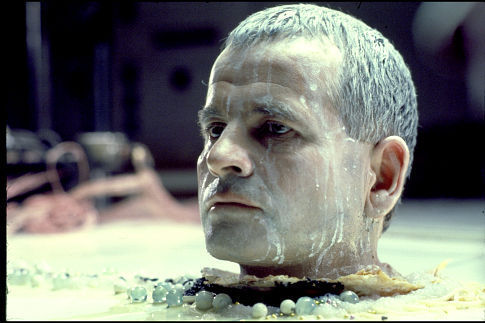
Alien (1979)

Ian Holm

Lance Henriksson

Scott also cleverly borrows from his own Blade Runner in the portrayal of David, who doesn’t possess Rutger Hauer’s maniacal desire to find his creator but does show more than a passing interest in the subject matter.

The script provides some explanation for why we started creating androids who are more than automatons:

Charlie Holloway: David, why are you wearing a suit, man?

David: I beg your pardon?

Charlie Holloway: You don’t breath, remember? So, why wear the suit?

David: I was designed like this, because you people are more comfortable interacting with your own kind. If I didn’t wear the suit, it would defeat the purpose.

Charlie Holloway: Making you guys pretty close, huh?

David: Not too close I hope.      

Scott bites off a little more than he can chew by adding an unnecessary twist at the end, and thereby rushing some scenes that could have been better developed.  It also has a few silly notes, like throwing in Rapace’s inability to get pregnant and having Rapace tell a crewmember he can’t bring a weapon because the mission is scientific . . . and he complies.  Come on!  Doesn’t he know that in space, no one can hear you scream?

Otherwise, it’s a very good picture, enhanced by the 3D.


This documentary is directed by Carl Colby, the son of the subject, former CIA Director William Colby. In all likelihood, therein lies the problem. Carl is torn as to which themes to stress, much as he is torn by the legacy of his father.  He settles on three.  First is a straight up documentary about a clandestine Cold Warrior who saved Italy from Communism and was critical to the Phoenix Program, eventually rising to the directorship of the CIA, where he was battered by Congress’s withering post-Watergate assault on the Agency.  Footage from Italy, Vietnam, and congressional hearings is provided, along with interviews of numerous members of the American power structure at the time, including Donald Rumsfeld, Bob Kerry, Bud McFarlane.  Bob Woodward and many others. This part is occasionally interesting, but since critical emphasis is placed elsewhere, the historical report lacks any real depth.

Carl Colby also presents a portrait of his family, with the strict and moralistic William Colby at the head, his wife Barbara at his side, as they were stationed from post to post. The interviews with Barbara Colby are affecting as she explains how her husband worked and the impact of Catholicism on his personality, and there are some charming vignettes, but we don’t get much of a sense as to how Colby interacted with anyone in the family.  Occasionally, Carl’s voiceover expresses disappointment about his father’s secretive nature, but there are no real insights.  Carl drops hints of various issues (an epileptic and anorexic sister, a late in life divorce), but they are only given the most cursory treatment (we never learn that, in fact, the sister died in 1973).  For a man “nobody knew,” secrets are to be expected, but we should get better from a son. 

Carl offers a third, more personal theme – the effect of having such a mysterious and enigmatic father. This aspect of the film is the weakest and most awkward. Very abruptly at the end, we’re informed that in 1996, Colby took a canoe from his Southern Maryland home after dinner and was found days later, dead.  The coroner concluded that Colby drowned after a stroke or heart attack. Carl does not provide an alternative theory though he strongly suggests the miserable, guilty William Colby did himself in, after some wine and clams(?)  Carl has been quoted as saying, “Call it whatever you like. I think he’d had enough of this life.”

Carl tells us – as he has in some form or fashion throughout the documentary – that Daddy wasn’t there for him, intoning, “I’m not sure he ever loved anyone and I’m not sure I ever heard him say anything heartfelt.”   Given the limited presentation, and in particular the absence of remembrances from William Colby’s other 3 children and his second wife, Carl’s view strikes me as unique.  Indeed, Carl told The Washington Post “I preferred the old dad, not the new . . . The old dad taught me how to sacrifice. The new dad . . . was just an ordinary guy with ordinary desires.”  That says a lot.  It is as if Carl has settled on his father as a dark, tortured soul and the coda to his life – a love affair with another woman that lasted 13 years that was by all accounts happy – didn’t fit his meme, so he ignored it.

The Shining (film) - Wikipedia

First things first.  I took my son to see The Shining at the American Film Institute Theater in Silver Spring, Maryland (they are running a Jack Nicholson retrospective).  The theater is ornate and massive and brings back the feel and style of the old movie house.

But not even the hallowed ground of a theater honoring film can persuade people to behave in a respectful fashion during a movie.  We had two fools in the front who found particular dramatic scenes funny and laughed and laughed and laughed . . . and laughed some more.  We also had two couples to our right who presumed if a character wasn’t talking, that was their cue to talk.  Stanley Kubrick films have long stretches of no dialogue.

Going to films is more and more difficult given the crude behavior of movie patrons, who cannot shut th f*** up, are now eating full meals during the show, and are otherwise oblivious to anyone around them.  Worse, those who are quiet, including myself, are often forced to simply accept the noise.  I have interceded a few times.  It has worked less often than not, because if you correct a young person in public, apparently, that is a humiliation too great to endure, and what follows is aggression and louder “I paid my ticket” talking.  Now, I’ve made the film less enjoyable for additional rows.

Okay.  To the movie.  Kubrick’s picture is methodical and creepy,  It opens abruptly with an aerial shot of Jack Torrance (Nicholson) driving for his interview at the Overlook Hotel to an ominous electronic score (think John Carpenter).  Torrance gets the job as the hotel’s winter caretaker, where he esconces his timid wife (Shelly Duvall) and his son (Danny Lloyd), who has the ability to see visions and occasionally communicate with like-talented people (i.e., he “shines”) such as the hotel’s head chef, Scatman Crothers.  Danny’s ability is also telling him that the Overlook Hotel is dangerous, a fact Crothers confirms.  Soon, the hotel insinuates itself into Torrance’s mind, turns him against his family, and he goes berserk.

The film is very scary, often terrifying.  Kubrick gives us the time to get to know the family, and all is not well:  Torrance has had recent problems with drink, injuring Danny in the process.  He is also a condescending prick, which in turn makes his wife more jittery, which in turns makes Torrance angrier and more removed.  With this fodder, the spirits of the hotel work themselves on Nicholson.

The imagery is unforgettable, be it Danny riding his big wheel (tracked by stedicam) through the halls of the Overlook, only to bump into gruesome visions, or the forbidding snow-covered hedge maze, the locale for the final scene.  Lloyd is very good:  he is withdrawn but sweet, trying to deal with a wretched home life and an amazing but confusing gift.  Duvall, whose performance has been criticized as annoying (she was nominated for a Razzie), is, in fact, very annoying, but it is a great performance nonetheless.  She is trying to hold the family together, as Nicholson is trying to destroy it, and her worry feeds his suspicion.  The hotel has to work on something; it has to find an “in” to get to Nicholson, which it does through Duvall, who is nervous and peppy and cloying.  Obviously, she doesn’t deserve to be murdered.  But the spirits of the hotel don’t need to much to convince Nicholson.

The only partial negative is Nicholson.  He’s very good as a man driven to insanity, but the performance has two faults.  First, Nicholson does not show much to recommend him when he has full sanity.  He’s superior and sarcastic and he doesn’t connect with his family.  As such, when he is enticed by the hotel, there’s not much of  struggle there.  He’s ready to fix them up right and there really was no question.  Second, there are too many “Heeeeeeere’s Johnnies” in his performance.  Nicholson goes so over-the-top that he becomes cartoonish.  Still, it’s a minor criticism and presumes the necessity of a struggle for Nicholson’s soul.

Life is Beautiful (La vita è bella) – Film Review | Ashley Manning

Roberto Begnini’s Academy Ward-winning fable is in two parts.  First, the love-at-first-sight courtship of a sweet and funny man and a beautiful schoolteacher, followed by a tale of a father’s love for his wife and son and the lengths to which he will go to spare them the cruelty of a Nazi concentration camp.  Both halves of the film seamlessly meld, and the picture travels a road from sunny to tense to dire, with Begnini at the heart, lending dignity as he dances faster and faster.

Begnini’s film is neither historically accurate or particularly reality-based.  Indeed, the half of the film occurring in the concentration camp could have taken place over a period of months, weeks or days, and Begnini’s character essentially creates a daily circus to shield his boy from the horrors that surround them, behavior not even Colonel Kilnk would have allowed.  For this reason, Life is Beautiful came in for criticism from some quarters who believe that a Holocaust movie should not necessarily be the backdrop for a comedy, however bittersweet, and/or that Begnini trivializes and historically mutated the reality of Italian Jews during World War II.

Nuts.  The overarching theme of the film is a father’s attempt to protect his son from death, both physical and spiritual, effectively conveyed in a respectful manner.  Complaints of inaccuracy or improper tone are misplaced and rigid, as if there is some politically correct blueprint for a Holocaust film.  Conservative film reviewer John  Podhoretz recently followed this line, attacking the latest X-Men movie – which traces Magneto’s powers and philosophy to his treatment at the hands of the Nazis – thusly: “Genocide and supernatural powers don’t mix”.

Nuts to him too.

Shoah has been made.  So too Schindler’s List and The Wansee Conference. Go see them, I implore you, and make your own judgments (and while you are at it, check out Enemies, A Love Story, which actually mines a Holocaust survivor’s post-trauma love triangle for a couple of chuckles).  But don’t stilt artistic vision in the name of grim devotion to past horror.

These criticisms smack of paternalistic preaching that might make The Catholic Standard proud.  Tarantino and Stone “glorify” and thus perpetuate violence.  Lolita makes child molestation all the more probable.  And Begnini’s work, according to Slate‘s David Edelstein, similarly offends: “Imagine Harpo Marx giving the hot foot to a pompous official, who takes out a machine gun and blows him away: That’s how cheap Benigni’s hash of farce and tragedy is.  It’s a gas, all right.”

Edelstein earned his “I’m A Sensitive Keeper of the Grim Tenor of Concentration Camp Flicks” ribbon.  And with that award goes a free ticket to Showtime’s offering, The Devil’s Arithmetic – Kirsten Dunst is transported from modern day history class, where she passes notes and ignores the teacher’s recitation of the the extermination, to a WWII-era Poland.   Or The Twilight Zone, where Vic Morrow’s modern day bigot was carted off in a train headed, presumably, to Treblinka.

Controversy aside, the film begins in brilliant color but mutes to near-black and white as the story continues its necessarily sorrowful pace.  I can say little about the direction as my eye was trained on Begnini.  His performance as an unserious man at the most serious of times mirrors Chaplin (another person we could criticize – how dare he benefit from physical comedy while aping the creator of the concentration camp, Adolf Hitler). His carefree and whimsy is tested as he becomes separated from a rich life, his wife is torn from him, and every day becomes a struggle to personally survive and protect his son.  Everyone else is quite good and the son is particularly affecting (the Italians get me every time – see Cinema Paradiso).

Former police officer Jack Nicholson is haunted by the murder of a little girl, so much so it tests his sanity.  He finds the love of a good woman (Robin Wright Penn), who has a little girl as well, but he remains haunted and, as near as I can tell from this complete mess of a movie, goes insane.

Sean Penn directed this picture, which was released in 2001 (he directed another similarly dark mess of a movie released that same year, The Crossing Guard, so perhaps this was a phase).  The film is clumsy, uninvolving and disconcertingly showy.  Penn can’t just have a cop walk into a room without cross-cuts to the ticking clock and the face of a fat, stupid common clerk telling us something (but what?).  Nicholson can’t drink at a Nevada airport bar without pointless flash cuts to whirring slot machines.  Not only does all this jazz lead to continuity problems (Nicholson’s scotch miraculously becomes a beer), it is annoying.

The Pledge also demonstrates Hollywood’s disdain for the working class.  Set in the flatland of Nevada, Robin Wright Penn, Sean’s then-wife, is a vessel of all Hollywood presumptions about regular folk.  She plays a barmaid.  She has a gnarled front tooth.  She is a little dim.  She wears a lot of flannel.  And when her savior Nicholson comes to love both her and her daughter, we know that they will commune because  . . . Nicholson fixes her tooth!  I mean, let’s not take this working class thing too far.  We can’t expect Jack Nicholson to have sex with woman with a gnarled tooth.

Ewwwwwwwwwwwwwwww.

Another problem?  Penn uses top actors for single scenes, so each feels compelled to ACCCCCCCCCCCTTTTTTTTTTT! like there’s no tomorrow.  Benicio Del Toro, Vanessa Redgrave, Mickey Rourke, Helen Mirren, they all emote for a brief, generally unnecessary scene, and boy do they make the most of it.  Also, the little girl is killed on the day of Nicholson’s retirement party.  If Penn directs a war picture, God help the character who shows his platoon mates a picture of the gal he has at home waiting for him.

That said, I was a big fan of Penn’s more restrained and mature Into the Wild, directed 6 years later, so I chalk The Pledge up to practice.

The pushback on the gore porn of Saw, Hostel, etc . . . is in full swing.   The Paranormal Activity flicks, The Woman in Black, Trick ‘r Treat, The Last Exorcism, and now, The Innkeepers all fall in a sub-genre that emphasizes pace, suspense and the little things that do not require splatter, chunks of flesh and no possible hope of escape.

The Innkeepers is about a haunted Connecticut inn on its last legs.  Two slacker employees (there are 3 guests and the workers can’t manage to have clean towels for any of them), one of whom is working on a website trying to trumpet the inn as a haunted locale, do 12 hour shifts on the inn’s last weekend in operation.  Bored, and stoked by a guest (Kelly McGillis) who is some sort of amateur medium in town for a convention, the duo pass the time filming and recording the inn in an attempt to engage its ghost.  They succeed, and the patience director Ti West exhibits in getting to a truly scary payoff is impressive.

It’s not flawless.  The principals are a bit stilted, though they warm to their roles; the humor is not always humorous; the character development is not super; and I wish we were given a little bit more on the history of the ghost.  But the strength is the feel and that feel is well-represented in the trailer.

Also, one caution – remember Kelly McGillis from Witness? 

This is McGillis from The Innkeepers

The Bone Collector is a thriller about a police detective (Denzel Washington) who is paralyzed.  Unfortunately for New York City, a serial killer is on the loose and there is nothing Denzel can do except mentor a rookie cop during the investigation.  The killer dwells in the NYC subway system, so naturally, the rookie cop must be sent in its bowels, with an earpiece and camera, allowing the bedridden Washington to see what she sees and thus guide her.

As implausible as that may seem, try this on for size – the rookie cop is Angelina Jolie.

Those lips, those cheekbones, that gun!

The choice was so inept that the scriptwriter actually wrote in the fact that she is an ex-model.  You half expect her to start disrobing, ala’

Blues, cop, Fashion, Cosplay

Truly, Jolie’s character should set the teeth of all modern womanhood on edge.  When she cries, all the men pat her on the back and tell her she is “terrific” (in fact, Mike McGlone and Denzel Washington actually call her “terrific” within 10 minutes of each other).  And then she bucks up with a pretty smile.  When she is upset, she huffs off the job, although she is a beat cop.  But then the men drop by to see if she is “all right.”

For some reason (and I am guessing “those lips, those cheekbones!”) the men don’t say, “Hey. Where the hell are you going, you piece of sh**.”

Anyone with a rudimentary knowledge of movies and a brain stem will have this figured out in a jif.  That said, New York City is very spooky in this film.  It gave me that same creepy, flesh crawl I felt in “Ghostbusters II.”  Hence the single star.

Matthew McConaughey plays a smarmy, slick, charming southern lawyer . . . in every single movie he makes.  He does it again here, inexplicably drawling his way through a role as a hotshot Los Angeles criminal attorney retained to defend Ryan Phillipe, a rich boy accused of a brutal rape.

The entire film rests on selling you the real possibility that Phillipe is innocent.  And there is not one moment when you believe that Phillipe is innocent.

Look at him.  Guilty, guilty, guilty.

Now that the story is hosed, we’re left with McConaughey’s schtick, a motley crew of character actors without character (dewy-eyed Marisa Tomei, as McConaughey’s ex-wife prosecutor; tough old cop Bryan Cranston; hippie P.I. William H. Macy; and the peripatetic bondsman John Leguizamo) and “twists” so implausible that Director Brad Furman must have assumed the audience had checked out by the time of the reveals.


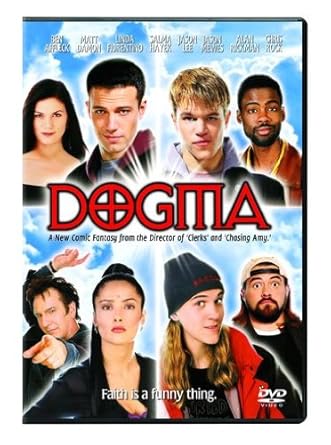
Amazon.com: Dogma: Linda Fiorentino, Ben Affleck, Matt Damon, Alan Rickman,  Salma Hayek, Chris Rock, Jason Lee, Kevin Smith, Kevin Smith, View Askew  Productions: Movies & TV

Prior to seeing Dogma, my dislike for Kevin Smith was pronounced.  His “breakout” self-financed picture Clerks was wildly overpraised and when he got a big budget behind him, he produced varying degrees of crap.  Mallrats showed that outside the confines of a convenience store, where camera movement is unnecessary, Smith was lost.  Chasing Amy proved Smith a lame, unfunny writer, incapable of directing actors, preferring to let them exfoliate, flatulate and otherwise bleed all over his print.

Dogma sucks as well, but there are some pleasures in the sucking, because Smith has written a hit-and-miss lampoon on the perversities of Catholicism.  Where he hits, he knocks it out of the park, as he plays fast and loose with the Bible in an effort to tell his modern fable (fallen angels trying to get back into Heaven; other angels, muses, apostles and assorted characters tryng to stop them).  Smith also takes a few decent shots at the Pope, and offers a heartfelt tribute to true faith, all in the zany format of The Russians are Coming, The Russians are Coming . . .

Smith still does not direct actors, so the players in Dogma look like they are in home movies (Linda Fiorentino manages an entire film with a smirk and rolled eyes). But his laissez-faire approach is made less ruinous by crafty renderings of four angels (Matt Damon, Ben Affleck, Jason Lee and Alan Rickman) and the best performance to-date by Smith regular, stoner Jason Mewes.  The movie is silly, but it is by far Smith’s best work.  What followed was more crap (Jay and Silent Bob Strike Back, Jersey Girl, Zack & Miri Make a Porno, Cop Out), and Smith’s sensibility that his crap was actually awesome and the studios don’t “get” it and that’s what makes him awesome and everyone else not awesome.

Which leads to a biography of a director highlighting the following: criticism of Paul Thomas Anderson, as if Anderson were a peer; becoming so overweight he is kicked off of a flight for not having bought two seats; attacking Bruce Willis (“I had no f***ing help from this dude whatsoever”) because Willis did not work hard enough to promote the execrable Cop Out); an attempt to market his last cruddy picture “outside the system”; and retiring, at the ripe old age of 41.