Archive

Genre

There simply hasn’t been a better satire since . . . well, since South Park: Bigger, Longer and Uncut. Matt Stone and Trey Parker carve up American idiocies and icons, and as is their custom, they fear no maven of political correctness nor do they take the easy shot. Of course, they do that sort of thing regularly on South Park, but not with puppets, and not with Broadway-worthy anthems. Offensive on almost every level, from the hilarious spoof of Rent (Lease) and its signature song (“Everybody has AIDS!”) to the jingoistic, red-white-and-blue power chordy

Casting marionette Alec Baldwin as not only the greatest actor ever, but also the head of a subversive Film Actors Guild (yes, F.A.G.) is genius, and if you’ve ever wanted to see the coterie of noxious celebrity dunces portrayed as members of a S.P.E.C.T.R.E.-like organization, only to get their comeuppances in the form of horrifically violent deaths (as marionettes, mind you), you’re in for a special treat.

Susan Sarandon is particularly good:

Apparently, Sean Penn was offended, but Sean Penn was offended when Chris Rock poked fun at Jude Law during the Oscars.

Be warned.  If you supported the ouster of Baldwin from MSNBC because of his homophobic broadsides against paparazzi, or you were hurt and dismayed when that woman on MSNBC made fun of the Mitt Romney family photo, or Rush Limbaugh’s broadsides against just about anyone furrow your brow and get you thinking about “positive action” or “inclusion” and “dialogue”, or the recent South Park where the boys cannot comprehend that anyone would name a psychological condition “Assburgers” made you think, “Where is the FCC in all of this to protect the children?”, this is not the film for you.

Or, it’s a necessity.

Few Stephen King books or short stories are successfully translated on screen, and only one is brilliant – The Shining (it speaks volumes about the author that he felt Stanley Kubrick got it wrong, so wrong he made another version, with one of the two leads from the sitcom Wings in Nicholson’s role).

Carrie, Salem’s Lot, and Misery are very good, and Stand by Me is competent, if treacly. Dolores Claiborne, 1408, Christine, and Silver Bullet are pedestrian, but have their moments.  The Shawshank Redemption is a wildly overrated, ridiculous film, but deserves mention because the great weight of authority deems it a near masterpiece.

Then you have a big pile of crap–

  • 1982 – Creepshow
  • 1983 – Cujo
  • 1984 – Children of the Corn
  • 1984 – Firestarter
  • 1985 – Cat’s Eye
  • 1986 – Maximum Overdrive
  • 1987 – The Running Man
  • 1989 – Pet Sematary
  • 1990 – Graveyard Shift
  • 1990 – It
  • 1991 – Golden Years
  • 1991 – Sometimes They Come Back
  • 1992 – Sleepwalkers
  • 1993 – The Dark Half
  • 1993 – Needful Things
  • 1993 – The Tommyknockers
  • 1994 – The Stand
  • 1995 – The Langoliers
  • 1995 – The Mangler
  • 1995 – Stephen King’s Nightshift Collection
  • 1996 – Thinner
  • 1998 – Apt Pupil
  • 1999 – The Green Mile (yes, this sucks)
  • 1999 – Storm of the Century
  • 2001 – Hearts in Atlantis
  • 2002 – Rose Red
  • 2003 – Dreamcatcher
  • 2003 – The Diary of Ellen Rimbauer
  • 2004 – Secret Window
  • 2004 – Riding the Bullet
  • 2006 – Desperation
  • 2006 – Nightmares and Dreamscapes
  • 2007 – The Mist
  • 2009 – Dolan’s Cadillac
  • 2011 – Bag of Bones 
  • 2013 – The Reaper’s Image
  • 2013 – Cain Rose Up
  • 2013 – Willa

So, where does David Cronenburg’s The Dead Zone fit in?  Three-fourths of this story in about a man who can see your future and your past after he touches you, I’d have ranked it just below The Shining.  Cronenberg creates a creepy atmosphere made even more unsettling by the unique performance of Christopher Walken, and the bleak misery of his existence as a crippled freak stuck in a small town is haunting.  Striking visuals add to the spooky feel:

Then, the damn thing falls apart due to two ridiculous storylines.  First, Anthony Zerbe plays a rich man who hires Walken to tutor his son, knowing full well Walken’s gift of second sight.  So, what does Zerbe do when Walken sees the boy and his friends crashing through the ice during hockey practice and warns him accordingly?  Wounded that his son has rejected his judgment about skating on the pond, Zerbe conducts hockey practice anyhow, and two boys die.  The decision is bananas yet in keeping with King’s low esteem for parents (the father in Stand By Me practically tells poor Will Wheaton, “the wrong kid died” like the father in Walk Hard: The Dewey Cox Story).

Second, Walken is introduced to senatorial candidate Martin Sheen and sees Sheen’s future as a messianic president of the United States, instigating a nuclear conflagration.  Sheen plays the character so oily and low it is hard to imagine anyone would vote for this cretin.  And when Walken thwarts his ambition, the manner in which Sheen self-immolates is so broadly stupid the film is near ruined.

Still, it coulda’ been a contender.

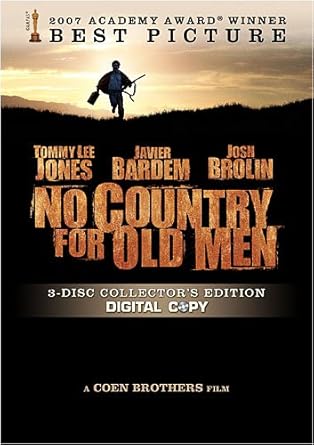
The Coen brothers’ finest film, a gritty, nerve-wracking crime story and an existential horror movie set in the harsh and desperate environs of dusty, bleak Texas.  Josh Brolin takes the wrong money from the wrong drug dealers, victims of a cocaine buy gone bad, after he happens upon their slaughtered bodies while hunting.  Javier Bardem is dispatched by the higher-ups to get it back, killing most everyone he encounters along the way (including rival bounty hunters sent by his employer).  The pacing is taut, the terror near-asphyxiating.   But interwoven in the story is a sense of generational disconnect, rot and the utter bewilderment of an older generation at the brutality and senseless violence of the new.  An observation from a friend is also spot on: “I thought the most important theme in the movie was that older men gradually lose contact with their country, and that this sad fact has nothing to do with the objective reality of what’s happening but is the natural consequence of getting older.”

Set in 1980, the young are depicted as callous and corrupt.  Brolin, shot and desperate to get to Mexico, encounters kids on the border bridge returning to the U.S. after a night of carousing.  He offers to buy a shirt from one of the trio to cover his bleeding, but they quickly demand money, and when he asks for a beer, they want more.  Similarly, at the end of the film, two boys encounter a wounded Bardem and bicker over the share of what he has given them for a shirt.

The Vietnam generation is represented by Brolin and Woody Harrelson, the latter sent to bring Brolin in before Bardem gets to him.  Brolin is not exactly honorable but he still maintains a tie to some principles.  He literally awakes with guilt because he can’t let a dying drug dealer go to his end without water, and it is that charity that brings Bardem his way.  Harrelson, also a Vietnam vet, has a similarly flexible code (he is a killer), but at least there is some code there.  As he says to Brolin about Bardem: “You can’t make a deal with him.  Let me say it again.  Even if you gave him the money he’d still kill you.  There’s no one alive on this planet that’s had even a cross word with him.  They’re all dead.  These are not good odds.  He’s a peculiar man.  You could even say that he has principles.”  When Brolin returns from Mexico, still hobbled but intent on stopping Bardem, a border guard lets him through on the strength of Brolin’s Vietnam service.

Then, there are the old men for whom there is no longer a country.  Tommy Lee Jones and his law enforcement contemporaries just don’t get it.  It’s all gone to hell and a hand basket and while they understand violence, they don’t understand the new violence.  As Jones says, bewildered, reading the paper: “Here last week they found this couple out in California they would rent out rooms to old people and then kill em and bury em in the yard and cash their social security checks.  They’d torture them first, I don’t know why.  Maybe their television set was broke. And this went on until, and here I quote… ‘Neighbors were alerted when a man ran from the premises wearing only a dog collar.’ You can’t make up such a thing as that. I dare you to even try.”

It is not Jones’ world anymore (my favorite Jones musing was from Cormac McCarthy’s book – “She kept on, kept on. Finally told me, said: I don’t like the way this country is headed.  I want my granddaughter to be able to have an abortion.  And I said well ma’am I dont think you got any worries about the way the country is headed.  The way I see it goin’ I dont have much doubt but what she’ll be able to have an abortion.  I’m goin’ to say that not only will she be able to have an abortion, she’ll be able to have you put to sleep.  Which pretty much ended the conversation”).

The film ends with Jones driven to retirement, talking to other older lawmen about what it all means:

Roscoe: It’s all the goddamned money, Ed Tom. The money and the drugs. It’s just goddamned beyond everything. What is it mean? What is it leading to?

Jones: Yes.

Roscoe: If you’d a told me twenty years ago I’d see children walkin the streets of our Texas towns with green hair and bones in their noses I just flat out wouldn’t of believed you.

Jones: Signs and wonders. But I think once you stop hearin’ sir and madam the rest is soon to follow.

Roscoe: It’s the tide. It’s the dismal tide. It is not the one thing.

And the end of the film, Jones has retired (he’s done, “overmatched,” he says) and he sits with an older retired lawman, Barry Corbin, who observes, “All the time you spend tryin to get back what’s been took from you there’s more goin’ out the door.  After a while you just try and get a tourniquet on it.”

And the coda:

Corbin: You’re discouraged.

Jones: I’m… discouraged.

Corbin: You can’t stop what’s comin.  Ain’t all waitin’ on you.

Bardem is what is waiting on us all. Certain, unstoppable, arbitrary death.

This is a beautiful, unrelenting movie, deservedly winning Oscars for best picture and supporting actor for Bardem.

Image result for Man of Steel

The allure of Superman is inescapable. A baby arrives on earth with super human strength and is cared for by a Midwestern couple. As he grows up, he must learn to surreptitiously use that strength for good, wondering all the while the nature of his origins.

Director Zack Snyder (300, Watchmen) gives us a few flashbacks to Clark Kent’s upbringing under the tutelage of his earth father, Kevin Costner, and these are by far the most interesting scenes in the film. But it is clear Snyder is more interested in the fate of Krypton, which results in a tedious dramatization of the planet’s politics and an over-the-top performance by Michael Shannon as the maniacal General Zod. Cue the inevitable, droning CGI fest at the end, plus Superman’s ridiculous triumph (all he had to do was snap Zod’s neck?), and you’ll be awakened from your slumber just in time to see Superman take a job at The Daily Planet, a newspaper populated by such dim bulbs that the mere accoutrement of horn rims serves to disguise the man who just saved them from certain death.

At least the film includes that sly indictment of modern journalism. Other than that, and a spunky performance from Amy Adams, there is little to recommend.

Part 2 would appear to be unavoidable, and word on the street is that Denzel Washington is in talks to take the role of The Green Lantern (green being the operative word).

When I was in a college band in the 80s, I played on one LP. We recorded it in Richmond, VA over a hurried couple of days and had the audacity to call it Hits, one of many mistakes associated with the disc.  But the songs on the record were a marked departure from what the songwriter had written before. It soon became apparent (at least to me) he was under the influence of Big Star, if not melodically, in the bold choice of record name.  That said, it was a long time ago, and I may be making this all up.

Big Star would influence much better bands (The Replacements and REM, to name two) and Big Star’s first two records – #1 Record and Radio City – are, as affirmed by the critics and other interviewees in this documentary, mind-blowingly great.  Exhibit A–

The documentary, however, is merely good. While it does a creditable job of showing how the band, under the direction of Alex Chilton and Chris Bell, came together and missed its shot at the golden ring, its coverage of the aftermath is alternatively listless and revealing. Particularly surprising is the time given to the peculiarities of Chilton and Bell after Big Star failed to make it. Disappointing is the meager attention given to the actual music, and make no mistake, those first two records are seminal. Instead, the film spends an inordinate amount of time on, in the words of one contemporary, Chilton’s “self-absorption, self-focus, [and his use of ] drugs and alcohol.” The documentary whizzes by Big Star’s 3rd record but offers a lengthy exploration of Chilton at his worst, his foray into punk and then a gruesome endeavor called Panther Burns.

As for Bell, the film does better with his story after Big Star missed its shot. In the words of one interviewee, Bell just “lost interest in bands period. He just wanted to hear his songs not translated.” He also became a born again Christian, told his brother “you should do drugs. It takes away your sexual urges”, and eventually found himself working at a local restaurant. But Chilton reconnected with Bell, and the result was an astonishing single, I Am the Cosmos, that harkened back to the sound of the first two records.

Much of the weaknesses of the documentary are inescapable. Bell and Chilton are dead (Bell died in a 1978 car accident, Chilton in 2010 of a heart attack) and they were extreme introverts while alive. In their stead, however, the film does a great justice to the broad music community in Memphis. And it wisely ends true to the form in the last 20 minutes, with a host of acts providing testaments and tributes to the band and its influence.


My nephew recommended this picture and it was directed by Guillermo del Toro (The Devil’s Backbone, Pan’s Labyrinth). I feared I’d missed a hidden gem. Monsters come from beneath the ocean to get us, and we humans make big metal suits helmed by duos to fight them. This is Transformers (and Real Steel) for middle schoolers instead of mental defectives, scored bombastically, loaded with manly exchanges (“let’s gets this son of a bitch!”, “you can finish this”) and cast with the immediately forgettable (except poor Idris Elba, who I trust just wants to forget).

There is some cool CGI and at the outset, it poses as being cynically dystopian. Still . . .

Ryyyyyyyaaaaaaaaaan!!!!!! You owe me one dollar!!!!!!!!!!

Thirteen years later, Martin Scorsese has re-made Boiler Room, writer-director Ben Younger’s patient and understated Wall Street picture about a sweet kid (Giovanni Ribisi) who gets sucked into the easy cash of a penny stock chop shop run by crooked investment manager Tom Everett Scott. Scorsese’s picture is from the vantage point of Scott’s character, penny stock maven Jordan Belfort, and clearly, the guy who played the drummer in That Thing You Do wasn’t going to cut it as his lead. Enter Scorsese’s boy Leonardo DiCaprio, an able and unsurprising choice. But as I sat through this excessive, gaudy, and at too many times, repetitive extravaganza of the go-go 90s, I pined for the more muted touch of Ben Younger.

DiCaprio as Belfort is an aspiring stockbroker tutored by Matthew McConaughey (who is hilarious; what a year he’s having) but wiped out on 1987’s Black Monday. He reinvents himself by switching to penny stocks, where the clientele is working class, the investments not so much risky as ludicrous, and the broker commissions 50%. Soon, with a band of merry fuckups (including Jonah Hill, who walks a steady line between an ambitious man and a raging child), he is crazy rich. He is also a drug and sex addict of mythic proportions and his life is an endless bacchanal, until, like Ray Liotta in Goodfellas, he must pay the piper.

The Wolf of Wall Street apes Goodfellas and Casino in its exposition, showing us through voiceover or DiCaprio speaking directly to the camera just how the securities game works. But writer Terence Winter lacks interest in the mechanics, and many times, DiCaprio leers and tells us directly, “You don’t want to know this.”

The film deduces that what we really want to know is what it’s like to live a high-wire act where every desire is fulfilled, and then some. For the most part, the filmmakers are correct, but in depicting the excess, they overindulge in it. There are two too many orgies, drug crack-ups and the like and at times, the mind wanders. Worse, as in Casino with Sharon Stone and Robert De Niro, Scorsese wrongly presumes we are interested in the marriage of DiCaprio and his trophy wife (Margot Robbie), a union founded on lust, greed and advancement that doesn’t deserve the time given to dramatize its crack-up. Our interest in Robbie peaked on her first date with DiCaprio, when she alights from the bedroom naked save for thigh highs of her own design.

Despite these foibles, the film is often very funny, and when it hits strides, dizzying and infectious. It also does not labor under the burden of a heavy message. Oliver Stone would surely have had Martin Sheen arrive in the final chapter to lecture us about American greed. Hell, Adam McKay, he of titanic films that reach to the heart of who we are as nation, closed The Other Guys with a tutorial on the excesses of Bernie Madoff (but we would expect no less from our new Capra, the creator of not only Anchorman, but Step Brothers and Anchorman 2). Instead, Scorsese and Winter don’t provide a message as much as a testament to the tribal customs and loyalty of certain American subcultures (Winter wrote 19 episodes for The Sopranos) and the universal intertwinement of the American dream and gluttony. But really, this is a picture about how crazy shit can get when those who pray at the altar of the dollar are fueled by endless cash, and the result is both alluring and grotesque.

The cast is very good. DiCaprio gives such a muscular, physical, manic performance (his 1 mile trip from his country club to mansion while on too many Quaaludes is herculean) , he is a lock for a best actor a nomination, but the win will go to McConaughey for Dallas Buyer’s Club.

Inside Llewyn Davis movie review (2013) | Roger Ebert

Melancholy, compelling and lyrical, one of the best films of the year, whether you like folk music or not.

Davis, a folk singer in 1961 New York City, is in crisis, his aspirations undermined by his uncomfortable and unwilling status as a solo act, a less than capable manager, and his own selfishness. The film is his journey to the realization that it is not to be (not that he lacks talent) just at the advent of Dylan. As club owner F. Murray Abraham tells him after an audition that is heartfelt, impressive and inapt, “I don’t see a lot of money here.” Davis made his way to Abraham via a harrowing trip to Chicago where he not only abandons something he has come to love, but may well have killed it. During the trip, he is harangued by a junkie jazz musician (John Goodman) whose takedown of folk as elemental is just another dagger in Davis’s ambition. Soon, Davis becomes too weary to pretend he can be successful, to flop on yet another couch, or to play local celebrity for well-meaning patrons on the upper West side.

The Coen brothers possess an attention to detail that serves the film exceedingly well. Their depiction of 1961 Greenwich Village and the folk scene feels just right, and the travails of Davis, a local Simon who has split with his Garfunkel and become more gritty, take the viewer back in time. Like David Chase’s Not Fade Away, the milieu is drab, smoky and intimate, and the music is at the forefront, but nostalgia is replaced by an elegiac feel and the Coen brothers’ signature dark humor. This is not a film about an unheralded legend, or something as corny as Chase’s paen to rock, but about art as work.

As for Davis, Oscar Isaac is anything but a character you champion. But he can sing and play and he embodies the sadness of having just enough talent. He is also loosely based on a real folkie, Dave Van Ronk.

If there is a weakness, it is Carey Mulligan as Davis’s bitter lover. She is so angry and one-note you feel pity for Davis when you should not. As she gets older, Mulligan is also strangely morphing into a replica of Katie Holmes.

When Dead Again came out in 1991, 31 year old Kenneth Branagh was fresh off his stunning Henry V, and along with Emma Thompson, threatened to be the next big thing. So as a follow-up, why not try a modern Hitchcockian homage set in San Francisco, with Branagh playing the hard-bitten gumshoe who runs across Thompson, a mysterious woman who has lost her memory, is terrorized by nightmares from her past, and needs Branagh to sort it out.

At the time, the film was well-received (Roger Ebert – “I am a particular pushover for movies like this, movies that could go on the same list with Rebecca, Wuthering Heights or Vertigo”) and it holds an 82% on Rottentomatoes. I can’t scoff. In 1991, I thought it was clever and well-conceived.

How wrong I was.  Dead Again just became available on Netflix streaming. It is an atrocious film.  Branagh’s “American” accent is an awful, nasally annoyance; Thompson barely makes an impression; the story (Thompson and Branagh both lived past lives where he, a famous composer in the 40s, was executed for her murder) is a preposterous pile of pure Gouda; and the villain is so obvious and nonsensical that you are offended at the degradation of the fine actor playing him.

He’s also not so good with scissors.

I’ll give credit where credit is due – Robin Williams does a few decent cameo scenes as a disgraced former psychotherapist and a babyfaced Campbell Scott shows off some nifty ninja kicks. 

Jack Nicholson and Helen Hunt won Oscars in this James L. Brooks comedy about a cantankerous romance writer with OCD (Nicholson) and a worn-out, single mother waitress (Hunt) who meticulously serves him at the only Manhattan diner at which he will eat. Nicholson is a holy terror, complaining “there are Jews at my table” when it is occupied. At home, he is no better, throwing the dog of his gay artist neighbor (Greg Kinnear, who won a best supporting actor Oscar) down the trash chute. But Nicholson is soon drawn into the world he loathes out of necessity. Hunt has to leave her job because of the health of her son, and Kinnear is beaten into a wheelchair by local thugs, which leaves Nicholson to take care of his dog. The man has to eat, and he bonds totally with the pooch, so soon, he is arranging for medical treatment for Hunt’s child and acting as support for Kinnear. In the process, he and Hunt begin a relationship that is halting at best.

This picture can be riotously funny, and Nicholson gets all the good lines, including my favorite.

If I have a problem with the movie, it is Hunt’s character. Her harried waitress is overbearing, self-pitying and often bullying, and her demand for control is every bit as off-putting as Nicholson’s knee-jerk rudeness and his fear of cracks on the sidewalk. Yet Brooks denies us any judgment of her – she is presented as plagued, but somehow noble. Mind you, Hunt’s performance is excellent, but her character is unpleasant without the benefit of making me laugh, and my teeth are always set on edge during her scenes.

That’s probably my hang-up.