Archive

Genre

Alexander Payne’s black-and-white portrait of a geriatric mid-westerner (Bruce Dern) intent on getting from Montana to Nebraska to collect a sham $1 million sweepstakes prize is patient, lyrical and loving.  The film evokes David Lynch’s The Straight Story in its pathos, but it also contains a wry sense of humor, largely provided by Dern’s suffering younger son (SNL alum Will Forte) and his brutal, loudmouth but ultimately protective wife (June Squibb)  Lesser films would have played up the wackiness of the extended family, who now believe Dern is flush and are making their claims, or they would have provided Dern the platform to release his Korean war demons or his crushed dreams to his son on their journey.  There is none of that easy bull here.  Instead, Payne presents an authentic portrait of a stoic rural family (Dern seems to have 7 brothers, all of whom watch the NFL with nary a quiver) steeled by time and want, with the very true message that most people don’t really know much about their parents, and that their pasts grow more foreign to us every day.  This film is a lesson in restraint, and Payne (The Descendants, Sideways, Election, Citizen Ruth) has cemented his place as a writer/director with a unique, American voice.
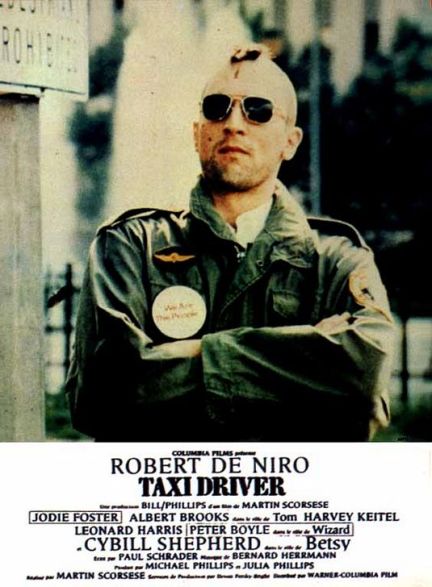
I was surprised to see several things in my recent re-viewing of Martin Scorsese’s classic, including Albert Brooks as the exact same character he has been playing for nearly 40 years; Scorsese himself making a Hitchcockian appearance in the background, but then taking a significant one-scene role as a lunatic in the back of Travis Bickle’s (Robert DeNiro) cab, suggesting he changed his mind about how much time he would spend in front of the camera; and the effectiveness of the score, which was Bernard Herrmann’s last one.

That aside, it holds up as the classic it is considered (47 on AFI’s Top 100). Scorsese’s New York is a modern hell.  He shoots the city so it almost reeks. Steam pulses out of the grates, rot is everywhere and kindness is non-existent (I couldn’t get a fantastic book, “Ladies and Gentlemen, the Bronx is Burning” out of my mind).  The viewer is immediately in kinship with Bickle’s voiceover, “All the animals come out at night – whores, skunk pussies, buggers, queens, fairies, dopers, junkies, sick, venal. Someday a real rain will come and wash all this scum off the streets.” Bickle is a Vietnam vet who can’t sleep and teeters on the edge of sanity. When he falls for a campaign worker (Cybill Shepherd) merely by viewing her through a plate glass window, it seems creepy only until he approaches her, and then there is charm and hope. He is similarly touching with teen prostitute Iris (Jodie Foster), passionately replying to her taunt that he is a square: “Hey, I’m not square, you’re the one that’s square. You’re full of shit, man. What are you talking about? You walk out with those fuckin’ creeps and low-lifes and degenerates out on the streets and you sell your little pussy for peanuts? For some low-life pimp who stands in the hall? And I’m square? You’re the one that’s square, man. I don’t go screwing fuck with a bunch of killers and junkies like you do. You call that bein’ hip? What world are you from?”

But they are from the same world. Bickle is not wired right, he sabotages himself with Shepherd, and soon, he retreats into the mode of a dangerous and unstable assassin, one who has gone from observer of the inferno to an extinguisher. Ahead of its time, Bickle’s would-be John Hinckley gets a Bernie Goetz makeover, cementing Scorsese’s theme that in the jungle, there’s often but a hair between hero and lunatic, moral beacon and dysfunctional threat. Woody Allen’s Blue Jasmine doesn’t seem a natural comparison to Taxi Driver, but in essence, when it ends with Cate Blanchett in rumpled clothes, talking to herself in the park, the directors are exposing the same reality.

The Silence of the Lambs - July 11th, 2020 at Lefty's Drive In!

My son is headed off with his pals to see The Silence of the Lambs tonight, courtesy of AMC theaters’ occasional screenings of older films. I saw it with him a few weeks back and I think he’s looking forward to watching it again in the theater as much as witnessing the reaction of his friends.

Jonathan Demme’s masterpiece is one of the few films that focuses on the serial killer but doesn’t give way to excess. What we know about Hannibal Lecter (Anthony Hopkins) is simple: he is locked up for eating people; he is brilliant and fascinating; and he is lethal. When a serial killer, Buffalo Bill (Ted Levine) starts to plague the Ohio, Pennsylvania, West Virginia area, FBI profiler Jack Crawford (Scott Glen) sends a trainee, Clarice Starling (Jodie Foster), to elicit any advice from Lecter. Starling and Lecter use each other for their own ends, engaging in a thrilling psychological dance that is one part therapy and one part mental combat; she seeks to stop Buffalo Bill while he waits for a slip-up.

The Silence of the Lambs is so well-paced and taut that on occasion, you are near-breathless. There is only one pause in the film’s very serious, unrelenting tone (when Starling is “hit on” by two geek entomologists with whom she is consulting). The pressure is not only from Lecter and Buffalo Bill, but from Starling’s lack of experience, harrowing childhood, and even her gender and diminutive physicality.  The odds seem uncomfortably stacked against her.

The exchanges between Hopkins and Foster are electrifying. You can see just how dangerous Lecter is and near curse yourself for being charmed by him. Yet, you root for the seemingly overmatched Starling, and when she stumbles, you feel the sting of her awkwardness. When Lecter so easily assesses her background and her sexual desires, it is excruciating. Yet Starling comes up to speed and achieves a plausible parity.  Levine is also expert as the tortured, frightening Buffalo Bill, and his transformation to “normal” when he is questioned is a chilling addition to this “monsters among us” story.

The picture is one of only three to win Academy Awards in all the top five categories: Best Picture, Best Actor, Best Actress, Best Director, and Best Writing (Adapted Screenplay), and deservedly so.

Jason Bateman’s directorial debut is bracingly cynical and consistently funny. Bateman stars as a jerk who has found the loophole that allows him to enter and win kids’ spelling bees, making it all the way to the nationally televised (on PBS) Golden Quill finals. On the way, he torments the journalist covering/funding his story (Kathryn Hahn), the competition director (Allison Janney), its founder (Phillip Baker Hall) and various parents, but he also befriends a young competitor (the wide-eyed and charming Rohan Chand). At just under 90 minutes, it never nears wearing out its welcome, and Bateman’s hand is steady. There are a few flat notes. Rachael Harris reprises her role from The Hangover as another repressed, psychotic type, and again, her performance is too much (as is her comeuppance). Bateman’s engagement with his child’s competitors is brutally funny, but his treatment of one girl, while a testament to his commitment, is perhaps too painful to endure. These, however, are minor problems. Bateman has depth beyond being a mere crank, and Chand’s insouciance blends perfectly with his deadpan amorality.

Cards on the table, I never read Tolkien, and I associate people who did (and do) with weirdos from high school who played Dungeons and Dragons and/or attend Renaissance festivals. I realize this is a blinkered view, but there you have it. I also watched the first two Lord of the Rings movies in the theater, fell asleep in both, woke up, and then fell asleep again (only two other films have elicited such a reaction – Gandhi and Passage to India – which suggests a weariness brought on by geography rather than production). I turned off the third Lord of the Rings DVD when the good guys enlisted very large trees and un-killable ghosts as their allies.

Since that time, my son has grown up, and he urged me to watch The Hobbit: An Unexpected Journey. My initial try was on a flight to LA, but after a decent setting of the scene (the dwarf king gets gold fever and a big dragon with a bigger gold fever fucks his kingdom up), the film quickly became wearying, as dispossessed dwarves arrive at the home of Bilbo Baggins (Martin Freeman), eat all his food, sing a sad song and head off on what promised to be a very long, tiresome adventure. I tried again with my son on Sunday, and we got perhaps an hour into the film when Bilbo and the dwarves run into three giants (they look like the troll in Harry Potter, but they talk about what they are going to cook and eat in silly voices just south of Jar Jar Binks). A big fight ensues.  Dwarves are tossed about like ragdolls yet never injured, and the trolls are furiously hacked but never bleed. Bilbo is captured and a Mexican standoff ensues – the dwarves have to drop their weapons or Bilbo will be ripped to pieces. The dwarves drop their weapons, and in the next scene, half are being slow-roasted over a spit and the other half are trussed up for later cooking.

That was the deal these idiots made? Spare Bilbo and in return, the giants can slow roast and eat ALL of you?

I had no intention of continuing with this unexpected adventure any further. It didn’t help that my son qualified his recommendation with ”it’s a good movie if you’re in those great lounge chairs at the Courthouse theaters and you have all the Coke and candy you want and you have nothing better to do.” Or that after that very scene, he remarked, “still about 2 hours to go.”

After seeing Harper as part of the AFI Silver LA Modern series, me and my son watched Paul Newman’s follow-up turn as Ross McDonald’s P.I. in 1975’s The Drowning Pool.  Lew Harper finds himself in New Orleans in the middle of a scandal involving an ex-love (Joanne Woodward), a sleazy oil man (Murray Hamilton) and a protective local police chief (Tony Franciosa).  Newman again gives an infectious star turn as the cynical but funny private detective brought into to town by Woodward to get to the bottom of her being blackmailed.  When Franciosa is impressed by his $150 per day plus expenses rate, Harper explains that it isn’t all that much when you work four days a year.

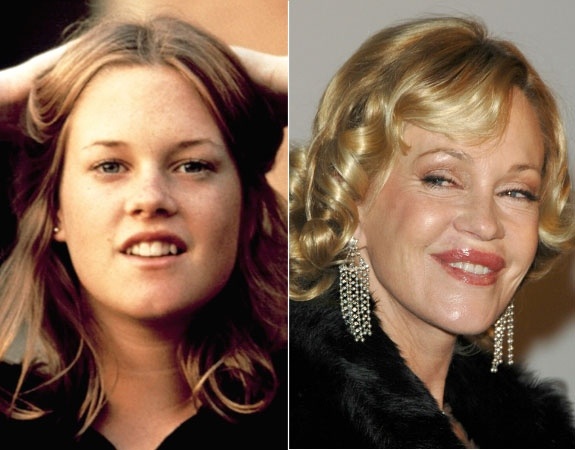
But the picture lacks too many elements that made its predecessor so good.  New Orleans ain’t LA, and while there is a certain fish-out-of-water charm to Harper’s investigation, the setting feels off.  The score is also very cheezy, alternating between musical interludes worthy of a Mannix or Barnaby Jones and an annoying symphonic riff of Roberta Flack’s “Killing Me Softly”.   Worse, Joanne Woodward’s Louisiana drawl is borrowed straight from The Long Hot Summer.  She’s ridiculous in her theatrics and a terrible replacement for Janet Leigh as Harper’s love interest. Hamilton does his best to give his character some flavor, and an 18 year old Melanie Griffith is an alluring near-jail bait, but most everyone else is either histrionic or blah.

While Woodward is a step down, Griffith as the poisonous Lolita is a significant upgrade from Harper’s Pamela Tiffin.

And a reminder of the horrors of plastic surgery.

Very much like Goodfellas, but with a broader palette and more compelling characters. In Goodfellas, Liotta, DeNiro and Pesci are sharks, swimming to survive and devour, and the peek Martin Scorsese gives us into their immoral, brutal world is such a dizzying kick, we tend to forget that these brutal archetypes are no more than that. In Casino, Scorsese aims higher. DeNiro’s Sam Rothstein is not just an Irish street thug, but instead, a wunderkind Jewish bookie who is handed the keys to the cash cow for the mid-West mob – the Tangiers hotel (funded, of course, by union pension money) in 70s Las Vegas. DeNiro finds his oasis in the desert and works to re-create himself as a solid citizen. His efforts are doomed to fail, however, because no executive title, country club membership, or professional success can sanitize the shit on his shoes. He’s still just a functionary effectuating the skim just like when he was picking Oklahoma, taking the points. But DeNiro’s self-deception is absolute. At one point, he even hosts a casino television show which he devotes to exposing the raw treatment he has received at the hands of the local politicians who have forsaken him, ala’ Lenny.

When DeNiro feigns respectability, his protector, Nicky Santoro (Pesci) is always around to puncture his pretensions. In one of my favorite scenes, Pesci accuses a silk robe wearing, cigarette holdered DeNiro of walking around like “fucking John Barrymore.” It is Pesci’s presence that ensures DeNiro’s success (he muscles out any competitor or threat) as well as his demise (every Pesci excess is linked to DeNiro). And DeNiro is incapable of truly weaning himself off of his criminal past. As he cannot reform or blunt Pesci, he uses him to bring his conniving wife (Sharon Stone) to heel. Stone was a working girl who DeNiro hoped to take with him on his journey to polite society, but she was no more malleable than Pesci. DeNiro is, rather strangely for a Nicholas Pileggi/Scorsese character, a romantic, opening the film with “When you love someone, you’ve gotta trust them. There’s no other way. You’ve got to give them the key to everything that’s yours. Otherwise, what’s the point? And for a while, I believed, that’s the kind of love I had.” So you invest in him. His inevitable tragedy is unsurprising yet moving.

Scorsese’s use of music is, as always, impeccable, and the fluid camera-work manages to convey not only the mechanics of Vegas but the exhilaration of the town. Moreover, the film’s ending lament about its corporatization is one of his few codas to a Scorsese film supported by what preceded it.

If there is a weakness, it is in the last third of the film, where the dissolution of the DeNiro-Stone marriage is exhausting and a bit tiresome.  That identified, this is a great film and certainly a top ten American crime picture.

Robert Altman’s send-up of Hollywood process and morality opens with an audacious 7 minute, no-cut scene that is a primer on economical, fluid exposition. We meet most of our characters, including the studio’s no. 2, the writer’s executive, Griffin Mill (Tim Robbins), and the tone is set.  Unfortunately, Altman cannot fulfill the promise of his introduction. Robbins’s star is falling and he is also being threatened via postcard by a writer he has brushed off. Unnerved, he sets up a meet with who he believes to be his stalker, accidentally kills him and then falls in love with the writer’s girlfriend (Greta Scacchi). The murder is implausible and the heat-of-the-moment relationship unconvincing (a love scene with Robbins and Scaachi is not so much hot as uncomfortable). Robbins is way too mannered and standoffish to elicit empathy, and the film swerves artlessly from suspenseful to broadly comic (Whoopi Goldberg is very funny as the investigating detective, but she’s too funny).

On the plus sides, we are treated to a whirlwind tour of LA, and Altman makes sure it is populated by just about every star, young or old, he can get his hands on. Also, the lingo of the pitch meetings can be very funny:

“It’s a TV star who goes on a safari.”

“A TV star in a motion picture?”

“A TV star played by a movie star.”

“A movie star playing a TV star.”

“Michelle, Bette, Lily.”

“Dolly Parton would be good.”

“I like Goldie.”

“Great, because we have a relationship.”

“Goldie goes to Africa.”

“She’s found by this tribe.”

“- of small people.”

“She’s found and they worship her.”

“It’s like The Gods Must Be Crazy.”

“except the coke bottle is an actress.”

“Right. It’s Out of Africa.”

“meets Pretty Woman.”

Still, the script is rather gentle on the town, and it never really succeeds as a thriller or a satire. In fact, the movie could have been done without any reference to the murder at all, which, ultimately, drags it down. The Player falls into the category of Movies You Thought Were Better at the Time (Altman was nominated as Best Director, as was Michael Tolkin for the script)

A game performance by Chadwick Boseman cannot overcome every sports, race, and mythic America trope or Harrison Ford’s schmaltzy Oscar-bait bid as Branch Rickey. Brian Helgeland’s script is a bore, and the performances feel like civic duty. If you want to watch a richer, more interesting baseball film with a numeric title, try Billy Crystal’s 61*.

Shorter than The Wolf of Wall Street by 41 minutes, David O. Russell’s American Hustle felt longer and more ridiculous by a good stretch. Loosely based on the Abscam bribery stings of the late 1970s, Russell introduces four purportedly colorful characters: portly, combed-over con man Christian Bale; his sexy mistress and partner in crime Amy Adams; his loony wife Jennifer Lawrence; and a hyper aggressive, curly headed FBI agent Bradley Cooper. Cooper nails Bale and Adams, forces them to entrap others (including Jeremy Renner, as a New Jersey mayor desperate for development funds), a love triangle ensues, and after countless zooms, swift pans and other frenetic camera shots utilized primarily to divert our attention from the banal, repetitive script, we reach a tacked on and unconvincing resolution.

The closest thing to a character is Bale, and his performance is the only reason to see the picture. Unfortunately, he plays a man desperately juggling knives, and it feels as if he’s doing just that masking this thin script. Lawrence plays a decent wacky shrew, and the soundtrack has a few fun numbers from the 70s (I’ve always been a sucker for Steely Dan’s Dirty Work). That’s all of the good.

The bad is really bad, starting first with the preposterous characters played by Adams and Cooper. Unlike with Bale, Russell (who co-wrote) doesn’t bother to give us any sense of where these two came from. She is an impossibly sensuous cypher, in a 70s Enjoli perfume commercial sort of way. Cooper is so manic it suggests severe chemical imbalance, as if his character in Russell’s Silver Linings Playbook got a job in law enforcement. While these two concoctions flirt, and even disco dance (because this is the 70s), the aimless story plods along.

There are other problems. Who could keep a mere fraudster imprisoned for three days without access to a lawyer just to soften her up? Why would you cast Louis C.K. in a supporting role when he’s already demonstrated in one of his sitcom episodes the silliness of having stand-up comics dramatically act? How can a script this talky lack one memorable exchange? Where is this fucking film going and will it never end? Why is Lawrence singing “Live and Let Die” to the camera as she dusts? Does Russell really think he can get by on stealing that Paul Thomas Anderson trick and his camera work, kitschy 70s fashion and hairdos, a few well chosen tunes and the same cast from his last two films?

The answer to the last question is a 93% rating on rottentomatoes and 10 Oscar nominations. Only two are deserved: Bale and Hair.