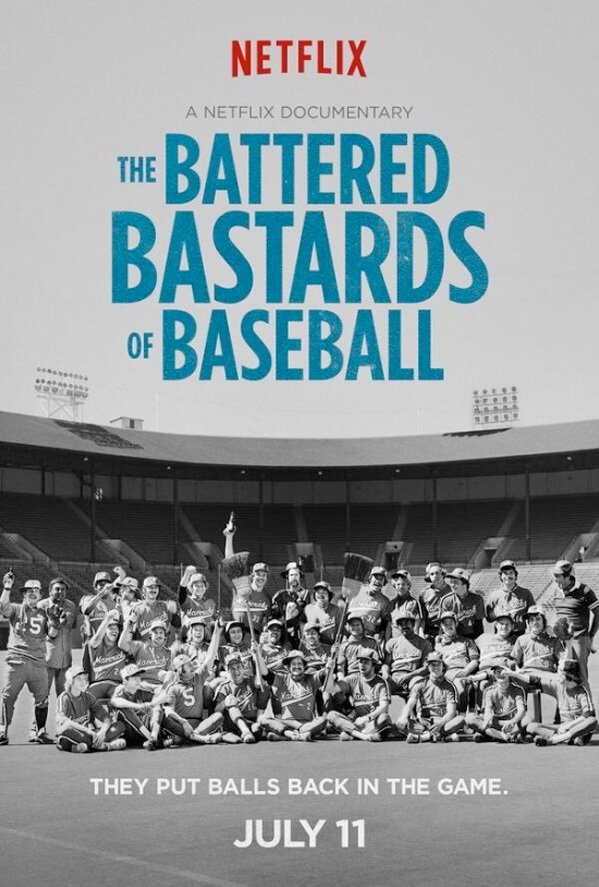
I’m not sure what is more surprising, this fascinating, Netflix-produced documentary chronicling the Portland Mavericks, an independent minor league baseball club run by baseball enthusiast and actor Bing Russell in the 1970s, or the fact that this story has not been made into a major motion picture. Russell capped off a lucrative career as a Hollywood “plumber actor” (according to his son, actor Kurt Russell, who also played on the Mavericks) by going to Portland and starting the only independent minor league baseball club in the country. The team is loaded with characters (including New York Yankee great and then baseball pariah Jim Bouton, who played for the Mavericks en route to a short MLB comeback), the story is utterly fascinating, and it has sweep, color, tragedy and vindication. Jesus, the damn thing writes itself.
This is available streaming on Netflix and I can’t recommend it enough, not only for the undiscovered gem of a story, but for the documentarians skillful restraint in reliance on interviewed remembrances and poignant found footage (a lot of which is 8mm). Not even close to schmaltzy, this output is yet another reason to get Netflix.
This movie is more than bad. It’s an affront to genre, consistency and common sense. It also represents the end of film as art, the shape of things to come. Just as novels will soon give way to comics, movies will give way to . . . . comics.
The sequel pretends at noir but it has no kinship with it save for a string of laugh-out-loud, hard-bitten lines. The worst of the bunch: “I was born at night. Not last night.” Every single line is like that, played deadly straight, as if writers Robert Rodriguez and Frank Miller concluded, “You know! The same idiots who have substituted, you know, books for serialized comics are, like, the ones coming to this stupid movie, so why would we try and, you know, make the dialogue anything more than the drivel in the picture book?”
There are three story lines, each more boring than the last. Joseph Gordon-Levitt is a hot shot gambler who crosses mean Senator Powers Boothe. Jessica Alba is a stripper who crosses mean Senator Powers Boothe. In between, Josh Brolin (taking over for Clive Owen, who screwed the pooch turning down James Bond but made the right call here) gets double-crossed by his ex-wife, Eva Green. Gordon-Levitt beats 4 Kings with 4 Aces and then, ah, who cares? Alba and Brolin enlist madman Mickey Rourke to get them out of jams. That’s the whole of it, except Lady Gaga pops up as a clichéd waitress, following in Madonna’s footsteps yet again. Blood spatters, bodies are dismembered, the ominous score thuds along, and yawns are stifled.
Nothing makes sense. While Rourke blows up an estate, the guards remain unalerted, the easier to chop their heads off. Green seduces a cop (Christopher Meloni) and enlists a crime boss (Stacey Keach, made to look like an ambulatory Jabba the Hut) to invade the part of Sin City run by armed whores clad in Frederick’s of Hollywood because the girls are hiding Brolin. Both entreaties are awkwardly dropped shortly after their introduction. Brolin, healed by the whores, comes back with a newly reconstructed face to exact revenge, except he looks just like he did before, only with a sprightly toupee.
It’s a nasty, stupid, senseless movie. It’s also a little frightening. The first Sin City was a modest success, grossing $70 million domestic on a $40 million budget. It had the benefits of being unique and a little humor. Almost ten years later, they churn this dour turd out, and the budget is $70 million.
Maybe there is hope in the fact that it is getting killed at the box office ($11 million and trickling) but something tells me the Chinese will bail it out.
Death is just like life in Sin City. It always wins.
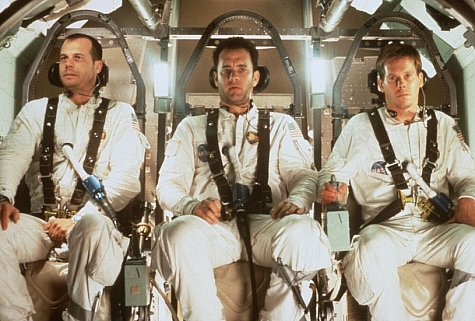
A thrilling and engaging piece of Americana and an homage to national ingenuity and purpose, this is the kind of film you hope your children watch (jocks and geeks and in-between alike, for they are all celebrated and shown as peers) and thereafter, become inspired. I was surprised at how white-knuckle the re-creation of the near-doomed mission felt given I knew the outcome (Spoiler – the crew of Apollo 13 survived), but this is really edge-of-your-seat fare.
The performances are all excellent. Tom Hanks as mission commander Jim Lovell is hitting right in his sweet spot, the decent, measured everyman of Saving Private Ryan, Castaway and Philadelphia, and he is ably supported by Bill Paxton (a likeable but ever weakening Fred Haise) and Kevin Bacon (as Jack Swigert, added to the mission at the last minute, both defensive and independent). On the ground at home, Kathleen Quinlan is steely and vulnerable as Lovell’s wife, she underplays a role that is stock and often butchered by over drama (see Madeline Stowe as the suffering wife in We Were Soldiers), and she was deservedly nominated for Best Supporting Actress. In Houston, it is a cast of seemingly thousands, led by Ed Harris as NASA Flight Director Gene Kranz, who work tirelessly to bring the crew back home to earth safely. At every moment, you recognize another character and/or commercial actor and say, “oh, yeah, he was in . . . .”
A year after the stunning visuals of Gravity, I expected the 20 year old Apollo 13 to feel dated. It does not. But this is not a picture featuring aesthetics, but rather, the resourcefulness of all types of individuals engaged in a grand effort during a harrowing rescue mission, told without schmaltz or thick reverence. The immediacy of the film comes in part from the fact that the dialogue between Houston and the astronauts is near verbatim from transcripts and recordings, and Hanks, Paxton and Bacon were all trained at NASA’s space camp in Huntsville, AL. It’s Ron Howard’s best picture.
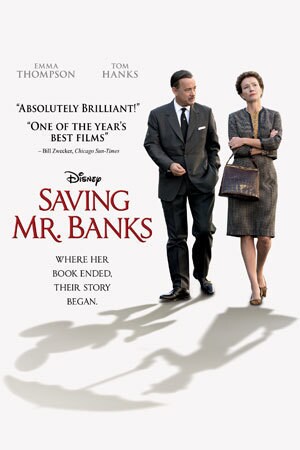
The writer of the Mary Poppins books, P.L. Travers, was apparently such a pain in the ass that, according to her grandchildren, she “died loving no one and with no one loving her.” As played by Emma Thompson, Travers more than fits this bill as she is whisked to Hollywood against her better instincts to be wooed by Walt Disney (Tom Hanks) in an effort to adapt her stories to the screen. Travers’ prickliness and exactitude with Disney and his team (Bradley Whitford, Jason Schwartzmann and B.J. Novak, all very good here) is the best part of the film. Unfortunately, director John Lee Hancock (The Blind Side) keeps interrupting the best part with flashbacks to Travers’ childhood, and in particular, her relationship with her whimsical, alcoholic father (Colin Farrell).
I understand the juxtaposition. The audience is supposed to learn what has embittered this awful woman. But you really don’t care (she’s such a witch that motivation is irrelevant), and you also begin to resent the interruption of the more interesting creation of a film.
Worse, the technique is cloying, leading to a sugary-sweet ending that has Disney melting the ice encasing Travers’ heart. In reality, Disney and Travers ended their relationship in acrimonious fashion, with Disney fed up with her stubborn nature, and Travers so offended she refused any further association between the company and her books. The disharmony is alluded to in the film, but it is near-blotted out by Travers’ copious tears as she undergoes a sort of catharsis at Grauman’s Chinese Theater.
Those were actually tears of fury. From Travers herself: “As chalk is to cheese, so is the film to the book. Tears ran down my cheeks because it was all so distorted. I was so shocked I felt that I would never write—let alone smile—again!”
Noah is a modern day environmentalist/pacifist who is also a vegetarian, fights the rape of the land, and communes with Transformer-like monsters/fallen angels (it was quite a shock to learn that Optimus Prime was so critical to the Old Testament). God tells him to save the innocent; the animals. He complies.
Unfortunately for us, neither God or Noah cannot save this dreary and ponderous story nor can they remedy Darren Aronofsky’s leaden direction. I was surprised by James Gunn’s ability to handle a broad and sweeping epic in Guardians of the Galaxy given his prior experience with smaller films. In Noah, Aronofsky, who also has little experience with big films, does not surprise. He is completely lost visually, primarily relying on a slow backward tracking shot to say BIG! Some of the CGI, and there is a lot of it, looks as silly as Harry Hamlin-age Clash of the Titans. The script, which Aronofsky co-wrote, is a repetitive mix of New Age blather (birds arrive and Crowe intones, “it begins”) and mundane domestic drama. The performances are rote, good actors intuiting “this is biblical” which they apparently perceive as solemn.
On the plus side, the making of this film means at least one less Aronofsky ode to masochism and sadism (although Aronofsky does let Russell Crowe sing again).
You also get the sense Aronofsky feels the film is getting away from him, so he relies more on Noah’s trippy dreams and his story of creation (a psychedelic light show and some stop-action photography), and indeed, they are welcome respites from the numbing dialogue.
There’s not a scene in this Coen Brothers film I don’t like, and the story of a Clifford Odets-esque playwright’s (John Turtorro) introduction to the oily world of Hollywood is both visually striking and thematically ambitious. But no matter the film’s look or intriguing interpretations (the mind of the writer, the dangers of solitude, the corruption of money), by the end, you feel trifled with, as if you watched a parlor trick perpetrated by a cast of broad, comic actors (John Goodman, John Mahoney, Michael Lerner) for no greater purpose than the goof. Like The Hudsucker Proxy and Miller’s Crossing, Barton Fink has its joys, but the feel is sterile and your investment unrewarded.
Martin Scorsese’s surreal nightmare of one man’s (Griffin Dunne) ill-advised late-night trip into lower Manhattan is painfully funny and, at times, genuinely unsettling. Dunne is beset by a quintent of quirky, if not outright dangerous females (Roseanna Arquette, Linda Fiorentino, Teri Garr, Catherine O’Hara and Verna Bloom), a fact that will one day be Exhibit X in his anticipated trial for misogyny. His torture is lovingly photographed by Michael Ballhaus, giving SoHo’s grimy exterior a dream-like quality (and there is no greater horror than being hunted by a mob that has commandeered a Mister Softee truck).
Dunne is very good and much like Steve Carell, except he’s not burdened at all by the imprint of a long-running character, and where Carell is childlike and vulnerable, Dunne is sympathetic, but sexually opportunistic.
Bonus: if anyone asks you, “What movie casts the parents from Home Alone, one of whom went to filmvetter’s high school?”, now you know.
Today, William Friedken’s 1971 Academy Award winner seems better-than-standard cop fare, but this is an extremely influential film, notable for its verisimilitude, grit and movement. Shot on the mean streets and ugly haunts of decrepit New York City, Friedken follows two detectives, Popeye Doyle (Gene Hackman) and Buddy Russo (Roy Scheider), as they try and take down a huge heroin shipment. No prior American film seemed as immediate or aggressive. Friedken’s camerawork is frenetic and edgy, and his virtuoso car chase scene is still one of the best in all of film. Here is Friedken on the chase, which took 2 weeks to shoot.
Friedken’s insistence on visual authenticity extends to Ernest Tidyman’s script. Doyle is a casual racist and a simplistic bully, Scheider a slightly more pleasant accomplice. They are neither archetypes or anti-heroes. They’re just dogged, unremarkable cops. What is a little mystifying is the Best Actor win and Best Supporting Actor nomination for, respectively, Hackman and Scheider. These performances are almost 100% sweat, the equivalent of thespian calisthenics. There is no arc or development, and I don’t believe there has been this much running in any film save for Chariots of Fire, The Gods Must Be Crazy and any film about Steve Prefontaine. Roger Ebert disagrees about Hackman’s performance, writing: “As Popeye Doyle, he generated an almost frightening single-mindedness, a cold determination to win at all costs, which elevated the stakes in the story from a simple police cat-and-mouse chase into the acting-out of Popeye’s pathology.”
Interestingly, Friedken didn’t want Hackman (they fought constantly and as Friedken writes in his memoir, “His outbursts [onscreen] were aimed directly at me… more than the drug smugglers”). But Paul Newman and Steve McQueen were too pricey, Peter Boyle objected to the film’s violence and Friedken’s first choice – Jackie Gleason! – was deemed unsuitable by the studio.
On the heels of Robin Williams suicide, I thought I’d review one his few films I liked. In Gus Van Sant’s drama, written by Matt Damon and Ben Affleck, Williams plays a community college professor and psychologist. With his MIT credentials, he could have been a big deal but was waylaid by love and is now stricken with grief at her passing.
When William is introduced to guide the damaged savant, Will Hunting (Damon), we know that when all is said and done, both characters will have taught each other something valuable about life.
A lot can go wrong here.
But Van Sant keeps it even. Williams is smartly subdued, with no hint of the manic persona that became more schtick and adrenaline than acting. He is patient, picks his spots and elevates much of the film’s schmaltz with real pathos. When he is riled, it feels authentic and raw.
As for the film itself, I’ve always been torn. The concept is smart. A working-class Boston kid is also a genius, sadly mopping floors at MIT, but he finds a way to shine and then falls in love and then, through therapy, grows out of his limiting, Southie world. Van Sant’s direction is inventive (the slo-motion rumble to Gerry Rafferty’s “Baker Street” is particularly nifty, and there are many such cool touches); the exchanges between the Southie pals (Damon, Ben Affleck – again, proving he can be very good in small doses – Casey Affleck and Cole Hauser) are believable, very natural, and often hilarious; there is actual heat between Damon and his romantic interest, Minnie Driver; and Elliot Smith’s musical contributions are hauntingly memorable.
On the downside, while Damon is quite good as the lead, his character is kind of one big cheat. Plagued by his own demons, we are supposed to empathize with Will, but he is a selfish, smug prick throughout, just about every assist you can give a modern protagonist – he’s lonely, he was shuttled from foster home to foster home, he was beaten as a child, his enemies are grotesque caricatures that lack only the villain’s mwahahahahahaha, and yet …
Here, Will goes toe-to-toe a snooty Harvard type:
Obviously, the Hah-vahhhd pony-tail is the bad guy (on the strength of the pony tail alone), but much of the film is sneering at the uptight folks who admire his genius and do him no injustice.
It reminded me of Walker Percy’s The Thanatos Syndrome: “There’s Hawkeye and Trapper John back in Korea. I never did like those guys. They fancied themselves super-decent and super-tolerant, but actually had no use for anyone who was not exactly like them. What they were was super-pleased with themselves. In truth, they were the real bigots, and phony at that. I always preferred Frank Burns, the stuffy, unpopular doc, a sincere bigot.”
So, as the music swells, and Will escapes the clutches of Southie to chase love, I’m pretty sure he’s going to revert to being a smug prick soon enough. Only now, Minnie Driver will be there to socialize him.
When Rain Man came out, I enjoyed it, but soon came to sour on the film for its easy emotional manipulation and an affected star turn by Dustin Hoffman. I didn’t credit Hoffman the prescience of Robert Downey Jr. in Tropic Thunder (“never go full retard”) and found Hoffman’s portrayal of an autistic adult unsubtle and obvious. Perhaps had I waited until Al Pacino’s blind rampage in Scent of a Woman, I would have been more forgiving.
Pauline Kael called it “a piece of wet kitsch” and I can’t say I could have disagreed. Rain Man has always maintained a spot in the pantheon of overpraised domestic drama Oscar winners that, I assumed, would age very ungracefully (see Forrest Gump, American Beauty, Crash).
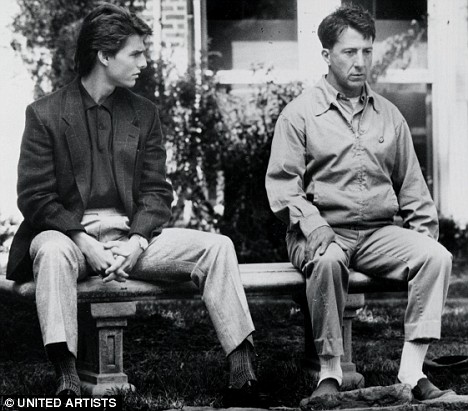
Rain Man has hit the schedule on my pay movie channels, and yes, it is emotionally manipulative and yes, it does sport some of the more annoying hallmarks of the 80s (a Hans Zimmer synthesized score that would put him on the map, a few too many montage scenes, a gorgeous and pointless female lead, Valeria Golino, who came and went). But Hoffman’s performance as a hidden older brother to Tom Cruise (Cruise learns of him upon their wealthy father’s death and “kidnaps” him to have an edge in getting his share of the will) is very strong. What unfortunately became represented by cute catchphrases (“I’m an excellent driver”, “10 minutes to Wapner”) is actually a canny, deep portrayal of a tortured soul, and director Barry Levinson never really lets you forget the dangers that lie therein. Much like Bradley Cooper in Silver Linings Playbook, Hoffman is endearing until he is terrifying, and at exactly the moment Spielberg would have inserted treacle, Levinson has Hoffman explode again.
Tom Cruise is even better in his role as Hoffman’s wheeler-dealer, LA smooth brother, Ray. His frustration with Hoffman is communal. His entire performance is a study in anger at Hoffman, not for being denied his loving company or for being shut out by his father, but because Hoffman is an annoying lunatic. “I know you’re in there somewhere,” he screams, and while he undergoes change in his time with the afflicted Hoffman, he does not become redeemed so much as educated.
The film is also very, very funny, perhaps too much so for our times. I can imagine grievance groups objecting to the use of an autistic adult for chuckles, but the screenwriters’ (Barry Morrow and Ronald Bass, the former of whom, like Golino, pretty much disappeared after this film) don’t pull many punches and the exchanges between Hoffman and Cruise are often brutally comic:




 filmvetter