Archive

Genre

image

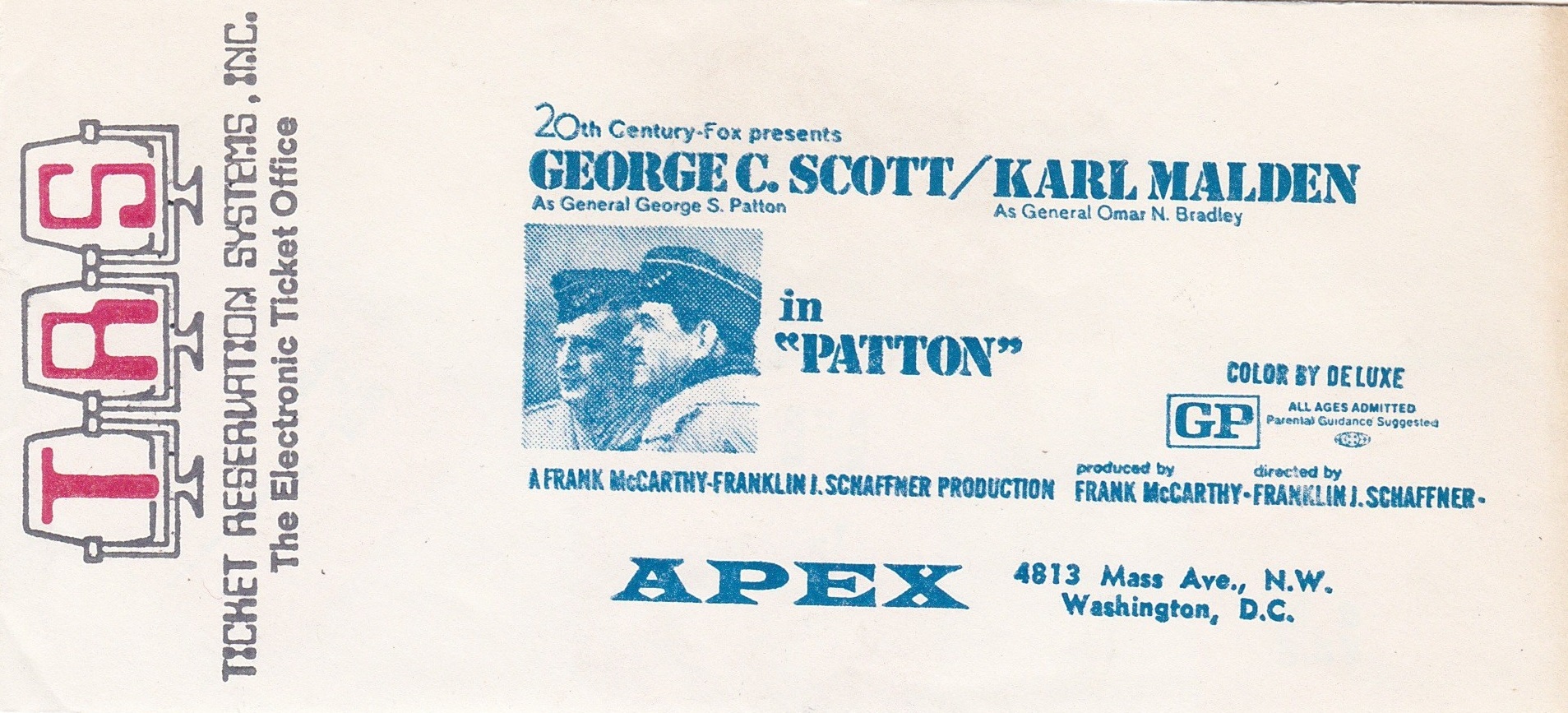
(actual ticket to a Washington, D.C. showing of the movie found in my father’s dresser drawer)

The quintessential biopic, Patton (which was co-written by Francis Ford Coppola) gets everything right.   Let me count the ways

It is content to present its subject without the context of some anachronistic cause. In Coppola’s hands, Patton is not emblematic of something larger and more ominous or glorious, be it the hubris of American imperialism, the degradation of war, blah blah blah. He is a flesh-and-bones person who grafted himself onto and shaped one of history’s more momentous times.

It is nuanced. Coppola never lets you get comfortable with Patton and by the end of the film, you remain torn as to the sum of his virtues and vices, which is so much more interesting than the hagiographies or hit jobs we see so often today.

It’s largely composed of true events. Patton did say the outrageous things attributed to him (if not in the form presented by the film), and he was every bit the preening ass and decisive, bold general portrayed in the film. The two incidents where Patton slaps soldiers are condensed into one, and Patton is given too much of a role in the plan to invade Sicily, but otherwise, the picture hews closely to history without becoming tedious. Most historical criticisms of the film zero in on what it doesn’t depict (much as with American Sniper), which is a legitimate criticism only if you give credence to the “I would have done it this way” school.  When it does take poetic license, it comports with other established facts. Patton did not shoot his pistol at attacking German aircraft, but the attack occurred just as he was berating the Brits for failure to provide air cover, and Patton’s risky bravado in the face of enemy fire was legendary. Patton did not shoot mules blocking a convoy, but he did order them shot and their cart dumped into the river.  Patton did not tell a British general that he had been in a battle centuries old, but he was a strong believer in reincarnation.  Indeed, he wrote a poem in 1922, “Through A Glass Darkly”, a stanza of which reveals his inclination:

Perhaps I stabbed our Savior
In His sacred helpless side.
Yet I’ve called His name in blessing
When in after times I died.

Patton is also noteworthy because the actor playing the subject gives a commanding performance. George C. Scott reportedly made a determined study of General Patton and by most accounts, captured him (save for Patton’s higher pitched voice). Incredibly, Rod Steiger, Lee Marvin, Robert Mitchum and Burt Lancaster all turned down the lead role.

It also looks authentic, in large part, because the producers rented out WWII-era materiel that had been sold to Spain and largely filmed the picture there.  Obviously, shortcuts were made (the Spaniards didn’t have a passel full of Tiger tanks), but director Franklin Schaffner (Planet of the Apes) does great work with what he has in terms of equipment and locale.

Finally, what a Jerry Goldsmith score.

The movie won 7 Oscars, including Best Picture, Best Actor, and Best Original Screenplay and sits at #89 in AFI’s top 100 films.

image

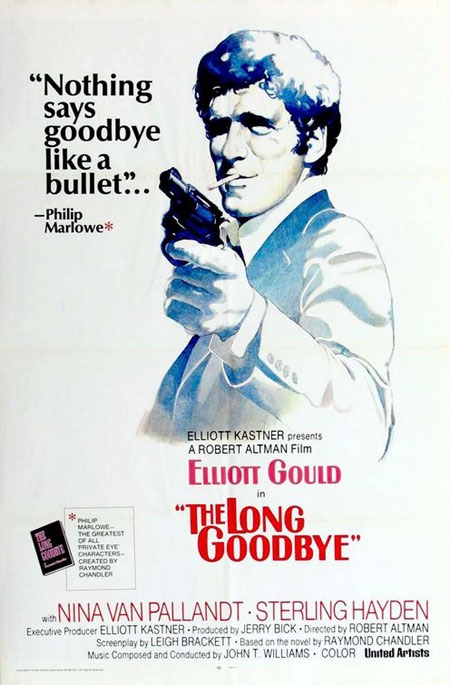
Robert Altman’s Phillip Marlowe (Elliot Gould) isn’t a hard-bitten cynic but rather, a seemingly scattered, chain-smoking hippie in a suit (his mantra? “it’s okay with me”), as bemused by the conservative cops who roughly bring him in for questioning (“Someday all the pigs are gonna’ be in here and all the people are gonna’ be out there. You can bet on that. You’re not in here. It’s just your body”) as the perpetually stoned yoga nudists who are his neighbors (“They’re not even there. It’s okay with me”). The truth is that much is decidedly not okay with Marlowe, in particular, his being used by old friend Terry Lennox (former NY Yankee pitcher and baseball whistleblower Jim Bouton) after the mysterious death of Lennox’s wife.  As Marlowe floats through a Los Angeles that feels desolate and burnt out, he moves closer and closer to the truth, navigating the authorities, hangers-on and brutes while standing by his friend.

Mark Rydell, who later became a decent director (Cinderella Liberty, On Golden Pond), stands out as a particularly chilling gangster who peppers his threats with loopy new age nonsense and boasts about his physical fitness regimen and the fact he lives near Nixon.

Altman and screenwriter Leigh Brackett aggressively revamp the source material, but Marlowe is still Chandler’s in many ways.  He needles the cops (“Is this where I’m supposed to say, ‘What’s all this about?’ and he says, ‘Shut up! I ask the questions’?”), can shake from his seeming fog to register a keen read on the situation, and when he arrives at the end of the journey, he is all Chandler’s Marlowe, with his own unyielding code.

Critic David Ehrenstein once told me that The Long Goodbye “was” Los Angeles and while the film doesn’t figure prominently in Los Angeles Plays Itself, it’s hard to argue it doesn’t have Hollywood in its marrow. Movie memorabilia can be found in Marlowe’s otherwise bare bones apartment (which was just recently available for rent), presumably from a prior occupant.  The security guard at a gated ocean community specializes in impressions, from Barbra Stanwyck to Jimmy Stewart to Walter Brennan.  The score is some version of the torch song “The Long Goodbye”, be it Muzak in a supermarket or a cocktail lounge piano number, the same ditty re-packaged as only Hollywood can.  Son of Old Hollywood Robert Carradine shows up as a jailhouse prophet and Altman exhibits prescience in his casting of Arnold Schwarzenegger as a mute thug.  LA itself seems an otherworldy ghost town, where everything seem to be trying to pass as a facsimile of the real thing.  As Ehrenstein noted, “Back then the city was a sprawling, sleepy, empty place — Altman’s The Long Goodbye capturing its ultra-casual look and feel perfectly.  ‘But there’s nothing there,” my east coast friends would say”).

This is a seminal picture, and a prime example of reinventing a genre.

image

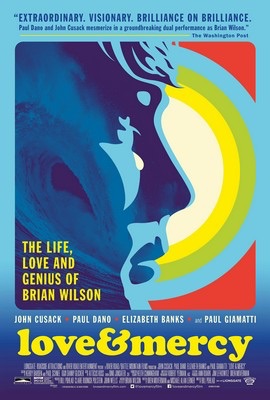
A competent biopic that smartly alternates between the rise of Beach Boys impresario Brian Wilson (played as a young man by Paul Dano) and his later life (during which he is played by John Cusack), where the ravages of mental illness, substance abuse and the dubious oversight of Svengali psychiatrist Eugene Landy (Paul Giamatti) have taken their toll. We meet the older Wilson as he tries to buy a Cadillac from saleswoman Melinda Ledbetter (Elizabeth Banks), revealing the only peace he can find, alone with her in the car at the dealership, while Giamatti and his associates hover on the other side of the glass.

The film spaces nicely, and the early pressures on Dano (fear of flying, his abusive and controlling father, the stress of touring, an aversion to conflict) are manifested in Cusack’s caged, distrusting performance, one of many really nice touches in the film.  Near first time director Bill Pohlad delves into but doesn’t overplay Wilson’s demons, choosing to give equal access to his love of the art of pop music and visionary work in the studio.  Nothing in the picture feels hackneyed or stale, a difficult feat in the face of traditional musical biopics like Ray and Walk the Line.  Also, in the era where “Behind the Music” has left these stories vulnerable to the Dewey Cox treatment, the film feels fresh and immune to parody.

Banks and Cusack also radiate the wonder of first love, subordinating the “bio” aspect of the movie to a heartfelt romance.  They have a convincing chemistry, which bolsters the efforts she undertakes to wrest Wilson from Landy.

As Landy, Giamatti is the weakest link.  He is ferocious where he should be merely intrusive, maniacal instead of crafty.  Landy may well have been that excessive, but he didn’t just walk off the street; he was a pop psychologist to many stars, from Alice Cooper to Rod Steiger.  The performance is so over the top, you wonder how Wilson, even in his vulnerable state, could have succumbed to such a bully and how Landy could have had the smarts to set himself up so nicely.

Currently on Hulu.

image

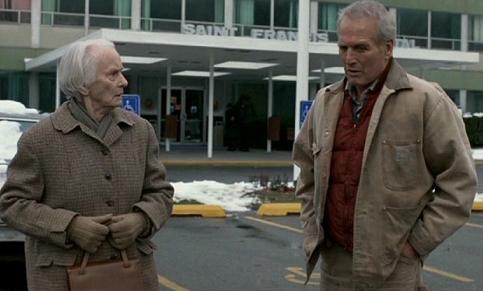
Robert Benton’s adaptation of this Richard Russo novel is centered in the wintry environs of North Bath, NY, where everyone knows each other so well they can be regular poker mates while simultaneously failing each other in any number of ways. Paul Newman plays Sully, an off again, on again employee of property contractor Bruce Willis (who he is suing in a personal injury claim) and the only tenant in an old Victorian owned by Jessica Tandy (in her last role before her death). Sully is woven into the fabric of the town, but he is at heart detached and cynical, and the only hint we get of any warmth are in his interactions with Willis’s wife, Melanie Griffith, who suffers her husband’s callous infidelities with a defiance that saps her verve. When Sully’s estranged son (Dylan Walsh) shows up in the midst of a marital and professional crisis, Sully becomes re-engaged, recognizing his role in the community and accepting the responsibility that comes with it, a George Bailey for the 1990s

The film is alternatively very funny and sneakily touching. Benton expertly captures the claustrophobia of a small town and even its collective ethos without letting eccentricity become cloying. Almost all of the characters are good, and Newman, who was rightly nominated for an Oscar, is perfectly suited to the material.   Of Newman, David Thomson wrote:

As a young man, Paul Newman was so handsome he developed a sneer as if to frighten away the fans – the women, especially – who assumed he was ready and available. There were times when this arrogant manner seemed ready to dismiss not just most of his work, but anyone who took it seriously. He seemed to be saying, “Can’t you see – I’m not like this. I’m a real person, unfairly afflicted with movie looks. I’m Jewish!”

Newman was 30 when he first appeared in a movie; it meant he was a grown man, with hard-earned experience, before he started pretending in public. He had been three years in the Navy, as a radio operator; he had helped run his father’s store in Cleveland; he had been married and had children.

Later in life, the sneer fell away, along with the prettiness, until he was left a stoical old man with pain and losses, as well as the abiding perplexity that anyone should take him or acting that seriously. By then, he was one of the finest and most resolute old men in pictures – some achievement in a culture horrified by age.

The observation perfectly captures Newman in this picture.  Newman communicates the pain and loss in Sully in barely perceptible ways, and when he does so, he doesn’t linger in a manner at odds with his core.  He retreats to the crass aside or the blithe “oh well” and that’s that, making those moments of introspection and dawning even more affecting.  It’s a sharp and knowing performance.

The film suffers a few missteps.  Dylan Walsh, as Newman’s son, is badly miscast. He not only looks nothing like Newman, but he doesn’t share a teaspoon of his inner strength or mystery.  Worse, when he arrives with family and children, they are played too broadly, with modern domestic woes and a miscreant younger child (who nicknames a child with a hitting problem “Whacker”?).  So too is a very young Phillip Seymour Hoffman as the anal town deputy, and Josef Sommer as Tandy’s cowardly son.  In a movie where every other character plays the line between comic and grounded beautifully, these turns are a shame, if easily overlooked.

It is a blessing to have children who like movies. We watched this classic John Huston film last night with my daughter, a movie I saw with my father in the theaters in the 70s. Based on a Rudyard Kipling short story, Michael Caine and Sean Connery are old vets in British India, cynical, loyal to each other and avarice. They make a compact to traverse Afghanistan to its upper northwest, into the wilds of Kafiristan, with provisions and weaponry to lend their talents as mercenaries. In doing so, they brave avalanches and the warring locals, and after allying with one in particular, Connery is deemed a god by virtue of an arrow that failed to pierce his heart and a Mason’s necklace.  It all goes to his head.

The sweep of the film is broadly romantic, though, visually, it suffers in comparison to today’s epics due mainly to technical advancement. Caine and Connery are very well-matched, and though Connery’s seduction and their estrangement is a bit rushed, their bond at the end is actually quite moving. This is a throwback adventure film, deliciously retrograde in attitude; the Brits are charming rogues and everyone around them is a cowardly or fundamentalist savage. As Vincent Canby wrote at the time, “Gloriously old-fashioned in its approach – right down to the characters’ politically incorrect attitudes toward anyone who isn’t one hundred per cent British – The Man Who Would Be King is pure entertainment in the grand tradition of Gunga Din.” The film would never be screened on an American campus today, but oh what fun if it were.

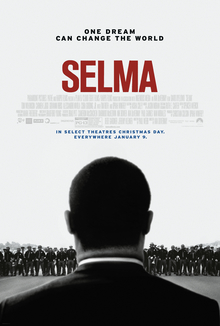
Selma (film) - Wikipedia

Moving, didactic and unsurprising.  The film suffers from what I call the Milk syndrome, a heartfelt fealty to its subject so strong it obliterates any sense of authenticity.  Martin Luther King (David Oyelowo) is etched in marble, and marble is both beautiful and boring.  While the film is occasionally poignant, we are left with its one-dimensional hero, colorless acolytes (Coretta Scott King and everyone who works with King) and cartoonish villains (Tom Wilkinson’s LBJ and Dylan Baker’s Herbert Hoover are particularly ridiculous).

The film’s best moments come when King is not ennobled, but crafty, as when he explains to two Selma locals why he needs to elicit violent repression from the authorities for publicity purposes; King as tactician is just more interesting than King as emblem.

The worst moments come in quiet discussions, where the activists trade speeches littered with biblical passages and maxims like “eyes on the prize.” There are too many long sermons provided to educate an audience director-writer Ana DuVernay doesn’t trust (a conversation between Coretta and her husband about his infidelities has a reserved dignity that is otherworldly).

In a film punctuated by Oyelowo’s expert recitations of King’s actual speeches, the effect is tiresome.  The characters are in the middle of a pressure-cooker maelstrom, uncertain as to which road to take, hemmed in by any number of political and social forces, and beset by violence at any turn.  Yet, they are reduced to the roles of resolute and/or suffering nobles.  When one black man wants to go get his gun after the marchers have been brutally bloodied, he is met with a sermon on the foolhardiness of his instincts and its effect on their historic struggle.  After an ass-beating, it’s a rare man who can summon a soliloquy.

The film is beautifully photographed. Cinematographer Bradford Young (who, in A Most Violent Year, captured early 80s NYC) employs a lyrical, classic style he describes as a “period, Kodachrome-esque look.”  The effect creates memorable moments, some stunning.

But pretty isn’t enough.

image

This is a football movie made by people who, if they ever saw a football, would mistake it for hippo shit.  Kevin Costner is the General Manager of the Cleveland Browns. His Dad just died. He’s in crisis. He’s a “go with your gut” kind of guy. He has the number 1 pick in the draft. He intends on getting a hot shot quarterback but becomes disenchanted when he learns that the quarterbacks’ teammates didn’t come to his 21st birthday party. Costner is then offered 2 NFL starters and 2 future number 1 draft picks for that number 1 pick. He declines the trade. Instead, he uses the number 1 draft pick to select a linebacker who we have been told “may” be selected 15th. For non-football fans, this is the equivalent of Bill Gates selling his Microsoft shares for a Shetland pony and a wheel of Gouda.  But Costner desires the linebacker because he saw the linebacker get kicked out of a game for giving his dying sister a football after he scored a touchdown.

Nothing I just wrote about the plot is made up.

Then, Costner wheels and deals with other NFL general managers to come out of the draft with 100 draft picks. One general manager is 11 years old. Another releases his bowels when Costner raises his voice during a conference call.  All the others are at risk of dying from swallowing their own tongues.

The movie is about men, and choices, and your instincts and tradition and commitment and respect.  The film also has a minor a romantic subplot between Kevin Costner and Jennifer Garner so uncomfortable it has an almost molesty feel. Garner feels it. She damn near makes herself catatonic to get through this travesty. Costner merely looks embarrassed.

This is the anti-Moneyball. This is not merely one of the worst sports films ever made. It’s one of the worst films ever made.  It is so bad, you have to see it.  It’s mandatory.

And it was endorsed by the NFL. When current NFL Commissioner Roger Goodell walks out to open the draft, the audience erupts in applause.

Which is bullshit.

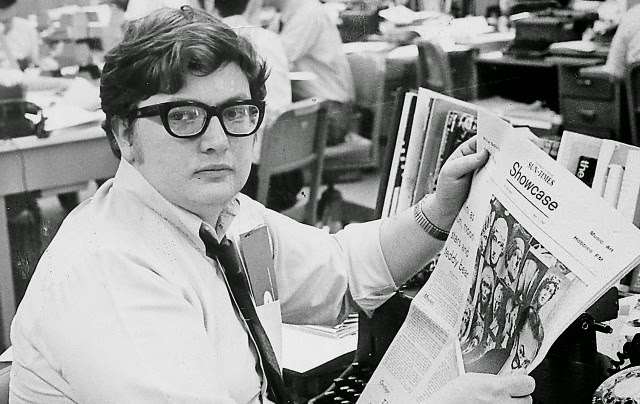
What stands out in Steve James’ engrossing documentary on Roger Ebert is not so much Ebert’s skill and status as a movie reviewer, but his absolute love of life.  It appears Ebert almost fell into his craft, found he had a knack for it (so much so he was awarded a Pulitzer), and thereafter, became a cultural icon, along with “frienemy” Gene Siskel, changing the way film criticism was perceived both by the public and Hollywood.  But when we are introduced to Ebert, he is in the midst of yet another of his trying medical travails near the end. Cancer has robbed him of his jaw (and, cruelly, his ability to speak), but he types ferociously and utilizes a voice-activated program to communicate.  And the prominent feature of his personality is not intellectual or esoteric; it is a lust for people and ideas.

We learn Ebert was a wunderkind college editor, then a hard-drinking Chicago newspaperman who swore off booze after one-too-many benders in his 30s, finding love in his 50s with a woman who already had children.  Ebert is also revealed as a know-it-all and, at times, petulant and self-important.  As James’s demonstrates, he was also a caring man, one whose passion was broad enough to encompass not only cinema but simple discussion and engagement.

Ebert has never been my favorite reviewer simply because I found him so mercurial, one moment intolerant of the offbeat, another celebrating it; I was looking for standards and signposts, and he wouldn’t oblige. But his best reviews were such a mix of accessible, earthy and honest, my expectations were unrealistic. Ebert could also smell a rat, and he had no problem going against the grain. Take, for example, his review of the highly touted anti-Vietnam War documentary Hearts and Minds, a celebrated work that greatly influenced documentary filmmaking. Ebert grants the film its due, but his caution, in 1974, is prescient:

My problem in writing about “Hearts and Minds” is how to go about separating the film’s images — which are sometimes heartbreakingly tragic, sometimes cruelly revealing — from the craft of the film itself. Here is a documentary about Vietnam that doesn’t really level with us on a simple technical level. If we know something about how footage is obtained and how editing can make points, it sometimes looks like propaganda, using such standard tricks as the juxtaposition of carefully selected but unrelated material to create a desired effect. And yet, in scene after scene, the raw material itself is so devastating that it brushes the tricks aside. . . The problem is that the film is at such pains to make its points that it doesn’t trust us to find our own connections. We see a tearful graveside scene in North Vietnam, for example, with a widow trying to throw herself onto her husband’s coffin, and then we get Westmoreland soberly explaining that Orientals don’t place a high value on life. In this and his other comments about what he calls “the Oriental philosophy,” Westmoreland comes over as not only racist and stupid, but incredibly lacking in awareness of how his remarks will sound. This man ran a war for years in a country he didn’t begin to understand. And yet placing these two pieces of film together — and the editing in “Hearts and Minds” consistently makes similar matches — finally only undermines the film’s effectiveness. It’s too heavy-handed. We’re bludgeoned by the point of view, we don’t like the feeling of manipulation we get. Yet there are scenes here of incredible power, even for a nation which watched this war on television every evening.

James’ documentary also shows Ebert to be the kindest and most giving of mentors and friends, which reminds me of Will Leitch’s piece on Ebert upon his death.  Leitch had edited the same college newspaper as Ebert, and Ebert’s generosity to him was astounding:

Because I was 19, I took this as an invitation to keep bothering Ebert, and over the next two years, I emailed him regularly, with questions about my career, with movie reviews I’d written and hoped he would offer tips on, with requests for advice on writing, on life, on the tough job market that awaited me upon graduation. Ebert wrote back to every single one, with lengthy and heartfelt missives that were far more than a snot-nosed kid clearly getting off on Knowing Roger Ebert deserved. I have no idea why he did it. He told me “that this is important to you as it is, that’s a very large percentage of what you need, really.” He emphasized that such ephemera like “career” and “success” were mostly beside the point. “Just write, get better, keep writing, keep getting better. It’s the only thing you can control.”

Ebert even recommended me for a job stringing movie reviews for the suburban Daily Southtown newspaper. For the first one — the Robert Downey Jr. movie Restoration — I borrowed my friend Mike’s car and drove up to a Chicago screening room. I didn’t know Chicago well and of course got lost, just sneaking into the theater right as the lights were going down. After the movie, I walked out to the elevator, and standing there, was Ebert.

“Sir,” I said, talking very fast. “I’m Will Leitch, from the DI. I wanted to thank you and say what an honor it is to me. I can’t thank you enough for what you’ve done. I promise not to abuse it.”

Ebert was bigger then, and his hand was meaty and sweaty.

“Of course, Will, I’m happy to help you in any way. You have talent, and anyone from the DI is a friend of mine,” he said. “Actually, I’m going to be in Champaign in a few weeks for a screening at the New Art, and I’d love to meet with you and some of the staff beforehand. Is Papa Del’s still open?”

Two weeks later, Ebert was entertaining me, my friend Mike and a few select editors — the fight to be included at the dinner was fierce and still angers some today — at Papa Del’s. (We had four pizzas, and Ebert ate 1 1/2 of them.) He took our questions, we talked about journalism and movies (he and I had a fierce debate as to whether or not Harry Connick Jr. was in the Holly Hunter movie Copycat: I was right, though nobody had an iPhone to prove it at the time), and he told us stories about the old days without ever romanticizing his good old days at the expense of ours. He was not Roger Ebert, the guy on television. He was just the fun guy eating pizza, dishing about Gene Siskel — he absolutely could not understand how that man could care so much about the Chicago Bulls, a stupid sports team — and having a grand time. We sat there for three hours. None of us wanted to leave, including him.

At the end of the night, Ebert took me aside. “I understand it’s your birthday tomorrow, Will,” he said. (It was. I was turning 20.) “Well, I have a gift for you. It’s a scoop. You can run it in the paper tomorrow. I received a print of a movie that’s not out yet to show at the theater tomorrow. You can have the exclusive: It’s Mighty Aphrodite, the new Woody Allen film.”

Yet, as Leitch shamefully admits, with the web exploding, “we [were] young turks . . . ready to kill our idols . . . we all thought we were hot shit.” In that vein, Leitch later wrote a piece for the web magazine Ironminds entitled, “I Am Sick Of Roger Ebert’s Fat F—-ing Face”, the thesis of the piece being that Ebert’s TV work was hurting his writing (with a few fat jibes included).

Ebert’s response, and his later correspondence with Leitch, is an epitaph to which we all should aspire:

Will —

I have always tried to help you, and you know that. I am not sure what you were trying to do with your piece — if you object to me being on television, there is a dial to the right that will take care of that problem for you — what issues you might be dealing with, but I am certain you will grow to regret writing it someday. If you were trying to make a point, I fear you are not in control of your instrument. I wonder if you feel shitty this morning, now that that piece is out there. I know that I do.

RE

Leitch wrote him back, completely backing down, apologizing, but the damage obviously had been done. I did feel shitty, instantly, and have ever since. A year later, I was working for Brill’s Content’s All-Star Newspaper . . . where I ran an early incarnation of a blog, linking to the best newspaper writers in the country every morning. As the job required me to do with all the writers we selected, I sheepishly emailed Ebert to tell him he was on the roster. He wrote back:

Does this mean you’re no longer sick of my fat fucking face? 🙂

It’s an honor. I hope you’re well.

RE

(Available on Netflix streaming)

Nick Broomfield’s (Kurt and Courtney, Battle for Haditha) documentary for HBO is a must-see for several reasons. First and foremost, I had no idea we had a modern serial killer of historical proportions in South Central Los Angeles, a killer of dozens and possibly over a hundred women over a 20 year period beginning in the 1980s. That, of course, is a large point of the story. Broomfield does an effective job of demonstrating that the dispossession of the citizens in that part of LA, coupled with the carnage occurring with the rise of crack cocaine, rendered the murders and disappearances of “crack whores” a rather low priority. After all, a majority of the women killed by local stolen car fixer and semi-strong man Lonnie David Franklin were likely lured to their deaths by the offer of drugs-for-sex, most meeting their ignominious ends in a camper parked at the back of his house.  I couldn’t shake wondering as to the numbers Jack the Ripper could have amassed if he’d kept to his Spitalfields hunting grounds and refrained from corresponding with the police.

The documentary is less an indictment of the police and government officials, who, when in “no comment” mode, always seem guiltier, than a singularly brave exploration of the urban condition in a rotted corner of the city. Broomfield, a Brit, is one of at least two white men poking their cameras in an area where white men generally fear to tread, and his endeavor results in incredibly revelatory footage. Franklin’s pals at first proclaim his innocence (he was set up by the cops, they swear), but as Broomfield spends more time with them, two open up, explaining that Franklin was indeed a suspicious character and that they were even involved in his kinks, so much so that they traded pictures of the naked street girls they photographed, almost as if in a local snapshot club. They were happy to party with the man, even if he was a brutal beast who preyed upon the addictions of so many street walkers. In this, Broomfield reveals that the neighborhood itself could be as blasé’ about the women as the authorities.  But he also captures the pain and regret of one friend, for whom the “hey, I didn’t know he was killing them after I left” explanation no longer fully suffices.

Broomfield also hits documentarian gold when he hooks up with a former crack addict/prostitute – Pam – who shepherds him through the dangerous streets, always introducing the crew to the locals as her “friends from England.” Her efforts actually lead the crew to women deemed “missing” by the LAPD after Franklin’s arrest (Franklin’s penchant for photography resulted in a 200+ picture sheet):

Pam’s tour of the neighborhood shows the depths of its depravity at its worst, but she has survived, now clean and out of the game, and there is fundamental decency about her, though encased in the hardest of shells, that is riveting.

Franklin goes to trial this summer.  Definitely catch this before you start reading about the case.

This is a really fine action film, all the more impressive for its lack of CGI and enhanced by an intricate dystopian vision and some very bizarre, very cool, hard comic-book baddies.  The plot is elemental.  The world has gone to shit, and barbaric fiefdoms and clans reliant on gasoline have arisen from the ashes. Furiosa (Charlize Theron), a trusted lieutenant and gas runner of the chief bad guy, Immortan Joe (Hugh Keays-Byrne), takes something very precious from him and in the process, is assisted by Mad Max (Tom Hardy) and a fundamentalist acolyte of the heavy (Nicholas Hoult) who turns from the dark side.  So, they are chased, and then, they double back through the dusty hell that is the future, and threaten all Immortan Joe possesses.

There isn’t much beyond action here, but it is inventive and exciting.  Hardy and Theron are taciturn, eschewing even Eastwoodian comic understatement.  They leave it to Hoult to provide most of the pathos, and he is an endearing motorized jihadist.  Thankfully, the movie does not really try to communicate how the world came to be so barren and unforgiving, a blessing, because there is nothing quite so annoying in today’s dystopian films than the inevitable philosophical discussions masquerading as backstory, where we learn how we pissed it all away, and why the sufferers must keep suffering (see Snowpiercer, Elysium, In Time).