Archive

Drama

Image result for The Florida Project

The Florida Project owes some debt to Beasts of the Southern Wild, another audacious and free-flowing picture that relied almost exclusively on a natural environment and its inhabitants through the eyes of a child.  In that film, the environment was the Southern bayou and a community cut off from the rest of the world by a Louisiana levee. Here, it is a stretch of highway miles from Orlando’s Disney World, where gift shops, liquor stores, time share scams and gaudy, low-end motels litter the strip.  The motels are primarily housed by people who pay by the week (the unfortunate tourists did not look too closely at the promotional materials), and we are introduced to the milieu via the daily play of four young actors. They are the children of poor people who cannot care for them during the day, and they play largely unobserved, unhindered, wildly, and desperate for attention.  That attention is given to them in a decent and caring manner by the motel manager, Willem Dafoe, who struggles to keep the right amount of emotional distance from the residents, almost all of whom are troubled or are going through tough times. He can barely disguise his affection for the children while at the same time maintaining order at his establishment, an order which includes forcing residents to spend a night away from the place at intermittent periods so they do not establish residency, and presumably, tenant rights.

I understand the child actors were for the most part amateurs, and the decision to use them was keen.  The best child actors lack the affectation and self knowledge you often find at its worst on Nickelodeon or in precocious children who watch too much of it.   These children are so natural, the film nearly veers into documentary, making their plight all the more harrowing and their story all the more compelling.  Brooklyn Prince, the leader of the kids, is seven years old, and she is mesmerizing.

Dafoe, who is nominated for best supporting actor, delivers a dignified, quiet and measured performance, but the film is stolen by Bria Vinatae, who plays the single mother of one of the children. She is a child herself, wholly ill-equipped to raise one of her own, yet fiercely loving and resourceful.

Director Sean Baker (Tangerine) eschews a traditional narrative, opting for a languorous approach that mirrors the hot summer days depicted in the film.  The effect is to embed the viewer with the children and their community, which heightens what you feel for these kids.  Yet, there is not a single maudlin or false note.

Best film of the year.
 

image

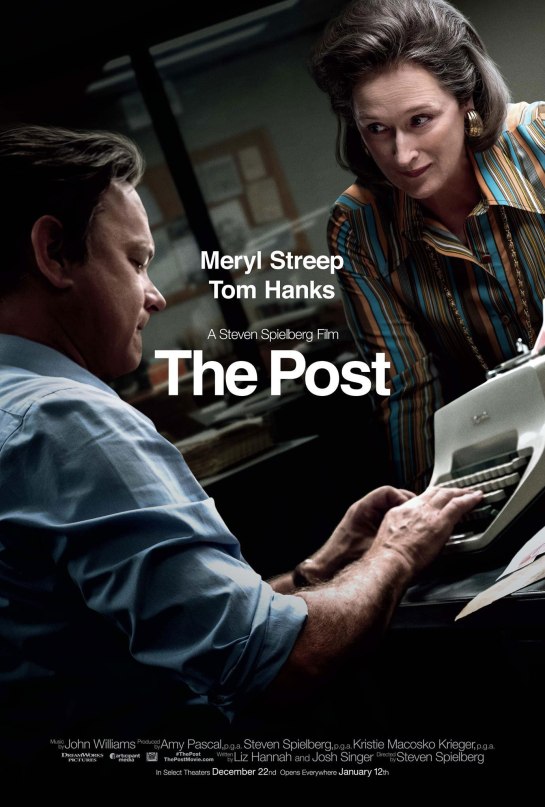
There are things to like about this film, but most of them occur in the first half. The script is smart and economical, delivered by a cast with an exceedingly high percentage of “where have I seen him/her before?” types. And Meryl Streep again absolutely captivates as the insecure publisher of The Washington Post, negotiating her new role as a corporate leader in a male-dominated world, where her father and husband (prior publishers) are not there to protect or assist her.

The look is also spot on. Primarily set in 1971 Washington DC, it felt like a a tour of every Northwest Washington den and kitchen I inhabited and, necessarily, every living room and dining room I avoided.

But I should have been warned as to the coming danger when the first scene, which occurs in Vietnam, featured the music of Creedence Clearwater Revival, such a trope that whenever I hear John Fogerty, I assume the sound of helicopter blades will follow.

As minor as that hackneyed facet appears, it is a fissure that later becomes a chasm. After all of the fantastic work Streep does to subtly and movingly depict the stakes from a personal and political vantage point, and they are large (her family newspaper is betting its future in publishing top secret documents that indict four administrations), Spielberg just doesn’t trust you to get it. “This is big,”you can hear him thinking. “I’m afraid that the audience won’t understand that it was hard to be a woman in 1971, that Nixon was bad, and that a free press is really, really important.”

So, out comes the Louisville slugger, and the director proceeds to bashing all of the important points into the heads of the audience, rendering it senseless.

Two scenes with Streep and her fiery editor, Ben Bradlee (Tom Hanks) are illustrative. In the first, when Hanks condescends to Streep by suggesting she is covering up for her good society friend Robert McNamara, she deftly parries his thrust with the observation that when he was close friends with President Kennedy, surely he must have “pulled some punches.” Later, however, when Hanks comes to Streep again to acknowledge his prior failures, we get a moist, awkward and unconvincing speech about how reporters can no longer be clubby with politicians going forward because, you know, Vietnam.

We had it, dummy.

Speaking of Vietnam, Spielberg’s rendition of it is so simplistic as to be offensive.  In his mind, The Pentagon Papers catalogued a multi-administration conspiracy almost wholly bent on killing innocents and saving face.  One can fault U.S. engagement in Vietnam until the cows come home, but when Spielberg distills it to such a childishly elemental basis, you can almost hear Ken Burns sighing, “I guess I didn’t need nine of those ten episodes.”

Spielberg‘s handling of the feminist theme is even more egregious. Everything Meryl Streep does in her performance makes superfluous the film’s later choices when dealing with the issue. Nonetheless, again, because Spielberg trusts no one, we are forced to endure a speech from Hanks‘s wife (Sarah Paulsen) that it sure has to be tough for Streep, because she is a woman; another woman approaches Streep at the Supreme Court, solely to thank her for her selfless sacrifice on behalf of her brother who is in, wait for it . . . Vietnam; and then, as Streep leaves the Supreme Court, in a scene that would have returned my breakfast had I had one, we see her walking down the steps of the building, cutting a line through throng of women, all of whom beam at their idol. DeMille’s parting of the Red Sea in The Ten Commandments was more understated. This is not to mention the penultimate and final scenes, where a Post editor reads out the first line of the Supreme Court decision exonerating the paper in a manner that would only be appropriate for “The only thing we have to fear is fear itself” and then, a security guard calling in a break-in at a little place called the Watergate. Because, can you believe it? This Nixon went on to be even more troublesome. Nuts, right?

You may feel good after you leave this movie, but take heed.   The feeling is akin to the immediate euphoria one receives from eating a whole carton of ice cream. Soon, you will feel sick and/or shame. It is a testament to all of the other good things about the movie that the final excesses did not render a zero star rating. But really, if you want to see a great movie about a newspaper, re-watch Spotlight or All the President’s Men.


Image result for Mudbound

A beautiful picture, depicting the lassitude and lethality of post World War II Mississippi as two families, one white and one black, are challenged and near-consumed by the stifling climate and punishing soil, as well as the psychological toll of war and the rotting cancer of racism.  It is rightly nominated for Best Cinematography and Adapted Screenplay, and Mary J. Blige stands-in as supporting actress nominee for any number of deserving performances (especially Rob Morgan as a stoic, beleaguered tenant farmer).  There is a stretch where the budding friendship of haunted war vets Garrett Hedlund and Jason Mitchell skirts cliche’, but other than that, the film is rich with authenticity and heart.   It is currently available to stream on Netflix.

image

During WWII, the Germans occupying Denmark laid 2.2 million mines on its coast in anticipation of an Allied invasion. The Danes employed their former occupiers to clean up those mines, the subject matter of this harrowing and haunting film. We follow a group of very young, very scared German soldiers who are given mine-clearing training and then a quadrant containing 45,000 mines. If they clear them at a certain rate, they will be allowed to go home in three months.

The process is nerve wracking. Mind you, these boys have instruction and some support, unlike the Iranian children during the Iran-Iraq war who were simply sent into the mine fields to clear by suicide in some glorious sacrifice. But the toll, both physical and psychological, is brutal, especially when inflicted on ones so young. They are homesick, hungry (their care was not paramount) and under the leadership of an embittered Danish sergeant who is fighting his own demons but is also humanized by their plight.

This is a beautiful picture, enhanced by touching, sensitive performances. There is talk every year of creating an Oscar for an ensemble, and this cast would be a deserving nominee. The film, however, is not for the faint of heart.


image

Writer-director Greta Gerwig’s picture is assured, ingenious, and alternatively, hilarious and moving. A coming-of-age story that touches on the themes of leaving home and the mother-daughter relationship is not exactly original, but in Gerwig’s hands, it is fresh. Lady Bird (Saiorse Ronan of last year’s beautiful Brooklyn) is a Catholic school senior in Sacramento navigating her college choices, academic ennui, sexual inexperience, insecurity, and her family’s economic frailty, all while negotiating an increasingly strained relationship with her passive-aggressive (and sometimes, aggressive-aggressive) mother (Laurie Metcalf).

Gerwig stitches a narrative together with brisk and evocative vignettes, and her characters carry the nuance and surprise of real people. Lady Bird’s reach for popularity and desire for something beyond what she deems the stodgy and suffocating Sacramento might normally make her empathetic, but she is of her age, which means selfish and even cruel, in her ambition. This harsh light prevents the film from becoming maudlin. She’s a real girl and her world feels authentic. I watched the film with my wife and daughter, and their knowing glances and nonverbal communication throughout certified the truth of its nature.

I was reminded of different films at different times while watching Lady Bird. Gerwig’s command of pace and sharp timing evokes Wes Anderson’s The Royal Tenenbaums, shorn of his mannered style. Her strong portrayal of the bond of family and place also brought to mind last years’ incredibly under appreciated 20th Century Women. Finally, the mother-daughter dynamic on the eve of separation made me think of Nicole Holofcener’s Enough Said.

I don’t mean to convey that Gerwig’s picture is derivative, only exceedingly accomplished. These are great pictures for purposes of comparison.

This is one of the best of the year, and I expect nominations for best picture, best director and best original screenplay. At a time when Hollywood may very well want to go with films that are smaller and more pure, keep this one in mind when filling out your Oscar ballot.

image

Taylor Sheridan, the writer of Sicario and Hell or High Water, has turned in a stunning directorial debut melding his signature economy of dialogue with an accomplished feel for the ebb and flow of backcountry America and a lyrical visual style. The frozen mountains of Wyoming serve as the locale to a murder investigation where FBI outsider (Elizabeth Olsen) partners with a fish and game tracker (Jeremy Renner) and an Indian reservation sheriff (Graham Greene) to solve the rape and murder of a teen found in the snow.

Sheridan is the nephew of a former U.S. Marshal and a Texas sheriff, and as with his prior films, his replication of the patter of law enforcement feels as if he has spent much time at their knee. His characters avoid the bravado and cliche’ of many movie cops. They inhabit a matter-of-fact world, not cartoonish macho, but one that exudes a professional cynicism. Like Emily Blunt in Sicario, Olsen is not the standard female law enforcement officer who has to “prove” herself in a near-all male world. There is no overcompensation.  She just is.

The performances are understated and genuine, and Renner in particular well renders the pain of a haunted but determined man.

Sheridan is also deftly political, never overt but still seamlessly intertwining some of the cultural realities in rural American with the narrative.  It never gets in the way of the pace, and Sheridan’s handling of the thrill part of thriller is expert.  The crescendo to a violent explosion is damn near excruciating

One of the better films of the year, which admittedly ain’t saying much this year, but that shouldn’t be held against this picture.

Image result for Fort Apache Monument VAlley

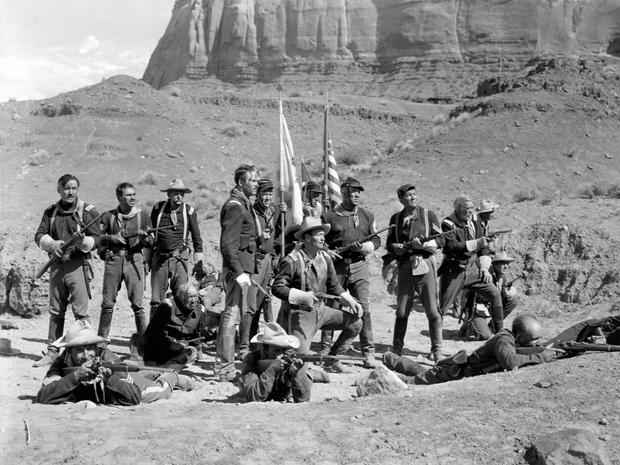
John Ford’s western, an extremely loose re-imagining of the Custer massacre, surprises in numerous ways.  The film has a heady sense of humor – the hard-boozing Irish of The Quiet Man are present, but not quite so cartoonishly so.  It again reveals that John Wayne was quite underrated as a dramatic actor.  But it is most unique in its melding of patriotic lore and bitter cynicism, ultimately concluding that the fraudulent propagation of patriotic heroism is at a minimum a necessary evil and perhaps even a critical component of the national ethos.  What matters, ultimately, is the myth.

It is also, of course, beautiful in its use of Monument Valley.

image

My first thought for a first sentence of this review was “I don’t get it.” But that was at about 1/4 of the way through this sparse (budget – $100,000) and ingenious film that unfolds at its own leisurely pace, with every scene building upon the last.

The story is simple. Casey Affleck and Rooney Mara are a young couple on the verge of a move from their home when Affleck dies in a tragic traffic accident. Rather than ascend to the hereafter, his ghost returns to the home. And that is where we find him. For all ages. Mind you, he is not in a CGI, wispy and elegiac form. He is wearing a sheet with two holes cut out for eyes.  And his rambler (not a creepy Victorian) is the place he haunts, throughout eternity.

Wordlessly.

The film is at first uncomfortable.  It’s hard to adjust to the low-tech representation of ghostdom, and writer director David Lowery’s penchant for lassitude tests, but soon, through the patience of the director and the stoic and sad nature of Affleck’s choice, you invest totally in his journey.

This is an art film. As such, it takes chances other movies would not dream of. Not all of its choices hit the mark, but by the end, it proves to be thoughtful, accomplished, and really intriguing.

I am stil not sure that I get it. But have been thinking and talking about it ever since watching. That alone merits high marks.


There’s nothing particularly bad about this biopic of Chuck Wepner, the Bayonne Bleeder, the fighter who went the distance with Ali (mainly as a human punching bag) and was the inspiration for Rocky.  Liev Schreiber gets to trot out his semi-lovable, Joisy-accented galoot, and at times, you actually feel bad for the guy, a palooka with a heart of tin who is given a taste of the big time and handles it poorly (drugs, booze, women, and perhaps most distressingly, disco).  But you don’t ever really develop an interest in him.

You’ve seen it all before, and even with the exertions of Schreiber, a pasty and portly Jim Gaffigan (as Chuck’s loyal and unctuous sidekick) and Elizabeth Moss (his suffering wife), you end up asking “to what end?”  Or, in Joisy parlance, “What the fuck?”

The film also makes a huge mistake by trying to recapture the Ali-Wepner fight, which feels as if it was held in a community rec center.