Archive

Comedy

Very similar to The Talented Mr. Ripley, but without any of the care, build, patience, intelligence, or style of that flick. In Ripley, we are wary of yet sympathetic to Tom (Matt Damon), the working class nobody who insinuates himself into the shine of the rich and beautiful. When the tanned god Dickie (Jude Law) casts him aside, we feel for Tom. We don’t endorse the sociopath’s actions, but as Tom grows closer to capture, we guiltily root for him. When Tom’s desires draw him into greater malfeasance, against our judgment, we thrill to see if he will actually get away with it.

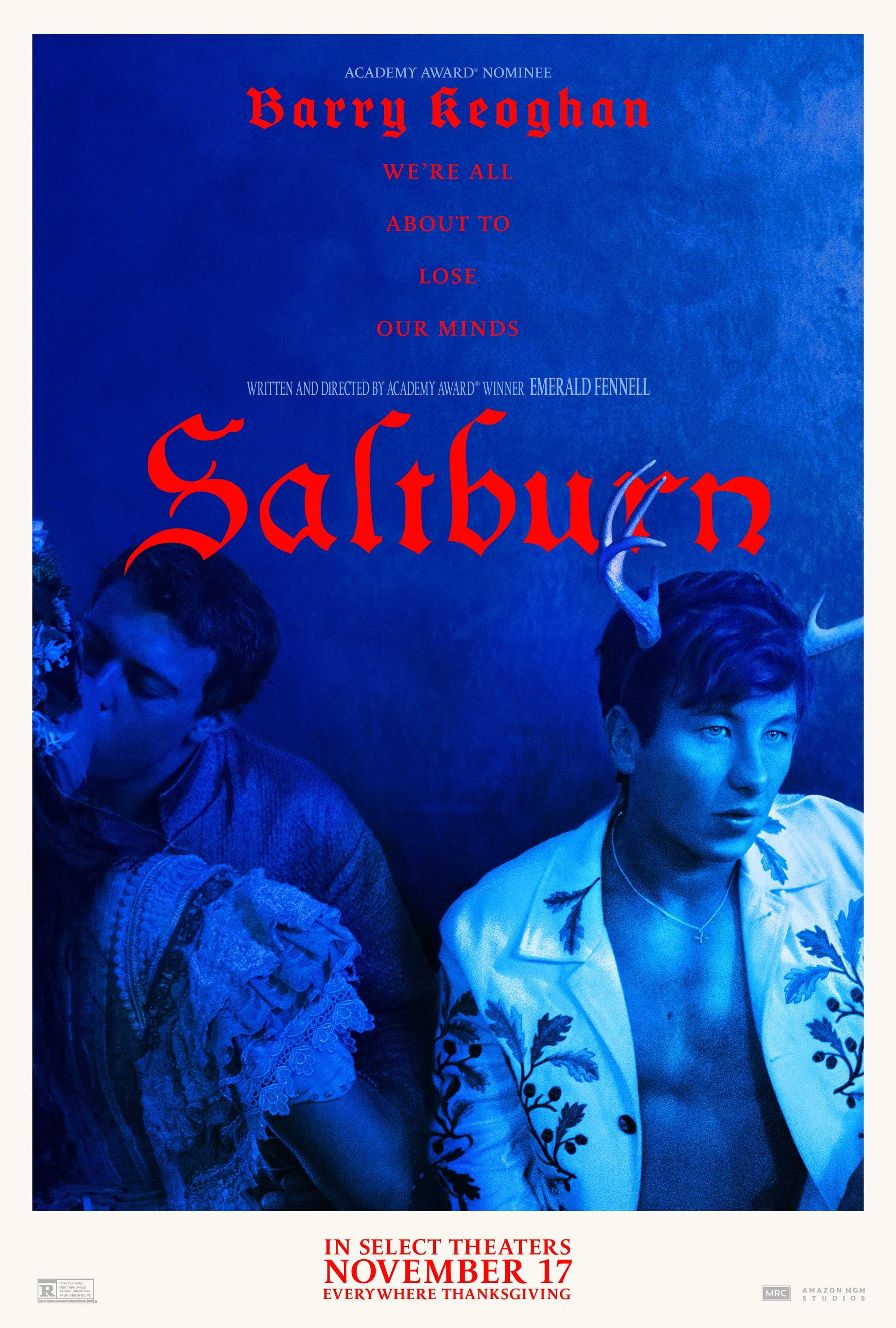
Here, our new Tom Ripley is Oliver Quick (Barry Keoghan), a modern day loser at Oxford who gloms on to his own Dickie, Felix (Jacob Elordi), a rich kid whose monied and titled family lives in a castle on Saltburn estate. After ingratiating himself with Felix, Oliver is invited to Saltburn where he negotiates Felix’s ridiculous caricature of an upper-class family, his own increasing desire for Felix, and the fact that he is disposable to these people when, like Ripley, he is trying to make himself indispensable.

Unlike Tom, however, we don’t root or care for Oliver. He’s a furtive creep. Even when he overhears the rich kids at school or Felix’s family malign him, our natural pang of sympathy immediately gives way to caution. The guy smells of wrong from the get-go and because of it, we have no skin in the game, either about Oliver’s fate or the cartoon characters around him.

What follows is a wretched flick infatuated with its own provocativeness. It’s not very funny, though it is labeled a black comedy. It’s not very edgy, though it is sexually perverse. It’s not very smart, unless rich people one level removed from The Howells on Gilligan’s Island saying grotesque things is your idea of smart. In Ripley, the rich were dazzling. Any condescension was barely perceptible, and accordingly, all the more cutting to Tom. You can see why Tom wants in and how much it stings. Here, Oliver yearns for a world populated by dolts and cretins, so, who cares?

The picture is also repetitive in the extreme. Basically, every scene is Oliver made uncomfortable until he becomes morose. When Oliver gets a win, another cliché rattling his/her jewelry reminds him for the umpteenth time that HE DOES NOT BELONG.

After running the tired plot into a very tight and boring corner, the end lapses into inanity (SPOILER: Oliver kills them all in a manner a mall cop would suss out as foul play inside of a minute; apparently, the British police force is trained by Magilla Gorilla).

But no one is on to Oliver because it’s a shit screenplay so far up its own ass that it need not deign to generate interest, draw characters, or construct a sensible narrative.

The near-end, where we flashback to Oliver’s machinations previously hidden to us, ala’ M. Night Shymalan, is such a clumsy and pathetic attempt at bringing order to this mess I almost felt for the creator.           

But then, I realized Saltburn is from the writer director of Promising Young Woman (Emerald Fennell), another infantile, impossible crapfest which got the critics to swooning.

On Amazon Prime.

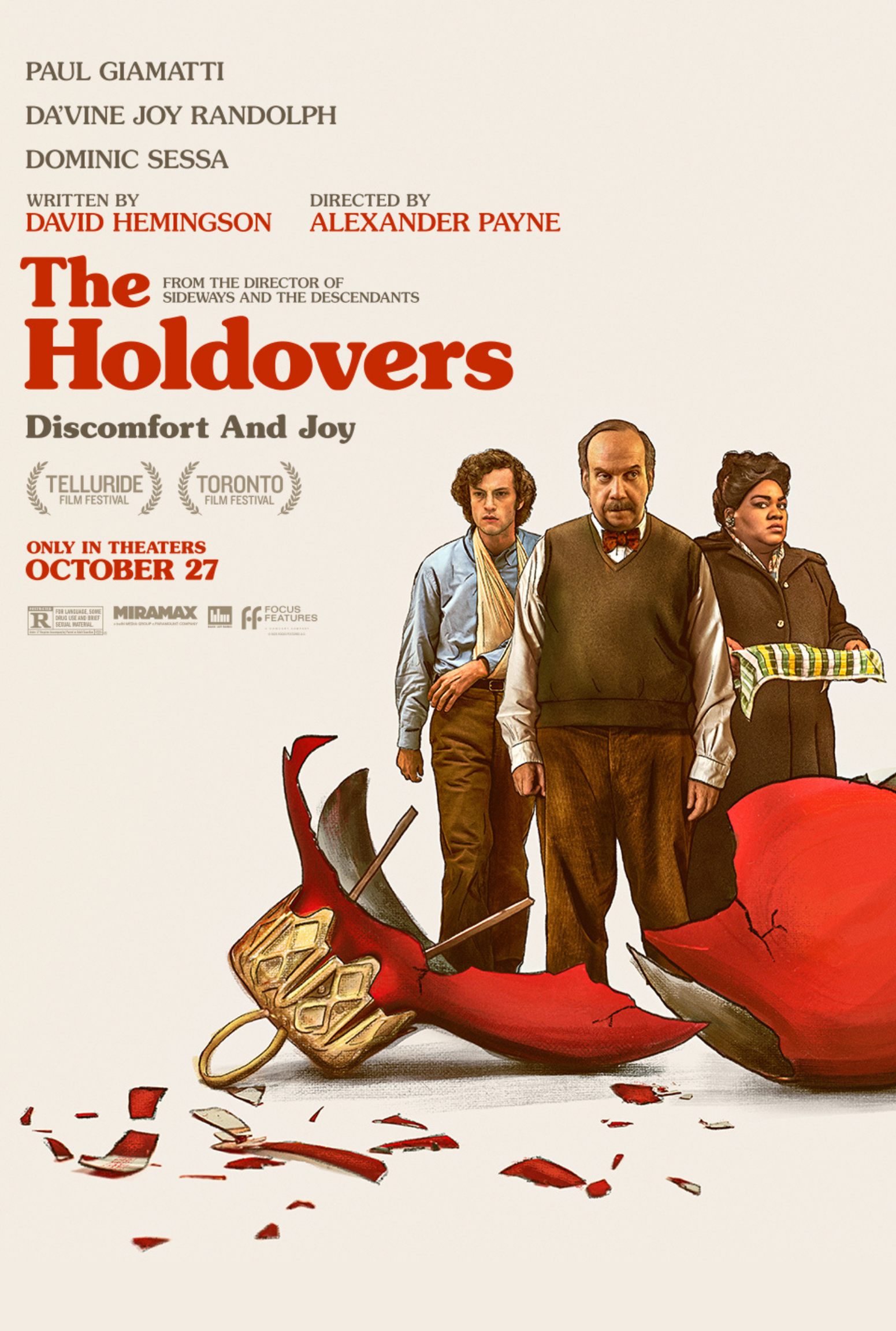
When I saw the preview for Alexander Payne’s latest picture, I thought, “Okay. Older father figure. Private New England boys school. Some Christmas break bonding. Not the Baird school, but Barton. It’s Scent of a Woman, with a couple of tweaks.” I was right and also very wrong.

Now, I like Scent of a Woman. It’s occasionally moving, impressively manipulative, and entertaining as hell. Chris O’Donnell is vulnerable and empathetic. And even in a small part, a young Phillip Seymour Hoffman (poor George, “sitting in Big Daddy’s pocket”) resonates.

But the picture is near-obliterated by Al Pacino’s roar and Martin Brest’s complete lack of restraint. Hey, folks, not only are we going on a last hurrah with a blind depressive and his young charge, but let’s make the blind depressive a) do a flawless tango with a complete stranger; 2) have such a “fix-is-in” fight with his family that you feel for the bad guy, Bradley Whitford, the sneeriest of nephews; and 3) drive a race car in the Big Apple!

Hoo-ah!!!!!!

Still, like a Whopper Jr., the flick delights until the inevitable dyspepsia.

Now, the differences. First, without Pacino sucking up all the oxygen, The Holdovers has room not only for a Paul Giamatti as a strict, sneakily populist professor, and newcomer Dominic Sessa, the poor rich boy abandoned to staying over at school for the holidays under Giamatti’s thumb, but Da’Vine Joy Randolph, the school’s cook, who must endure the Christmas break and her own recent tragedy. I can’t commend her performance enough – restrained, clever, surprising, and then heartrending without a hint of stereotypical sass and easy schmaltz. Her sharing of the ins-and-outs of The Newlywed Game with Giamatti is primo.

But Pacino could not have allowed it. There was simply no space.

Second, Giamatti and Sessa actually grow, and bond, primarily through conversation, revealing a beautifully rendered mutually protective nature. Whereas, Pacino and poor O’Donnell simply pinged from situation to situation, each increasingly absurd, because they were confronted with two legitimate threats.

Third, again, whereas the scorching flames from Pacino’s engine disallowed any real growth, space or time for others, Payne depicts important interplay between or including secondary characters. The heartbreak and frustration of a bullied kid and his mitten choked me up, and after another poor holdover from Korea breaks from homesickness in the middle of the night and is comforted by Sessa, the job was nearly finished. Indeed, the kids in The Holdovers run the gamut – the dumb bully is there, but so too the clueless but tender-hearted jock and the poor youngsters. In Scent, with the exception of O’Donnell, every kid at Baird seemed to be some form of generic, shit heel carnivore or mere prey. Here, Payne delves a little deeper and produces some truly poignant moments.

Last, Pacino had one change to make, from bigger-than-life suicidal howler to a man who wants to live for himself and others. Conversely, Giamatti is seemingly a martinet, but in fact, turns out to be multi-layered. Rather than merely having Giamatti overcome his condescending and authoritarian nature, writer David Hemingson explores several aspects of his personality and past, all of which fill in the puzzle. And Sessa isn’t the only contributor to his growth, which fleshes him out even more fully,

The end of the film is a bit of a surrender to Scent’s need for big dramatic closure, and in particular, one Giamatti zinger is off-kilter and completely out of character. But the sin is venial.

If they are still holding the Academy Awards, I see a slew of nominations, and if you can get some juicy early odds on Da’Vine Joy Randolph for supporting actress, go heavy.


The previews suggest an unrelenting, biting send-up of the idiocy of the so-called black experience as represented in the arts. On that front, the film delivers, though with a stiletto rather than a cleaver.  But while the social satire of the film is paramount in its marketing, in presentation, the picture is a sweet and moving story about a family whipsawed by tragedy. It is not lost on the viewer that the dramedy is refreshingly devoid of the stereotypes punctured by the picture. Writer-director Cord Jefferson practices what he preaches, delivering on the traditional at the expense of a caricature he effectively obliterates.

We meet Monk (Jeffrey Wright), a college professor and author in California, as he is confronted by an entitled white undergrad who objects to his having written the title of a Flannery O’Connell short story on the blackboard. Monk explains that as a black man, if he can get over the word that shall not be said, surely, so can she. Our Precious, however, stands in for every vapid girlchild who haunts the modern university, likely cheering for Hamas though they would throw her and her heightened sensibilities off the nearest roof. So she complains. Monk is summarily placed on sabbatical and forced to reunite with his upper middle class family back in Massachusetts and, as with all “going home” movies, things get messy. 

Monk is also going through a professional slump, his books fewer and farther between, and not very popular. While attending a book fair, he notices the crowds at another black writer’s (Issa Rae) event, and when she reads a passage from her novel, a tale of domestic hardship told in the patois of the street (“Yo, Sharonda! Girl, you be pregnant again?”), Monk winces. The crowd, however, swoons and applauds the bravery, grit and authenticity.

Furious, Monk writes his own ghetto tale, My Pafology, as a joke and a rebuke.  He also creates a pseudonym, and soon, the big publishing houses and Hollywood come calling. He is stunned yet seduced, and in aid of his scam, must adopt the mien of the inner city thug, a character so “real” that he cannot make public appearances because, of course, he is wanted by the law.  He negotiates his double life in the midst of rapprochement with his family, with varying levels of success.

I laughed out loud in the theater at least a dozen times, and was thoroughly amused throughout. No one is unscathed, and nothing feels cheap or gratuitous. Most jibes are nuanced, and when Rae and Monk finally go at it, there is no dawning, no lesson. Just an insoluble conundrum that thankfully is not laid at the feet of whitey or oppression or the usual suspects that are part of the grievance mill Jefferson has in his crosshairs. 

The script crackles. Not only in Monk’s hilarious attempts at playing street, but in the familial slings and arrows between Monk and his siblings and the interplay between Monk and his colleagues. When Monk is solicited by a tony literature award contest to be one of the judges, the courter explains that they needed to add some diversity to the panel.  Monk responds, “I’m honored you’d choose me out of all the black writers you could go to for fear of being called racist” to which he receives the oblivious reply, “Yeah. You’re very welcome.”

If it has any flaws, it may be a bit top-heavy on family melodrama over the social satire. But it’s one of best movies of the year. 


The other day, my son bemoaned people who couldn’t just enjoy the silly movies from their childhood, like Star Wars or Indiana Jones, because they had to find a reason to justify the continuation of their early filmic love into adulthood. So, they create a form of criticism that makes their adoration of juvenilia acceptable, even erudite, elevating simple, fun movies to high art or of great social import (which then naturally leads to a concomitant acceptability of their living at home in the basement amongst their toys well into their 30s).

To be fair, I added the parenthetical.

I thought about what he said when I was watching Barbie. Of course, it will be the subject of Gender Studies papers for the next 20 years, and has already spawned reviews of great seriousness (“a searing social critique”; “An earnest feminist manifesto inside a barbed social satire”; an “existential exegesis on what it means to be a woman, and a human”).

There are indeed very smart things in Greta Gerwig and Noah Baumbach’s script, including some clever, contemporary touches and social observations. Some land and some elicit a groan.

However, the movie works best as a series of jokes and physical humor encased in a startlingly resonant set design and an energetic commitment to unbridled fun.

That it lightly lampoons patriarchy, consumerism, wokeness, feminism, bro’ culture, capitalism, and much more is undeniable. But that is icing. The cake is the yuks, and Gerwig offers an endless parade of laugh-out-loud lines and sight gags and rousing musical dance numbers, almost all of which land and charm.

A few nits.

I am sick of Will Ferrell. He’s the same schtick, every single time, and he is lazy and boring.

Also, there’s an inspiring speech that screeches the flow to a halt. A rousing feminist speech. To dolls. It’s a bit like watching a character in Star Wars give a soliloquy about colonialism. To Wookies.

The picture is also a bit repetitive and long in its syrupy, maudlin end (though it lands on a great crack to close out).

But these are annoyances. The film opens wondrously, as we are introduced to Barbieland, where everything is perfect; what is not perfect is plainly identified as such (aka, “Weird Barbie” and “Pregnant Barbie”); girls rule; and the Kens serve and bicker amongst themselves, vying for the attention of their masters. But the perfect world of one Barbie (Margot Robbie) begins to crack (her arches fall, she thinks of death), the real world beckons, and she answers the call with a besotted Ken (Ryan Gosling) as a stowaway. There, she finds sadness, men in power, and her own obsolescence. When she is gone, an empowered Gosling returns to Barbieland, and the Kens rise, in hilarious fashion.

After checking its social responsibility box with indelible ink, the picture ramps up as the Barbies use their superior intellects and, interestingly, their feminine wiles, to overthrow the dum dum Kens during their short-lived reign.

This allows for Gosling’s musical numbers, which are worth the entire movie. There is no way around it. He steals this picture. It crackles in every frame in which he appears, and his resume’ as a strong comedic actor (The Nice Guys, Crazy Stupid Love) has expanded.

And “I’m Just Ken” is undeniably the best musical number EVER!

As a social experiment, I would like to run this movie at Oberlin or Brown during Pride Week. In preparation, it would probably be best to stock up on smelling salts, fainting couches, and emergency room personnel. 

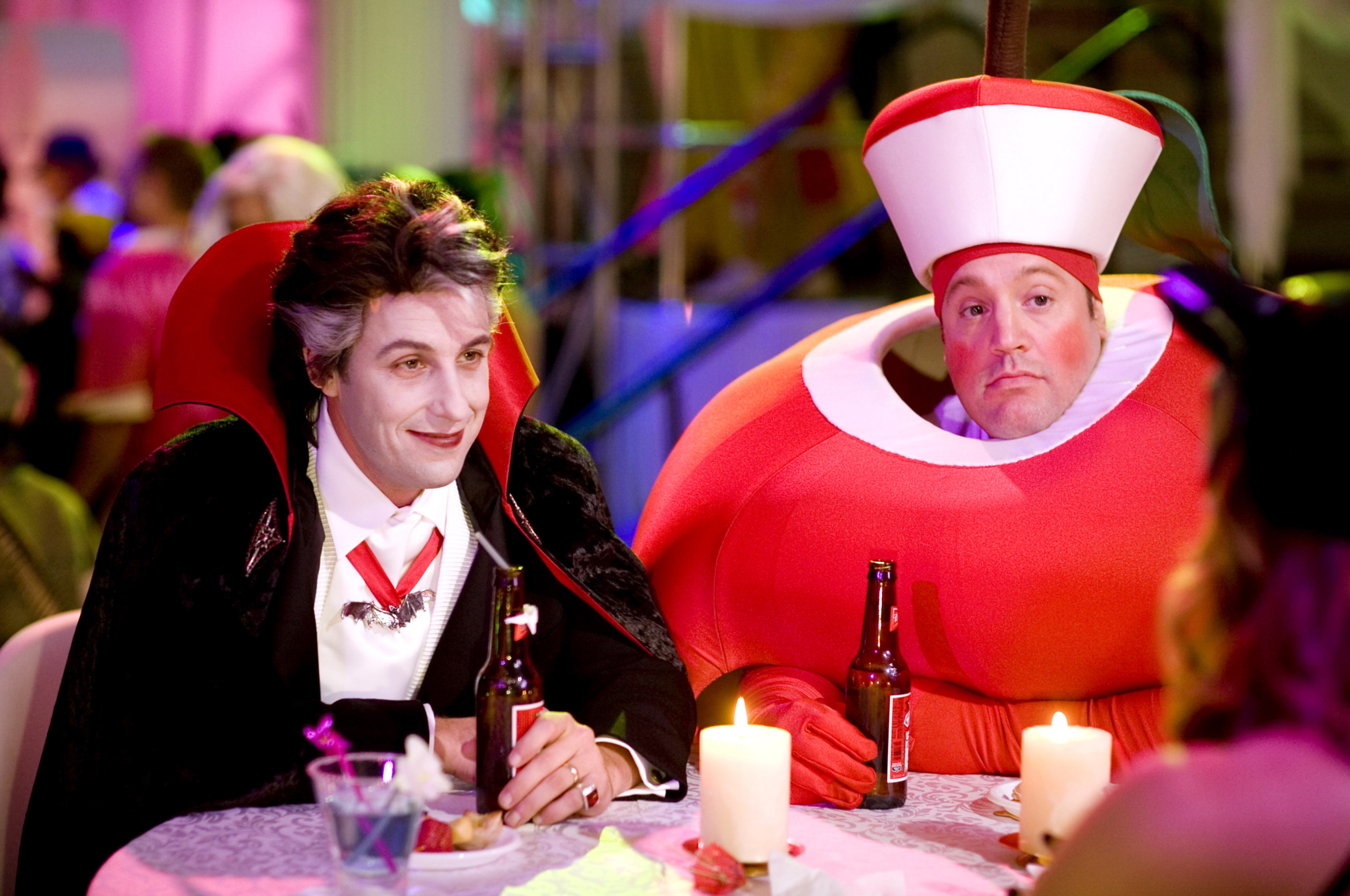
The set-up is standard Sandler. Two best friends and Brooklyn firefighters (Adam Sandler and Kevin James) pretend to be gay so they can establish a domestic partnership which will ensure benefits for James’ children. James is a widower. Sandler is a cocksman, bedding Hooters gals 5 at a time.

But then the city gets wind of the potential fraud, they must retain a beautiful lawyer (Jessica Biel) for whom Sandler falls, they become a cause celebre’, and hijinks ensue.

On the one hand, there’s scads of ass, tits, fart, balls, dick, poop, and pee jokes, overweight people are mercilessly skewered, and racial and ethnic stereotypes abound. No matter the subject or target, the Sandler brand is respected.

Indeed, this is the kind of landmine film that would normally result in serious reputational damage, like blackface. A few nuggets:

  • Rob Schneider plays gay and Asian. And by Asian, I mean, Bucktooth, Charlie Chan, as stereotypically offensive as it gets Asian. 
  • Dave Matthews plays in a wordless cameo where he mincingly makes eyes at Sandler. One can assume that his desire to make it to the big screen obliterated all judgment. 
  • When James goes to his child’s bring your father to school day, the following exchange occurs-

“Student:
Mr. Valentine, you said you’re a fireman.

Larry
Valentine: Yes, that is correct.

Student
Do you have two jobs? Because my dad said that you’re also a butt pirate.”

  • Dan Ackroyd plays their fire chief. His admonition? 

“Gentlemen, I have a very simple policy. What you shove up your ass is your own business.”

  • And when Larry springs his scheme on Chuck?

Larry
Valentine: Domestic partnership.

Chuck
Levine: Domestic partnership? You mean like faggots?

Larry
Valentine: No, I mean yeah but, no, not us. Obviously. Just on paper.

Chuck
Levine: Paper faggots?

Larry
Valentine: Well, the accepted vernacular is “gay”… but yes.

I mean, if Gone with the Wind requires a warning, this thing should come with a signed waiver. 

So, how did anyone who had anything to do with this film remain unscathed? I have thoughts.

First, the consistency of the folks with the torches and pitchforks has never been their strong suit. Some people get eviscerated, others get a pass. Here, everybody seems to have gotten a pass, which is to the good. I suspect the body count would have simply been too high.

Second, for all of its excess, the picture is “up-with-people, we-are-the-world” inclusive.  While the film luxuriates in its offensive stereotypes, it offers redemptions (unlike, say, Animal House, which is similarly politically incorrect yet doggedly cynical).  At the end, Ackroyd provides the necessary immunity:

No matter whom we choose to love, be they heterosexual, homosexual, asexual, bisexual, trisexual, quadrisexual, pansexual, transexual, omnisexual or that thing where the chick ties the belt around your neck and tinkles on a balloon, it has absolutely nothing to do with who we are as people.”

The fist of stereotype encased in the velvet glove of love.

Third, it is also not terrible. Like with Get Hard, I laughed more than I expected to and was impressed by the sheer gusto of James and Sandler. A solid A for effort if not execution. 

Fourth, the anti-gay bigots get a comeuppance (which is a word that, were it to be in the script, would soon be followed by “ass” or “butt”). Sandler even gets to play Harrison Ford amongst the Amish in Witness, because, as everyone knows, gay people don’t punch their tormentors, they only sass them. 

Finally, the picture was fortunate to precede the most recent spate of witch trials (see Bradley Cooper’s insensitive Jewish nose in the new Leonard Bernstein endeavor).  This is 2007, which seems modern, but it is almost a quarter of a century ago. 

Watch it.  It’s worth the time for historiographic purposes. And the ass, tits, fart, balls, dick, poop, and pee jokes.

In a year when Andrew Dominik thudded with a Hollywood fable, Blonde, Damian Chazelle, who was on a three picture heater for the ages (Whiplash, La La Land, First Man – yes, people, that’s three 5 star pictures), also crashed and burned, bigly and badly. But where you can see that Dominik’s failure was easier to hide in the making, Chazelle’s epic expanse of shit seems so obviously terrible in its awful construction that you hold everyone involved responsible, for any of them could and should have struck Chazelle hard across his face and said, “What the fuck are you thinking!”

The film, set in Hollywood in the silent to sound era, mistakes bloat as grandeur, Looney Tunes-level excess as glory, and crassness as knowing cynicism. Chazelle’s monstrosity has nothing to say or offer though what the picture does provide is a lot, and loudly. Then, unforgivably, it closes with paeans to the magic of the movies, gaudy testaments as they live in the hearts and hearths of the little people. Chazelle has the audacity to attempt to transform two sybaritic simps (up and coming ingenue from the wrong side of the tracks Margot Robbie and drunken leading wreck Brad Pitt, who fared poorly from the silent to the talkie) into the nostalgic wreckage of TinselTown.  And if that wasn’t enough, a racial parable is tacked on in the story of a jazz trumpeter who crosses over to the screen (Jovan Adepo). He is given just enough of a story to feel both insufficient and patronizing.

The movie is not a takedown of old Hollywood or an homage or even a madcap celebration of the hedonistic heyday. It’s just a boring, overlong freight train that supplants story and motivation for one spectacle after another, mainly in distractingly dizzying and ostentatious tracking shots. Then, after treating the characters as little more than CGI, they are destroyed amidst an ill-considered lecture about the perils of fame, the fakeness of it all, and the fact that Hollywood, as a Hedda Hopper type (Jean Smart) relays to Pitt, “is bigger than you.” But, she promises, you will … live on … forevah, on celluloid, “with angels and ghosts.”

Retch.

The performances are necessarily cartoons. Robbie, in particular, is obscenely over-the-top and nearly abused. As I said, you don’t care about her, you don’t care about anyone. Unless you care about Wile E. Coyote.

So bad you feel a little sick at the end, following a grotesque foray into the truly seamy underbelly of the town (think Freaks-meets-Carnival of Souls).

This was all done better by the Coens in Barton Fink and a heckuva lot better in Hail, Caesar!

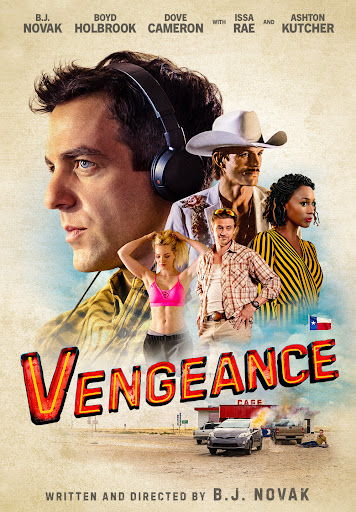
BJ Novak‘s black comedy nicely straddles the line between laugh-out loud funny and acerbically insightful. Ultimately, a culture class vehicle, the film also hits every one of its marks in blue and red America.

Ben Manalowitz (Novak) is a NYC writer who longs to host a hot transformative podcast, a vessel for his views of America. When we meet him, he is so hiply ironic and up his own butt, there’s not a lot to root for. But we do, because he seems adrift and in struggle for meaning. Once you get past all his posturing, he also seems decent, if weak.

Novak’s Ben reminds me of Lena Dunham’s Hannah Horvath in Girls, a clearly unsympathetic protagonist shown in an unflattering light who still manages to elicit empathy. Novak skewers himself mercilessly (shout out to John Mayer, whose one scene with Novak is a hilarious, ostentatious riff between two “bro’s” that introduces Ben and what he is about with economical precision), but stops short of the cartoonish, offering a balanced portrayal of a narcissistic guy with bite-sized intellectual pretensions who also wants to be a good dude.

When Ben gets a call from a distraught man in Texas telling him that his sister and Ben’s girlfriend Abilene is dead, it takes Ben a minute to realize that she was just one of his many occasional hookups, one who must have told her family that he was her steady boyfriend back in the city.  Ben takes an extra beat to see a trip to Texas for Abilene’s funeral as an opportunity to immerse himself in some of the America he waxes so philosophically about. Upon arrival, a hot podcast is born.

Ben is the quintessential fish-out-of-water, and in lesser hands, the film would have had little to say about the cultural divide while maximizing the pratfalls and faux pas of a NYC Jew in shitkicker county. Or, the picture would have jettisoned the funny for deep intonement about the state of our current national fracture, such as it is. 

Novak smartly balances both elements while crafting a genuine connection he makes with Abilene’s family.  A scene where Ben attends a rodeo is gut-busting, another where he interviews Abilene’s record producer (an impressively soulful Ashton Kutcher) is thought-provoking and intelligent, and the deeper his dive into fly-over country, the funnier and more meaningful the picture becomes. Novak takes hard, amusing, and accurate shots at everyone’s station with a humility that elevates the movie.   

The picture suffers just a bit at the end from repetition (a little Ashton Kutcher goes a long way) and a discordant, implausible cherry on the top, but no matter.  Very sharp, very tight, highly recommended.                   

On Amazon Prime.

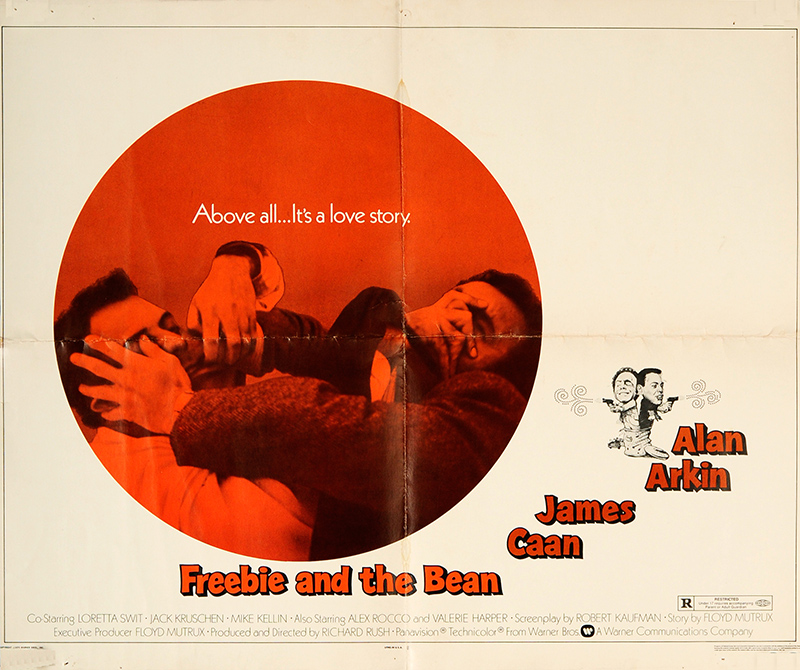
Another of the 70s flicks my Dad took me to when I was probably way too young  I remember being so jazzed at the back-and-forth between the manic Alan Arkin and wisecracking, nattily dressed James Caan, two San Francisco detectives trying to take down a mob boss. To make things cooler for a 9 year old, the violence was hilarious yet brutal, the dialogue scabrous, and the car chases relentless and in great supply.

Would it hold up 50 years later?

Yes, and how. Quentin Tarantino has raved, “nothing short of a masterpiece…absolutely brutal…part of the way the film worked was for you to laugh at the brutal violence and then feel bad about yourself for laughing.”  That is too much praise, but not by much. Caan and Arkin are a scream, very natural, yet way, way out there in terms of chemistry, perhaps riffing before it became standard, but fully committed, never lazy. I remember cracking up with Dad in the theater and after paying $2.36 for the rental on Amazon this weekend, I laughed out loud a half dozen times and smiled throughout.

It’s a strange duck of a picture, a flimsy cynical story giving way to an entertaining buddy cop yarn (clearly echoing The Odd Couple). Director-writer Richard Rush allows for very long takes of Arkin and Caan needling each other and then, there’s absolute chaos, followed by sweet scenes between Caan and his gal and Arkin and his wife. You get the sense that tonally, no one is steering the ship, and Arkin has remarked that he never really knew what kind of movie Rush was trying to make. Still, Rush makes it more seamless than it has a right to be. Good fun through and through, and The Nice Guys owes a lot to this picture.

Also, wildly offensive. For those keeping count, Arkin of European Jewish descent plays Hispanic (he is “the Bean” – get it?), as does Valerie Harper (“Rhoda”). The script is littered with politically-incorrect jibes that would likely result in a campus protest these days, and the treatment of the villain would require the calling in of the National Guard. So, gird your loins.

On Amazon Prime.

“Well, that was quite a thing” – my wife, at the end of the movie. Spoiler. Animals die.

About my wife. When that occurs, consider all your slack given.

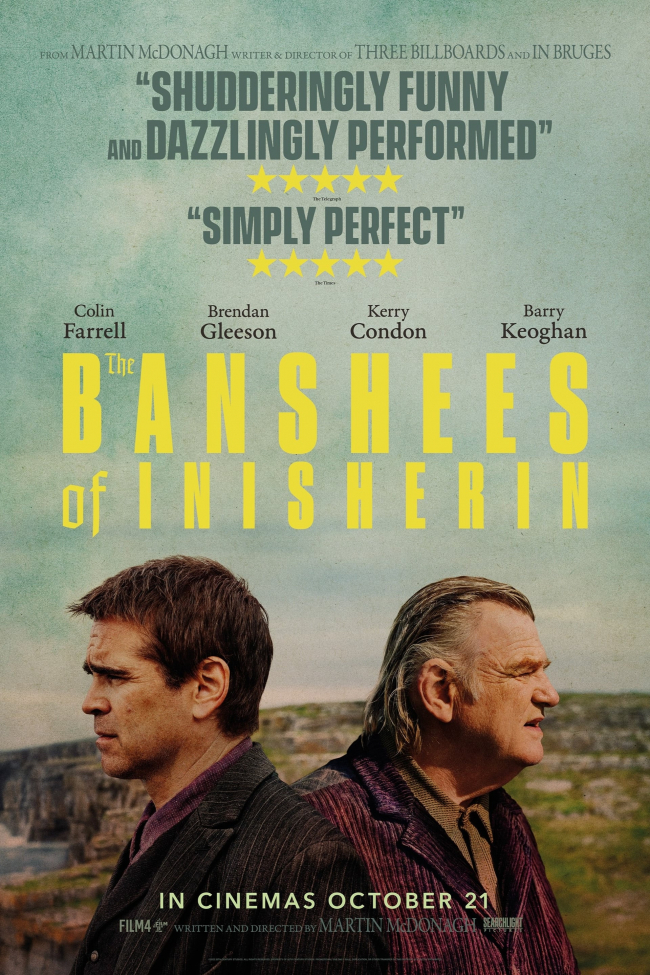
It is indeed, however, quite a film, one that works as a fable, a meditation, and a beautiful, conflicted, messy tale of the shackles, joys and miseries of isolation, friendship and love.

I have a deep frustration with people who have the kind of depression that blots out the sun and cripples those who love them so much that they become collateral damage. The narcissism. The “I don’t take drugs because they change the essence of meeeeeeeeeeee!” The voracious appetite for the steadfastness of the simpletons who take the kicks and keep coming back for more. Blech. I’m not always proud of it but it is genuine and fixed in my marrow.

Here, a depressed, artistic man in despair (Brendan Gleeson) cuts off his simple, dull pal (Colin Farrell) even though they are lifelong friends on a barren Irish Island. The disassociation is brutal and final and nothing less than an assault from the intellectually superior and more sophisticated of the union. Every instinct I had was to decry Gleeson and champion Farrell, even as I grudgingly respected Gleeson’s stand, cruel and self-abasing as it was. I’m more gravitated to the simple and the banal, the loyal, Particularly when the artist’s excesses, in all their Van Gogh glory, start taking hostages. Taken at face value, it was no contest.

But as the picture progressed, my sympathies for both men equalized. Somewhat. Against all of my internal instincts. And in the struggle, the picture opens up and draws you into a much deeper analysis.

Fecking hell.

Interspersed in this tug-of-war is Martin McDonagh’s (In Bruges, Seven Psychopaths, Three Billboards) alternatively hilarious and mournful dialogue, deeply rooted in the Irish experience, with its strange and compelling fixation on conflict, routine, simplicity, and the Church.

A gem I wanted to hate.

On HBOMax.

You know you are getting old when you see a movie that you have reviewed but you forget you reviewed it and review it again. In 2016, I gave the picture 4 stars and wrote: Richard Linklater’s astute command of time and place is forever proven by his masterpiece, Dazed and Confused, which captured a Texas town’s high school circa 1976 in all its bell-bottomed, long-haired, keg-in-the-woods glory. Everybody Wants Some! ain’t Dazed and Confused. Focusing on a young college baseball player’s matriculation at a Texas college, Linklater appears to be satisfying an 80s-era checklist. Mud wrestling. Check. Disco. Check. Mechanical bull. Check.  “Get the Knack!” Check. And while Dazed and Confused gave you insight into the jocks, the stoners, the geeks, the parents, the coaches, the teachers and the townies, Everybody Wants Some! is limited to the hyper-male competitive environment of the baseball team, a group that parties hard, jumps on your Achilles at every opportunity, and challenges each other in all respects, when not dime-store philosophizing about winning, commitment, pot and “pussy.Yet, with all its flaws and limitations, I dug the movie. Linklater lovingly recreates the art of male bullshitting, which, granted, is not for everyone; the wonder of all the possibility of college; and the camaraderie of sports, all to an unabashedly “classic rock” soundtrack. it’s an acquired taste, and this is a very light film that at its best is merely charming, but I was smiling throughout.

I have apparently become more besotted. My review today:

The party band from Houston, Old 97s, have a couple of tunes off of Fight Songs – “19” and “Oppenheimer” – that are clean, crisp pop paeans to young love and the wonder that goes with it. Richard Linklater’s Everybody Wants Some! is the filmic equivalent of those songs, where a college freshman baseball player (Jake, played by Blake Jenner) arrives at school in Texas (where else? This is Linklater) and is immediately immersed in the camaraderie of his carefree team, a welcoming party culture, and the early throes of young love with someone who is outside of his normal ambit, a theater major. There is nothing cynical or particularly challenging in the film. In fact, it is so conflict-averse and hellbent on nostalgic tomfoolery, it makes Linklater’s classic forerunner Dazed and Confused seem almost dour. And I loved every minute of it. All the silly machismo, the pranks, and the primal dance of young college kids.  All the 80s music.  All of the doggedly upbeat fun and the sweetness of the jocks.

When Jake goes over to the dorm room of the girl who has flirted with him on his first day (Zoey Deutch), and they introduce themselves, I was transported.

Some might find the picture maudlin, or pollyannish, or even retrograde. As one stinker predictably opined, “It’s as if Linklater is bound by a bro code that obliges him to present these guys in a basically uncritical light.”

But as they say, I laughed, and while I did not cry, I laughed some more and became a little wistful. Great time of a movie.