Archive

Comedy

Whit Stillman films are similar to Woody Allen films if you dispense with the angst and replace older urban New York Jews with younger urban New York prep school/deb type WASPs.  Also, toss out the whole “big notion” premises of death, morality and faith and replace them with passing fashion, pop culture, and functional philosophy.  And since Stillman does fewer films than Allen, listening to the witticisms of attractive scions of varying degrees of wealth as they contemplate their navels is neither grating or played out.

Stillman directed two prior films, Metropolitan and Barcelona, the former dealing with New York City private high school kids and the latter taking two of those characters and transplanting them to liberal, carnal Spain.  If you’ve seen Metropolitan and Barcelona, this is similar in tone, content and style.  However, this one is a bit more fun loving and free, as it chronicles the fall of disco in New York City through the eyes of several fresh out of college young urban professionals (though the moniker of “yuppie” is hotly debated) who negotiate their first jobs (publishing house, advertising, prosecutor’s office, environmental law firm) during the day and cruise the disco at night.  It’s also a little more personal.  Even though Stillman has a usual ensemble cast, which thankfully includes the brilliant Chris Eigeman, in this film, Chloë Sevigny is our primary guide and with her we suffer the perils and awkwardness of casual sex for an intellectual frump in the 80s.  It is painful indeed to watch her seduction tecnhiques, which includes a breathless, “There’s something really sexy about Scrooge McDuck.”     

As in all Stillman films, the conversations that meld college bull sessions and comparative literature courses are the gems, such as this back-and-forth on Lady and the Tramp

marjorie nugent

Richard Linklater offers the story of Bernie Tiede (Jack Black), a gay mortician who companions a significantly older woman, Marjorie Nugent (Shirley MacLaine) and then, in a fit of rage and exasperation at her domineering ways,  shoots her in the back and stuffs her in a freezer, pretending she is still alive (not ala’ Norman Bates).  Tiede is the town Robin Hood, the town being Carthage, Texas, and in many ways, Carthage is the star of the film.  Linklater uses very few professional actors, instead interspersing the dramatic narrative with interviews of real-life Carthage citizens, almost all of whom are squarely on the side of Tiede, and almost all of whom are hilarious.  To them, Nugent was a nasty, wicked old wretch and Bernie Tiede was the man who bought you a nice gift, sang the beautiful song that escorted a loved one to the hereafter, directed the town play or just gave you a nice wave everyday.  And he was driven to it.

Of course, in the presentation, Linklater neglects a few ugly details of the real life Tiede (not all of the vast sums he spent of Nugent’s wealth went to charity), but it appears the basic premise is true – Tiede was well-loved and Nugent well-hated (her own nephew observed, “‘Bernie’s not the first one who thought about killing her.  He’s just the first one who went through with it”).

Black is mesmerizing as Tiede, hilarious, hapless and harried, but uncontainably sweet and just a  little guilty (even before the murder).  MacLaine is effective as an old witch and Matthew McConaghey is amusing as the dogged D.A.  But the stars are the real people of Carthage, who Linklater neither mocks or mythologizes, wisely letting them be.

My only criticism is the choice to make Tiede so sympathetic.  Black does a great job in keeping him from being saccharine, with occasional flashes of guilty pleasure at his newly found wealth, but Linklater keeps away from any real dark heart, opting for a feel-good film.  Which is fine, but I think it could have remained feel-good and still been a little more revealing.

In my house, we have a few Christmas rituals, including a slate of television shows and movies we must watch on or near the holiday.  The shows are sacrosanct; “A Charlie Brown Christmas” and “The Grinch.”  The movies have always included such staples as A Christmas Carol (the George C. Scott version) and A Christmas StoryIt’s a Wonderful Life tends to be seen bi-annually, and it can be watched at Thanksgiving.  The most recent additions have been Elf and, of course, that holiday heartwarmer, Die Hard

My boy and I gave A Very Harold & Kumar Christmas its audition.  Harold and Kumar are much funnier than Cheech and Chong, and in this third installment of their stoner oeuvre, a baby gets stoned, does coke, and ecstacy; Neil Patrick Harris attempts to pleasure himself on an unsuspecting chorus girl who he is massaging (the joke? Doogie’s Howser’s homsexuality is really just a ruse to take advantage of vulnerable women); the 3D is used mostly for the shooting of bodily fluids at the screen; Harold gets his penis stuck to a cold pole ala’ A Christmas Story; and then he shoots Santa in the head.

Let’s just say it’s on the bubble.

Splash put Tom Hanks on the map as a leading man, though he was not yet filled-in and substantial.  Instead, Hanks was mannered in the way an actor can be after a long stint on a sitcom (Hanks was one of the Bosom Buddies from 1980 to 1982).  The film was also Ron Howard’s biggest feature, and its success would launch his career as the director of competent, workmanlike, earnest and generally dull films.

Hanks plays a love-phobic NYC businessman (derived from a childhood trauma – he fell off a Cape Cod ferry and encountered a mermaid).  In the depths of despair over his romantic failures, he returns to Cape Cod, falls in the water again, and is again rescued by the mermaid, now grown up (Daryl Hannah), who follows him to New York.  She is pursued by a cruel scientist (Eugene Levy), captured and probed to the point of sickness (ala’ E.T.) and then is busted out by Hanks, his brother (John Candy) and a repentant Levy.

Almost 30 years later, it’s a shock to see such a callow and obnoxious Hanks.  His voice is whiny, his character churlish and childish, and he seems too much the boy for the part, light as it is.  Perhaps because a mermaid has no experience with men, she just presumed Hanks was a good catch (ba-dump) but he is not.  He’s aggravating and surprisingly unfunny.

The same cannot be said for Candy, who steals the movie as the heavy, schmoozing, hard drinking,  yuk-yukking brother, excited to have one of his letters printed in Penthouse.  Levy is also good as the nerdly, bitter scientist, and Hannah is appropriately innocent and glowing as the fish-out-of-water.

It’s a cute movie, no more, but it ends in an uninentionally ridiculous fashion.  Hanks jumps in the water, making the choice to live the rest of his live with Hannah under the sea (he cannot, for reasons unexplained, ever return to land).  The credits roll and Hanks and Hannah swim the ocean as she shows him her world.  She has a big fin, he does not (when she was on land, when dry, she had legs and what goes along with them when they meet, and they were able to have a lot of sex).  Her world is murky and humdrum.  “See, this is the ocean floor.  And there is a conch.  And there are some fish.”  And what will Hanks eat?

Image result for Splash hanks underwater

“This was a poor choice.”

Two dumb Southerners vie for a North Carolina congressional district, one a Democrat (Will Ferrell), a randy Bill Clinton wannabe, and one a Republican (Zach Galifinakis), who is essentially Ned Flanders. But they are of the same bent, using appeals to God, country, morality, patriotism and the like to sway the voters, who, being Southern, are borderline mentally retarded.  After an unscrupulous campaign that features baby punching, grudge wife screwing and near-maiming, we are all served a lesson in civics.

There are a few very funny gags — Ferrell accidentally leaves a message for his mistress on a phone answering machine while an unsuspecting family is having dinner; Galifinakis uses a book (“Rainbowland”) Ferrell wrote in the second grade to suggest Ferrell is a socialist because, in Rainbowland, everything is free; the baby punching; and Ferrell’s tortured rendition of The Lord’s Prayer at a debate.  But much of it is derivative, either of earlier Ferrell vehicles or the fim itself.  Worse, Ferrell so over-relies on his own brand of wild man antics that you can feel the air release from the movie.  Quite something when it clocks in at a mere 90 minutes or so.  When Ferrell engages in the gibberish-spouting freakout scene, I’m reminded of the story about the late Chris Farley, who once shoved a pool cue up his own ass to get yucks. Ingenuity or desperation? You make the call.

To compensate, we get some political instruction, presumably from producer Adam McKay, who must actually believe that vehicles created for the delivery of fart jokes will also suffice for ideological lessons (he did the same thing in the seminal Ferrell pic The Other Guys, which ended with a primer on the evils of TARP).  In this movie, the Citizens United Supreme Court case is actually cited, and stand ins for the Koch brothers (John Lithgow and Dan Aykroyd reprise the roles of Ralph Bellamy and Don Ameche from Trading Places) are wasted when provided with no funny material. There’s also much that is not funny, including a gag where an Asian housekeeper is made to talk black . . . again and again.

With only five films to his credit (Metropolitan, Barcelona, The Last Days of Disco, Damsels in Distress, Love & Friendship) and all but one of them in the same milieu (upper class young people in comedies of manners), Whit Stillman is overlooked in discussions of  great American filmmakers who are still working.  This despite the fact that Stillman has written and directed all five of his films, and all have been critically acclaimed.  

Barcelona, Stillman’s second picture, reprises two actors from Metropolitan as different characters.  Taylor Nichols plays Ted, a neurotic salesman in 1980s Barcelona. Chris Eigeman plays his cousin, Fred, a naval officer and freeloader sent ahead of the Sixth Fleet in the midst of a wave of anti-Americanism.  Both negotiate their acrimonious relationship, borne of childhood injuries inflicted by Eigeman, a truly obnoxious sort who as a visitor begins to stink after a day (unlike, as Nichols observes, the fish who takes three).  They discuss religion, women, anti-Americanism, sales, history and shaving, all the while falling in and out and in love with various Catalan women.

Nobody writes quite like Stillman. His dialogue is distinct and erudite, but his characters have such a surface forthrightness that what could seem contrived comes out as wholly honest and fresh. Stillman is particularly impressive in presenting a funny, incisive culture clash between the mildly ugly Americans and the bemused, mildly antagonistic Spanish. Both treat each other as curious, and even hostile interactions over politics are amusing and revealing.

Again, Stillman has no bad films on his resume’,  a rare honor.  Paul Thomas Anderson comes close. Though the second half of Magnolia is bad, the sheer perfection of the first half of that film and its overall audacity generally gets him a pass, but The Master is a long, very hard slog.  Scorsese is a great, but Gangs of New York and Shutter Island are very, very bad films, and his later sycophantic rock documentaries are downright embarrassing.  Coppola has some late career dreck (Jack, The Rainmaker) and have you even heard of his last three efforts (Youth Without Youth, Tetro, Twixt)?  Eastwood has his share of humdrum work (J. Edgar, Bloodwork, Space Cowboys).  Try as I might to suggest otherwise, Wes Anderson’s The Life Aquatic is haphazard at best.  Even the Coens, David Fincher, Gus van Sant, David O. Russell, Richard Linklater, and Steve Soderbergh have at least one dog (see A Serious Man, Alien3, Psycho, I Heart Huckabees, Bad News Bears, Solaris).

Woody Allen is closer to Stillman in style but Allen also makes some really horrific pictures (less so now that he’s not acting in them as much), redeeming himself with a great surprise just when you’ve written him off.  Take this list of Allen movies – Hollywood Ending (2002), Anything Else (2003) and Melinda and Melinda (2004).  All pretty bad.  Ballgame, right?  But then, Allen offers a smart Hitchcockian crime movie, Match Point (2005), and he is resurrected.  Two more sh** sandwiches follow in 2006 and 2007 (Scoop, Cassandra’s Dream), but in 2008, Allen comes off the canvas again with the charming and seductive Vicky Christina Barcelona.  And last year, after another pair of clunkers (Whatever Works, You Will Meet a Tall Dark Stranger), the best original screenplay Oscar goes to Allen for Midnight in Paris, a movie I hated, but I defer to the Academy. 

Stillman deserves better.

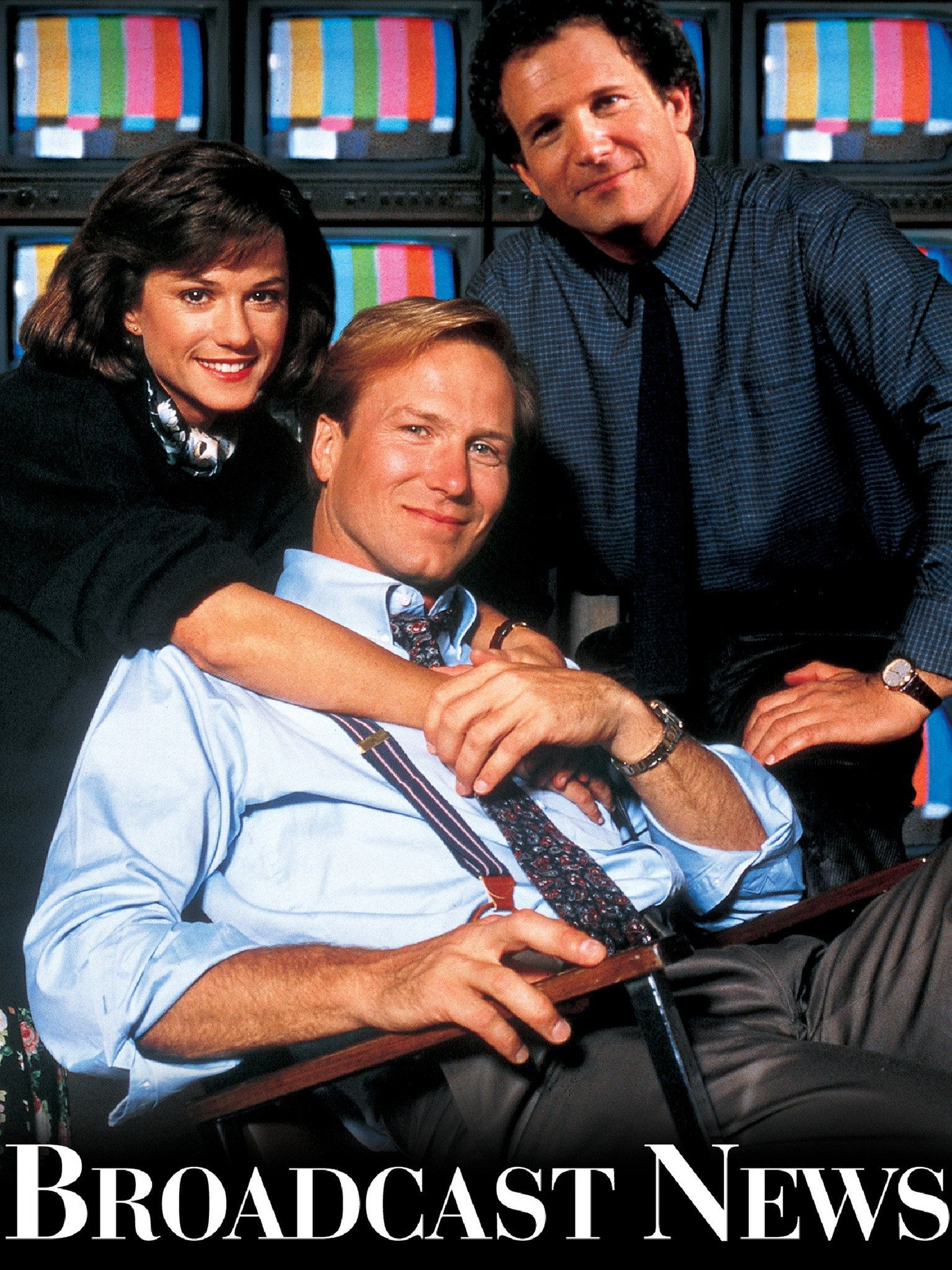
Broadcast News - Rotten Tomatoes

James L. Brooks has the ability to make you laugh out loud just before he brings a tear to your eye, a skill he has honed in Terms of Endearment and As Good as It Gets. His missteps (How Do You Know, Spanglish) still contain very funny dialogue, even if the whole doesn’t work.  But to be fair to Brooks, Paul Rudd, Reese Witherspooon, Adam Sandler and Tea Leone are not very formidable substitutes for Jack Nicholson, Shirley MacLaine, and Debra Winger.

In Broadcast News, Brooks melds a love triangle with a story about journalism and ethics that is prescient.  Holly Hunter is the producer of the Washington bureau of a major news network, Albert Brooks is a gifted but un-telegenic correspondent, and William Hurt is the new up-and-coming golden-boy, groomed to replace the current anchor (Jack Nicholson, in a hilarious cameo).  Hurt is attractive but shallow (as Brooks says, he is against everything Hunter is about).  But Hurt is also sweet and in his own way, genuine.  He fancies Hunter and when Brooks tries to anchor the weekend news in an effort to save his job, Hurt is there, giving him advice, some of which is excellent (“punch” a thought in each sentence) and some of which makes Brooks very uncomfortable (“Just remember that you’re not just reading the news, you’re narrating it. Everybody has to sell a little. You’re selling them this idea of you, you know, you’re sort of saying, trust me I’m, um, credible. So when you feel yourself just reading, stop! Start selling a little”).  Hunter becomes infatuated with Hurt, and as they grow closer, Brooks professes his long love for Hunter and reveals the ethical threat that is Hurt.

The picture is loaded with crisp, witty dialogue, and at its best, it evokes the great Grant/Stewart/Tracy v. Hepburn romantic comedies. The picture also injects something of substance (the deterioration of the news), not with the acid cynicism of Network, but gently, so as not to get in the way of the story and humor.

There is also great physical comedy, provided by Joan Cusack as a gawky assistant producer, and Brooks, who endures the great humiliation of flopsweat during his shot at anchor.  The scene is one of the funniest in film history.

The movie has one problem, but it is a big one.  Holly Hunter is so mannered and quirky that you simply cannot understand Hurt’s attraction to her, much less that of Brooks. Sure, the good looking neophyte might be intrigued by the neurotic but fascinating “other” ala’ Robert Redford and Barbra Streisand in The Way We Were.  But Hunter takes “odd” up several notches, and in many scenes, her facial expressions approximate her work in the live cartoon Raising Arizona.  Her temper is also so volcanic as to suggest mental illness.

Certain lines cannot be crossed in a romantic comedy.  I was reminded of the awful Hugh Grant-Sandra Bullock vehicle Two Weeks Notice, wherein Bullock has an attack of diarrhea on the highway and Grant has to commandeer a stranger’s RV so she can relieve herself.  This may work for Will Ferrell and Zach Galifinakis.  But no romantic lead can be shown in such an unflattering light.  Hunter does not sink to such depths here, but her portrayal does border on the grotesque and it detracts.

There is also the weakness of the import of Hurt’s great journalistic sin (he recreates a moment of emotion in an interview) .  There is no question – the act was unethical.  But in the context of some of the other stagey and easy shortcuts engaged in by Hunter and Albert Brooks, their high dudgeon (which is critical to the picture) rings hollow, and the film never gives them a comeuppance on this point other than Hurt’s rebuttal to Hunter after she accuses him of crossing the line — “It’s hard not to cross it.  They keep moving that little sucker, don’t they.”

Romantic.  Comedy.  Can one be successful with only a little bit of both?  The Jennifer Aniston-Vince Vaughn vehicle, The Breakup (2006), fell into the category, as it depicted the deterioration of a relationship primarily built on convenience and a shared apartment.  The scenes between Vaughn and Aniston were so arch and cringe-inducing you wondered, ‘where the hell is the ‘rom’ much less the ‘com’?'”

Friends with Kids makes The Breakup seem like Love Actually.  Three couples form the center: the unmarried, platonic sister-brother like duo (Adam Scott and Jennifer Westfeldt); the canoodling, just pregnant, earthy types (Maya Rudolph and Chris O’Dowd);and the sizzling, “just had sex in the bathroom” couple (Jon Hamm and Kristen Wigg).  We meet them at a fancy dinner in Manhattan and then fast forward four years to a second meal at the home of Rudolph and O’Dowd.  Scott and Westfeldt are unchanged, but Rudolph and O’Dowd are now sloppy, harried and laden with kids (she screams at him for doing nothing, he does less, and their kids scream all around them).  Hamm and Wigg bring their own newborn, who appears to be just one source of tension in their quietly crumbling relationship.  Scott and Westfeldt survey the wreckage, determine they can do it better, have their own baby while maintaining their independence (and separate apartments in the same building) and live happily ever after.

Well, no.  Westfeldt is in love with Scott, and Scott has absolutely no clue – he’s bought into their experiment.  In the meantime, they go on a ski trip with their friends, each bringing a new beau (Megan Fox and Ed Burns).  Hamm and Wigg implode, and Westfeldt realizes that her love for Scott is so strong she must profess it.

So, let’s tally.  The first scene of mayhem and bitterness (the four years later dinner) is depressing.  The scene of Scott and Westfeldt trying to make years of friendship square with sex to conceive is uncomfortable.  The scenes of Scott casually mentioning how awesome Fox is to Westfeldt are brutal.  The ski trip is akin to the dental examination in Marathon Man.  And Westfeldt’s profession of love, which is spurned by Scott, will open the vodka.

I liked the picture, but it ain’t no rom-com.  Scott, as always, is perfect, both wry and when it is called forth, impressively anguished.  What is funny in the picture is largely due to the crude banter between Scott and Westfeldt.  The other characters play well, save for Westfeldt, who also wrote and directed.  She is so pitifully earnest, it didn’t seem a fair fight.  And the exchanges between the couples are often illuminating.

The film is also quietly traditional.  Scott and Westfeldt do appear to be doing well on the outside with their arrangement, but as the fissures show, during the ski trip from hell, Hamm, in his own deteriorating marriage with Wigg (note: the mastermind of Bridesmaids provides not one single laugh in this picture) delivers an angry, vicious broadside against their hubris.

Scott delivers an effective rebuttal, which, of course, cements Westfeldt’s love for him:

You think that we don’t love each other? You know, I have loved this girl for nineteen years, Ben. That is fully half my life. I know everything there is to know about her. I know the mood she’s in when she wakes up in the morning – always happy, ready for the day. Can you imagine? I know that she is honest; she won’t even take the little shampoo bottles from the hotel room, or sneak into the movie theater for a double feature. She always buys a second ticket. Always. I know that we have the same values, we have the same taste, we have the same sense of humor. I know that we both think that organized religion is completely full of shit. I know that if she is ever paralyzed from the neck down, she would like me to unplug her – and I will. I know her position on just about everything, and I am on board. I am on board with everything about her, so you tell me, Ben. What better woman could I have picked to be the mother of my child?

Nonetheless, the film culminates in Scott’s realization that Hamm was right – you can’t just craft a perfect bubble of domestic bliss by jettisoning the inconvenient parts, such as “’til death do us” and fidelity.

Still, this movie can be a trial.  And the picture is not too traditional.  It is probably the only film to conclude with the line, “Fu** the sh** out of me.”

This is a very funny parody of the unraveling of Richard Nixon, by this story, at the hands of two high school girls, one of whom lives at the Watergate and happens upon G. Gordon Liddy and the gang during the break-in.  To shut them up, the girls are given jobs as dog-walkers at the White House and become seminal in our nation’s history.

Dave Foley (from “Kids in the Hall”) is hilarious as H.R. Haldeman, Dan Hedaya is a workable Nixon – not quite as sweaty as Anthony Hopkins and nowhere near the master of all Nixons, Frank Langella, but still, he’s appropriately shifty and skulking.  Priceless is one girl’s fantasy about Nixon – she has fallen in love with “Dick”, who supplants Bobby Sherman in her world – and in one fantasy, Hedaya rides up on horseback on the beach to tell the girl “Pat understands”.

Bruce McCullouch (also from “Kids”) and Will Ferrell are laugh-out-loud as a fey and bickering Bernstein and Woodward.

Is Will Ferrell ready for a dramatic role? As an alcoholic salesman fired from his job (typically, cruelly, as his boss has to get digs in during the termination meeting just so we know we’re on Ferrell’s side), for the most part, he seems just a spit-take away from breaking into Ron Burgundy or Frank the Tank. A thousand clown roles creates a hearty persona.

He’s fired, bullied at the convenience store, and when he gets home, his stuff is on the lawn, courtesy of his wife, who discovered he had an affair, changed the locks and left town. Ferrell then starts living on his lawn.

His neighbors are quirky, there’s a wise neighborhood child, and the moment I saw Michael Pena in the opening credits, I knew he’d be the Hispanic cop assigned the task of saying, “Dude. You can’t be living on your lawn.” There’s not a character in this who resembles a real person, and no amount of acoustic guitar/piano in the background can change that.

Ferrell is supposed to be endearing or at least sympathetic. For the most part, he’s neither. Rather, he’s bland, one note and when he tries to show depth of feeling, he just looks uncomfortable. He confesses his life and mistakes to an improbable pregnant new neighbor (Rebecca Hall) who, upon moving cross country to a new neighborhood ahead of her husband, naturally takes a shine to a weirdo drunk living on his lawn. Even his confession of what I think was an accused date rape only flummoxes her for a moment. You just keep hoping Vince Vaughn will show.

The film is also sloppy. Ferrell is able to blackmail his neighbor into giving him power from a cord, but in the deep throes of alcohol need, desperate for drink, he downs the backwash from old Pabst cans. With what he has on his neighbor, he’d certainly have been able to wrangle enough for a six pack. And when he’s desperately looking for beer, he checks his mini-frig, and it is empty. The next morning, however, he’s grilling bacon. Where did he get bacon?

Finally, there’s the insipid suburbia bashing as Ferrell decries the mother down the street who “blew her brains out because her daughter didn’t make cheerleading” and preaches, “I’m no different than any of you. I just don’t hide in my house.”

Heavy, man.