Archive

Classic

Rear Window, or the World's Scariest Bottle Episode – Scriptophobic

I just engaged in a donnybrook of a discussion with a few friends over this film, the primary contention being what it was actually about. It was the kind of exchange only the participants could enjoy, but the spirited debate about the film and Hitchock in general led me to re-watch Rear Window this weekend.

Jimmy Stewart is an adventurous photographer who has a broken leg (but he got the shot of the crashing motor car before it hit him). Cooped up in his New York City apartment, he spends the time peeping on his neighbors across the way (he has a splendid view of their windows and courtyards), and in the process, he begins to suspect one (Raymond Burr) of murdering his wife. He enlists his socialite girlfriend (Grace Kelly), whose marriage entreaties he is fending off, in his investigation, leading to a thrilling conclusion.

The film succeeds on three levels. First, it is a witty comedy, with sharp exchanges between Stewart (the confirmed bachelor and super snooper) and Kelly, as well as Stewart’s health care attendant, the brusque Thelma Ritter. The women are pro-marriage and anti-peeping. As these discussions develop, Stewart enlists them in his monitoring of Burr, and thereby, Kelly “proves” herself to Stewart as something more than a rich, pampered girl. At its best, it plays like a David Ogden Stewart or Ruth Gordon battle of the sexes script.

It is also a love story, initially very light, but when Kelly is in harm’s way, Stewart evinces true passion. Stewart has been lampooned so often (“Zu Zu’s petals!”) that one forgets his ability to communicate depth of emotion, but before those petals, there was his haunting breakdown in Martini’s bar. Also, given the 21 year age disparity, it is surprising Stewart and Kelly manage chemistry, but it’s there.  Indeed, the insane idea of rejecting Grace Kelly is made more comprehensible by Stewart’s cranky maturity.

Finally, this is a meticulous thriller with a few dark overtones. Stewart peeps as a lark, but soon, he is obsessed and a little ashamed.  He sheepishly admits to Kelly that they’re viewing “pretty private stuff going on out there.”  She retorts, “We’re two of the most frightening ghouls I’ve ever known.”  And what they see is generally pretty depressing: a suicidal Ms. Lonelyhearts, a composer in despair, newlyweds from shine to routine. And, of course, a killer, nagged by his wife and driven to extremes. It’s not a happy place, as is shown by one neighbor whose dog, sniffing in the wrong garden, meets an untimely end.

I’ll end with the thoughts of someone more distinguished, David Thomson, from his book The Moment of Psycho: How Alfred Hitchcock Taught America to Love Murder:

Hitchcock knew that a system locked into watching and seeing can misread its surroundings and can even lose its identity and ordinary human sympathies because of the pressure of voyeurism. The voyeurism is so heavy, so forceful, it can smother real human nature. Psycho is the conclusion to a set of films beginning with Rear Window, and for me that is Hitchcock’s best film in that the smile of satisfaction at the end covers without hiding the loneliness that affects real people. Rear Window is a romance, a comedy and a thriller, but a portrait of alienation too. The apartments and windows are screens, of course, but they are traps, or cells – in that entire courtyard no one seems to “know” anyone else; neighborliness has not been invented.

The exploration of the Tarantino oeuvre ended last night as me and the boy watched Tarantino’s opus (I will not subject my son to Death Proof from Grindhouse or Tarantino’s contribution to Four Rooms unless he’s really bad). Pulp Fiction is audacious in its break with continuity and vibrant in dialogue.  The film is essentially a series of riffs (and nobody riffs better than Samuel Jackson and Christopher Walken) or two person sketches. A stunning follow-up to Reservoir Dogs, the movie is a pop culture totem, demonstrating Tarantino’s love for kitsch as well as his sharp ear for a modern, urban, tough guy patter, Spillane-meets-Quisp.

Almost all of the performances are brilliant.  I’ve criticized Tarantino’s reclamation projects, but his insistence on JohnTravolta (over Daniel Day Lewis) was exactly right.  In the words of Tarantino’s agent, at the time, “John Travolta was at that time as cold as they get.  He was less than zero.” But Tarantino would not budge, and as hit man/enforcer Vincent Vega, Travolta is just the right amount of cool and introspection to Jackson’s ferocity. When the boss’s wife (Uma Thurman) mistakes his heroin for coke and overdoses, Travolta snaps out of his own drug-induced laze and, in one of many comic but harrowing scenes, becomes electric. The performance is artful, it resulted in an Academy Award nomination, and it resurrected his career.

If there is a criticism, it is of one vignette, after Jackson and Travolta accidentally shoot a man’s head off in their car. They need to get off the street, and end up at the home of one . . . Quentin Tarantino. Even the introduction of “The Wolf” (Harvey Keitel), a Mr. Fix-It who arrives to assist the stranded duo, cannot save this halting sequence or Tarantino’s amateurish acting. Rank has its privileges, but this particular hubris was detrimental.

But that’s a minor bump in the road in this highly engaging and original flick.  Related — The Pulp Fiction Oral History:  Uma Thurman, Quentin Tarantino, and John Travolta Retrace the Movie’s Making.

EBFDF7B9-9AE9-4195-8CD8-70BF9A2C66AB
Any film where the director kicks the Jesuitical screenwriter off set because the latter wants the film to be unequivocal in its conclusion that God triumphs over Satan is bound to be unique. As that screenwriter William Peter Blatty observed:

Like so many Catholics, I’ve had so many little battles of wavering faith over the course of my life. And I was going through one at that time. And when I heard about this case and read the details, that seemed so compelling. I thought, my God, if someone were to investigate this and authenticate it, what a tremendous boost to faith it would be. I thought, someday I would like to see that happen. You know, I would like to do it . . . the research into it affected me. And the novel, it very much strengthened my faith.

Director William Friedken had other ideas.

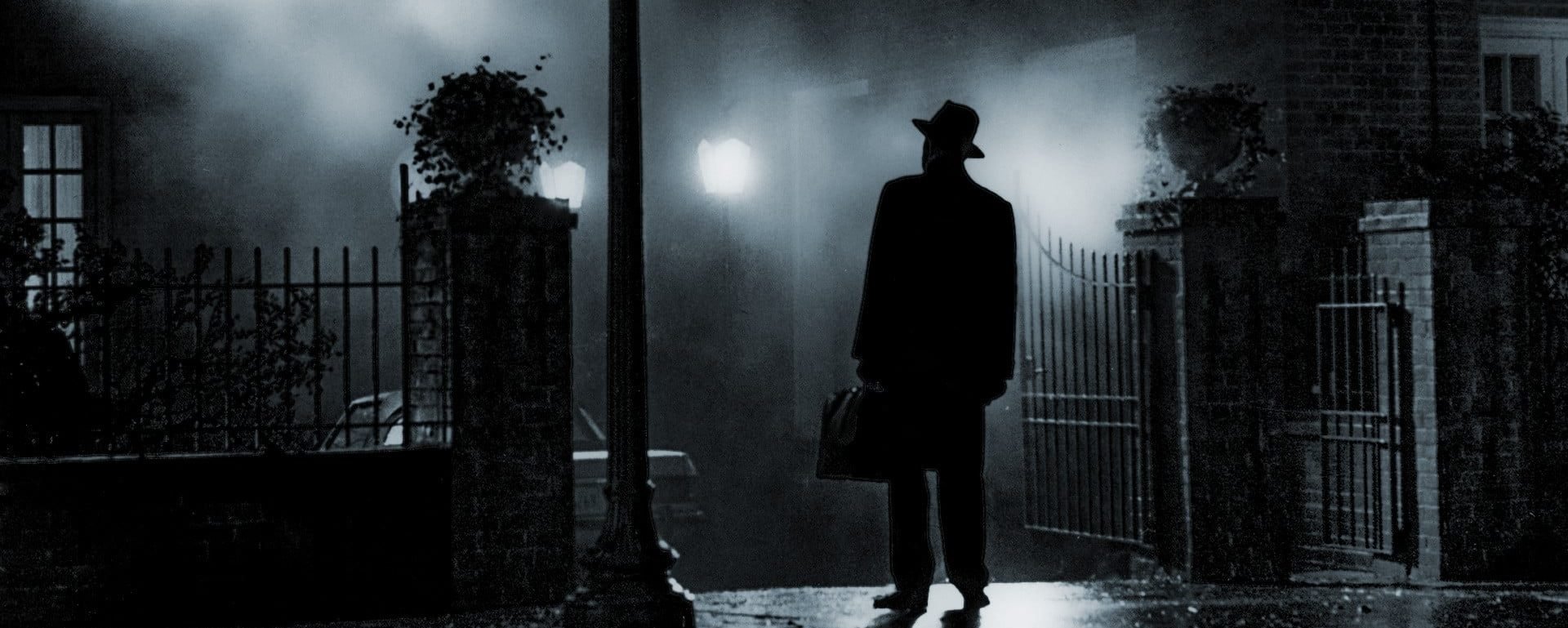
The film opens near an archaeological dig in Iraq. There, Friedken depicts a harsh and poverty-stricken world, where the blind are led by starving children, a widow grieves inconsolably, people work in small foundries like toilers in a fiery, oppressive Hell, and Father Merrin (Max Von Sydow) receives a sign that he will soon be meeting Satan.  We are then transported to Washington, D.C., where another priest – Father Karras (Jason Miller) – is in a modern Hell.  He is counselor to unsure and shaken Catholic priests.  He tells one, “There’s not a day in my life when I don’t feel like a fraud.” To another, “I think I’ve lost my faith.”  Karras’ mother is in her own nightmare, 1970s New York City.  She needs care, she lives in a slum, and Karras is wracked with guilt over her abandonment.

Friedken masterfully portrays the connection between a society sick by sin and the infestation of one little girl, Regan McNeil (Linda Blair), the daughter of a Hollywood actress (Ellen Burstyn) filming on location in D.C.  As Regan’s personality changes, she undergoes rigorous medical procedures (an arteriogram and a pneumoenchephalogram, to name two) that are graphic and invasive, as well as psychological probing (way before its time, the film has a doctor extolling the virtues of Ritalin).  Her father forgets to call her on her birthday, pointing up the damage of divorce.  Regan is alone and left to play by herself and eventually, an imaginary friend, in a foreign town and a rented townhouse.  She is the quintessential “modern” child.

Other characters are also on the point of a knife.  Father Karras nears breakdown after the death of his mother yet he continues to counsel other priests sick at heart and doubting of faith. The director of Burstyn’s “film in the film” (Jack MacGowran) is a lonely drunk cursed by memories of the Holocaust who scathingly brands Burstyn’s housekeeper of Germanic descent a closet Nazi.  Everything and everyone seem rife with wrong and discomfort, raw and vulnerable. Von Sydow is nothing less than a condemned man, awaiting his confrontation with Satan and dependent on nitroglycerin pills for his ailing heart. 

As Regan descends into the throes of possession, Friedken and Blatty smartly turn the world on its head: the physicians, once cocky, can offer Burstyn only the Jesuits, but only because a symbol of God might suggest salvation to Regan, the idea of faith, of course, being ridiculous. And when Regan talks to Karras (himself an Ivy League trained psychologist), the priest immediately sends her back to the doctors and recommends the child’s institutionalization. This is what modernity does when confronted by evil – denies it or locks it away. Friedken’s reservations aside, Blatty gets his morality play.

But it’s a morality play encased in a thrill ride. When the nature of Regan’s torment can no longer denied, and her abuse progresses, Friedken uses all means at his disposal to discomfort the viewer, from the foul, such as the vomit and green goo and the masturbation-with-crucifix (Blair had a stunt double who was used in the disturbing sexual scenes, for those who may have been wondering – double or no, it is still quite a shock to see a little girl utter the abomination “Let Jesus fu** you, let him fu** you”) to the subtle (the use of subliminal cuts, as when Father Karras dreams of his mother and sees a death mask and then, the same mask is overlaid on Regan’s face during the exorcism).  Friedken also had the set dropped to below freezing by placing a restaurant air conditioner across the top of the set, which he then ran all night. The effect on the actors is stunning – their fear is enhanced by physical cold and the steam of breath is another frightening component.

Understandably, Blatty fretted over Friedken’s depictions: “A large section of the audience probably came because something that shocking and vulgar could be seen on the American screen. Bill Friedken always said that would be the case; that they would come to see the little girl masturbate with the crucifix . . . At the time I didn’t believe it; I thought he was destroying the film. But when I perceived that he was absolutely right, I thought it was terribly depressing.”

Friedken, however, is not only a showman, he’s a damn good one. He sets one spooky scene after another, constantly tracking his characters slowly in a manner that feels as if they being enveloped … by something. Burstyn’s walk home from a film shoot in Georgetown, where she witnesses Karras furtively counseling one priest and then passes two nuns with the wind whipping their garb, lends an eerie sense of the foreign and the what is to come.  Much of the camera work is elegant tracking and slow zooms, soon to be punctuated by the occasional hand-held jolt (mostly, when characters are rushing to Regan’s room). The effect lulls the viewer, making the terror – when it occurs – all the more shocking.

Friedken understood that the spinning head was important but not as important as verisimilitude: “It’s set in the real world, with characters who are portrayed as humanly possible. So I think that the fact the story is portrayed realistically is what disturbs people about the events in it.”

The performances are poignantly measured, just on the edge of documentary. The film should be a Hollywood treatise on the exposition of minor characters. Blair is sweet and gentle as needs be, until – with the help of a stunt double, the guttural voice of Merecedes MacCambridge and various pulleys – she transforms convincingly into a leering, goading demon. Burstyn presents as a pampered star and mother at the end of her rope, but she grows to a hardened, more simple warrior. Von Sydow is appropriately ghostly as the doomed Father Merrin. McGowran and Lee J. Cobb are memorable as the murder victim and the murder policeman. Cobb’s gentle interrogations of Karras and McNeil are the kind of quiet respites necessary for such a tense film. Cobb also represents the skeptic and a rebuttal to any sense of despair. He is, after all, steeped in the evil that men do.  But he is also kind and supportive, looking for an autograph from Burstyn and a friend in Miller. His supporting performance is one of my favorites in all of film.

 The great turn, however, belongs to Miller (a playwright who succumbed to drink and never really did much as an actor after The Exorcist). His is a tortured existence, filled with doubt. His trepidation shows in his eyes. Physically, Miller plays as a man who fears his weakness is obvious to all, so he shrinks into himself so as not to be noticed. Merrin and Karras act like a men who know Satan is looking for them. The difference is that Merrin knows what is coming and solemnly accepts it. Karras thinks he can hide, and that is why he is so compelling. Friedken almost always films Miller hunched over, or huddled in talk, or sitting down, or crouched, or in a crowd, accentuating his need to be anonymous.

In the end, despite the tension between  Friedken and Blatty, the latter need not have worried. The film is a clear triumph of good over evil.  To save Regan, Karras defies the devil, “Come into me! Come into me!” The devil obliges, and for a moment, it looks as if Satan/Karras will kill Regan. Karras, however, summons his faith and hurls himself out of the window. He is given last rites, and later, a recovered Regan (having no memory or the possession) sees a priest and kisses him.

The Exorcist is a great popcorn flick but also a cinematic declaration that palpable, defined evil exists. It is an ultimate rejection of moral relativism, a harsh check on modern mores and technological advances. It is also, despite its slick sophistication, religious.  After all, you cannot really find “good” or “justification” or “well, sure . . . but” in Satan. There is no bargain, even as Burstyn asks a herd of befuddled doctors “You’re telling me that I should take my daughter to a witch doctor?” The answer is, yes, there is no modern skate or help for you. And Friedken, the carnival barker, effectively shows you just how frightening and insidiously entertaining Satan can be.

A closing note: Blatty wrote The Exorcist many years after attending Georgetown University in Washington, D.C.  One of his inspirations was newspaper reports of a real life exorcism of a boy in Mt. Rainier, Maryland.  That boy went to my high school, and you can read about his story here — http://www.strangemag.com/exorcistpage1.html  Enjoy.

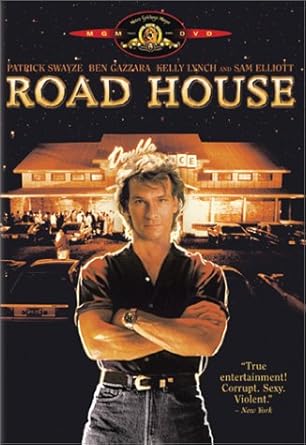
Image result for Roadhouse

A small town is run by the ruthless Ben Gazarra, who shakes down the local businesses to support his decadent lifestyle.  He lives in the gaudiest mansion, and he is surrounded by a thick, loyal squad of yokel goons.  He also has a few 80s trashy blondes in his coterie, like Julie Michaels–

Image result for Roadhouse Julie Michaels

Interesting note on Julie.  Roadhouse was her debut.  In her subsequent roles, these were the names of her characters:  Naran Anie, Professor, Professor (uncredited), Accident Victim, Accident Victim (uncredited), Sandy, Mom, French Patron (uncredited), California Blonde, California Blonde (uncredited), Pedestrian, Female Bar Patron #2, Barrista, Fashion Show Patron, Florist, Slutty Woman, Female Fan, Julie Mermaid mother, Harem Girl (uncredited), Groupie (uncredited), Female Club Goer, Maggie, Woman on Bike, Laundry Wife, Marilyn Monroe #2, Catherine Moore, Caitlin’s Sister, Frat Girl, Woman (uncredited), Vampire, Jane (uncredited), Catherine, Tami, Sillicate UC, Cage Dancer, Agent Elizabeth Marcus, Susan, Irene, Waitress, Waitress (uncredited), Amy Cutler, Freight Train, Susie Q, Cinnamon.

I digress.

One business won’t knuckle under to Gazarra – The Double Deuce.  Instead, bar owner Kevin Tighe calls in a zen master bouncer with a degree in philosophy (not joking – the script references that the professional bouncer has a degree in philosophy from NYU). That bouncer is Dalton (Patrick Swayze) who stands up to Gazarra, calls in a bouncer compadre (Sam Elliott), cleans up the bar and the town and says all of the following:

“Pain don’t hurt.”

“Nobody ever wins a fight.”

“My way… or the highway.”

“All you have to do is follow three simple rules. One, never underestimate your opponent. Expect the unexpected. Two, take it outside. Never start anything inside the bar unless it’s absolutely necessary. And three, be nice.”

“Take the biggest guy in the world, shatter his knee and he’ll drop like a stone.”

“You’re too stupid to have a good time.”

“It’ll get worse before it gets better.”

Roadhouse also features Kelly Lynch, the emergency room physician who patches Dalton up.

The year this picture came out, she was in Drugstore Cowboy. I wonder which film she is most proud of?  Regardless, I’ve had stitches like 5 times and there’s never a Kelly Lynch at the emergency room.  Ever.

By now, Roadhouse has become a cult classic, but when I saw it, I knew it was something special taken at face value, no sniggering. To this day, I can’t stop watching it.  It’s an awful film, and the inquiry should end there, but there is such earnestness in the effort that at 2 am, having just had 5 beers and a half bag of gummy bears, when Swayze says

“I want you to be nice until it’s time to not be nice.”

I’m like, “Hell, yea. Dalton. That’s some heavvy ass shi**!”

And now, every punch in the face in the movie!

The Shining (film) - Wikipedia

First things first.  I took my son to see The Shining at the American Film Institute Theater in Silver Spring, Maryland (they are running a Jack Nicholson retrospective).  The theater is ornate and massive and brings back the feel and style of the old movie house.

But not even the hallowed ground of a theater honoring film can persuade people to behave in a respectful fashion during a movie.  We had two fools in the front who found particular dramatic scenes funny and laughed and laughed and laughed . . . and laughed some more.  We also had two couples to our right who presumed if a character wasn’t talking, that was their cue to talk.  Stanley Kubrick films have long stretches of no dialogue.

Going to films is more and more difficult given the crude behavior of movie patrons, who cannot shut th f*** up, are now eating full meals during the show, and are otherwise oblivious to anyone around them.  Worse, those who are quiet, including myself, are often forced to simply accept the noise.  I have interceded a few times.  It has worked less often than not, because if you correct a young person in public, apparently, that is a humiliation too great to endure, and what follows is aggression and louder “I paid my ticket” talking.  Now, I’ve made the film less enjoyable for additional rows.

Okay.  To the movie.  Kubrick’s picture is methodical and creepy,  It opens abruptly with an aerial shot of Jack Torrance (Nicholson) driving for his interview at the Overlook Hotel to an ominous electronic score (think John Carpenter).  Torrance gets the job as the hotel’s winter caretaker, where he esconces his timid wife (Shelly Duvall) and his son (Danny Lloyd), who has the ability to see visions and occasionally communicate with like-talented people (i.e., he “shines”) such as the hotel’s head chef, Scatman Crothers.  Danny’s ability is also telling him that the Overlook Hotel is dangerous, a fact Crothers confirms.  Soon, the hotel insinuates itself into Torrance’s mind, turns him against his family, and he goes berserk.

The film is very scary, often terrifying.  Kubrick gives us the time to get to know the family, and all is not well:  Torrance has had recent problems with drink, injuring Danny in the process.  He is also a condescending prick, which in turn makes his wife more jittery, which in turns makes Torrance angrier and more removed.  With this fodder, the spirits of the hotel work themselves on Nicholson.

The imagery is unforgettable, be it Danny riding his big wheel (tracked by stedicam) through the halls of the Overlook, only to bump into gruesome visions, or the forbidding snow-covered hedge maze, the locale for the final scene.  Lloyd is very good:  he is withdrawn but sweet, trying to deal with a wretched home life and an amazing but confusing gift.  Duvall, whose performance has been criticized as annoying (she was nominated for a Razzie), is, in fact, very annoying, but it is a great performance nonetheless.  She is trying to hold the family together, as Nicholson is trying to destroy it, and her worry feeds his suspicion.  The hotel has to work on something; it has to find an “in” to get to Nicholson, which it does through Duvall, who is nervous and peppy and cloying.  Obviously, she doesn’t deserve to be murdered.  But the spirits of the hotel don’t need to much to convince Nicholson.

The only partial negative is Nicholson.  He’s very good as a man driven to insanity, but the performance has two faults.  First, Nicholson does not show much to recommend him when he has full sanity.  He’s superior and sarcastic and he doesn’t connect with his family.  As such, when he is enticed by the hotel, there’s not much of  struggle there.  He’s ready to fix them up right and there really was no question.  Second, there are too many “Heeeeeeere’s Johnnies” in his performance.  Nicholson goes so over-the-top that he becomes cartoonish.  Still, it’s a minor criticism and presumes the necessity of a struggle for Nicholson’s soul.

Before The Hunger Games, and its depiction of a televised death match for teens, there was Network, perhaps the most prescient film ever made.  Released in 1976, Network foreshadows the gruesome future of television as it slides nearer and nearer to county fair freak show.  Caustic, incisive and at times frightening, if modern writers managed half of Paddy Chayefsky’s lines in Network, we’d all be better off for it.

The plot is simple.  A network is going down the tubes and in order to save it, the reckless, soulless and brilliant Faye Dunaway is given free reign over programming.  She forwards numerous efforts, the most popular being The Howard Beale Show, a nightly venue given to a network news anchor (Peter Finch) who is slowly going mad.

The script bogs down a bit in the last quarter, mainly, I think, because the medium of film does not handle monologues for two hours, and in between Chayefsky’s smart dialogue, this is essentially a film of well-delivered speeches.

The movie is filled with gems.  Finch making his mark with an on-air nervous breakdown (“I’m mad as hell and I’m not going to take it anymore!”) or corporate titan Ned Beatty thundering to Finch that he has meddled with “the forces of nature” after one of his on-air screeds affects an oil investment.  A scene that is unparalleled involves the activists from the Ecumenical Liberation Organization, a quasi-Symbionese Liberation Organization, upon which Dunaway is basing a “reality” show.  These revolutionaries for the proletariat are soon perverted by the influence of TV and begin squabbling as to points and percentages off the back end.   There are also wonderful pitch scenes for shows that in 1976 would have seemed outrageous, but would now be ho hum.

There are some weaknesses.  The romance between Dunaway and William Holden, the old network bull, is unconvincing.  It is easy to understand a older man-younger woman dalliance, but in this case, Dunaway plays as a frenetic shark.  Her character freely admits she is a lousy lay and then demonstrates as much with Holden.  Dunaway’s character is about power and moving up (when a young, non-powerful man kisses her shoulder, Dunaway’s sharp “Knock it off” tells you all you need to know), and the fact that Holden does not see it is problematic.

Perhaps it was Holden trying to understand the future, or he was waning and wanted a taste of youth.  It’s possible that Dunaway, like televison, is empty but still capable of beguiling Holden for a time, like Beale’s viewers.  But the relationship seems peculiar and off-kilter. That said, some of Chayefsky’s best lines are during their conversations, so the curious nature of the couple can be forgiven.

Network is deservedly ranked 64 on AFI’s Top 100 movies.

A crime family, one of the five that runs New York post World War II, negotiates the fall of its patriarch, the aging Don Corelone (Marlon Brando), and the transfer of power to the son who was supposed to the family’s representative in the legitimate world, Michael (Al Pacino). Francis Ford Coppola takes Mario Puzo’s potboiler and creates a rich, operatic, and layered crime saga.  As the film opens, it depicts the family’s strong ties to the old world of loyalty and blood with the marriage of the Don’s daughter (Talia Shire), and economic introduction of the hierarchy of the family: hot-headed oldest son Sonny (James Caan), sensitive and simple middle son (John Cazale), the adopted chief advisor son Tom (Robert Duvall) and Michael, who introduces his love Kay (Diane Keaton) to his family, all the while explaining that he is not them.  Indeed, he is in uniform, having distinguished himself in World War II. The disconnect is beautifully evoked in the back-and-forth between the primal Sonny and the advanced Michael.

What follows is the inevitable slow decline of the family as Michael is corrupted and deformed, becoming a Sonny, but with a perverted, soul-sapping sense of “blood” and “family.”

The casting is flawless and given the later body of work of the players, it may be the strongest ensemble in film history. Brando won best actor, and Pacino, Caan and Duvall were nominated for best supporting actor. Other character actors are brilliant in smaller but integral roles, like Richard Castellana and Abe Vigoda as the Don’s chief lieutenants; Al Letieri as a rival who tries to get the Don to bankroll him in the future of drugs; Sterling Hayden as a crooked NYC police captain who serves as Letieri’s guard; and John Marley as the Hollywood mogul and Alex Rocco as the Vegas founder who won’t bend to the desire of the Corleone family until they are made offers that cannot be refused.

Perhaps the best of the bunch is Cazale as the weak, disturbed Freddo. Cazale died of lung cancer after only five films, but what a career: The Godfather, The Godfather II, Dog Day Afternoon, The Conversation, and his last film, The Deer Hunter. If you have not seen it, I strongly recommend the documentary on Cazale, I Knew it Was You.

Mob stories are difficult to resist.  The allure of the criminal life, with its excess, dizzying violence and the seductive freedom to do whatever one pleases without retribution, makes for captivating viewing. The Ray Liotta character in Goodfellas is emblematic of the theme; he was intoxicated by the life and ended up being just an every day schmo, a schlub. The Sopranos melded soap opera and commentary on the modern that, while overpraised, was consistently sharp and engaging. But, oh, the moments when Tony does the things we all wish we could do. Like all mob figures in the movies and TV, the draw is the freedom and the power, consequences of the ethos over time be damned!

The Godfather, however, works as both Shakespearian tragedy and pulp. While providing a seamless criminal power struggle and family drama, Coppola articulates the creeping rot.  The degradation comes in many forms, but Pacino’s haunting performance exhibits it best in Michael.  He starts as a fresh face, canny, even altruistic, but determined to be separate.  Yet, by the end of the film, Michael is hollow, almost physically transformed, as if he has been poisoned slowly by an internal disease.  It’s an incredible turn, solitary and meticulous, so utterly different from the excess of what would come later in Scarface and Scent of a Woman.

The look of the film is stunning, perfectly attuned to the material. Gordon Willis’s cinematography is classic nostalgia.  Willis shoots in a darker hue as the story becomes more ominous and sinister.  Martin Scorsese has called it a trick so influential that “every director of photography over the last 40 years owes [Willis] the greatest debt for changing the style completely.”  The art direction is also noteworthy.  Whether it is an art deco bar that serves as the meeting ground where an enforcer is offed or the sumptuous estate of a problematic Hollywood mogul, every setting feels timeless.  Coppola is also crafty, shooting old New York tightly (his budget was not huge).  Nonetheless, iconic wide shots (a Long Island expressway and causeway, a Times Square street) make up for the lack of sweep.

For enthusiasts, Mark Seal’s book is a must read:

Leave the Gun, Take the Cannoli: The Epic Story of the Making of The  Godfather by Mark Seal

The film is no. 2 on AFI’s top 100. It should be no. 3, after The Godfather, Part II.

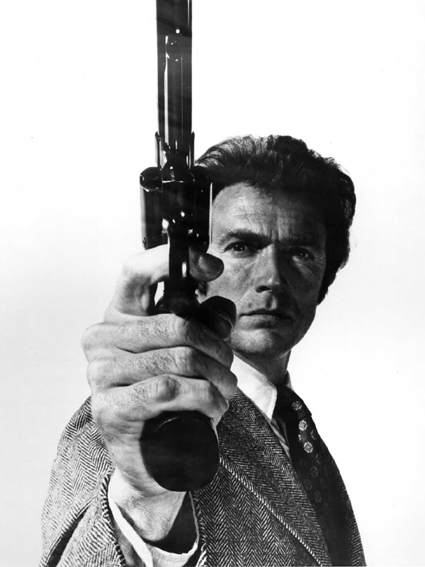
Harry Callahan (Clint Eastwood) is a no-nonsense detective in 1970s San Francisco, where the political correctness is thick, Miranda-warning era sensitized bureaucrats rule, and crooks are coddled (every thug in Dirty Harry has the sneering, arrogance of a punk who knows that the law is on his side). The baddest guy in a sea of bad guys is the film’s facsimile of the Zodiac Killer, a vicious beatnik with Woodstock hair, an army fatigue jacket and a peace symbol on his belt buckle. Callahan is called in to help with the case.  He is immediately accosted by the D.A. for his excessive brutality.

District Attorney Rothko: You’re lucky I’m not indicting you for assault with intent to commit murder.

Callahan: What?

District Attorney Rothko: Where the hell does it say that you’ve got a right to kick down doors, torture suspects, deny medical attention and legal counsel? Where have you been? Does Escobedo ring a bell? Miranda? I mean, you must have heard of the Fourth Amendment. What I’m saying is that man had rights.

Harry Callahan: Well, I’m all broken up over that man’s rights!

In fighting with the mayor – who wants to give in to the killer’s demands – Callahan is blunt and dismissive.

Mayor: I don’t want any more trouble like you had last year in the Fillmore district. Understand? That’s my policy.

Harry: Yeah, well, when an adult male is chasing a female with intent to commit rape, I shoot the bastard. That’s my policy.

Mayor: Intent? How did you establish that?

Harry: Well a naked man is chasing a woman through an alley with a butcher’s knife and a hard-on, I figure he isn’t out collecting for the Red Cross.

Even in his ultimate scene, where he mocks one of three hold-up men, Callahan embodies the rugged conservative fantasy of turned-tables and frontier justice.

Harry: Ah Ah, I know what you’re thinking. Did he fire six shots or only five? Well, to tell you the truth, in all this excitement, I’ve kinda lost track myself. But being as this is a .44 Magnum, the most powerful handgun in the world, and would blow your head clean off, you’ve got to ask yourself one question: ‘Do I feel lucky?’ Well, do ya punk?

Punk. He’s a punk. Not a suspect. Not a person. Not a downtrodden, misunderstood product of an uncaring society.

Paul Newman was offered the film, but legend has it he was nervous about its politics, and suggested Eastwood for the part. Great suggestion. Eastwood has commented on Dirty Harry that “It’s not about a man who stands for violence, it’s about a man who can’t understand society tolerating violence.” Pauline Kael called the film “fascist.” This is, however, the same Pauline Kael who was stunned when McGovern lost in 1972, saying “I live in a rather special world. I only know one person who voted for Nixon.”

Politics aside, this is an excellent picture. Eastwood is mythic, the story moves, the San Francisco locale is used to great advantage, and the killer is truly frightening.

This movie is so good that AFI’s ranking of 94 is an embarrasment (Forrest Gump is rated almost 20 slots higher). From the moment of Ray Liotta’s first voice-over line (I don’t think there is more effective voice-over work in any film ever) to the maniacal, miserable fall, Scorsese chronicles the mob as fantasy to the crime as reality from Liotta’s boyhood to Witness Protection schlub. In re-viewing, here are my thoughts on what makes Goodfellas the greatest crime picture ever made.

The camera-work. The sheer audacity of Scorcese’s tracking shots make their counterparts in The Player and Boogie Nights seem gimmicky.  Scorcese goes on without an edit, not as flourish, but to introduce the cast of mob characters and their life  The uninterrupted trip of Liotta getting into a nightclub speaks volumes about the life – the excitement of his date (Lorraine Bracco) as they are being guided to the best table in the house is shared by the audience.  As we take the trip with Bracco, we are introduced to the glitz during a seemless dreamy waltz.  This is the difference between Spike Lee silliness (floating characters) and skill with purpose.

The Feel.  It looks and sounds right in every respect, from the kitschy Tiki bars to the outlandishly tacky apartments and home to the ghastly look of the mobster wives to the diners and late night drives.   Better, Scorsese, as always, picks the right song for each trip.

Liotta, Pesci and DeNiro, especially Pesci. Liotta, like us, is the outsider, though he is effortlessly conscripted.  Still, he plays Henry Hill as a shade removed from the crazy of DeNiro and Pesci.  He’s a brute but he is not an innate killer.  Thus we are capable of remaining empathetic.  Robert De Niro also keeps vestiges of humanity, though in fact, he is only one notch below Joe Pesci in terms of sociopathy. Pesci, however, is the most honest character and the heart of the picture.  He is a killer, his code is barbaric and his emotions uncontrolled. Which means that he can beat you near to death and comfortably have a meal right after.

Authenticity. The best example of this is not in the look or the sets or the music, but rather, in Scorcese’s portrayal of the easy violence, which one assumes he knows from his roots and/or from working with writer and former Mafia journalist Nicholas Pileggi. No better example is when Pesci comes back to kill the “made” guy (Scorsese and The Sopranos regular Frank Vincent) for busting his balls.  We know Pesci is going to snap, but the moment Pesci attacks him, De Niro jumps in viciously to assist, no hesitation. De Niro knows that killing the guy is stupid. In fact, De Niro was calming Pesci down earlier in the evening, trying to smooth things over. But the attack sets him off like a shark smelling blood, and he instinctively jumps in to rip the guy’s head apart. He’s an animal in a feeding frenzy.

Scorsese’s Casino is actually a deeper film about the Mob, but Goodfellas is the landmark, a precursor to the humor of The Sopranos and an obliteration of the operatic grandiosity of the life left to us by The Godfather.