Archive

Decade

Whit Stillman films are similar to Woody Allen films if you dispense with the angst and replace older urban New York Jews with younger urban New York prep school/deb type WASPs.  Also, toss out the whole “big notion” premises of death, morality and faith and replace them with passing fashion, pop culture, and functional philosophy.  And since Stillman does fewer films than Allen, listening to the witticisms of attractive scions of varying degrees of wealth as they contemplate their navels is neither grating or played out.

Stillman directed two prior films, Metropolitan and Barcelona, the former dealing with New York City private high school kids and the latter taking two of those characters and transplanting them to liberal, carnal Spain.  If you’ve seen Metropolitan and Barcelona, this is similar in tone, content and style.  However, this one is a bit more fun loving and free, as it chronicles the fall of disco in New York City through the eyes of several fresh out of college young urban professionals (though the moniker of “yuppie” is hotly debated) who negotiate their first jobs (publishing house, advertising, prosecutor’s office, environmental law firm) during the day and cruise the disco at night.  It’s also a little more personal.  Even though Stillman has a usual ensemble cast, which thankfully includes the brilliant Chris Eigeman, in this film, Chloë Sevigny is our primary guide and with her we suffer the perils and awkwardness of casual sex for an intellectual frump in the 80s.  It is painful indeed to watch her seduction tecnhiques, which includes a breathless, “There’s something really sexy about Scrooge McDuck.”     

As in all Stillman films, the conversations that meld college bull sessions and comparative literature courses are the gems, such as this back-and-forth on Lady and the Tramp

William Friedkin is apparently “back” with his black crime picture Killer Joe, but he never really went away.  I suppose what critics mean about Friedkin’s return is that he’s “back” in his 1970s The Exorcist and  The French Connection form, the one-two punch of Friedkin’s career.  These films are nothing to sneeze at, the former being the greatest high-brow scare flick ever made, the latter number 93 on AFI’s top 100, but since those halcyon days, Friedkin suffered his Heaven’s Gate (Sorcerer); helmed some off-kilter duds (Deal of the Century, a black comedy about arms dealers with Chevy Chase (?)) and Bug (here’s the IMDB set-up so you can run quick to your Netflix queue — “An unhinged war veteran holes up with a lonely woman in a spooky Oklahoma motel room. The line between reality and delusion is blurred as they discover a bug infestation”); and delivered a gripping, underappreciated crime picture that utilized the musical stylings of Wang Chung for the score (To Live and Die in LA).

Rules of Engagement, an effective, thoughtful, political potboiler about a Marine officer (Samuel L. Jackson) tasked with protecting an American embassy under siege in Yemen.  In extricating embassy staff, the ambassador (Ben Kingsley) and the ambassador’s family, Jackson gives the order for his men to fire into a crowd that includes women and children.  For that act, he is brought up for court martial and must rely on his Vietnam pal (Tommy Lee Jones) who is squaring off against a tough, determined prosecutor (Guy Pearce).  The shooting is recapitulated from various vantage points, the characters compellingly provide their assessment of what happened (of particular note, Blair Underwood, who was probably too good looking to be a bigger star, is excellent as part of the Marine contingent), and political skulduggery is uncovered.

The picture moves fast, alternating between flashbacks of the shooting, courtroom drama and a sojourn back to ‘Nam.  It is also topical and adult, reluctant to direct us to any pat conclusion (Stephen Gaghan wrote it, and followed it up with the Academy Award winning Traffic and the Academy Award nominated Syriana).  Jackson and Jones are not exactly breaking new ground here, but they are very good actors who know what to do with the material.  Finally, with the exception of Kingsley (whose imperiousness and cowardice are cartoonish), all the characters feel real.  Roger Ebert disliked the film, noting, “At the end we have a film that attacks its central issue from all sides and has a collision in the middle.”  That’s exactly true, and it is the movie’s strongest attribute.  There is no assured resolution of many of the issues it raises, but the story at the center holds you to the point where you can come to your own conclusions.  The political shenanigans at the end feel very tacked-on, but otherwise, this is a strong movie.

Of course, anything less than a full filmic indictment of the Jackson character was enough to send some reviewers into apoplexy.  Hence, Michael Atkinson from The Village Voice: “William Friedkin‘s bathetic flag-fucker Rules of Engagement is as dogged and concise an apologia for using militarist might to control civilians as any City Hall publicists could ever concoct . . . . Who’s talking this neo-con psycho-talk, exactly”?   Given that, as noted, Gaghan wrote it and was pilloried later by the right for his allegedly lefty take in Syriana, consider Atkinson’s broadside a strong recommendation indeed

I’ve had the misfortune of watching this movie twice (I endured it because I remembered a better film).  Mel Gibson had his own cut, which was better than that of director Brian Helgeland (screenwriter for LA Confidential), though still pretty bad. The picture is a loose remake of John Boorman’s 1967 Lee Marvin vehicle Point Blank. The story is uncomplicated. A crook (Gibson) pulls of a heist, is double-crossed by his girlfriend and partner and left for dead. He does not die, but returns, to collect his share of the money. It turns out his partner used that share to buy his way back into “the Syndicate,” so Gibson works his way up the chain, killing folks up a higher level of authority until he gets to the top. The original was arty, tough and noir, and Marvin’s anger convincingly propelled the simplistic plot, which culminated in a cool shoot-out in then-abandoned Alcatraz.

Gibson’s version exchanges San Francisco for Chicago, tough for brutal, and noir for ostensibly hip (which, as defined by Gibson, is taking every opportunity to smack women and crunch bones). While Gibson throws in a touch of humor in the plot, his performance is leaden. He emulates Robocop and The Terminator, not Marvin.

Gibson’s version ends better (he uses a kidnap of the top Syndicate man’s son to get at him, while Helgeland settles for a lame shoot-out on a Chicago train platform), but it’s a pointless endeavor. The only redeeming qualities are some wry performances as criminal lowlifes by Gregg Henry, James Coburn, William Devane, John Glover, David Paymer and Lucy Liu.


It ain’t nearly enough.

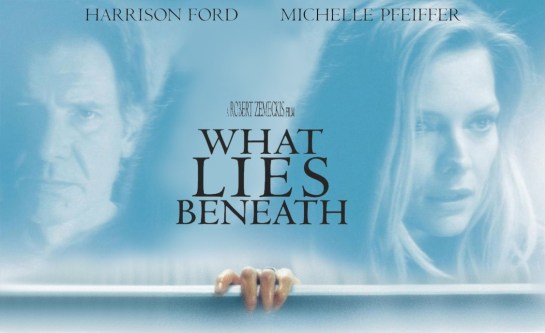
What Lies Beneath Was All Wrong. What Lies Beneath is the type of film… |  by Brett Seegmiller | Brett Seegmiller | Medium

Robert Zemeckis’ ghost story is both an homage to Hitchcock and a vehicle for the director’s visual audacity (or, if you’re harder on Zemeckis, gimmickry). There’s little new in this old-fashioned haunted house tale, but what is presented is solid and entertaining.

A beautiful, vulnerable Michele Pfeiffer lives with her researcher/scholar husband (Harrison Ford) in a New England college town, their home a picturesque waterfront exemplar from Architectural Digest.  Pfeiffer has just dropped her only child off at college and is in the midst of an empty nest crisis.  Worse, she’s recovering from a car accident a year prior and she believes her new neighbors’ marital woes have escalated to the husband killing the wife (she even believes she sees the husband disposing of the body, much as Jimmy Stewart saw Raymond Burr covering up his foul deed in Rear Window).  What better to harass this fragile woman than a spirit attempting to communicate with her?

Zemeckis does a nice job of interweaving a few plot lines, and he produces some genuinely creepy moments.  But the film has flaws.  First, Zemeckis so distrusts the audience’s ability to follow the plot he over-lingers to focus our attention on a fact or clue.   So, in his work, Ford is working with a drug that immobilizes while the subject maintains consciousness. I wonder if that will come into play later?  Second, Hitchcockian is one thing, but a replica is quite another. By the end of the film, the score is a mash of Bernard Hermann and the tribute so unrelenting, Mel Brooks’ High Anxiety comes to mind.  The movie is also overlong, piling reveal scenes on top of each other, replacing tension with exhaustion.

The virtues, however, outweigh the negatives.  The film mostly moves briskly, there are genuine scares, and the characters, while a tad humorless, are engaging.  Pfeiffer is an effective mix of emotional fragility and upper class angst, and Ford is a surprisingly sympathetic villain.  Indeed, Pfeiffer comes off as spoiled and becomes so unstable, you find yourself siding with the seemingly reasonable Ford, who fairly suggests his wife is punishing him in a passive aggressive manner with all the ghost nonsense.

Solid.

Like Any Given Sunday, a bad movie that is occasionally engaging but makes you feel guilty for being engaged, Oliver Stone’s The Doors is indulgent, dizzying and vapid. The caricature of James Morrison invades Val Kilmer, who gives an embarrassing, showy performance.  Kilmer’s idea of Morrison is little more than a faraway stare and a lycanthropic lope.  So perpetual is Kilmer’s saunter that he presents less Lizard King, more inebriated catwalk model.

The film almost stops dead in its tracks a third in with a ridiculous overlong band “trip” to the desert for some peyote and pretentious native American b.s. The Doors emerge from this interminable detour performing a live version of a song as silly and overlong as the movie, “The End.”  All time taken away from the only story you want to see about a marginal rock talent: rise to fame, drugs, booze, chicks, and then, crash and burn.

Stone is so enamored of his subject he not only photographs him lovingly, he actually takes the singer’s poetry seriously.  Morrison is such an obvious talent Stone felt he could dispense with any back story for him.  We don’t know much about his early life (except he once saw a dead Indian by the road during a family trip) because Stone is in such a hurry to show us this avant garde pioneer, a guy who riffed “mother, I want to f### you” right into the director’s heart.

We get a few fun moments, snapshots of nostalgia from the 60s, like the Ed Sullivan performance.  But even that has to be gussied up and romanticized. The Doors were asked to forego the line “girl we couldn’t get much higher” from their hit, “Light my Fire.” They happily did so in rehearsal, but during a lethargic live performance, Morrison forgot and sang it.   Not good enough for Stone.  In the film,  Kilmer lectures the band on kowtowing to “the Man” and then belts it out as a taunt just to show those suits what for. Then he starts hip swiveling, sending lily-livered execs into apoplexy.

As Morrison descends into the fat, bloated bore he would become, visions of a dour Indian pop up.  In the desert.  During gigs.  Even before meeting Andy Warhol (portrayed by Marty McFly’s father).  When unintentionally funny imagery isn’t on screen, the picture is a crashing bore.  Morrison always was a pompous dick and a medium talent at best.  He never really merited the Stone treatment.  Or maybe that is exactly what he deserved.

Splash put Tom Hanks on the map as a leading man, though he was not yet filled-in and substantial.  Instead, Hanks was mannered in the way an actor can be after a long stint on a sitcom (Hanks was one of the Bosom Buddies from 1980 to 1982).  The film was also Ron Howard’s biggest feature, and its success would launch his career as the director of competent, workmanlike, earnest and generally dull films.

Hanks plays a love-phobic NYC businessman (derived from a childhood trauma – he fell off a Cape Cod ferry and encountered a mermaid).  In the depths of despair over his romantic failures, he returns to Cape Cod, falls in the water again, and is again rescued by the mermaid, now grown up (Daryl Hannah), who follows him to New York.  She is pursued by a cruel scientist (Eugene Levy), captured and probed to the point of sickness (ala’ E.T.) and then is busted out by Hanks, his brother (John Candy) and a repentant Levy.

Almost 30 years later, it’s a shock to see such a callow and obnoxious Hanks.  His voice is whiny, his character churlish and childish, and he seems too much the boy for the part, light as it is.  Perhaps because a mermaid has no experience with men, she just presumed Hanks was a good catch (ba-dump) but he is not.  He’s aggravating and surprisingly unfunny.

The same cannot be said for Candy, who steals the movie as the heavy, schmoozing, hard drinking,  yuk-yukking brother, excited to have one of his letters printed in Penthouse.  Levy is also good as the nerdly, bitter scientist, and Hannah is appropriately innocent and glowing as the fish-out-of-water.

It’s a cute movie, no more, but it ends in an uninentionally ridiculous fashion.  Hanks jumps in the water, making the choice to live the rest of his live with Hannah under the sea (he cannot, for reasons unexplained, ever return to land).  The credits roll and Hanks and Hannah swim the ocean as she shows him her world.  She has a big fin, he does not (when she was on land, when dry, she had legs and what goes along with them when they meet, and they were able to have a lot of sex).  Her world is murky and humdrum.  “See, this is the ocean floor.  And there is a conch.  And there are some fish.”  And what will Hanks eat?

Image result for Splash hanks underwater

“This was a poor choice.”

Cinemascope: The Departed [2006]

A meaty, engrossing crime picture, right in Martin Scorsese’s wheelhouse.  Jack Nicholson is a Boston crime boss who has a quasi-adopted son/mole in the Boston PD (Matt Damon).  In that same department, a small unit (headed up by Martin Sheen and Mark Wahlberg) is set up to get Nicholson, and they recruit a police academy trainee (Leonardo DiCaprio) who has one leg in the tough streets of Southie (his dad’s side) and another in the upper crust of Boston (his mom).  Meanwhile, a second task force, headed by Alec Baldwin, is also trying to get Nicholson and can’t get a handle on why they are thwarted at every turn.  DiCaprio is “erased” from police files, purposely gets arrested, and infiltrates Nicholson’s organization, which is populated by colorful, brutal goons (Ray Winstone, David O’Hara), in order to identify the mole.  Meanwhile, Damon keeps screwing Baldwin’s pooch.

A cat-and-mouse hunt ensues, as Damon searches for DiCaprio and vice versa.  Damon is also dating a psychologist (Vera Farmiga) who treats cops and ex-cons, including DiCaprio.

Almost to a person, the performances are rich and rough.  DiCaprio is now in full bloom, grown out of the Titanic baby face and having just previously offered two nuanced and substantial performances in The Aviator and Blood Diamond.  Nicholson is bloody and funny, and, well, Nicholson.

All the supporting characters are strong and natural save for Farmiga (she’s too feminine for the role and when she becomes infatuated by a clearly unstable DiCaprio, it is unconvincing) and Wahlberg, who, ironically, was nominated for best supporting actor.  He yells an awful lot and delivers a few speeches, but volume and line memorization do not deserve a nomination.  Wahlberg seems uncomfortable and masks it with rage.   And once again, Matt Damon does all the heavy lifting and gets none of the credit.  His turn as the fatherless boy who is being manipulated by Nicholson is alternately frightening and heartbreaking, yet he remains a very charming sociopath.

The picture whizzes by.  Scorsese effortlessly paces what could have been a morass of a story, providing his signature quick-cut expositions to perfectly chosen music (The Stones, Badfinger, Allman Brothers).

Otto Preminger skillfully presents Allen Drury’s Pulitzer Prize winning political potboiler (published in 1959), the story of  a senatorial nomination (Henry Fonda, who is tapped to be Secretary of State)  gone bad under the weight of McCarthyite tactics, vicious blackmail, and a dying president.  The story is intricate, but Preminger, ever the pro, handles it with ease.  For example, if there is an issue of senatorial procedure, it is cleared up in a clever discussion with foreign tourists, who receive a crisp and unobtrusive explanation as to parliamentary procedure and the role of the vice president in American government.

It is decidedly not an all-star cast, but it is a very good one.  Franchot Tone, as the tough and dissipated president, wields his waning power with as much vigor as he can muster.  He has a wonderful scene where first he tries to smooth-talk the chair of the subcommittee handling the nomination (Don Murray) into reporting it out and when the senator does not budge, his flash of anger is actually a little terrifying.  Walter Pidgeon plays the Senate Majority leader, tasked with shepherding the nomination through, and Charles Laughton hams it up wonderfully as the Strom Thurmonesque senator who opposes the nominee.  Lew Ayres, as the in-over-his-head vice president, is a perfect combination of insecure and decent.

Having been born in Washington, D.C., the shots of the nation’s capitol in a more innocent and uncluttered time are worth the viewing in and of themselves.  And look close, because Will Geer (Grandpa Walton) plays the Senate minority leader and Betty White also has a role in that august body.

Image result for advise and consent betty white

With only five films to his credit (Metropolitan, Barcelona, The Last Days of Disco, Damsels in Distress, Love & Friendship) and all but one of them in the same milieu (upper class young people in comedies of manners), Whit Stillman is overlooked in discussions of  great American filmmakers who are still working.  This despite the fact that Stillman has written and directed all five of his films, and all have been critically acclaimed.  

Barcelona, Stillman’s second picture, reprises two actors from Metropolitan as different characters.  Taylor Nichols plays Ted, a neurotic salesman in 1980s Barcelona. Chris Eigeman plays his cousin, Fred, a naval officer and freeloader sent ahead of the Sixth Fleet in the midst of a wave of anti-Americanism.  Both negotiate their acrimonious relationship, borne of childhood injuries inflicted by Eigeman, a truly obnoxious sort who as a visitor begins to stink after a day (unlike, as Nichols observes, the fish who takes three).  They discuss religion, women, anti-Americanism, sales, history and shaving, all the while falling in and out and in love with various Catalan women.

Nobody writes quite like Stillman. His dialogue is distinct and erudite, but his characters have such a surface forthrightness that what could seem contrived comes out as wholly honest and fresh. Stillman is particularly impressive in presenting a funny, incisive culture clash between the mildly ugly Americans and the bemused, mildly antagonistic Spanish. Both treat each other as curious, and even hostile interactions over politics are amusing and revealing.

Again, Stillman has no bad films on his resume’,  a rare honor.  Paul Thomas Anderson comes close. Though the second half of Magnolia is bad, the sheer perfection of the first half of that film and its overall audacity generally gets him a pass, but The Master is a long, very hard slog.  Scorsese is a great, but Gangs of New York and Shutter Island are very, very bad films, and his later sycophantic rock documentaries are downright embarrassing.  Coppola has some late career dreck (Jack, The Rainmaker) and have you even heard of his last three efforts (Youth Without Youth, Tetro, Twixt)?  Eastwood has his share of humdrum work (J. Edgar, Bloodwork, Space Cowboys).  Try as I might to suggest otherwise, Wes Anderson’s The Life Aquatic is haphazard at best.  Even the Coens, David Fincher, Gus van Sant, David O. Russell, Richard Linklater, and Steve Soderbergh have at least one dog (see A Serious Man, Alien3, Psycho, I Heart Huckabees, Bad News Bears, Solaris).

Woody Allen is closer to Stillman in style but Allen also makes some really horrific pictures (less so now that he’s not acting in them as much), redeeming himself with a great surprise just when you’ve written him off.  Take this list of Allen movies – Hollywood Ending (2002), Anything Else (2003) and Melinda and Melinda (2004).  All pretty bad.  Ballgame, right?  But then, Allen offers a smart Hitchcockian crime movie, Match Point (2005), and he is resurrected.  Two more sh** sandwiches follow in 2006 and 2007 (Scoop, Cassandra’s Dream), but in 2008, Allen comes off the canvas again with the charming and seductive Vicky Christina Barcelona.  And last year, after another pair of clunkers (Whatever Works, You Will Meet a Tall Dark Stranger), the best original screenplay Oscar goes to Allen for Midnight in Paris, a movie I hated, but I defer to the Academy. 

Stillman deserves better.

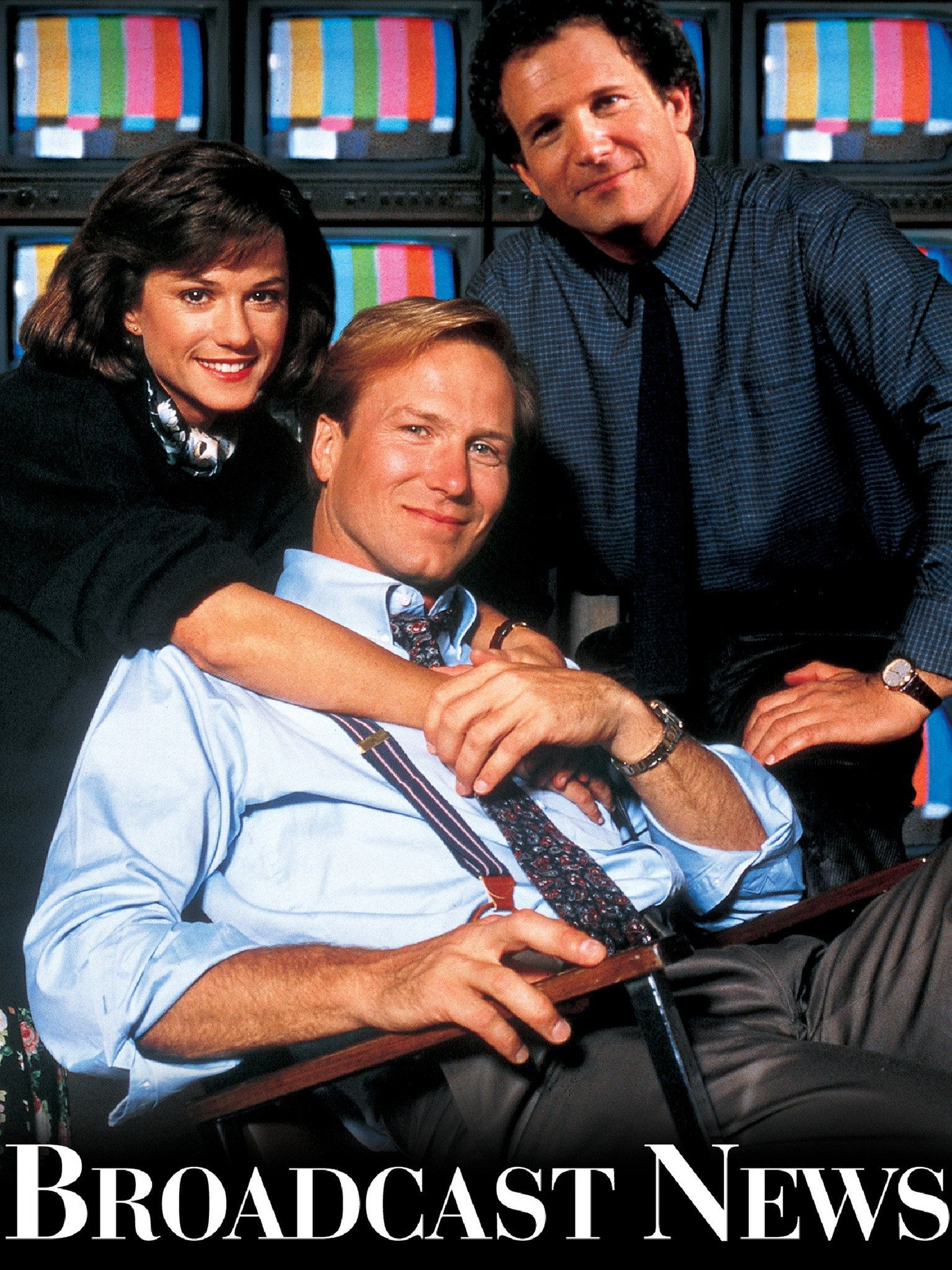
Broadcast News - Rotten Tomatoes

James L. Brooks has the ability to make you laugh out loud just before he brings a tear to your eye, a skill he has honed in Terms of Endearment and As Good as It Gets. His missteps (How Do You Know, Spanglish) still contain very funny dialogue, even if the whole doesn’t work.  But to be fair to Brooks, Paul Rudd, Reese Witherspooon, Adam Sandler and Tea Leone are not very formidable substitutes for Jack Nicholson, Shirley MacLaine, and Debra Winger.

In Broadcast News, Brooks melds a love triangle with a story about journalism and ethics that is prescient.  Holly Hunter is the producer of the Washington bureau of a major news network, Albert Brooks is a gifted but un-telegenic correspondent, and William Hurt is the new up-and-coming golden-boy, groomed to replace the current anchor (Jack Nicholson, in a hilarious cameo).  Hurt is attractive but shallow (as Brooks says, he is against everything Hunter is about).  But Hurt is also sweet and in his own way, genuine.  He fancies Hunter and when Brooks tries to anchor the weekend news in an effort to save his job, Hurt is there, giving him advice, some of which is excellent (“punch” a thought in each sentence) and some of which makes Brooks very uncomfortable (“Just remember that you’re not just reading the news, you’re narrating it. Everybody has to sell a little. You’re selling them this idea of you, you know, you’re sort of saying, trust me I’m, um, credible. So when you feel yourself just reading, stop! Start selling a little”).  Hunter becomes infatuated with Hurt, and as they grow closer, Brooks professes his long love for Hunter and reveals the ethical threat that is Hurt.

The picture is loaded with crisp, witty dialogue, and at its best, it evokes the great Grant/Stewart/Tracy v. Hepburn romantic comedies. The picture also injects something of substance (the deterioration of the news), not with the acid cynicism of Network, but gently, so as not to get in the way of the story and humor.

There is also great physical comedy, provided by Joan Cusack as a gawky assistant producer, and Brooks, who endures the great humiliation of flopsweat during his shot at anchor.  The scene is one of the funniest in film history.

The movie has one problem, but it is a big one.  Holly Hunter is so mannered and quirky that you simply cannot understand Hurt’s attraction to her, much less that of Brooks. Sure, the good looking neophyte might be intrigued by the neurotic but fascinating “other” ala’ Robert Redford and Barbra Streisand in The Way We Were.  But Hunter takes “odd” up several notches, and in many scenes, her facial expressions approximate her work in the live cartoon Raising Arizona.  Her temper is also so volcanic as to suggest mental illness.

Certain lines cannot be crossed in a romantic comedy.  I was reminded of the awful Hugh Grant-Sandra Bullock vehicle Two Weeks Notice, wherein Bullock has an attack of diarrhea on the highway and Grant has to commandeer a stranger’s RV so she can relieve herself.  This may work for Will Ferrell and Zach Galifinakis.  But no romantic lead can be shown in such an unflattering light.  Hunter does not sink to such depths here, but her portrayal does border on the grotesque and it detracts.

There is also the weakness of the import of Hurt’s great journalistic sin (he recreates a moment of emotion in an interview) .  There is no question – the act was unethical.  But in the context of some of the other stagey and easy shortcuts engaged in by Hunter and Albert Brooks, their high dudgeon (which is critical to the picture) rings hollow, and the film never gives them a comeuppance on this point other than Hurt’s rebuttal to Hunter after she accuses him of crossing the line — “It’s hard not to cross it.  They keep moving that little sucker, don’t they.”