Archive

70s

Me and my boy are scheduled to see The Who playing Quadrophenia from beginning to end next week, so we prepared by watching Franc Roddam’s directorial debut, a story of a miserable 1960s London “Mod” (Phil Daniels) eternally at war with his parents, his job, the girl he fancies, rival “Rockers” and all that bourgeois b.s.

Daniels is a punk, through and through, and increasingly, it appears he is mentally disturbed.  He either laughs goofily or snarls, and at no point do we feel empathy for his not particularly difficult plight.  He has a job, a super cool Vespa, a gang of friends who are pleasant and tepid, and a fondness for readily available pills.  His life is also soundtracked to The Who, fer crissakes (poorly, though – it’s clear the director didn’t know how to fit the music into the film and with the exception of the final scene, the musical contribution of band is distracting rather than evocative).

There are some charms to the movie.  It was filmed on location in London and Brighton and the final scene (where Daniels either kills himself or he doesn’t) is a pretty impressive (though overlong) helicopter shot of a precarious ride along the Brighton cliffs.

If you look close, you’ll also see a boatload of very young Brit actors who went on to solid careers, including Tim Spall, Ray Winstone, and Phillip Davis.  It’s a shame one of them didn’t get the lead, because Daniels appears to have been chosen solely for his likeness to Pete Townsend.

Sting is also featured.

EBFDF7B9-9AE9-4195-8CD8-70BF9A2C66AB
Any film where the director kicks the Jesuitical screenwriter off set because the latter wants the film to be unequivocal in its conclusion that God triumphs over Satan is bound to be unique. As that screenwriter William Peter Blatty observed:

Like so many Catholics, I’ve had so many little battles of wavering faith over the course of my life. And I was going through one at that time. And when I heard about this case and read the details, that seemed so compelling. I thought, my God, if someone were to investigate this and authenticate it, what a tremendous boost to faith it would be. I thought, someday I would like to see that happen. You know, I would like to do it . . . the research into it affected me. And the novel, it very much strengthened my faith.

Director William Friedken had other ideas.

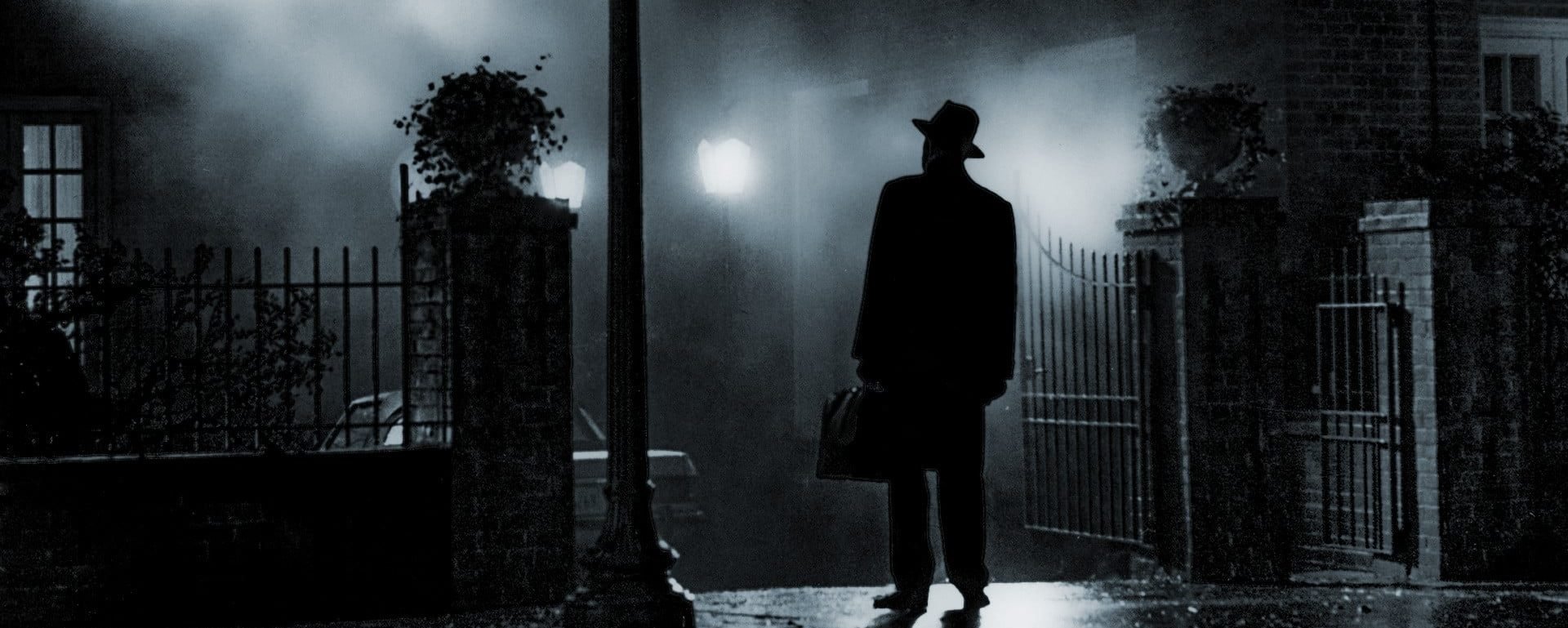
The film opens near an archaeological dig in Iraq. There, Friedken depicts a harsh and poverty-stricken world, where the blind are led by starving children, a widow grieves inconsolably, people work in small foundries like toilers in a fiery, oppressive Hell, and Father Merrin (Max Von Sydow) receives a sign that he will soon be meeting Satan.  We are then transported to Washington, D.C., where another priest – Father Karras (Jason Miller) – is in a modern Hell.  He is counselor to unsure and shaken Catholic priests.  He tells one, “There’s not a day in my life when I don’t feel like a fraud.” To another, “I think I’ve lost my faith.”  Karras’ mother is in her own nightmare, 1970s New York City.  She needs care, she lives in a slum, and Karras is wracked with guilt over her abandonment.

Friedken masterfully portrays the connection between a society sick by sin and the infestation of one little girl, Regan McNeil (Linda Blair), the daughter of a Hollywood actress (Ellen Burstyn) filming on location in D.C.  As Regan’s personality changes, she undergoes rigorous medical procedures (an arteriogram and a pneumoenchephalogram, to name two) that are graphic and invasive, as well as psychological probing (way before its time, the film has a doctor extolling the virtues of Ritalin).  Her father forgets to call her on her birthday, pointing up the damage of divorce.  Regan is alone and left to play by herself and eventually, an imaginary friend, in a foreign town and a rented townhouse.  She is the quintessential “modern” child.

Other characters are also on the point of a knife.  Father Karras nears breakdown after the death of his mother yet he continues to counsel other priests sick at heart and doubting of faith. The director of Burstyn’s “film in the film” (Jack MacGowran) is a lonely drunk cursed by memories of the Holocaust who scathingly brands Burstyn’s housekeeper of Germanic descent a closet Nazi.  Everything and everyone seem rife with wrong and discomfort, raw and vulnerable. Von Sydow is nothing less than a condemned man, awaiting his confrontation with Satan and dependent on nitroglycerin pills for his ailing heart. 

As Regan descends into the throes of possession, Friedken and Blatty smartly turn the world on its head: the physicians, once cocky, can offer Burstyn only the Jesuits, but only because a symbol of God might suggest salvation to Regan, the idea of faith, of course, being ridiculous. And when Regan talks to Karras (himself an Ivy League trained psychologist), the priest immediately sends her back to the doctors and recommends the child’s institutionalization. This is what modernity does when confronted by evil – denies it or locks it away. Friedken’s reservations aside, Blatty gets his morality play.

But it’s a morality play encased in a thrill ride. When the nature of Regan’s torment can no longer denied, and her abuse progresses, Friedken uses all means at his disposal to discomfort the viewer, from the foul, such as the vomit and green goo and the masturbation-with-crucifix (Blair had a stunt double who was used in the disturbing sexual scenes, for those who may have been wondering – double or no, it is still quite a shock to see a little girl utter the abomination “Let Jesus fu** you, let him fu** you”) to the subtle (the use of subliminal cuts, as when Father Karras dreams of his mother and sees a death mask and then, the same mask is overlaid on Regan’s face during the exorcism).  Friedken also had the set dropped to below freezing by placing a restaurant air conditioner across the top of the set, which he then ran all night. The effect on the actors is stunning – their fear is enhanced by physical cold and the steam of breath is another frightening component.

Understandably, Blatty fretted over Friedken’s depictions: “A large section of the audience probably came because something that shocking and vulgar could be seen on the American screen. Bill Friedken always said that would be the case; that they would come to see the little girl masturbate with the crucifix . . . At the time I didn’t believe it; I thought he was destroying the film. But when I perceived that he was absolutely right, I thought it was terribly depressing.”

Friedken, however, is not only a showman, he’s a damn good one. He sets one spooky scene after another, constantly tracking his characters slowly in a manner that feels as if they being enveloped … by something. Burstyn’s walk home from a film shoot in Georgetown, where she witnesses Karras furtively counseling one priest and then passes two nuns with the wind whipping their garb, lends an eerie sense of the foreign and the what is to come.  Much of the camera work is elegant tracking and slow zooms, soon to be punctuated by the occasional hand-held jolt (mostly, when characters are rushing to Regan’s room). The effect lulls the viewer, making the terror – when it occurs – all the more shocking.

Friedken understood that the spinning head was important but not as important as verisimilitude: “It’s set in the real world, with characters who are portrayed as humanly possible. So I think that the fact the story is portrayed realistically is what disturbs people about the events in it.”

The performances are poignantly measured, just on the edge of documentary. The film should be a Hollywood treatise on the exposition of minor characters. Blair is sweet and gentle as needs be, until – with the help of a stunt double, the guttural voice of Merecedes MacCambridge and various pulleys – she transforms convincingly into a leering, goading demon. Burstyn presents as a pampered star and mother at the end of her rope, but she grows to a hardened, more simple warrior. Von Sydow is appropriately ghostly as the doomed Father Merrin. McGowran and Lee J. Cobb are memorable as the murder victim and the murder policeman. Cobb’s gentle interrogations of Karras and McNeil are the kind of quiet respites necessary for such a tense film. Cobb also represents the skeptic and a rebuttal to any sense of despair. He is, after all, steeped in the evil that men do.  But he is also kind and supportive, looking for an autograph from Burstyn and a friend in Miller. His supporting performance is one of my favorites in all of film.

 The great turn, however, belongs to Miller (a playwright who succumbed to drink and never really did much as an actor after The Exorcist). His is a tortured existence, filled with doubt. His trepidation shows in his eyes. Physically, Miller plays as a man who fears his weakness is obvious to all, so he shrinks into himself so as not to be noticed. Merrin and Karras act like a men who know Satan is looking for them. The difference is that Merrin knows what is coming and solemnly accepts it. Karras thinks he can hide, and that is why he is so compelling. Friedken almost always films Miller hunched over, or huddled in talk, or sitting down, or crouched, or in a crowd, accentuating his need to be anonymous.

In the end, despite the tension between  Friedken and Blatty, the latter need not have worried. The film is a clear triumph of good over evil.  To save Regan, Karras defies the devil, “Come into me! Come into me!” The devil obliges, and for a moment, it looks as if Satan/Karras will kill Regan. Karras, however, summons his faith and hurls himself out of the window. He is given last rites, and later, a recovered Regan (having no memory or the possession) sees a priest and kisses him.

The Exorcist is a great popcorn flick but also a cinematic declaration that palpable, defined evil exists. It is an ultimate rejection of moral relativism, a harsh check on modern mores and technological advances. It is also, despite its slick sophistication, religious.  After all, you cannot really find “good” or “justification” or “well, sure . . . but” in Satan. There is no bargain, even as Burstyn asks a herd of befuddled doctors “You’re telling me that I should take my daughter to a witch doctor?” The answer is, yes, there is no modern skate or help for you. And Friedken, the carnival barker, effectively shows you just how frightening and insidiously entertaining Satan can be.

A closing note: Blatty wrote The Exorcist many years after attending Georgetown University in Washington, D.C.  One of his inspirations was newspaper reports of a real life exorcism of a boy in Mt. Rainier, Maryland.  That boy went to my high school, and you can read about his story here — http://www.strangemag.com/exorcistpage1.html  Enjoy.

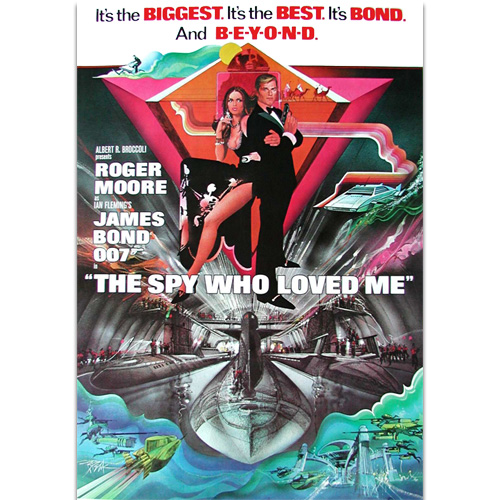
This is the second Bond film I saw in the theater, after Live and Let Die, and it is probably the last of the series that gave us a youthful Roger Moore.  By the next installment, Moonraker, the lines had gotten deeper, the hair higher yet thinner, and the bones creakier.

Billionaire Kurt Jurgens (Karl Stromberg) seeks to start a nuclear war between the Soviet Union and the United States, so he can rule a post-apocalyptic world from the sea.  Jurgens steals a Russian and American nuclear submarine to his purpose, and Bond and his female Russian counterpart Anya Amasova (Ringo Starr’s gorgeous but not particularly talented Barbara Bach) are dispatched to get to the bottom if it.  Unbeknownst to Bond, in one of the few Bond ski sequences that work, he killed Amasova’s love, and she has vowed to kill Bond – when the mission is over.

Many of the hallmarks of a good Bond film are here – exotic locales (such as Asgard Peak in Austria; Egypt, including the Giza Necropolis, Great Pyramids and Great Sphinx; and the cliffs of Sardinia), a first-rate Bond song (“Nobody Does it Better”), and several beauties, including  a favorite, the lethal helicopter pilot Caroline Munro-

The Spy Who Loved Me review - Moore's best Bond - Lyles Movie Files

The film also has an interesting and grandiose villain and a serviceable script.  The action sequence when the Soviets and Americans join forces to take on Stromberg’s army is also very exciting and novel.

However, the warning signs for the series first appeared in The Spy Who Loved Me.  The pun and snappy rejoinder quotient increased markedly.  The use of the cheezy, roving sax to denote the funny or the fanny is prevalent.   The introduction of the villain Jaws (Richard Kiel) pushed the story further, into slapstick.

There is simply too much of that and not enough of this:

(though, even here, a meaner Bond is compelled to drop, “You shot your bolt” into the action)

The changes, however, could in no way be challenged at the time.  The film cost $14 million to make and grossed $185 million worldwide.

Rocky is Not a Sports Story (But Wow, What a Love Story). | elephant journal

Sylvester Stallone wrote this gem and wisely insisted on starring (possible replacing, if you can imagine, Ryan O’Neal, Burt Reynolds or Robert Redford), leading to many more Rocky movies, and some Rambos, and a dozen other mumbling portrayals.  Say what you will about what it spawned, but Rocky is near flawless.

Rocky is a busted up club fighter living in the bleak hell that is mid 70s Philadelphia. He’s a sweet guy, but he is an admitted bum, getting a fight every few weeks and paying the rent by collecting for a local loan shark. We meet Rocky after a sixth round knockout of another bum nets him $40, and he’s just been unceremoniously evicted from his gym by its manager, Burgess Meredith. His best friend is a meat packing cretin (Burt Young) who lives with his paralyzingly shy sister (Talia Shire), who Rocky is sweet on. Rocky’s fortunes change, however, when the champion, a Muhammad Ali figure named Apollo Creed (Carl Weathers), has a ranked contender drop out from a well-promoted fight. Creed fixes on a gimmick – give a nobody – the “EYE-talion Stallion” – a shot at the title.

This is often heralded as the quintessential boxing movie, but boxing is secondary to a moving, beautiful love story between Shire and Stallone, and the portrayal of a Philadelphia so cruel and cold that Rocky seems like its only validation.

Shire is so withdrawn, a character taunts Rocky, suggesting she is “retarded.” She is not, but she is painfully muted. Rocky’s persistence, and the innate sweetness in him, pulls her out. The scenes of their first encounters, and particularly, the scene where he takes her on a first date, are realistic, poignant and heart wrenching. As they come together, you can see that each provides the other a confidence and support they’d never known. Stallone and Shire share a haunting chemistry of losers, and their story really is the movie.

As is the city. Director John Avildsen uses the gritty corners and grimy haunts of poor and working class Philly and the verisimilitude contributes heavily to the drama. Rocky lives in a hell, where folks sit on the cold streets, trash is strewn everywhere, and it is not enough to ignore someone – you must abuse them. So, Rocky’s loan shark boss has a driver who mocks Rocky mercilessly. When Rocky tries to tell a neighborhood girl to get off the streets or she’ll get a “rep,” she responds, “Screw you, creepo” and when he is kicked out of his gym, Burgess Meredith humiliates him publicly.

Of course, when Rocky gets his shot, Meredith, hat in hand, comes to help. The result is one of the most beautiful scenes in Hollywood history:

The picture received 10 Oscar nominations, including ones for Stallone, Shire and Meredith, and it deservedly won Best Picture.

The only fault is the fight itself, which is hampered by fighters who look buff and have some moves (Weathers simulates a nice stinging jab), but unrealistically degenerates into a clumsy brawl. While Avildsen does the best he can with the budget (a mere $1 million shot in less than a month), his interspersing of stock arena footage cannot save the fact that the Rocky-Apollo fight looks very small indeed, and you can see empty seats in the background of various shots of the fighters.  Given the budget and the quick pace of filming, these weaknesses are easily overlooked.

Before The Hunger Games, and its depiction of a televised death match for teens, there was Network, perhaps the most prescient film ever made.  Released in 1976, Network foreshadows the gruesome future of television as it slides nearer and nearer to county fair freak show.  Caustic, incisive and at times frightening, if modern writers managed half of Paddy Chayefsky’s lines in Network, we’d all be better off for it.

The plot is simple.  A network is going down the tubes and in order to save it, the reckless, soulless and brilliant Faye Dunaway is given free reign over programming.  She forwards numerous efforts, the most popular being The Howard Beale Show, a nightly venue given to a network news anchor (Peter Finch) who is slowly going mad.

The script bogs down a bit in the last quarter, mainly, I think, because the medium of film does not handle monologues for two hours, and in between Chayefsky’s smart dialogue, this is essentially a film of well-delivered speeches.

The movie is filled with gems.  Finch making his mark with an on-air nervous breakdown (“I’m mad as hell and I’m not going to take it anymore!”) or corporate titan Ned Beatty thundering to Finch that he has meddled with “the forces of nature” after one of his on-air screeds affects an oil investment.  A scene that is unparalleled involves the activists from the Ecumenical Liberation Organization, a quasi-Symbionese Liberation Organization, upon which Dunaway is basing a “reality” show.  These revolutionaries for the proletariat are soon perverted by the influence of TV and begin squabbling as to points and percentages off the back end.   There are also wonderful pitch scenes for shows that in 1976 would have seemed outrageous, but would now be ho hum.

There are some weaknesses.  The romance between Dunaway and William Holden, the old network bull, is unconvincing.  It is easy to understand a older man-younger woman dalliance, but in this case, Dunaway plays as a frenetic shark.  Her character freely admits she is a lousy lay and then demonstrates as much with Holden.  Dunaway’s character is about power and moving up (when a young, non-powerful man kisses her shoulder, Dunaway’s sharp “Knock it off” tells you all you need to know), and the fact that Holden does not see it is problematic.

Perhaps it was Holden trying to understand the future, or he was waning and wanted a taste of youth.  It’s possible that Dunaway, like televison, is empty but still capable of beguiling Holden for a time, like Beale’s viewers.  But the relationship seems peculiar and off-kilter. That said, some of Chayefsky’s best lines are during their conversations, so the curious nature of the couple can be forgiven.

Network is deservedly ranked 64 on AFI’s Top 100 movies.

A crime family, one of the five that runs New York post World War II, negotiates the fall of its patriarch, the aging Don Corelone (Marlon Brando), and the transfer of power to the son who was supposed to the family’s representative in the legitimate world, Michael (Al Pacino). Francis Ford Coppola takes Mario Puzo’s potboiler and creates a rich, operatic, and layered crime saga.  As the film opens, it depicts the family’s strong ties to the old world of loyalty and blood with the marriage of the Don’s daughter (Talia Shire), and economic introduction of the hierarchy of the family: hot-headed oldest son Sonny (James Caan), sensitive and simple middle son (John Cazale), the adopted chief advisor son Tom (Robert Duvall) and Michael, who introduces his love Kay (Diane Keaton) to his family, all the while explaining that he is not them.  Indeed, he is in uniform, having distinguished himself in World War II. The disconnect is beautifully evoked in the back-and-forth between the primal Sonny and the advanced Michael.

What follows is the inevitable slow decline of the family as Michael is corrupted and deformed, becoming a Sonny, but with a perverted, soul-sapping sense of “blood” and “family.”

The casting is flawless and given the later body of work of the players, it may be the strongest ensemble in film history. Brando won best actor, and Pacino, Caan and Duvall were nominated for best supporting actor. Other character actors are brilliant in smaller but integral roles, like Richard Castellana and Abe Vigoda as the Don’s chief lieutenants; Al Letieri as a rival who tries to get the Don to bankroll him in the future of drugs; Sterling Hayden as a crooked NYC police captain who serves as Letieri’s guard; and John Marley as the Hollywood mogul and Alex Rocco as the Vegas founder who won’t bend to the desire of the Corleone family until they are made offers that cannot be refused.

Perhaps the best of the bunch is Cazale as the weak, disturbed Freddo. Cazale died of lung cancer after only five films, but what a career: The Godfather, The Godfather II, Dog Day Afternoon, The Conversation, and his last film, The Deer Hunter. If you have not seen it, I strongly recommend the documentary on Cazale, I Knew it Was You.

Mob stories are difficult to resist.  The allure of the criminal life, with its excess, dizzying violence and the seductive freedom to do whatever one pleases without retribution, makes for captivating viewing. The Ray Liotta character in Goodfellas is emblematic of the theme; he was intoxicated by the life and ended up being just an every day schmo, a schlub. The Sopranos melded soap opera and commentary on the modern that, while overpraised, was consistently sharp and engaging. But, oh, the moments when Tony does the things we all wish we could do. Like all mob figures in the movies and TV, the draw is the freedom and the power, consequences of the ethos over time be damned!

The Godfather, however, works as both Shakespearian tragedy and pulp. While providing a seamless criminal power struggle and family drama, Coppola articulates the creeping rot.  The degradation comes in many forms, but Pacino’s haunting performance exhibits it best in Michael.  He starts as a fresh face, canny, even altruistic, but determined to be separate.  Yet, by the end of the film, Michael is hollow, almost physically transformed, as if he has been poisoned slowly by an internal disease.  It’s an incredible turn, solitary and meticulous, so utterly different from the excess of what would come later in Scarface and Scent of a Woman.

The look of the film is stunning, perfectly attuned to the material. Gordon Willis’s cinematography is classic nostalgia.  Willis shoots in a darker hue as the story becomes more ominous and sinister.  Martin Scorsese has called it a trick so influential that “every director of photography over the last 40 years owes [Willis] the greatest debt for changing the style completely.”  The art direction is also noteworthy.  Whether it is an art deco bar that serves as the meeting ground where an enforcer is offed or the sumptuous estate of a problematic Hollywood mogul, every setting feels timeless.  Coppola is also crafty, shooting old New York tightly (his budget was not huge).  Nonetheless, iconic wide shots (a Long Island expressway and causeway, a Times Square street) make up for the lack of sweep.

For enthusiasts, Mark Seal’s book is a must read:

Leave the Gun, Take the Cannoli: The Epic Story of the Making of The  Godfather by Mark Seal

The film is no. 2 on AFI’s top 100. It should be no. 3, after The Godfather, Part II.

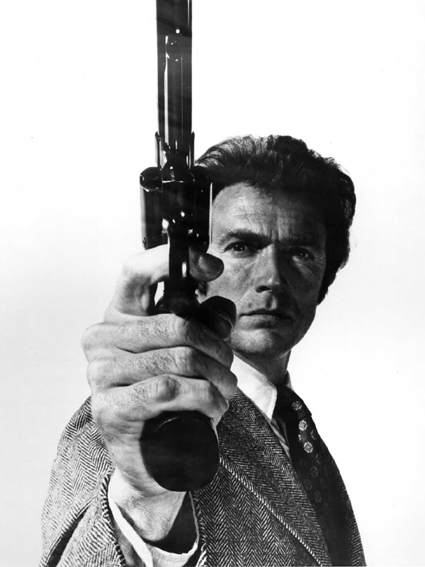
Harry Callahan (Clint Eastwood) is a no-nonsense detective in 1970s San Francisco, where the political correctness is thick, Miranda-warning era sensitized bureaucrats rule, and crooks are coddled (every thug in Dirty Harry has the sneering, arrogance of a punk who knows that the law is on his side). The baddest guy in a sea of bad guys is the film’s facsimile of the Zodiac Killer, a vicious beatnik with Woodstock hair, an army fatigue jacket and a peace symbol on his belt buckle. Callahan is called in to help with the case.  He is immediately accosted by the D.A. for his excessive brutality.

District Attorney Rothko: You’re lucky I’m not indicting you for assault with intent to commit murder.

Callahan: What?

District Attorney Rothko: Where the hell does it say that you’ve got a right to kick down doors, torture suspects, deny medical attention and legal counsel? Where have you been? Does Escobedo ring a bell? Miranda? I mean, you must have heard of the Fourth Amendment. What I’m saying is that man had rights.

Harry Callahan: Well, I’m all broken up over that man’s rights!

In fighting with the mayor – who wants to give in to the killer’s demands – Callahan is blunt and dismissive.

Mayor: I don’t want any more trouble like you had last year in the Fillmore district. Understand? That’s my policy.

Harry: Yeah, well, when an adult male is chasing a female with intent to commit rape, I shoot the bastard. That’s my policy.

Mayor: Intent? How did you establish that?

Harry: Well a naked man is chasing a woman through an alley with a butcher’s knife and a hard-on, I figure he isn’t out collecting for the Red Cross.

Even in his ultimate scene, where he mocks one of three hold-up men, Callahan embodies the rugged conservative fantasy of turned-tables and frontier justice.

Harry: Ah Ah, I know what you’re thinking. Did he fire six shots or only five? Well, to tell you the truth, in all this excitement, I’ve kinda lost track myself. But being as this is a .44 Magnum, the most powerful handgun in the world, and would blow your head clean off, you’ve got to ask yourself one question: ‘Do I feel lucky?’ Well, do ya punk?

Punk. He’s a punk. Not a suspect. Not a person. Not a downtrodden, misunderstood product of an uncaring society.

Paul Newman was offered the film, but legend has it he was nervous about its politics, and suggested Eastwood for the part. Great suggestion. Eastwood has commented on Dirty Harry that “It’s not about a man who stands for violence, it’s about a man who can’t understand society tolerating violence.” Pauline Kael called the film “fascist.” This is, however, the same Pauline Kael who was stunned when McGovern lost in 1972, saying “I live in a rather special world. I only know one person who voted for Nixon.”

Politics aside, this is an excellent picture. Eastwood is mythic, the story moves, the San Francisco locale is used to great advantage, and the killer is truly frightening.

The cynical Western of the 70s has a few decent entrants.  The Ballad of Cable Hogue and The Life and Times of Judge Roy Bean come to mind.  Butch Cassidy showed it in sleek form (though it was released in 1969), and The Wild Bunch was the birth. Richard Brooks’ Bite the Bullet is a lesser work, a film that doesn’t catch its stride until well into the last third, giving you precious little to savor until that point.

Essentially, the film is a turn of the century Cannonball Run. A disparate cast of characters comes to town to run a 700 mile race.  There’s the gambler looking for his last big score (James Coburn – in a nice touch, he is introduced kicking the boot of another character, just as he had his boot kicked in The Magnificent Seven), the wild young kid looking to make a name for himself (Jan Michael Vincent, pre-crack up), the mysterious ex-whore with a heart of gold (Candice Bergen), the proud and quietly suffering Mexican (some Mexican guy), the over-the-hill man looking for his place in the era (Ben Johnson), and the sporting English gentleman (some English guy).

Off they go, with Gene Hackman to round them out. Hackman is a pre World War I man of the ages; he loves animals (if this wasn’t the forerunner to Robert Redford in The Electric Horseman, I’ll eat my Willie Nelson records, an empty threat for I own none). He is kind to women and whores, treating them as equals. He is a civil rights advocate, and he even is a little anti-war.  This is the story, and the characters live and learn – and become better people for it – through the grueling marathon.

The script has some punch, but is mostly leaden.  You’ll find that Coburn quoted Bible verse well-ahead of Samuel L. Jackson in Pulp Fiction and someone punched an animal on film before Alex Karras in Blazing Saddles.  You’ll suffer through “I’ve forgotten how good a bad women feels” and “Killin’ a man don’t prove you’re a man” (delivered unconvincingly by fashion model Bergen) but you’ll also enjoy “Why don’t you tell me the story of your life.  Just skip everything until the last few minutes.”  Particularly good – the whore who asks Hackman pre-coitus, “How do you like it?” – to which he retorts, “Without conversation.”

Coburn and Hackman are fine, but they aren’t exerting themselves, and you see in their performances a defter Mel Gibson/Danny Glover tandem, with a bit more grit and dust.  Bergen is invisible, as should be expected. She is the Andie MacDowell of her age (Raquel Welch did better in Hannie Caulder and that’s saying nothing).

Brooks’ direction is workmanlike and uninspired (he is, after all, a workmanlike and largely uninspiring director, with credits from Cat on A Hot Tin Roof to Elmer Gantry to Looking for Mr. Goodbar).  That said, he reaches a few moments of renown.  In one sequence, he effectively uses slow-motion to depict a horse sprint between Coburn and Vincent.   Vincent is losing, and his horse is fading, so Brooks splits the screen for effect (not split by a bar, ala’ The Boston Strangler, but split so that Coburn and Vincent are side-by-side), but Brooks keeps Vincent in slow-motion, while Coburn remains in real time.

Alex North’s score was nominated for an Academy award.  I cannot see why.  It is a bad Aaron Copland copy, and in that Copland has been used rather freely, from The Magnificent Seven to Spike Lee’s He Got Game, the cheap facsimile (replete with orchestral diversions into standard American ditties) was hardly necessary.