I’ve had the misfortune of watching this movie twice (I endured it because I remembered a better film). Mel Gibson had his own cut, which was better than that of director Brian Helgeland (screenwriter for LA Confidential), though still pretty bad. The picture is a loose remake of John Boorman’s 1967 Lee Marvin vehicle Point Blank. The story is uncomplicated. A crook (Gibson) pulls of a heist, is double-crossed by his girlfriend and partner and left for dead. He does not die, but returns, to collect his share of the money. It turns out his partner used that share to buy his way back into “the Syndicate,” so Gibson works his way up the chain, killing folks up a higher level of authority until he gets to the top. The original was arty, tough and noir, and Marvin’s anger convincingly propelled the simplistic plot, which culminated in a cool shoot-out in then-abandoned Alcatraz.
Gibson’s version exchanges San Francisco for Chicago, tough for brutal, and noir for ostensibly hip (which, as defined by Gibson, is taking every opportunity to smack women and crunch bones). While Gibson throws in a touch of humor in the plot, his performance is leaden. He emulates Robocop and The Terminator, not Marvin.
Gibson’s version ends better (he uses a kidnap of the top Syndicate man’s son to get at him, while Helgeland settles for a lame shoot-out on a Chicago train platform), but it’s a pointless endeavor. The only redeeming qualities are some wry performances as criminal lowlifes by Gregg Henry, James Coburn, William Devane, John Glover, David Paymer and Lucy Liu.
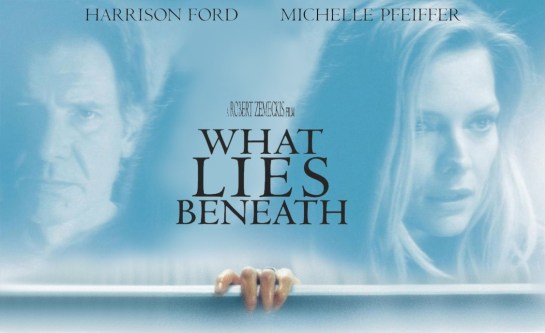
Robert Zemeckis’ ghost story is both an homage to Hitchcock and a vehicle for the director’s visual audacity (or, if you’re harder on Zemeckis, gimmickry). There’s little new in this old-fashioned haunted house tale, but what is presented is solid and entertaining.
A beautiful, vulnerable Michele Pfeiffer lives with her researcher/scholar husband (Harrison Ford) in a New England college town, their home a picturesque waterfront exemplar from Architectural Digest. Pfeiffer has just dropped her only child off at college and is in the midst of an empty nest crisis. Worse, she’s recovering from a car accident a year prior and she believes her new neighbors’ marital woes have escalated to the husband killing the wife (she even believes she sees the husband disposing of the body, much as Jimmy Stewart saw Raymond Burr covering up his foul deed in Rear Window). What better to harass this fragile woman than a spirit attempting to communicate with her?
Zemeckis does a nice job of interweaving a few plot lines, and he produces some genuinely creepy moments. But the film has flaws. First, Zemeckis so distrusts the audience’s ability to follow the plot he over-lingers to focus our attention on a fact or clue. So, in his work, Ford is working with a drug that immobilizes while the subject maintains consciousness. I wonder if that will come into play later? Second, Hitchcockian is one thing, but a replica is quite another. By the end of the film, the score is a mash of Bernard Hermann and the tribute so unrelenting, Mel Brooks’ High Anxiety comes to mind. The movie is also overlong, piling reveal scenes on top of each other, replacing tension with exhaustion.
The virtues, however, outweigh the negatives. The film mostly moves briskly, there are genuine scares, and the characters, while a tad humorless, are engaging. Pfeiffer is an effective mix of emotional fragility and upper class angst, and Ford is a surprisingly sympathetic villain. Indeed, Pfeiffer comes off as spoiled and becomes so unstable, you find yourself siding with the seemingly reasonable Ford, who fairly suggests his wife is punishing him in a passive aggressive manner with all the ghost nonsense.
A meaty, engrossing crime picture, right in Martin Scorsese’s wheelhouse. Jack Nicholson is a Boston crime boss who has a quasi-adopted son/mole in the Boston PD (Matt Damon). In that same department, a small unit (headed up by Martin Sheen and Mark Wahlberg) is set up to get Nicholson, and they recruit a police academy trainee (Leonardo DiCaprio) who has one leg in the tough streets of Southie (his dad’s side) and another in the upper crust of Boston (his mom). Meanwhile, a second task force, headed by Alec Baldwin, is also trying to get Nicholson and can’t get a handle on why they are thwarted at every turn. DiCaprio is “erased” from police files, purposely gets arrested, and infiltrates Nicholson’s organization, which is populated by colorful, brutal goons (Ray Winstone, David O’Hara), in order to identify the mole. Meanwhile, Damon keeps screwing Baldwin’s pooch.
A cat-and-mouse hunt ensues, as Damon searches for DiCaprio and vice versa. Damon is also dating a psychologist (Vera Farmiga) who treats cops and ex-cons, including DiCaprio.
Almost to a person, the performances are rich and rough. DiCaprio is now in full bloom, grown out of the Titanic baby face and having just previously offered two nuanced and substantial performances in The Aviator and Blood Diamond. Nicholson is bloody and funny, and, well, Nicholson.
All the supporting characters are strong and natural save for Farmiga (she’s too feminine for the role and when she becomes infatuated by a clearly unstable DiCaprio, it is unconvincing) and Wahlberg, who, ironically, was nominated for best supporting actor. He yells an awful lot and delivers a few speeches, but volume and line memorization do not deserve a nomination. Wahlberg seems uncomfortable and masks it with rage. And once again, Matt Damon does all the heavy lifting and gets none of the credit. His turn as the fatherless boy who is being manipulated by Nicholson is alternately frightening and heartbreaking, yet he remains a very charming sociopath.
The picture whizzes by. Scorsese effortlessly paces what could have been a morass of a story, providing his signature quick-cut expositions to perfectly chosen music (The Stones, Badfinger, Allman Brothers).
Proof of Life is a competent but dull thriller/romance. Russell Crowe is the hot shot “negotiator” assigned to extricate Meg Ryan’s husband, David Morse, from the clutches of South American kidnappers.
Director Taylor Hackford tries to reprise the simmering steaminess he got from Jeff Bridges and Rachel Ward in Against All Odds and Richard Gere and Debra Winger in An Officer and a Gentleman. He has a harder road to hoe here. Crowe and Ryan rub against each other, as they apparently did in real life doing shooting, but sparks do not emit. Crowe is only offering a sly “mate” every now and again, and no matter how strong the effort, Ryan can never get too far from perky popsicle.
There are a few good things: David Caruso was actually built to be a supporting actor (his run as a post “NYPB Blue” movie lead – Jade and Kiss of Death – sent him quickly back to television for “CSI”) and he is sly and funny as Crowe’s number 2, an integral part of his professional extrication team (though he’s always been a strange choice for gritty physicality; he seems more ballet than brute).
This is also one of the last films before Meg Ryan finally succumbed to the excesses of plastic surgery and became
My boy Will got back from camp yesterday and while he was away, I DVRed Spielberg’s War of the Worlds (2005). I’d forgotten how scary the first half of this movie is. I’d also forgotten how effective Tom Cruise is as the “in over his head” father of two who must escape the aliens while protecting his children (Dakota Fanning and Justin Chatwin). Cruise has always infused a little of Risky Business in all his roles, hindering his ability to play period or even mature. That bright smile is too youthful and winning, and Cruise as a weathered or dispirited character seems both a stretch and a waste. Even his Ethan Hunt in the Mission Impossible movies is always kept running at full clip lest we realize he’s having too much fun to be such a serious international spy.
Here, however, Cruise plays weary, completely out of depth and even selfishly beleaguered in being stuck with his two children at a moment when the world is being ravaged and dominated by aliens. His performance is riveting and is enough to overcome some clunky father-son, “why weren’t you there for me?” dialogue with Chatwin.
As the family wends its way from New Jersey to Boston, where Cruise hopes to reunite the children with their mother, massive Imperial Walker-like monsters emitting ominous foghorn sounds vaporize some people, and collect others for extraction of their blood, for fertilization. I think. This is where the movie gets weaker. Since the alien invasion is so unexpected, we have no clue, no Jeff Goldblum scientist, to explain what is happening. Like Cruise, we can only guess. I respect the bravery of the decision with regard to the narrative, but after all of Spielberg’s set pieces are finished (the initial appearance of the aliens, the aftermath of the crash of a jumbo jet, the alien attack on a ferry crossing the Hudson), one starts to wonder why the aliens are so meticulous about finding Cruise and Fanning, who, after surviving the ferry attack, are hiding out in the root cellar of an unstable Tim Robbins. Thus far in the picture, the m.o. of the aliens had been indiscriminate and brutal, yet near the end, they send a snake-like probe into the basement, followed by an investigatory party of 4 aliens, followed by yet another probe. The only reason for this deviation in behavior is to create a very tense scene that seems out of place when, flushed out, Cruise and Fanning are merely scooped up. The extended sequence also allows for some tiresome back and forth between Robbins (let’s fight) and Cruise (let’s not).
The ending is also a let-down. The aliens get sick and die. Movie aliens have many of the same problems we do as an occupying force, but we look much better in comparison. If you thought it took us some time to get our footing in Iraq or Afghanistan, at least we figured out we could breathe the air in those places before undertaking the endeavors. The ultimate fault of the aliens in War of the Worlds seems a little rudimentary, though not so stupid as the aliens in Signs, for whom water was acid, making Earth a strange choice for colonization.
One other complaint. For all of Spielberg’s gifts and power, he can be gutless in his presentation of popcorn fare (see another Cruise vehicle, Minority Report, a film noir spoiled by Spielberg’s constitutional inability to have the audience walk away sad). There is no way Chatwin survives this picture. But not only does he survive, he beats Cruise and Fanning to Boston for a family homecoming and a stirring end.
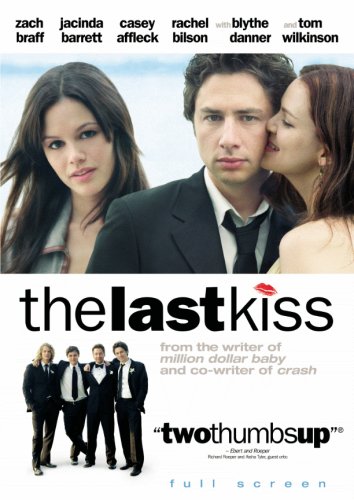
Zach Braff’s gruesome, false dramedy about a guy in his twenties who “has everything” but gets the jitters when his long time girlfriend (Jacinda Barrett) becomes pregnant. He then recklessly beds a college hottie (Rachel Bilson), and the audience is treated to the extended punishment of his shrieking girlfriend, his unctuous attempts to elicit forgiveness, and side-stories of friends and family similarly bollixed by love, which, as I understand it, reduces everyone to shrieking hysterics.
This indeed may be the way of love for many people, but I sure don’t want to watch it, even with an implausible, redemptive, happy ending. Braff’s responsibility is minimized. He only starred in and co-wrote this disaster, with, shockingly, Oscar-winning screenwriter and Scientology attacker Paul Haggis (perhaps this is an excess of Scientology?)
But a curse is a curse, and his post-TheLast Kiss, non “Scrubs” work is a cautionary tale — one Canadian movie (The High Cost of Living) and a cameo on a 2012 episode of “Cougar Town.” He played the pizza delivery guy.
David Mamet-speak is one thing. There is nothing quite like the staccato of the pitiable salesman in Glengarry Glen Ross, and Alec Baldwin’s thunderous sermon to those below him has become so ubiquitous that a generation of frat boys can now recite it – or parts (“coffee is for closers!”) – verbatim.
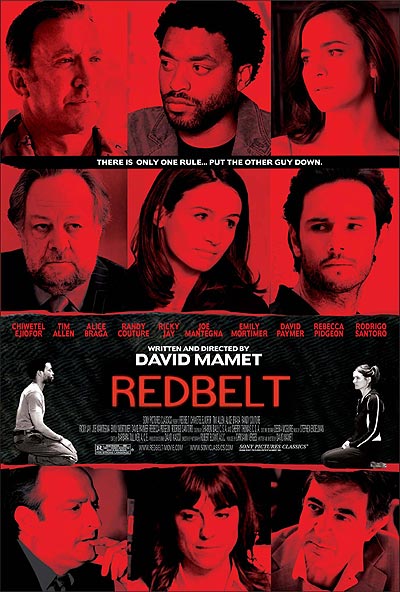
But Mamet-speak has it limits and when coupled with Mamet’s macho honor philosophy, the results can be toxic. And thus, we have Redbelt, a bizarre modern moral tale about a martial arts enthusiast (Chiwetal Ejiofor) who spouts a lot of Kung Fu b.s. while negotiating through a plot so byzantine and ridiculous that were I to attempt to encapsulate it, I’d have a stroke.
So, I’ll let Wikipedia do it for me:
While closing his Jiu-jitsu studio one evening, Mike Terry (Chiwetel Ejiofor) is approached by attorney Laura Black (Emily Mortimer), who is seeking the owner of the vehicle she accidentally sideswiped. Off-duty police officer Joe Collins (Max Martini), who was receiving a private lesson from Mike, sees that Laura is distressed and tries to take her coat. Startled, Laura grabs Joe’s gun and fires it; shattering the studio’s front window. To avoid having Laura charged with attempted murder, Mike and Joe agree to conceal the event.
Mike’s insurance, however, will not cover his act of God claim that the window was broken by a strong wind. Mike’s wife Sondra (Alice Braga), whose fashion business profits are the only thing keeping the struggling studio afloat, requests that Mike ask for a loan from her brother Ricardo (John Machado), a mixed martial arts champion. At Ricardo’s nightclub, Mike meets with Sondra’s other brother, Bruno (Rodrigo Santoro), and learns that Joe quit as the club’s bouncer because Bruno never paid him. Mike confronts Bruno about the situation but is rebuffed. Mike then declines Bruno’s offer to fight on the undercard of an upcoming match between Ricardo and Japanese legend, Morisaki (Enson Inoue), which could potentially pay out $50,000. Mike believes competitions with money as the incentive are not honorable and weaken the fighter.
Meanwhile, aging Hollywood action star Chet Frank (Tim Allen) enters the nightclub without security and is accosted by a man with a broken bottle. Mike intervenes and subdues three men in the process. The following day, Mike receives an expensive watch and an invitation to dinner from Chet. Mike gives the watch to Joe to pawn in lieu of his unpaid salary at the nightclub. At the dinner party, Chet’s wife Zena (Rebecca Pidgeon) arranges an informal business deal to buy a large amount of dresses from Sondra’s company. Chet, impressed by Mike, invites him to the set of his current film. As Mike and Sondra leave the dinner, Mike explains his unique training method to Chet’s business associate Jerry Weiss (Joe Mantegna). Before a sparring match, each fighter must draw one of three marbles, two white and one black; whoever draws a black marble has to fight with a handicap.
Mike uses his military experience to answer a few technical questions for Chet on the film set and is offered the role of co-producer. That evening, Mike faxes the details of his training methods to Jerry so they can be used in the film. Joe arrives at the studio and informs Mike that he was suspended from duty for pawning the watch, which turned out to be stolen. During their dinner that evening, Mike relays the information to Jerry who excuses himself to handle the matter, but never returns. At home, Mike learns that the phone numbers that Zena gave Sondra have been disconnected. Sondra is panicky, having borrowed $30,000 from a loan shark to order the fabric for the dresses. As he meets with the loan shark to discuss an extension, Mike notices Bruno and Marty Brown (Ricky Jay) on television using Mike’s marble-drawing method as a promotional gimmick for the undercard fights of Ricardo’s match.
Mike hires Laura to sue, but Marty’s lawyer threatens that if they do not drop the lawsuit, he will give the police an empty shell casing with Laura’s fingerprints, as proof that she attempted to kill an off-duty cop. He also threatens Mike as a witness who covered up the crime by bribing the cop with a stolen watch. When told of the situation, Joe feels responsible and kills himself. Mike feels obligated to help Joe’s financially struggling wife and, in desperate need of money himself, decides to compete as an undercard fighter in the upcoming competition.
At the arena, Mike discovers the fights are being fixed via a magician (Cyril Takayama) using sleight of hand to surreptitiously switch the white and black marbles. Disgusted by this revelation, Mike confronts the conspirators: Marty, Jerry and Bruno who confirm that unknown to the competitors, the fights are handicapped by the fight promoters so as to ensure winning bets. They also reveal that Ricardo is intentionally losing the fight to Morisaki so they can make money on the rematch. Jerry tells Mike that Sondra is the one who told them about Laura shooting the window and Bruno justifies her betrayal by explaining that his sister is too smart to stay with someone who cannot provide for her.
As Mike is exiting the arena, he meets Laura. Their conversation is not audible, but it ends with Laura slapping Mike. Mike then re-enters the arena. He incapacitates several security guards trying to stop him and is ultimately engaged by Ricardo. The audience and camera crews take notice as Mike and Ricardo face off in the arena’s corridors. Inspired by the Professor, an elderly martial arts master attending the match, Mike manages to slip a difficult choke hold and defeats Ricardo. He is approached by Morisaki, who awards Mike with his ivory-studded belt, previously referred to as a Japanese national treasure. Mike is then approached by the Professor himself, who awards Mike the coveted Redbelt.
As my Mom might say, “Jeez-o-flip!”
I am not a Mamet hater. Oleanna, Glengarry, Homicide, State and Main, House of Games, The Spanish Prisoner, these are all very good films, and Mamet displays an authentic American voice in their telling. His work on films he did not direct, or which did not come from one of his stage plays, such as The Verdict, The Untouchables, The Edge, Hoffa and Ronin, is vivid and accomplished.
Redbelt, however, came out in 2008, about the time someone needed to tell Mamet that his mystical machismo and rat-a-tat dialogue had not only reached their expiration date, but had become as embarrassing as a driver’s hat and leather gloves on a newly divorced man.
Since Redbelt’s release, and critical failure, Mamet has written a few shorts, and episodes for his TV show “The Unit.” He also wrote a very interesting book explaining his “conversion” from Hollywood liberal to a member of the right, “The Secret Knowledge: On the Dismantling of American Culture,” as fine a read as you’ll get if you want to understand the nuts-and-bolts philosophy and precepts of a modern conservative (beyond the human sacrifices of panhandlers and the ritual rape of the land). Perhaps he’s done with film writing, but if so, Redbelt is both Mamet’s pathetic coda and a testament to his loss of the gift.
Former police officer Jack Nicholson is haunted by the murder of a little girl, so much so it tests his sanity. He finds the love of a good woman (Robin Wright Penn), who has a little girl as well, but he remains haunted and, as near as I can tell from this complete mess of a movie, goes insane.
Sean Penn directed this picture, which was released in 2001 (he directed another similarly dark mess of a movie released that same year, The Crossing Guard, so perhaps this was a phase). The film is clumsy, uninvolving and disconcertingly showy. Penn can’t just have a cop walk into a room without cross-cuts to the ticking clock and the face of a fat, stupid common clerk telling us something (but what?). Nicholson can’t drink at a Nevada airport bar without pointless flash cuts to whirring slot machines. Not only does all this jazz lead to continuity problems (Nicholson’s scotch miraculously becomes a beer), it is annoying.
The Pledge also demonstrates Hollywood’s disdain for the working class. Set in the flatland of Nevada, Robin Wright Penn, Sean’s then-wife, is a vessel of all Hollywood presumptions about regular folk. She plays a barmaid. She has a gnarled front tooth. She is a little dim. She wears a lot of flannel. And when her savior Nicholson comes to love both her and her daughter, we know that they will commune because . . . Nicholson fixes her tooth! I mean, let’s not take this working class thing too far. We can’t expect Jack Nicholson to have sex with woman with a gnarled tooth.
Ewwwwwwwwwwwwwwww.
Another problem? Penn uses top actors for single scenes, so each feels compelled to ACCCCCCCCCCCTTTTTTTTTTT! like there’s no tomorrow. Benicio Del Toro, Vanessa Redgrave, Mickey Rourke, Helen Mirren, they all emote for a brief, generally unnecessary scene, and boy do they make the most of it. Also, the little girl is killed on the day of Nicholson’s retirement party. If Penn directs a war picture, God help the character who shows his platoon mates a picture of the gal he has at home waiting for him.
That said, I was a big fan of Penn’s more restrained and mature Into the Wild, directed 6 years later, so I chalk The Pledge up to practice.
Gore porn (Hostel, Saw, etc . . . ) has taken over the scary movie market, and in that genre, the more grisly, authentic and perverse a killing, the better. There is never any question of escape for the protagonists. Almost all (if not all ) will be sacrificed, mutilated, or both so that a potential franchise is not suffocated in the crib.
Films that truly create a creepy sense of dread are dinosaurs. In The Exorcist, for example, none of William Friedken’s visual frights happen for nearly an hour. The head spinning, pea-soup vomiting and levitating all follow a rigorous exposition on the characters, the time, Catholic theology, medical inquiry and the growing mystery that surrounds a little girl who keeps getting sicker. There is no chance such a film in its current form would be greenlit today. The best Friedken could hope for would be an early shot of pea-soup vomiting followed by flashback.
Sue me, but I’m a fan of horror film foreplay, which explains my enthusiasm for this years’ The Woman in Black and the Paranormal Activity films (I’ve seen 1 and 2, but not the third installment). The premise is simple. Modern day characters live in homes haunted by demons. The story is recorded ala’ The Blair Witch Project (in the first Paranormal film, one of the residents starts with a handheld camera and when things get spooky, sets up a few security cameras to validate his claims of the supernatural at work; in the second film, after the house is ransacked, the owners also install internal security cameras, supplemented by a teenage daughter’s video journal).
The effect is chilling though very little happens for awhile. A hanging pot falls. Doors swing open. Shadows appear. And curious noises emit. In both films, however, the demon is aggravated even as we learn the source of its existence, and from there, things move with alarming speed. Adding to the fear is the use of unknown actors. Because they look like you in a wedding video or security cam, you feel more vulnerable.
Sure, some of their decisions are questionable. But when demons infest your house, you’re allowed a few bad decisions.
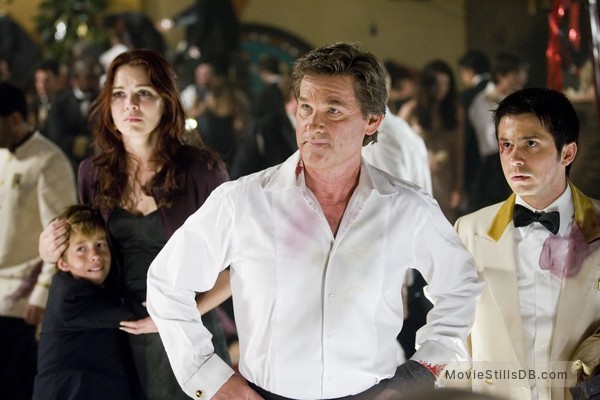
This boring, blaring, hackneyed remake of The Poseidon Adventure cost $160 million to make and made $181 million at the box office. It was nominated for a best visual effects Oscar, but I have questions:
1. Who casts Kurt Russell as the former mayor of New York City? San Pedro, maybe. But The Big Apple? Look at this guy?
2. How good is Kevin Dillon? He walks right in as Johnny Drama from HBO’s “Entourage”, says “Look at me, I’m Mr. Lucky” and then he dies. $1 million?
3. Fergie is the singer. But she doesn’t sing “There’s Got to Be a Morning After.” Huge mistake.
4. I miss Shelly Winters. Why couldn’t she cameo? She died the year it was released, but still . . . .
5. I liked Andre Braugher as the new captain. But why he didn’t get to say “Oh My God” as the wave hit, like Leslie Neilson?

![Cinemascope: The Departed [2006]](https://filmvetter.com/wp-content/uploads/2012/08/e65d1-the2bdeparted.jpg?w=545)






 filmvetter