Archive

2016


One of my favorite films from a few years back was Blue Ruin, writer director Jeremy Saulnier’s moody, crisp, and realistic revenge-gone-wrong drama. That film was completed with a budget of $500,000. I was happy to see Saulnier get a bigger budget follow-up film, Green Room, which was produced for $5 million. Unfortunately, it has only made half of its budget back, a shame, because the picture further demonstrates Saulnier’s obvious talent and ingenuity (don’t just take it from me – it rates at 91% on rottentomatoes.com).

The story is simple: we meet an East coast punk band in the Northwest “on tour”, having just played a Portland gig where they made a whopping $6. To make up for the paltry cut, the quartet is recommended to a club located out in the woods. The pal putting them on to the gig is quick to note that while they may not like the politics of the place, the money is good and assured – $350.   Mind you, the band has been subsisting on junk food and making its way across the country by siphoning gas from other vehicles. They take the gig..

When they arrive, they immediately get a good sense of the politics of the place, what with the odd Confederate flag and Nazi graffiti about in an otherwise survivalist-meets-skinhead environment. It is, however, a pretty professional survivalist/skinhead environment. The club acts like any other club. The band is admonished not to clutter the hallway and to keep their set to time. They do, and all is well.  Until other things go wrong. Terribly wrong.

What ensues is a gripping, occasionally funny, but mainly cold-sweat inducing fight for survival. Saulnier continues to impress with his ability to convey the gritty realities of every day violence.  It almost always goes wrong, it is messy and it is rarely cinematic. He also does a few other things very well. First, his dialogue is grounded and mature. The characters say things to one another you would expect people to say in such a fucked up, dangerous and confusing situation. There are no schmaltzy foxhole confessions or dramatic readings of the riot act. These people are regular folk and they are at the point of a knife. There is no time to whinge on about extraneous bullshit.

Second, Saulnier avoids stereotype without being showy. The band members are as civilian as you can get, but they are not ineffectual. And while the skinheads are terrifying, they are not caricatures nor are they of one stripe.  I was happy to see Saulnier’s lead in Blue Ruin, Macon Blair, cast as a bad guy.  Saulnier manages to subtly convey equivocacy within the ranks of the villains like Blair, which has greater implications as the plot develops.

Look, this is a genre film along the lines of The Purge or the flicks where white kids (and Cuba Gooding) take the wrong turn in LA after a Lakers game and become prey to rappers and cholos, but as it goes, it is at the top of that heap.

image

Paul Rudd lost his young son in an accident and compensates by taking a 6 week caregiving course for the disabled. His first client is a plucky, wheelchair bound Brit named Trevor, who suffers from muscular dystrophy and an over-inflated sense of his own cleverness. For example, to shock Rudd, he pretends he’s choking or having a seizure, a real gut buster. Rudd later pretends he has misplaced Trevor’s lifesaving medicines, so . . . relationship established.

Both parties learn life lessons, but to better cement them, they–

A). Make love
B). Take a road trip
C). Join a white supremacist sect
D). Enter into a suicide pact

Of course the answer is B), but the other answers would have made for a better film, for those options would not have resulted in their meeting bad girl hitchhiker Selena Gomez. How do we know she is bad? She–

A). Smokes
B). Curses
C). Is a white supremacist
D). Smokes while cursing

Oh, if it had only been C).

Gloppy, lazy, hackneyed gruel.

Review: In 'Midnight Special,' on the Run With a Highly Unusual Child - The  New York Times

No one does Americana better than Arkansan writer-director Jeff Nichols. Shotgun Stories and Mud are monuments to understatement and authenticity. He has a unique ability to convey the lazy currents rural life as well as its plain-spoken and direct dialogue. None of it comes off as a posture or a condescension.

These qualities are found in Midnight Special, a story of a boy kidnapped by his father (Michael Shannon) away from the clutches of a religious compound in Texas. Soon, however, the federal government gets involved, and that’s where Nichols loses his way. The story morphs into the supernatural, the genesis of which is never fully explained, and the visual payoff – a world within our own that arises in Louisiana – is jarringly cheesy (I was reminded a little of The Abyss, James Cameron’s gripping underwater yarn, which was undone by the silliest representation of aliens you ever saw).

Still, I recommend the picture for the quiet moments and the care Nichols takes with both characters and milieu.

Richard Linklater’s astute command of time and place is forever proven by his masterpiece, Dazed and Confused, which captured a Texas town’s high school circa 1976 in all its bell-bottomed, long-haired, keg-in-the-woods glory. Everybody Wants Some! ain’t Dazed and Confused. Focusing on a young college baseball player’s matriculation at a Texas college, Linklater appears to be satisfying an 80s-era checklist. Mud wrestling. Check. Disco. Check. Mechanical bull. Check.  “Get the Knack!” Check. And while Dazed and Confused gave you insight into the jocks, the stoners, the geeks, the parents, the coaches, the teachers and the townies, Everybody Wants Some! is limited to the hyper-male competitive environment of the baseball team, a group that parties hard, jumps on your Achilles at every opportunity, and challenges each other in all respects, when not dime-store philosophizing about winning, commitment, pot and “pussy.”
Yet, with all its flaws and limitations, I dug the movie. Linklater lovingly recreates the art of male bullshitting, which, granted, is not for everyone; the wonder of all the possibility of college; and the camaraderie of sports, all to an unabashedly “classic rock” soundtrack. it’s an acquired taste, and this is a very light film that at its best is merely charming, but I was smiling throughout.

Image result for Risen movie

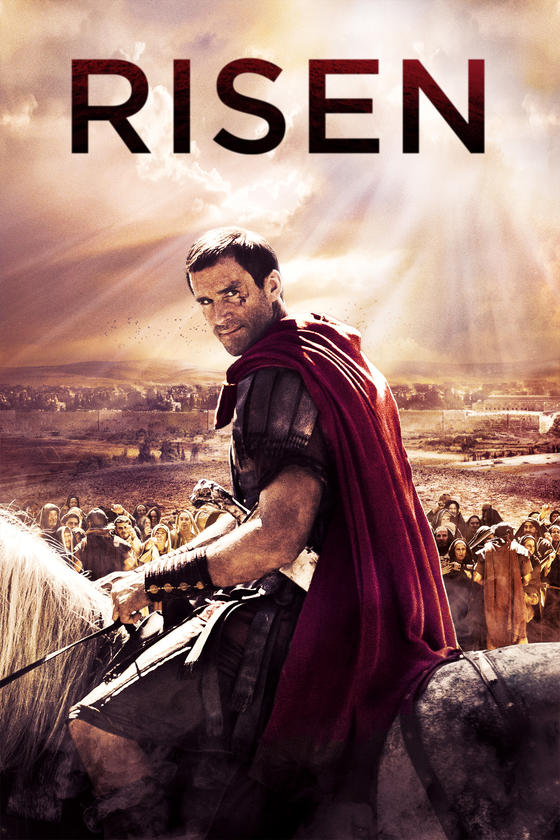
Kevin Reynolds was a big deal at exactly the same time Kevin Costner was a bankable lead, directing or helping Costner out in massive budget fare like Dances With Wolves and Robin Hood (they fell out over Waterworld, with Reynolds remarking that Costner “should only act in movies he directs. That way, he can work with his favorite actor and director”).   It’s been a decade since Reynolds last helmed a Hollywood feature, but with Risen, he manages several minor victories that amount to a pretty compelling religious/historical procedural.

Jesus is on the cross and Pontius Pilate’s right-hand tribune, Clavius (Joseph Fiennes) is dispatched to hurry the process and smooth out the disposal of the body. When that body disappears, due it seems to the drunken inattention of Clavius’ guards, the politics of the situation (a pressed Pilate, furious Pharisees) finds Clavius embarking on an investigation and a manhunt for the apostles. In an era when big budgets and sweep are expected in “mere” television (see Game of Thrones), Reynolds does a nice job of minimizing the scope of the film while projecting authenticity. Shot on location in Malta and Spain for $20 million, the picture looks right.

Reynolds also effectively communicates the religious message (the previews for Risen include numerous films that share a common Christian theme that God is here, with us, saving kids from illnesses, showing them heaven, etc.) Naturally, Clavius has his own religious conversion, but it is not a momentous, eyes-shimmering thing.  Fiennes is understated and quite moving as he grapples with what he cannot believe. While the end is anticlimactic (Jesus appears to his disciples and then he’s off), it had to be, unless we were going to follow those apostles to their eventual, gruesome ends (11 of the 12 died ugly; only John died of natural causes).

It’s not perfect.  The script is a little thin and the one battle scene between the Romans and the Zealots feels tiny, but all-in-all, this is a game effort.

Semi-compelling in its melding of the English countryside circa 1812 and brain-eating undead, this film has its moments.   In particular, Matthew Smith (an old Dr. Who) as Parson Collins and Lena Headey (Ceirse Lannister in Game of Thrones) as Lady Catherine de Bourgh get the joke, stealing every scene they are in with wink and nod mugging that acknowledges the levity of this venture. Unfortunately, the rest of the cast actually seems to be struggling with the delivery of Jane Austen in the middle of a zombie outbreak and choose to treat the latter as a catastrophe that demands some degree of solemnity. Worse, director Burr Steers finds it necessary to inject the tiresome physicality of a kung-fu movie, which is one ingredient too many for the stew. Still, this is pretty decent fun.

The Witch | Rotten Tomatoes

This is a consistently disturbing and terrifying film, one that explores myth, religion, and the dread of isolation in the cruel and unforgiving setting of pre-colonial America.  Writer-director Robert Eggers is a master of the creepy visual as he tracks a Puritan family, cast out from their community and into the wilderness on the strength of religious conviction. It is there, alone, that the bonds of their faith and family and the limits of their sanity are tested by the supernatural.

This film has a lot in common with The Babadook, invoking both curse, madness and the susceptibility of children, and like that film, there are moments of absolute horror that do not rely on a drop of shed blood.  If there is a weakness (and it is by no means universal, just one of personal taste), it is the simplicity of the threat. In The Witch, the threat is omnipotent and unexplained. It has no backstory, no articulated lore, and no vulnerability. As such, as assured as it presents, there is a decided lack of drama. We quickly learn these folks don’t stand a chance, and while their fate and story is loads more interesting than standard meat grinder fare, I just don’t have much of an interest when the deck is so stacked, no matter how skilled the effort.  Nonetheless, this movie has one of the spookiest feels of any I’ve seen.

Image result for Deadpool

It’s hard to decide on what was more enjoyable about Deadpool. There’s the ingenious flash-forward, flashback in story, which keeps the action fresh. There is also an intelligent self-referential trick; as Deadpool (Ryan Reynolds) is dragged to the estate of the X-Men, he asks “ “So, McAvoy or Stewart?”.  The back-and-forth between Reynolds – our hero, though he insists he is not – and the other characters is sharp and profane. The utter lack of seriousness, save for a very few poignant moments that are immediately deflated by the screenwriting equivalent of fart noises – is also a joy (indeed, Reynolds actually farts as he walks by his roommate, who, unbelievably, is a geriatric blind woman). There’s the 106 minute running time, juxtaposed nicely with the bloated, Shoah-like length of the interminable Avenger movies, which keeps things humming.

But I guess my favorite part is when Reynolds meets his love interest (Morena Baccarin) and we are educated as to the depth of their ardor via a montage of their incredibly kinky sex life, which incorporates days of commemoration. The image of Reynolds bound and on all fours as Baccarin prepares to “celebrate” International Women’s Day with him is hilarious, made more so by the image of parents quickly hustling their children out of a theater they lazily thought was showing children’s fare

image

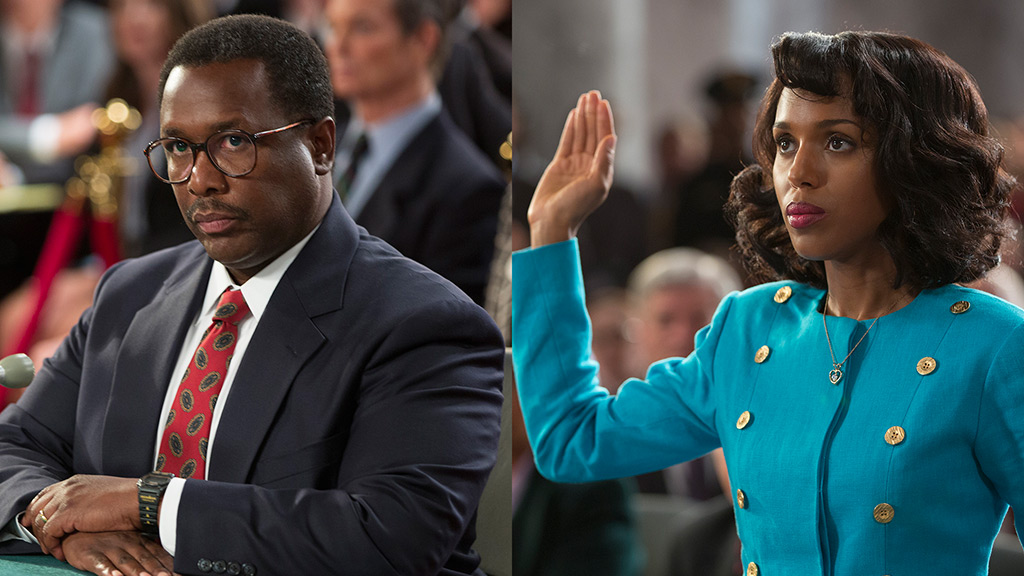
Execrable.  Anita Hill as Jesus Christ, Clarence Thomas as Impenetrable Sphinx, the story so stacked in her favor it’s a liberal wet dream. Then, there is this laughable coda where the hard charging female Kennedy aide says to the more judicious female Biden aide, “who’d you believe, him or her?” like any response other than “her” was possible given the hagiography that preceded the exchange.

Not only is the mythology laughable (apparently, Anita Hill will be replacing someone on currency sooner than we think), but the presentation is lackluster and vanilla.  It’s not Kerry Washington’s fault that Hill is so dull.  She’s written as nothing more than a platitudinous victim, and her emotional response to any given development is a self-pitying, dew-eyed disappointment in how mankind has failed her.  Wendell Pierce’s Thomas is no better, occasionally rising above catatonic, always in the corner, ruminating, obsessing, zzzzzzzzzzz.  The Democrats are hands-tied, decent truth-seekers, the Republicans hysterical street brawlers, not a scene surprising or enlightening.

It’s a shame.  The story of Hill and Thomas is, in the seams, the story of two people who worked together, she relied on him for advancement, but clearly developed a grudge at some point.  He said some Long Dong Silver shit to her, and then she, for whatever reason, took her shot at him on the eve of his confirmation, with the naively hopeful guarantee of anonymity.

And then wham!  She’s outed (a mere anonymous statement will not stop the Hope from Pinpoint, Georgia) and the process takes them both to places they never imagined they’d be, where he must play a hard race card against a cheap smear, and she must feign dramatic victimhood.  Their champions bloody and bruise the protagonists.

She tried a back alley stilleto and it wasn’t enough. He replied with a daylight, streetfront 2×4 and overcame.  They both became emblems of something larger, which, given the picayune roots of their antagonism, is the essence of the tragicomic.

Could have been a great movie.