
Archive

2015

Jurassic World (2015) - IMDb

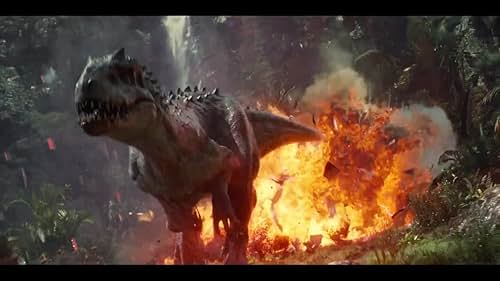
Very much in the vein of Godzilla, Jurassic World is just gripping and exciting enough, you almost look past its flaws.

Almost.

The script is cobbled-together from the Spielberg factory and is largely a knock-off. We come to the park with kids scarred by impending divorce bond (two, like in the first movie) where they are met by their aunt, a park executive, who has no parenting instincts (ala’ Sam Neill, in the first movie).  There is also a bad guy who wants to use velociraptors for, you guessed it, military purposes, and plenty of discussions about the ethics of all of this (much less impressive coming from the likes of B.D Wong and Chris Pratt, as opposed to Sir Richard Attenborough and Jeff Goldblum). And our heroes live because the dinosaurs fight amongst themselves (again, as in the first movie).

Speaking of Pratt, he’s in a bit of bind here. Pratt’s wheelhouse is a certain goofy but childishly masculine charm, best represented in Guardians of the Galaxy and Moneyball (as the confused, boyish catcher-turned-first-baseman). Here, when Pratt flashes that charm – mainly in banter with the aunt, Bryce Dallas Howard – he’s fun to watch. But Pratt also tries to play it straight, and he simply lacks the gravitas to do so.  A fair comparator is Bruce Willis, who went from the light comedy of TV and Moonlighting to the sarcastic aside of John McClane in the Die Hard flicks to a plausible straight hero. But Willis started late and had the rough look of an older man, coupled with a menace he could draw upon. Pratt ain’t there yet and it’s hard to tell when he is being serious or joking. 

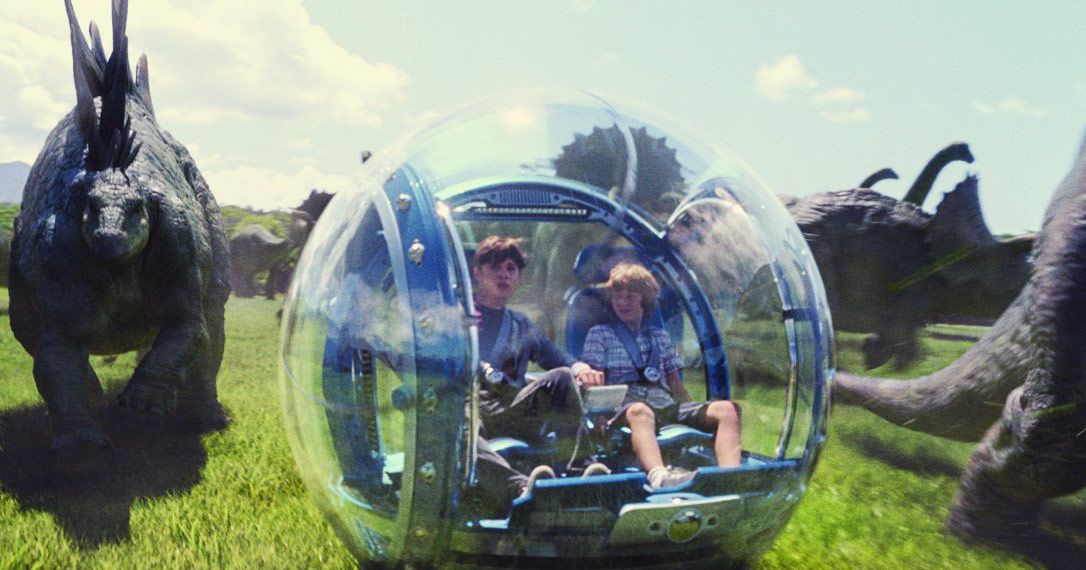
There’s also a fair amount of lazy plotting.  It is never adequately explained why certain features of the new, terrifying animal – Indominus Rex – were allowed to manifest themselves in the creature (such as its ability to think like George Patton) without also injecting a kill switch.  Also, the response of the park staff is less professional than what you might get on a windy day at Busch Gardens, and if Busch Gardens keeps you on a metal track for the Old Time Antique Car Ride, there is no way a park would allow its patrons to self-navigate dinosaurs in one of these:
A Broker Explains How a Real-Life Jurassic World Would Get Insurance  Coverage

Still, this is an easy and fun movie which, at last count, has made enough dough to bail out Greece.  
image

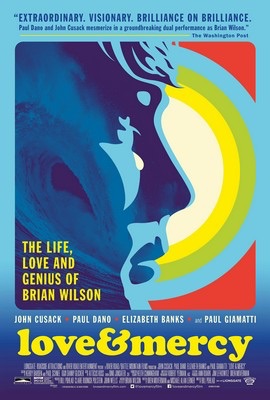
A competent biopic that smartly alternates between the rise of Beach Boys impresario Brian Wilson (played as a young man by Paul Dano) and his later life (during which he is played by John Cusack), where the ravages of mental illness, substance abuse and the dubious oversight of Svengali psychiatrist Eugene Landy (Paul Giamatti) have taken their toll. We meet the older Wilson as he tries to buy a Cadillac from saleswoman Melinda Ledbetter (Elizabeth Banks), revealing the only peace he can find, alone with her in the car at the dealership, while Giamatti and his associates hover on the other side of the glass.

The film spaces nicely, and the early pressures on Dano (fear of flying, his abusive and controlling father, the stress of touring, an aversion to conflict) are manifested in Cusack’s caged, distrusting performance, one of many really nice touches in the film.  Near first time director Bill Pohlad delves into but doesn’t overplay Wilson’s demons, choosing to give equal access to his love of the art of pop music and visionary work in the studio.  Nothing in the picture feels hackneyed or stale, a difficult feat in the face of traditional musical biopics like Ray and Walk the Line.  Also, in the era where “Behind the Music” has left these stories vulnerable to the Dewey Cox treatment, the film feels fresh and immune to parody.

Banks and Cusack also radiate the wonder of first love, subordinating the “bio” aspect of the movie to a heartfelt romance.  They have a convincing chemistry, which bolsters the efforts she undertakes to wrest Wilson from Landy.

As Landy, Giamatti is the weakest link.  He is ferocious where he should be merely intrusive, maniacal instead of crafty.  Landy may well have been that excessive, but he didn’t just walk off the street; he was a pop psychologist to many stars, from Alice Cooper to Rod Steiger.  The performance is so over the top, you wonder how Wilson, even in his vulnerable state, could have succumbed to such a bully and how Landy could have had the smarts to set himself up so nicely.

Currently on Hulu.

This is a really fine action film, all the more impressive for its lack of CGI and enhanced by an intricate dystopian vision and some very bizarre, very cool, hard comic-book baddies.  The plot is elemental.  The world has gone to shit, and barbaric fiefdoms and clans reliant on gasoline have arisen from the ashes. Furiosa (Charlize Theron), a trusted lieutenant and gas runner of the chief bad guy, Immortan Joe (Hugh Keays-Byrne), takes something very precious from him and in the process, is assisted by Mad Max (Tom Hardy) and a fundamentalist acolyte of the heavy (Nicholas Hoult) who turns from the dark side.  So, they are chased, and then, they double back through the dusty hell that is the future, and threaten all Immortan Joe possesses.

There isn’t much beyond action here, but it is inventive and exciting.  Hardy and Theron are taciturn, eschewing even Eastwoodian comic understatement.  They leave it to Hoult to provide most of the pathos, and he is an endearing motorized jihadist.  Thankfully, the movie does not really try to communicate how the world came to be so barren and unforgiving, a blessing, because there is nothing quite so annoying in today’s dystopian films than the inevitable philosophical discussions masquerading as backstory, where we learn how we pissed it all away, and why the sufferers must keep suffering (see Snowpiercer, Elysium, In Time).

Inventive, scrupulous and at times, bone chilling, It Follows is yet another nail in the coffin of gore porn and a heck of a scary move to boot. The set-up is simple (stop reading if you don’t want to know even this much): a “thing” that can take many forms follows its target, and you become a target through having sex with someone the thing is following. If you have sex with someone else, it throws the follower off, until it gets that someone, and then it is back on your trail.  No one can see the thing except its targets.

It Follows adroitly handles the revelation of the curse, and what ensues is a terrifying spook story in which Kelly (Lili Sepe) must run from what follows, with the assistance of her sister, friends and neighbor, while weighing the moral implications of buying herself more time.

Writer-director David Robert Mitchell knows his stuff; the film is a near homage to John Carpenter’s Halloween, with its dreamy sense of suburbia and techno-synthesized score. His actors approach the material in a studied, restrained manner, further emphasizing the hazy unreality of the entire endeavor. He also incorporates Detroit and its desolate environs, as near an urban haunted ruin as this country has.  Finally, the film trusts your intelligence rather than being explicit, no mean feat in this genre.  It gets a tad ragged in the end, but closes smart.

One of the charms of The Blair Witch Project was a nostalgic authenticity, which transported you back to a younger time and made the actions of the hikers seem like exactly the kind of hubristic, stupid thing you would do at that age. It Follows has the same trait: this feels like your childhood neighborhood, and evokes the times you looked out the window and saw something that seemed off, or something you were not supposed to see, or even something your fevered mind conjured after watching too many Kolchak The Night Stalkers.

I watched this flick with my son and 5 of his high school friends; they all agreed it would be significantly more effective as a sex-ed tool than what they were currently enduring.

A hilarious mockumentary done in the style of The Real World and other reality dramatizations of domestic life. Four mates, distinct in style and manner, share a house in Wellington, New Zealand, and a documentary crew shadows them for a period of months to capture their lives. In the style of the genre, we get to witness petty fights about house rules, dirty dishes, who can have friends over and which clubs to frequent on the weekends. The twist is that our flat mates are all vampires of varying ages, and soon, they add a fifth (Nick) to their coterie, which rapidly undoes their dynamic. As the youngest, Nick is my second favorite, simply because he is so enthused by his new powers, repeatedly telling anyone who will listen that he is a vampire. My favorite of the household, however, is the oldest, Petyr, for the obvious reason that he is a Nosferatin curmudgeon who cannot speak and presents a brilliant deadpan:

This is consistently funny, with particularly great bits about the vampires’ fascination with technology and run-ins with self-improving werewolves.