Archive

2015

image

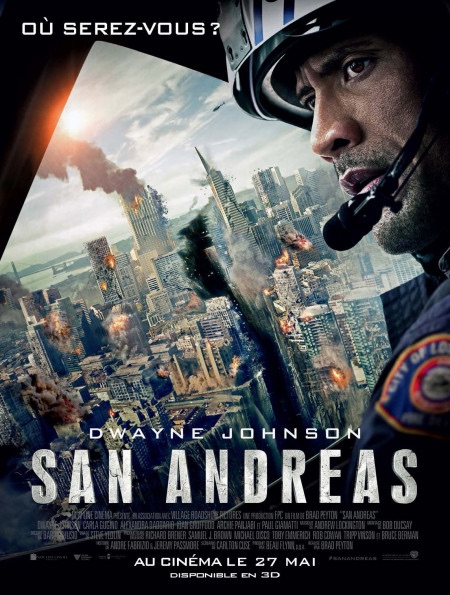
I have an affinity for “the world is ending” movies. None of them are very good and they follow the same model, be it Earthquake, The Day After Tomorrow, Independence Day, Armageddon, 2012, Godzilla and now, San Andreas.  Disaster strikes, the warnings of smart, nebbishes notwithstanding. Heroes arise, but family comes first, so Charlton Heston, Dennis Quaid, Randy Quaid, Bruce Willis, John Cusack, Aaron Taylor, and The Rock brave the catastrophe to find and/or save their loved ones. It is in these ordeals that frayed relationships are cemented, so much so that often, new and old spouses have to be dispatched. The children are always saved and mankind perseveres. But their surroundings are ravaged. And as they witness the destruction, they say “oh my God” (twice in San Andreas).  Just like Leslie Neilsen in The Poseidon Adventure. Well, not exactly. No one says “oh my God” like Neilsen playing it straight.

It’s the ravaging I love most. The cyclones of The Day After Tomorrow thrillingly rip Los Angeles apart, the same city where those moony hippies with their “we love you, aliens” signs get satisfyingly incinerated and Genevieve Bujold’s house on stilts slides into the canyon below. Godzilla quickly stomped Honolulu and Vegas and nearly took down the Golden Gate Bridge, which – in one of the few cool moments – does not survive San Andreas. Armageddon disappoints for any number of reasons, but foremost is the fact that Willis, Affleck and company save the day. That’s no fun and its best moment is when the pre-meteors obliterate Paris.

Same story, same devastation here, but somehow, San Andreas is worse than the others. It’s as if The Rock decided to use this film as his first true test playing sorrow, and boy is that uncomfortable. So uncomfortable that Carla Gugino, playing his wife, appears to be averting her eyes. While The Rock, recalling the pain of losing their daughter white water rafting, tries to squirt a few out, Gugino plays it rather lightly, as if to say, “hey, The Rock, this is just filler until the next shot of a building collapsing. Don’t be so glum.”

And here we are in San Francisco, but for the most part, the stuff we know is left alone. Instead, most of what gets shredded are office buildings, one of which is not even a real building. Give me Coit Tower! Give me some careening cable cars! Give me Alcatraz or at least the Transamerica Pyramid! Nope. Just nondescript skyscrapers falling listlessly into each other.

Finally, the movie has no sense of humor. None. Not an aside, or an inside joke, or even the thrill of watching something cool, like Paris obliterated. It’s dead straight, serious as a heart attack, except when The Rock and Gugino sky dive into second base at AT&T Field and he says, “it’s been a long time since I got to second base with you.” And then you appreciate the film’s dull seriousness.

A final note. The daughter who The Rock and Gugino cover hill and dale to save (Alexandra Daddario, who played Woody Harrelson’s impossibly beautiful mistress in the first season of True Detective) is so buxom and model-like that it feels exploitative. Yes, parents have daughters that grow up to be busty bombshells, but the first time we meet her, she’s splayed out on a chaisse lounge by the pool, Kardashian-like, and you kind of want her to die. Of course, she doesn’t.

When my grandmother started to lose it, she was ingenious in masking it. If you asked her who was president, she’d say, “that fool in the White House.” If you asked her about something topical, she’d reply, “Who has time for such things?” It was her game face as her memory began to fail her.

At the beginning of I’ll Be Me, this is where we find Glen Campbell, recently diagnosed with Alzheimer’s. He is vague, folksy and stubborn in attempting to defend himself from a world ever more foreign to him. He leans heavily on his wife, who acts as his lifeline to his past, but we see his true state when he watches old home movies, and asks “who is that?” It’s achingly painful to hear his wife’s reply, “That’s you, silly.”

Campbell’s diagnosis came on the eve of his final tour, and in an effort to increase awareness about the disease, he went public and allowed a documentary crew along for the ride. The result is a bittersweet retrospective of his work (I had no idea just how big a star he was) and an examination of what it is to suffer this disease through the eyes of his family (three kids are in his touring band). I feared that this might become exploitative and was heartened to see that not only was it not, but that Campbell’s wife acknowledged the concern, explaining that they weighed the costs and benefits and decided to go forth. I also feared that it would be altered to create a “triumph of the spirit” vibe, but director James Keach (an actor in his own right and Stacy’s brother) presents Campbell and the disease in sober fashion; when Campbell’s issues become acute, it is almost too much to bear, and when they evince on stage (as is shown on the clip above), it is not sugar-coated. But the audience is with him, so are we and the fact that his music is so ingrained in him it triumphs over the disease, for a time, is a wonder to watch.

Currently on Netflix Streaming.

You won’t fall asleep in this picture, and it has a few nice moments (plus very good performances by Rory Cochrane and W. Earl Brown, as henchmen), but at root, this is a hackneyed crime saga that celebrates the dreary over all else.

Sure, it offers a bonanza of Boston accents. There’s the “Downtaaaaaaaaahhhhhhhn Abbey” (Benedict Cumberbatch, as Whitey Bulger’s more respectable brother), the “all-in” (Australian Joel Edgerton, as the FBI agent who utilizes Bulger as a confidential informant), and even the “Robin Hood Costner” (Corey Stoll, as the U.S. Attorney who brings the Bulger crew down; sometimes he does a Boston and sometimes he says, “Eh, fuggedaboutit”), all of which, mind you, are better than the “Kennedy Costner” from 13 Days, which, while we’re talking, was execrable, yet better than the Cajun Costner in JFK.

As fun as it is watching everyone extend there “aaahhhhrrrrrrrrrrrrrrrrrrrs”, they ahhhhhhhrrrrrrrrrrrrrren’t saying anything worth hearing. We are introduced to Whitey Bulger (played by a monochromatic, cloudy-eyed Johnny Depp) on his way up, and that trip is blindingly dull. He is kind to the old women of the neighborhood, he loves his Mommy, he tells his son “if no one sawwwwr it, it didn’t happen” and if you cross him, he comes at you in a gray, humorless, inexorable way.  When he does joke, it’s in the Joe Pesci manner of Goodfellas, by which I mean this movie actually has him bully a guy after the guy says something innocuous, only to say, “I had you going there, didn’t I.” It’s hard to say if Bulger was even that good a criminal. They keep telling us he’s mythic and runs all the dirty deeds in Beantown, but as far as I can tell, he made enough dough to live in a shitty house and occasionally go to Florida to watch Jai alai.

Bulger’s way up was paved by the FBI agent, played by Edgerton, so perhaps he’s the story? He turns out to be not much of one. He wants fancy things and he wants them badly, and he’s loyal to Bulger from his Southie days, so we suffer countless scenes of him defending the protection of Bulger as a source of information at FBI headquarters. Kevin Bacon, who plays Edgerton’s boss, pops in repeatedly to say the same things, awkwardly accompanied by Adam Scott sporting a porn ‘stache (Scott’s presence is jarring; you almost expect the rest of the Anchorman gang to follow behind him).  As Edgerton grows more desperate, Edgerton’s Boston mugging gets worse.

With accent wars and a story bordering on the torpid, at least we get Boston, no? Not really, Director Scott Cooper (Out of the Furnace) has a fondness for bad 1970s kitchens and office buildings. We get it. Even interior design was ugly in the 70s.

Pointless.

Director-writer John Maclean has crafted a hypnotic fable, an ingenious tweak on the western that bundles the innocence of Wes Anderson, the sly cynicism of the Coen Brothers, and the quiet, stunning visuals of Terence Malick. Maclean has us follow a Scottish naif (Kodi Smit-McPhee, presenting more Australian than Scottish, but no matter) as he travels through the Colorado territory, clueless and not long for the world until he is taken under the wing of an experienced gunman (Michael Fassbender). Smit-McPhee is on a quest to find his true love and Fassbender is in it for the cash, but as they wend their way through an expanse that is vast, surreal and sporadically lethal, they develop a bond that seals their fates. The cinematography is stunning, and Maclean’s confidence and patience are all the more impressive given this is his first feature. There are times you feel the scene has near been painted, until Maclean shatters it with violence. I was surprised to see many critics hail the picture as a revisionist western or an action film. It dabbles a little in both, but the heart of the picture is in the dreamy world of child’s myth and unrequited love. This is a beautiful, patient picture, to be watched on a large screen with no interruption. Available on Amazon Prime streaming.

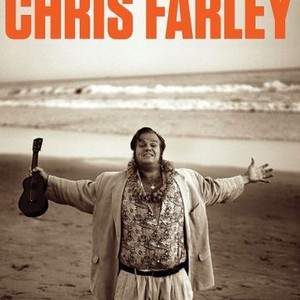
I Am Chris Farley - Rotten Tomatoes

Slapdash, clunky and almost obstinately uninteresting, this 90 minute documentary (of which I watched about 64 minutes) tells us nothing about the comedian that we didn’t already know. He was funny, crazy, sweet, insecure and had a large appetite for drugs and alcohol, which led to his untimely death. He was also surrounded by family, friends and colleagues who I am sure had much more interesting things to offer about him than what was presented here, which comes off as generic or even dull. Some amusing childhood remembrances and cuts of some great Saturday Night Live clips don’t make the effort a total disaster, but it’s a tough slog nonetheless. There is not one anecdote that meets the quality of the dozens reported in Live from New York: An Uncensored History of Saturday Night Live. Worse, the quality of the documentary is shoddy. There is a persistent and annoying background musical track, interviewees are filmed in unnatural poses (Farley’s sister gets a side view that is both unflattering and bizarre), and when we see Adam Sandler, the filmmakers find it necessary to remind us in writing the next time he is shown that, in fact, it is still Adam Sandler.  Poorly done all around.

image

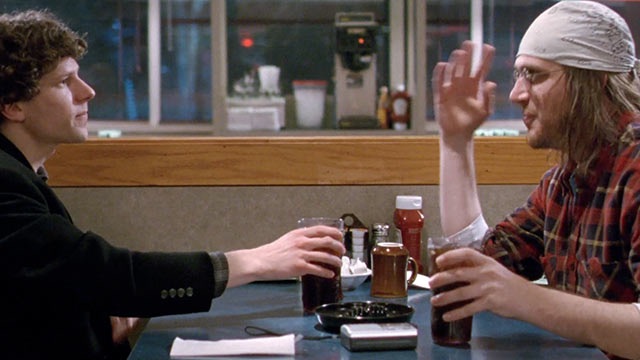
The film is a flawless meander over a few days with an enigmatic and at times debilitatingly insecure novelist.  Jason Segal’s turn as author David Foster Wallace is soul-deep, a particularly impressive performance given that it is from a light comedian. As a film about a doomed man (Wallace hung himself 12 years after the events depicted), the picture is also refreshingly light on foreboding. We are not here to observe the clues that led to Wallace’s demise.  Rather, we are here to enjoy the mind of the author, while being made privy to some of the demons within him, as he is interviewed by a Rolling Stone writer, played by Jesse Eisenberg. We are allowed to hang out with two writers as they discuss their craft, their fears, and America; fence over their different viewpoints and goals through the interview process; and eventually, form a fleeting friendship. Thankfully, the movie is so self assured it doesn’t feel the need to provide the expected big reveal or the emotional paroxysm.

But perhaps what is best about this film – a film about a writer where we do not hear him recite his prose – is the fact that you’ll become affected enough to go read his work after the movie is over. I generally do not read fiction, I have never read Wallace (with the exception of a few magazine pieces), but on the strength of this very personal and intriguing film will read one of his novels.

image

First time film director Yann Demange’s cat-and-mouse historical thriller is taut and assured, blending wrenching action sequences with emotional and historical authenticity.  A Brit soldier (Jack O’Connell) detailed to Belfast in 1971 is stranded after a riot in the Catholic section, and he must negotiate an internal power struggle amongst IRA strongmen, retribution from Protestant terrorists, army incompetence, and double-dealings amongst the intelligence personnel that have rank over his unit, to get out alive.

Belfast is portrayed as nothing less than the white man’s Mogadishu, and while there are some intelligent exchanges in first-time screenwriter Gregory Burke’s script, thankfully, there is no time for an examination of the various political agendas and hypocrisies at play.  Instead, the dismal backdrop of Belfast does most of the political talking, taking a backseat to the heart-pounding chase of O’Connell (who played the lead in Unbroken, so he’s created a niche for characters who have been put through the wringer).  It’s realistic, engrossing and heart-pounding.

In an interview, Demange gives a sense of his perspective on balancing the historical and the dramatic:

At first you can say, “It’s ‘Apocalypto’ in Belfast!” And yes it is, but you can’t just exploit a recent and painful period in people’s lives to make a fucking genre picture. And we all knew that. So we knew it had the shape of a genre picture, that’s how we’ll get a 20-year-old to watch it. But it had to have an honesty, a humanity, a soul.

What was hardest was bringing in shades of grey. Because I’m not like a Greengrass, you know? I’m not that bright, I didn’t go to good schools, I’m not a historian. I’m not interested in lessons. I just wanted to connect in a human way.

And I really struggled, when I began, to understand the Loyalist point of view. It was all white noise when I grew up. I was born in Paris, and plonked into Streatham in the late ’70s, ending up in West London, and this thing was just on the news constantly. But no one in my house understood it, it was just, “there’s been another bomb” “Who is it?” “The IRA” “Oh right.” It was like hearing Brits trying to talk about the Algerian conflict: Algeria? Where’s that? Eastern Europe?

We were so parochial, you know? I was amazed how ignorant I was, once I started meeting people and talking about it. I had no idea the level of sectarian division. I had no idea, and why they don’t put it on the curriculum?

Demange does owes a bit to Paul Greengrass’s Bloody Sunday and some more to the Red Riding trilogy, but his vision is unique.  His camerawork alternates between shaky documentarian and lyrical, giving you a breather while amping up the suspense.

As with those films, I recommend use of the subtitles.  I couldn’t understand a damn thing most folks were saying.

.

Image result for ex machina

Writer director Alex Garland has written several very distinct dystopian films (28 Days Later, Dredd) and his directorial debut is assured and not unexpectedly, unique. Oscar Isaac is Nathan, a Steve Jobs-esque reclusive titan who invites Caleb (Domnhall Gleeson), a coder at his web service monolith, to his retreat deep in the mountains to conduct the testing of an artificial intelligence being (Alicia Vikander) he has created. While Nathan and Caleb start off in an awkward forced friendship hampered by their employer-employee dynamic, and the fact that the reason for Caleb’s selection seems flimsy, they soon become adversarial – with Nathan chastising Caleb for his unscientific approach and Caleb increasingly distrustful of Nathan’s methods. It then becomes unclear exactly who is being tested, Eva, Caleb or Nathan, as the three negotiate their roles while strategizing to achieve their aims.

Expertly paced and beautifully photographed, there is a little bit of Her and Spielberg’s A.I. in here, but ultimately, the film that best captures the ethos of this picture is Mousetrap. This is an intelligent, absorbing and imaginative sci-fi thriller which rejects shocks for a slow dance and smartly realized  dawning at the end.

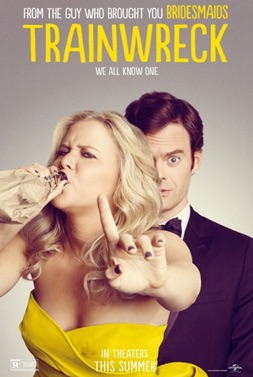
imageAfter the gruesome This is 40, it’s good to see Judd Apatow back.  He owes it to Amy Schumer’s crackling script and impressive breadth, as well as an unexpected Bill Hader as a rom-com lead and fantastic support, especially cameos by non-actors LeBron James and John Cena.  Schumer is a loose narcissist who shuns intimacy when she is given the assignment to write a magazine piece on Hader, surgeon to sports stars.  They click and he weans her off her casual cruelty, but, of course, she relapses and then . . .

Schumer is very funny, as evidenced by her Comedy Central sketch show, where she melds winning and loathsome, no small feat (Lena Dunham has mastered the same trick).  Schumer digs a little deeper here, showing some real depth in a few scenes of despair, so you’re rooting for her, a critical element for a rom-com.  As noted, she’s well-supported, and James is particularly memorable as himself, although I don’t know if he is notoriously cheap, into Downton Abbey, or so relentlessly competitive that he wouldn’t let up on the likes of Hader in a game of one-on-one.

There are some problems.  The film is too damn long at two hours, and the scenes that could be cut (an unfunny intervention, a scene where Schumer condescends to two stock, unhip suburbanites who don’t stand a chance, an overlong wacky seduction, one scene too many of an otherwise hilarious and barely recognizable Tilda Swinton as Schumer’s boss) are obvious.

Still, what’s funny is very funny and the picture sticks the landing.

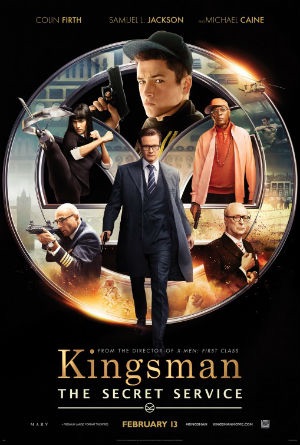
image This is a Roger Moore-era Bond flick, but with cheeky self-referential humor, first-rate, modern action sequences and a decidedly South Park sensibility. It features a budding, young James Bond from the wrong side of the tracks (Taron Egerton), his sophisticated mentor (Colin Firth), a megalomaniac, quirky villain (Samuel L. Jackson, with a lisp), his own Odd Job (Sofia Boutella, who slices you with her scythe legs instead of a hat) and a plan to destroy the world to save it from the menace that is man, much like Drax in Moonraker and Stromberg in The Spy Who Loved Me.

Spoilers follow. There’s no way to do the film justice without talking about the plot.

Jackson, a zillionaire, has decided, like his Bond forebears, that man is a virus. So, he enlists the upper reaches of society – prime ministers, royalty, heads of state (including President Obama) and the rich and powerful – to let him loose a transmitting signal that will make man kill man. And thus, the world will be saved from the global warming man has created through immediate, violent, hand-to-hand near self-extinction. Again, Jackson “enlists” the upper crust. But to ensure they stay the course, he implants a chip in all their necks so, if they do decide to balk, he can blow their heads up. But they don’t balk. The world’s leadership is mostly in on the gig.  They willingly and without reservation sign on to the plan that will have mankind wipe itself out, except for the rich and powerful.

This is a delightful, wildly politically incorrect “eat the rich” comic book, which just amps up the absurdity.  The Kingsmen not only thwart Jackson’s design, but we get to see it tested out on Westboro Baptist Church-types,  who dispatch each other out with gusto in a raucous church melee. Then, a Kingsman activates the implants, so we see the heads of state and the rest of their aristocratic collaborators, blow up.

Some world leaders do not collaborate, and they are jailed.  One is a beautiful Swedish princess, blonde and resolute, and when Egerton shows up to save her, as with Bond before, she offers him a kiss and more if he will free her and kill Jackson.  And if he saves the world?  His prize is enhanced.

That’s a couple of extra stars right there.