Archive

2013

World War Z Zombies GIF - WorldWarZ Zombies Click GIFs

This is a gripping, dystopian roller coaster ride, intelligent but not dense. Marc Forster, who showed action skill in Quantum of Solace, opens with an enthralling scene.  Brad Pitt, wife Mireille Enos, and two daughters are stuck in downtown Philadelphia traffic as a fast-moving rabies epidemic sweeps the city, and by fast, I mean that people are transformed into frenetic, vicious predators 10 seconds after a bite. Complete societal breakdown follows, but Pitt, who has experience as a U.N. global crisis expert, is extracted and tasked with investigating the source in an effort to combat the epidemic.

There are some ragged connections as Pitt goes from the U.S. to South Korea to Jerusalem to Cardiff, but his journey is packed with thrills and terror. Better, there is none of the preaching and sophistry so typical in modern dystopian films. Screenwriter Matthew Michael Carnahan (State of Play), with an assist from a couple of the writers of Lost, stays focused on moving the story forward and avoiding cliche’, showing no interest in the standard “what have we done?” crapola. I kept waiting for the suits to show, explaining that things just got out of hand when the military tried to weaponize and/or the evil corporation tried to monetize. Thankfully, they did not.

Forster’s judicious use of CGI is also to be commended. While the digital monsters of I Am Legend became less terrifying the more you watched them up close, Forster only uses CGI in broad scope, to show the mass of humanity infected, moving almost as an ant colony. Up close, real people play these very gruesome zombies, and they are frightening.

Finally, the film embodies an “every man for himself” quality that is refreshing and eschews the hackneyed twin of “what have we done?”, the dreaded “what have we become?”  When an 18 wheeler tries to make his escape from Philadelphia at high speed, crushing innocents left and right, Pitt pulls his car into the lane opened up to escape, marveling at his good fortune.  When the authorities, ensconced in a naval ship, believe Pitt has died in his efforts, his family loses their most favored civilian status and are evacuated to the more dangerous site of a refugee camp in Nova Scotia.  This is the moment when a bad screenwriter would have penned Enos’ “how could you?” speech to the chastened authorities.  Instead, she stoically accepts the verdict.

Finally, the set piece, and there are several, are finely drawn.  The scene in the airplane is particularly memorable.

It’s the height of audacity to incorporate your name into the title of your film. Imagine High Plains Clint or Reservoir Quentins? Eastwood and Tarantino aren’t exactly shrinking violets, but there are limits and there is etiquette.

Will Larroca dispenses with both in his sophomore feature, Will Will Kill.

The title not only suggests hubris, but an homage to Tarantino. He’s not quite there yet.

Still, this is leaps and bounds above Larroca’s first feature, The Monster. For several reasons.
First, The Monster provided us the chilling visage of Reid Brown as a crazed ghost. Here, he’s criminal mastermind Rico Brown, and he is again pretty damned chilling. Something about that shock of red hair makes it easy for you to put your guard down.

Second, the acting is generally first-rate, and Larroca smartly casts actors who look distinct.

Third, on a shoestring budget, I was impressed by the low-tech approach. It felt real. Visceral.

Finally, I was intrigued by the approach, derivative as it was.

Still, there are problems.

Why do Larroca’s characters always wear hoodies? Is this some kind of Trayvon Martin deal?

Why the finger in the camera? Is it amateurism or something else?

Why is Larroca’s vision of a clone-infested future so mundane? Is the future really as bad as all that? Does everyone wear shorts?

Why would a clone engage in a samurai fight with a hand in his pocket?

Who rides a train to Las Vegas?

Would Rico Brown really have a tag coming out of his shirt?

Again, the word is that Larroca is working with a bigger budget and should have a fall release of his third picture.

It better be special or he may go the way of David Caruso.

Another esteemed reviewer weighs in.

Image result for this is the end

The first third is sharp. Comic actor Jay Baruchel comes to LA to hang with his big star pal Seth Rogen and before long, they’re at a celebrity-studded party at James Franco’s house, where Michael Cera snorts coke and slaps Rhianna’s ass, Jason Segal tries to convey the pedestrian nature of his sitcom to Kevin Hart (Hart is genuinely cracked up by the scenario Segal bemoans), and Jonah Hill shows pictures of his new rescue dog, who is incontinent and doesn’t know how to bark.  There are scads of other notables revealed in their self-involved element, which is great fun when The Apocalypse begins and they are dispatched in hideous, hilarious fashion. Example: a gaping sinkhole takes stars galore to the fiery depths and as Aziz Ansari clings to the edge, Craig Robinson responds to his pleas with a cold calculation.

Unfortunately, the middle third, which features Baruchel, Rogen, Hill, Franco and Robinson holed up and survivalist, is ragged. Much of it feels like creaky improv, and the self-centeredness becomes tedious as the fellas bicker and crack under the strain.  There is a self-satisfied laziness, a “this is cracking us up, so that’s enough” vibe that bores. Andrew O’Hehir nailed it: “I’m all in favor of movie stars making jokes at their own expense, but an entire movie based on that premise starts to seem like a suspiciously large amount of upside-down vanity.”

You know you’re in the tall grass when an SNL bit about chewing food for someone else is shamelessly recycled. Worse, Danny McBride joins the group, his turn is singularly unfunny, and he compensates by cranking up the volume.

Luckily, McBride exits, Hill is possessed by a demon, and a laugh-out-loud exorcism gets the picture back on pace to its largely satisfying conclusion.  Good laughs, but wait for DVD and you’ll value it more.

An ingenious concept undone by a tedious pace, a dull heroine, an indecisive tone, and a cheezy feel.

First, the concept. The world is post-apocalyptic and zombies mill about, waiting to eat human brains. One twist – when they eat the brains, they get a rush of the memories of the prior owner. Our protagonist. Nicolas Hoult (About a Boy, X-Men: First Class) eats the brains of Dave Franco (brother to James), fiance’ to Teresa Palmer, and immediately falls in love with Palmer.  So, he saves Palmer’s life and an unlikely romance ensues. So far, so good.

Palmer, clearly an acolyte of the Kristen Stewart school of acting, makes no impression. She’s all smarm and attitude and lacks any depth necessary for material deeper than Glee. It may seem like niggling but it is not, because she has to convey that she has fallen for a zombie. She doesn’t come close.

With Palmer failing to communicate a romance, what is left is the scary.  It is not scary, at all, and the use of CGI skeletors – really evil zombies who have lost all their flesh – suggests the old stop motion visual effects of the Harry Hamlin Clash of the Titans – and not in a good way.

Since it is not scary, it should be funny. After all, talk about your clash of cultures. But it is only occasionally amusing. Hoult, whose speaking is necessarily rudimentary, mainly mumbles and moons at Palmer. While he is given a voiceover to explain what he feels and sees, the observances are pedestrian.

The picture looks just awful – again, not in a good way. The post-apocalyptic world looks more like a Meadowlands dump, the encampment where the humans are holding out looks like the porn set of a parody (Dawn of the Head? apologies)*, and in comparison to Zombieland or even The Walking Dead, the feel just seems chintzy.

It’s also deathly slow. At only 90 minutes, I started to feel like the zombies themselves, numb and mindlessly staring at the TV, waiting desperately for something to chew on.

*  I made that up, but I shouldn’t have had to.


The follow-up replicates many of the good things about Star Trek.  The characters are fresh and in keeping with the personas of their forebears; the action is brisk and the banter clever; the special effects are impressive; and the balance of fun and serious is just right.  It even has a better villain (Benedict Cumberbatch).

There are, however, weaknesses.  First, it suffers from Avengers-itis.  There are just too many set piece action sequences, including a tedious one where the Enterprise is plummeting in a death spiral that Kirk and company manage to get around easily enough.

The politics are also pinko.  The joy of Peter Weller as a Starfleet admiral is lessened given he is a predictable warmonger bent on starting a war with the Klingons, and modern Starfleet feels almost pacifistic (basing Starfleet in San Francisco took its ideological toll).

It is also a little sloppy.  Two of the security “red shirts” sent on a shore party are forgotten in a shoot ’em up melee with the Klingons; JJ Abrams decided their fate was not even worth memorializing.

And why “kill” Kirk when only a monkey would accept his demise as permanent?  The picture is already an overlong 2 hours and 12 minutes.

The crew has also taken on a new science/weapons officer (Alice Eve), one so slight and dull that Abrams cheats to keep us interested.

While there are a few scary moments, and the young actor who plays the “disfigured baby” grown up is, in fact, truly terrifying, there are just too many problems to recommend the picture, including–

*  thematic confusion – is this a comedy?  Because if it is, casting such a frightening actor as the demon is a mistake.  Why is the screenwriter wearing sunglasses inside in the middle of winter?  Why is the neighbor wearing a Virginia Tech hoodie?  And why does he smile so much and then screech intermittently?

*  mumble mouth dialogue from the young actor playing the neighbor (he tells us the story of the house but we can’t understand him) and over-acting (“Who could that be?”) from the protagonist, who distrusts the script and opts for a play-by-play narrative.

*  sloppy editing – why use tracking shots if your actors are going to be looking back as if being chased by the camera?

*  poor scene locations – the haunted house is dank and scary, but it seems that a young screenplay writer who just moved into it would not have a Batman pillow case and  a life size figurine of Batman.

*  Will Larroca’s insistence on playing the lead was too much of a distraction.  He seems to be giving non-verbal direction to the camerman.

Again, this is a shame, because the actor playing “The Monster” is bone-chillingly good.

Word on the street is that the writer/director/star is in pre-production for another horror film, and he has some money behind it.  It may be make or break.

UPDATE:  My review has been reviewed, and rather unkindly


This Guillermo del Toro produced ghost story is scary, judiciously using the shock techniques of The Woman in Black, and intriguing, developing an actual mystery behind the horror.  First time director Andres Muschietti is confident, evoking the creepy feel of The Ring, and Jessica Chastain and Nikolaj Coster-Waldau (Jamie Lannister in Game of Thrones) are convincing as the caretakers of two girls found abandoned in a Virginia cabin 5 years after their father (Coster-Waldau’s brother) absconded with them and disappeared. Upon discovery, it turns out the girls have been adopted by a new, more sinister force. A little more patience and exposition prior to the gripping finale, and less of a CGI bonanza during that finale, could have made this a horror classic. As it is, it’s pretty damn good.

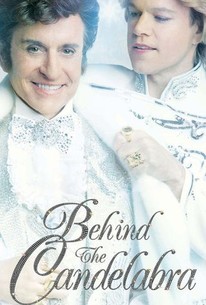
Behind the Candelabra (2013) - Rotten Tomatoes

This is Steven Soderbergh’s last picture? A flimsy, small biopic about a kitschy figure (Michael Douglas as Liberace) and his boy toy (Matt Damon as Scott Thorson), arguing over dog poop in the mansion, plastic surgery and the fact that Thorson won’t agree to be on the receiving end in sex? There is no insight, Liberace’s fear of being outed is without nuance, and Soderbergh doesn’t have any fun with the Vegas excess, so the film fails as a character study and as a mindless guilty pleasure, ala’ Mommy Dearest. At its best, it is a decent VH1 “Behind the Music” as Thorson’s descent progresses. Mainly, it is clumsy and pedestrian and really disappointing when we realize this is Thorson’s story (Liberace is the reasonable one pretty much throughout).

Douglas has some strong moments, especially during his last visit with Thorson as he lay dying of AIDS, but Damon is way past “boy” much less “toy” (Thorson met Liberace when has was 17 and stayed with him until he was in his mid 20s) and he is unconvincing.

This is the filmic equivalent of Bjorn Borg’s comeback and the subject matter is Soderbergh’s wooden racket.

The Last Stand is as formulaic as they come and is strangely populated by 5 characters sporting near-incomprehensible accents: Arnold Schwarzenegger (born in Thal, Styria, Austria), as a retired LA narcotics detective who is the sheriff of a small town on the Mexican border; Forest Whittaker (born in Longview, Texas), as the out-of-breath, over-salivating, beleaguered FBI agent who has lost a major cartel figure in an attempt to transfer him from Las Vegas to a super max prison; Eduardo Noriega (born in Santander, Cantabria, Spain), as that cartel figure, who is hurtling at 200 MPH in a tricked-out sports car, hoping to make the border; Peter Stormare (born in Arbrå, Gävleborgs län, Sweden), Noriega’s henchman, who is clearing the path for Noriega’s arrival by trying to kill Schwarzenegger and his motley crew of small town defenders (Stormare’s southern accent is hilarious, half ABBA, half Foghorn Leghorn); and Rodrigo Santoro (born in Rio de Janeiro, Brazil), one of those defenders, an Iraq and Afghanistan war veteran locked up on a drunk and disorderly, deputized to assist Schwarzenegger.

Since you can’t understand what most of the people are saying, the pedestrian script is mooted, leaving you free to enjoy director Kim Jee-Woon’s (born in Seoul, South Korea) impressive chase scenes and shoot ’em ups.

I’ve seen worse, and Schwarzegger maintains an irrepressible likeability that makes for an enjoyable ride.

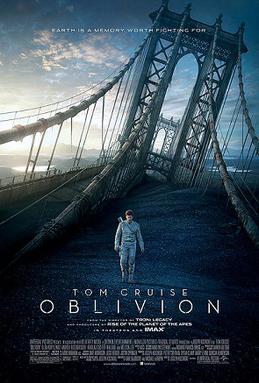
Oblivion (2013 film) - Wikipedia
There has been a cataclysmic war. Aliens destroyed our moon leaving earth ravaged and uninhabitable.  While we won the war, the victory was pyrrhic, as we were forced to abandon earth to a few remaining aliens. In our new home in space, we need seawater, and the massive machines that suck it up are threatened by these aliens. Accordingly, earth is monitored and protected by drones, which are monitored and maintained by Tom Cruise and Andrea Riseborough.

But all is not as it seems. Spoilers follow.

1) the aliens threatening the seawater suckers are actually humans, and earth is actually habitable.

2) we didn’t win the war. We lost. Cruise and Riseborough are clones of two humans captured by the aliens. Hence, Cruise is always having dreams and flashbacks of pre-war earth. Which makes him curious. Which makes him increasingly problematic. Which makes him singularly the worst choice an alien could make to monitor earth.

The choice of clones who can dream and recollect their past is the least of the aliens’ ineptitude. When Cruise turns, and flies his vessel into the alien planet/ship, the alien (voiced by Melissa Leo) —

A. Allows Cruise to come into the planet/ship even though he’s clearly gone rogue

B. Detects that Cruise is nervous and lying, but does not detect that he has brought a big bomb with him.

Cruise actually seems to be telegraphing how ridiculous the film is as he acts. His face says, “Wait. This makes no sense. Does this makes sense to you?”

It’s also sloppy. When our Cruise gets bashed in the face, he gets a cut on his nose and a scrape on his cheek. Later, he meets one of his clones and pretends to be that clone. So he goes back to a Risenborough clone, and she doesn’t say, “hey, what happened to your face?”

On the plus side, Riseborough is beautiful.