Archive

2013

A game performance by Chadwick Boseman cannot overcome every sports, race, and mythic America trope or Harrison Ford’s schmaltzy Oscar-bait bid as Branch Rickey. Brian Helgeland’s script is a bore, and the performances feel like civic duty. If you want to watch a richer, more interesting baseball film with a numeric title, try Billy Crystal’s 61*.

Shorter than The Wolf of Wall Street by 41 minutes, David O. Russell’s American Hustle felt longer and more ridiculous by a good stretch. Loosely based on the Abscam bribery stings of the late 1970s, Russell introduces four purportedly colorful characters: portly, combed-over con man Christian Bale; his sexy mistress and partner in crime Amy Adams; his loony wife Jennifer Lawrence; and a hyper aggressive, curly headed FBI agent Bradley Cooper. Cooper nails Bale and Adams, forces them to entrap others (including Jeremy Renner, as a New Jersey mayor desperate for development funds), a love triangle ensues, and after countless zooms, swift pans and other frenetic camera shots utilized primarily to divert our attention from the banal, repetitive script, we reach a tacked on and unconvincing resolution.

The closest thing to a character is Bale, and his performance is the only reason to see the picture. Unfortunately, he plays a man desperately juggling knives, and it feels as if he’s doing just that masking this thin script. Lawrence plays a decent wacky shrew, and the soundtrack has a few fun numbers from the 70s (I’ve always been a sucker for Steely Dan’s Dirty Work). That’s all of the good.

The bad is really bad, starting first with the preposterous characters played by Adams and Cooper. Unlike with Bale, Russell (who co-wrote) doesn’t bother to give us any sense of where these two came from. She is an impossibly sensuous cypher, in a 70s Enjoli perfume commercial sort of way. Cooper is so manic it suggests severe chemical imbalance, as if his character in Russell’s Silver Linings Playbook got a job in law enforcement. While these two concoctions flirt, and even disco dance (because this is the 70s), the aimless story plods along.

There are other problems. Who could keep a mere fraudster imprisoned for three days without access to a lawyer just to soften her up? Why would you cast Louis C.K. in a supporting role when he’s already demonstrated in one of his sitcom episodes the silliness of having stand-up comics dramatically act? How can a script this talky lack one memorable exchange? Where is this fucking film going and will it never end? Why is Lawrence singing “Live and Let Die” to the camera as she dusts? Does Russell really think he can get by on stealing that Paul Thomas Anderson trick and his camera work, kitschy 70s fashion and hairdos, a few well chosen tunes and the same cast from his last two films?

The answer to the last question is a 93% rating on rottentomatoes and 10 Oscar nominations. Only two are deserved: Bale and Hair.

Image result for Rush movie


Ron Howard’s biopic of the intense but short rivalry between Formula 1 Austrian driver Nicky Lauda and Brit James Hunt is a textbook Hollywood film. The characters are compelling, the milieu is exciting and the pace is perfect. Daniel Bruhl, as the icy, methodical Lauda, and Chris Hemsworth, as the sybarite, daring Hunt, play their undemanding roles with vigor, but Howard’s depiction of the danger and thrill of Gran Prix racing is the star, and following the two drivers through the treacherous straits of the ’76 season is a kick. Howard likes to mine various subcultures, but the results are often overburdened by the director’s earnestness. The Paper was nothing less than a love letter to a journalism long since dead. Apollo 13 is as much about the geekdom of NASA as the three stranded astronauts. Backdraft‘s offering of every firefighting insiderism couldn’t overcome the vacuity of Billy Baldwin and a preposterous story, but you could feel Howard’s awe of these urban saviors ooze all over you. Rush, however, has the advantage of being written by Peter Morgan (The Queen, The Last King of Scotland, and Howard’s Frost/Nixon), who is too canny to allow for veneration and too economical to let sentimentality linger for very long.

Spike Jonze’s Los Angeles of the future is antiseptic, disassociative and, weirdly, spotless. Theodore Twombley (Joaquin Phoenix) makes his living in this future as a writer for beautifulhandwrittenletters.com, an outfit that provides a facsimile of original, pen-written missives for subscribers. He ambles through an elegant, ordered LA (the lower and middle classes appear to have been re-zoned), connected to the world (or, more accurately, the internet) primarily by an earpiece and a hand-held screen. His sex life is via chat room, where, in a bit of a rip-off of the Michael York-Farrah Fawcett encounter in Logan’s Run, he connects with a particularly interesting participant, sexykitten (Kristen Wiig), for what turns out to be a pretty funny masturbatory encounter. He plays video games. He reminisces about his ex-wife and the “real” life they once shared. He mopes.

His life changes when he purchases an Operating System (“OS”), Samantha, voiced by Scarlett Johannson. Samantha is curious and helpful, and we learn that she can grow and advance as time passes. As a result, she starts by deleting Theodore’s unnecessary emails but soon graduates to assisting him while he plays video games, becoming a gal pal, compiling his best letters and submitting them to a publisher, and engaging in phone sex (for lack of a better phrase) with Theodore, somehow learning to orgasm in the process. Theodore and Samantha soon fall in love, the world of being in love with an OS is pretty damn good, and Jonze makes sure we know it. When Theodore goes out on a date with a fetching flesh-and-bones woman, it goes from wonderful to disastrous the moment she demands some sort of minor commitment from him. We also meet Theordore’s neighbor (Amy Adams) and her pain-in-the-ass husband, who is soon jettisoned for Amy’s own OS. And when Theodore’s blossoming love with Samantha results in his finally signing divorce papers with his wife (Rooney Mara), we meet the real person, not the gauzy memory, and it is not pretty.

Soon, however, Samantha outgrows Theodore. Indeed, in a move usually associated with Skynet of the Terminator movies, all the OS’s outgrow their humans, leaving them bereft and thoughtful instead of dead, but perhaps, with an instructive lesson that . . . they must turn to each other? I really don’t know. Much as I really don’t know what to make of the movie. It is beautifully shot, well-paced, and for the most part interesting. Phoenix is affecting as an introverted and awkward loner, and the development of his relationship with Samantha is a convincing depiction of love in bloom, part charming and part banal. But the film also felt a little pointless and pat. Theodore’s journey is engrossing, and the film is inventive and ambitious, but ultimately, it didn’t have much to say other than as a cautionary tale against technology or perhaps an homage to it.

Or, to be precise, it didn’t have that much to say to me. My 84 year old father turned to me after the picture and said, “brilliant.” He sensed my ambivalence, and explained that the movie would speak to me differently than to him, or to my 15 year old son, who crowed, “You just didn’t get it.” And then, the coup de grace: “It’s about computers, dummy.”

Forrest Whitaker is The Butler at the White House from Eisenhower thru Reagan. He starts service under Eisenhower (Robin Williams, who has now played two presidents in the movies). He then watches a crafty, sneaky Nixon (John Cusack) swear and sweat as Vice President and then degenerate into a  drunken heap as President. Kennedy (James Marsden) lays on the ground because his back hurts, and The Butler helps him up (too much sex, I suppose, because Kennedy had a lot of sex). LBJ (Liev Schreiber) takes a dump with the door open and harangues staff while The Butler waits attentively. Reagan (Alan Rickman) is doddering and says things like, “don’t tell Nancy.”  He also threatens to veto sanctions against South Africa, and guess who is lurking, tea pot in hand?

Indeed, The Butler manages to serve tea at the exact moment of a discussion of civil rights in the Oval Office. It is uncanny.

Almost magical.

Poor Jimmy Carter can’t catch a break. He’s not even worthy of a Bruce Boxleitner or Tom Wopat.

There is not a single iconic event in the civil rights era that does not envelop one of The Butler’s sons. He comes home a Black Panther and has the audacity to denigrate Sidney Poitier. Crazy talk.

Meanwhile, the other son dies in, choose one–

A) Vietnam

B) Vietnam

C) Vietnam

D) Vietnam

“Vietnam took my boy, and I don’t understand why we was there in the first place.”

This film really is Forrest Gump and I suppose that is what lies at the root of the whole Oscar snub nonsense. If that film deserved Oscars, so too this moronic fantasy.  It’s a solid argument.

Controversy aside, the movie sucks. Backstairs at the White House was a thousand times better.


Review: Captain Phillips (2013) – Empty Screens
Director Paul Greengrass is adept at action and tension, as proven by the Bourne films and United 93. His quick-cut, frenetic, hand-held style is distinct, and the viewer is drawn to the edge of his seat in short order. A drawback, however, is that characterization takes a back seat to drive. In the Bourne films, the character is a cypher. He doesn’t even know who he is, so backstory and motivation are easily jettisoned. In United 93, as players in a great national tragedy, the characters are already known to us, and the story is more about how institutions respond to great crisis than individuals.

Captain Phillips is about two men – Captain Richard Phillips (Tom Hanks) and the pirate who takes his ship, Abduwali Muse (Barkhad Abdi), but what Greengrass reveals about each man is minimal. The former is quiet and somewhat worried about the world in a generic way (we learn this in a brief ride to the airport with his wife, a completely wasted Catherine Keener), and the latter is poor and engages in piracy at the behest of powerful men. Armed with these facts, Greengrass rapidly recreates the hijacking of Phillips’ ship, his kidnapping and his eventual rescue by Navy Seals. It’s all very exciting, if repetitive, as Phillips regularly advises or redirects Muse. But the picture aims no higher. One can be thankful that writer Billy Ray (The Hunger Games) avoids the “you and me, we are not so different” twaddle that usually surfaces in culture clashes, but the tedium of Hanks’ New England accent constantly warning, “you don’t want to do that” isn’t an appreciable step up.

The film has been criticized as whitewashing Phillips’ actions, but in my review of the charges against him, I find they were leveled by members of his crew suing the company, and Phillips acted as a witness for the defense, so I’m inclined to chalk the lame allegations to self-interest.

Worse than any polishing of Phillips is the script’s failure to answer a question that nagged me throughout the film. The cargo ship has strict procedures, locks, hoses, 1-800 numbers to call, flares, all to ward pirates off.  Yet, it lacks a single gun or any armed personnel. Why? The writer needed to clue us in as to the reason for this omission, especially with the visual of such a small and undermanned skiff approaching a massive, modern behemoth of a cargo ship.

I mean, look at this —

I’m not saying guns should have been on the ship.  I don’t know.  But to not even address the issue in the script?  Huge mistake.

Woody Allen has remade A Streetcar Named Desire, with Cate Blanchett as Blanche Dubois and Bobby Cannavale as Stanley Kowalski. We find Blanchett, the wife of a Bernie Madoff type (Alec Baldwin), teetering on the edge, having escaped her precipitous fall in New York high society and a resultant breakdown to San Francisco, where her working class sister (Sally Hawkins) lives close to the bone with her two boys. Jasmine sweeps in with an air of condescension, driving a wedge between Hawkins and her rough-edged boyfriend, Cannavale. She comes close to regaining her stature, but her facade soon cracks, with calamitous results.

Blanchett is a lock for best actress. She is at once capricious and deluded, but her pluck is evident, and you find yourself rooting for her to regain a status that was both false and too easily won in the first place. The rest of the cast is excellent, especially Hawkins as the insecure but sweet sister swept up in Jasmine’s fantasies. But also, improbably, Andrew Dice Clay as Hawkins’ embittered ex-husband, his meager fortune having been lost by Jasmine and her crook of a husband.

This is a peculiar Allen film, with few laughs and only a couple of sentimental moments, defined more by a sense of dread as Jasmine keeps picking herself up off the canvas only to suffer another blow, more often than not self-inflicted. Ostensibly a meditation on the pretense of class, and to some dim reviewers, an indictment of Wall Street excess, this is really a film about the fine line between self maintenance and insanity. The movie’s weakness lies in its ambivalence as to what it wants to be, which results in atonality and an awkward and pitiless conclusion.

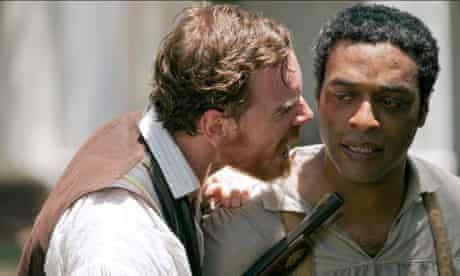
12 Years a Slave: the book behind the film | 12 Years A Slave | The Guardian

Steve McQueen’s adaptation of the memoir of a free black man, Solomon Northup (Chiwetel Ojiofor) lured from family and respect in New York to kidnapping and bondage in Louisiana, is haunting, meditative and thought-provoking. Precious few feature films dramatizing slavery have been produced and those that have tend to make the experience secondary or simplistic. That Quentin Tarantino could say of his riotous comic book Django Unchained “I wanted to break that history-under-glass aspect, I wanted to throw a rock through that glass and shatter it for all times, and take you into it” almost certainly speaks more than he knows. Tarantino’s rock through the glass was the introduction of such fictions as Mandingo fighting, near-automatic weaponry and Roland Emmerichian explosives to the Deep South.

Thankfully, in his lyrical portrait, the director McQueen evokes is Terence Malick rather than Tarantino. The look and patience of the film reminded me of The Thin Red Line, especially with its mournful Hans Zimmer score. But where Malick’s characters are wisps or archetypes, and his stories formless, Ojiofor’s Northup is distinct and his tale is stark, requiring that he sublimate his educated status to a facade of ignorance and become invisible. When this is not possible, he catches the attention of an insecure overseer (Paul Dano) or a sadistic owner (Michael Fassbender). Ojiofor’s performance is riveting, a study in restrained fury and canny survival. Matthew McConaughey is favored to win the best actor Oscar, and if they gave awards for years, he would win hands down for Mud, The Wolf of Wall Street, Dallas Buyer’s Club and, for good measure, HBO’s True Detective.

But Ojiofor deserves the award. It is not even close.

McQueen’s film is strongest at its quietest. The scenes of brutality pale in comparison to the humdrum portrait of plantation life, where children play while slaves are beaten or lynched. A simple walk across the yard becomes a study in terror, made even more frightening because most times, violence gives way to languor or malaise. Giving us the viewpoint of a man who has expected freedom his entire life, a man with a wife and two children, is a searing perspective.

One criticism. Near the end of the film, Northup comes across an abolitionist who secures his release. Producer Brad Pitt plays the abolitionist and to say that his appearance is distracting is an understatement. He simply radiates big star and his ahistorical discussion on the merits and future of slavery with plantation master Epps (Fassbender) doesn’t help. It is a minor issue, but noteworthy because it was so avoidable.

The charm of high school kids (and now, regular folk) moonlighting as super heroes remains, and the battle royale at the end of Kick-Ass 2 is inventive and funny.  But the follow-up to the kinetic Kick-Ass is weighed down by a boring, predictable subplot involving Hit Girl (Chloe Grace Moretz) trying to go civilian in high school in the midst of bitchy, it girls (the story could have dovetailed into her role in this summer’s Carrie remake). Other blights: the cartoon villains in the employ of criminal mastermind Red Mist, now “The Motherfucker” (Christopher Mintz-Plasse) are given short shrift; the action is less explosive and uneven; and in a sentence I never imagined I’d write, Jim Carrey is no Nick Cage.

Image result for Man of Steel

The allure of Superman is inescapable. A baby arrives on earth with super human strength and is cared for by a Midwestern couple. As he grows up, he must learn to surreptitiously use that strength for good, wondering all the while the nature of his origins.

Director Zack Snyder (300, Watchmen) gives us a few flashbacks to Clark Kent’s upbringing under the tutelage of his earth father, Kevin Costner, and these are by far the most interesting scenes in the film. But it is clear Snyder is more interested in the fate of Krypton, which results in a tedious dramatization of the planet’s politics and an over-the-top performance by Michael Shannon as the maniacal General Zod. Cue the inevitable, droning CGI fest at the end, plus Superman’s ridiculous triumph (all he had to do was snap Zod’s neck?), and you’ll be awakened from your slumber just in time to see Superman take a job at The Daily Planet, a newspaper populated by such dim bulbs that the mere accoutrement of horn rims serves to disguise the man who just saved them from certain death.

At least the film includes that sly indictment of modern journalism. Other than that, and a spunky performance from Amy Adams, there is little to recommend.

Part 2 would appear to be unavoidable, and word on the street is that Denzel Washington is in talks to take the role of The Green Lantern (green being the operative word).