Archive

Monthly Archives: February 2012

Image result for From Hell

A stylish revamp of the Jack the Ripper saga.   It has many things wrong with it.  Here are a few:

1) Johnny Depp, the lead Ripper investigator, is a psychic, which comes in handy;

2) The Ripper entices prostitutes with grapes, a neat fact the investigators choose to withhold from potential victims (as well as the fact that the Ripper is an educated man);

3) Heather Graham is about as convincing as a Whitechapel prostitute as I might be as the lead in “The Clint Eastwood Story.”

4) Every murder (and every autopsy/crime scene) is shown.  Each more bloody than the next.  Exhausting.

The crime of it is not the gore, tedium and heavy hand, but the fact that this Hughes Brothers picture (the Hughes Brothers of the classic Menace II Society) was the end for them until 9 years later, when they helmed The Book of Eli

It is bad enough that Hollywood would hand a period piece to a couple of young directors who made their bones on the verisimilitude of modern South Central LA.  But after they botch it, nine years later, they’re given The Book of Eli?

Not fair.

Me, Myself and Irene.  Wretched. Unfunny, disgusting, self-indulgent poop from the Farrelly Brothers, who, apart from the inspired There’s Something About Mary, have delivered such dreck as Dumb and Dumber, Outside Providence, and Kingpin.  The movie – a formless miasma that makes the plot to Ace Ventura: Pet Detective look like Chinatown – is ostensibly about Rhode Island Highway Patrolman Jim Carrey, who has been taking crap for so long that he develops a psychotic condition replete with a mean alter ego.  It has one funny running joke (Carrey’s three black sons, who speak Hollywood jive but sport high IQ’s to the effect of “Shit, you be one dumb mutherfu**er, not knowing the speed velocity of the inverse quantum theorem, bitch”) that gets run into the ground, and Carrey’s physical comedy can occasionally make you laugh.  Otherwise, it is unwatchable.

Made.  Jon Favreau’s follow-up to Swingers is less hilarious, less fresh, and more edgy, but it is still a very, very funny buddy movie.  Vince Vaughn plays Favreau’s childhood pal, a jumpy, almost Rupert Pupkinesque accomplice, unnerving, entertaining, and perhaps chemically imbalanced.  Favreau, a dopey boxer and bodyguard for his stripper girlfriend (he has a tendency to beat up the recipients of her lap dances) is assigned by LA mob boss Peter Falk to a drug buy in New York City. Favreau vouches for Vaughn and their travels become the movie.  Puff Daddy even holds his own as a New York thug.

If you liked Swingers, you’ll probably like this movie, but if you liked Swingers and King of Comedy, you almost assuredly will like it.

You can only go so far with Oliver Stone’s antics behind the camera.  But sometimes, it gets you 3/4 through a movie.  Watchable, occasionally engaging, and always stupid, anything of value from this movie comes from Stone’s eye on the speed and madness of professional football.  His frenetic editing and jump-cuts to varying film stocks keeps you watching, plus the fact that it is football, it is glitzy, it is steamy, sultry Miami, and Dennis Quaid, Jamie Foxx and James Woods provide some surprises to their hackneyed personas.

All of which helps you forget that Al Pacino, as the gruff ole’ coach, is mailing in his 76th lousy post-Tony Montana performance; Stone’s tried-and-true preachy and over-the-top screenplay of (you guessed it) man stuff and redemption; Stone’s excesses, borne of a director who simply won’t take “Um, Oliver, isn’t that a little much?” for a question; a high cheesiness factor, as Stone (unlike Cameron Crowe in Jerry Maguire) apparently wouldn’t pony up to pay for NFL rights, so we are left with the Dallas Knights and the Miami Sharks; and, an embarrassing turn by wide-mouth bass-headed Cameron Diaz, as a supposed ball-busting owner of the Sharks (it appears she just misses her Daddy, the former owner, who wanted a boy).

Bulworth.  Warren Beatty advised George McGovern in the 1972 campaign. Nixon won in a landslide.  Later, he went on to have sex with Madonna and enjoyed it enough to allow himself to be filmed in her grotesque documentary Truth or Dare (wherein he actually looked to be a beacon of sanity and maturity).  Somewhere in between these ignominies, he must have conceived Bulworth.

Not Birth of a Nation but closer to Huggy Bear in “Starsky and Hutch” offensive, the film begins as a lampoon of the modern American politician beholden to the evil and corrupt corporations.  It ends as a morality tale that even “the brothers” are supposed to understand.  The senator, you see, has sold out and – gasp! (a gasp probably heard most audibly in the relative splendor of Beverly Hills) – is in the collective pockets of the health insurance industry, the welfare reformers, and the anti-affirmative action crowd.  For those of Beatty’s stripe, this is the modern equivalent to enslavement.

Beatty, as the senator, suffers a breakdown in the midst of his crisis of conscience (and finances).  On the eve of a primary, and, in a suicidal funk, he arranges his own murder to provide insurance money for his heirs.  Why?  Who cares? The cheap plot device allows Beatty to speak the plain truth in his final days.

He embraces the African-American urban culture, or at least, Beatty’s vision of same (it appears to be culturally tone-deaf, more “Jeffersons” than Beatty might want to admit).  As he speaks the truth, he raps, and wears the acoutrements of the urban ghetto.  He also fumbles his way through the closing days of his primary.  He preaches, in garbled rap, that the parties are all the same, the rich folk are bad, and the country is controlled by a monolithic entity (including the media) that keeps “the brothers” down.  As for the brothers, they are portrayed either as beatific, just-seen-the-light types, “You go, Bulworth” fly girls or mere background for the Beatty-as-homey sight gag. 

Message?  All it takes for racial justice is an addled but straight-up white man to stand up to the racist LAPD, eschew the drug trade and stick it to “the man.” In the telling, the black characters are relegated to the worst kind of condescension. Halle Berry, the whitest of the black characters in skin tone, is hired to be Beatty’s demise, yet becomes his soulmate (Beatty always gets the girl); the little drug-dealers are treated to ice cream by the kind white man who stands up to the bad white cops; and the drug lord (Don Cheadle) changes his ways at the sight of such honesty and compassion. 

Beatty not only touches the people, he is touched.  What he sees in the ‘hood – the desolation wrought by Cigna and Humana – almost brings him to tears. 

But let’s not get too maudlin. Beatty also eats collard greens.  Except, it isn’t collard greens.  It’s kale!  Get it? A funny white man eats collard greens, but it turns out, it isn’t collard greens, it is kale, and he doesn’t know the difference.

Knee slapped.

More yuks follow.  Because if the “the brothers” are to be engaged, it got to rap, it got to groove, and it got to be Jimmie JJ Walker funny.  So Beatty bounces from one venue to the next, saying “co**sucker” and “motherfu**er”  because that’s the truth both “the brothers” and the American people will understand.  And Beatty employs various get-ups, often approaching the comic genius of Eddie Murphy as The Nutty Professor

At the heart of this self-satisfied broadside against the status quo is the rich Hollywood conceit that, if only someone talked straight to the anaestethized, bamboozled people about the falsity of their existence, the system would be fixed, schools would be changed, health care would be free to all, the ghetto would be energized, and Huey Newton would get his props in the pantheon of social reformers.  And who better than an aging Hollywood type who dabbles in politics and used to hang with Hef to deliver this message?

By the end, Beatty’s revelation to the people (never fully realized through either McGovern or Madonna) is a big hit.  He wins his primary.  Hints of a presidential run are dropped.  We see the light!  He’s not Clinton. He’s not Gingrich.  He’s not Dole.  He’s Bulworth.  And he’s down.

On the plus side, the performances are all rather good.  Beatty exhibits deft physical comedy and Oliver Platt as his scum-sucking campaign manager has some very funny moments. 

I am glad of the film, for there are people who still adhere to the tripe Beatty is selling, and between hosting talk shows, touting anti-bullying, fighting trans-fat, and rushing to “Larry King” to bemoan the horror of celebrity when a Princess Diana dies, it is nice to know that they have a good rental. Still, in the genre of self-congratulatory, lefty sermons, they’d do better with Bob Roberts, An American President, or Wag the Dog.

All pretty awful films, but, in comparison to Bulworth, true gems.

Boys Don’t Cry is a picture about an unfortunate Lincoln, Nebraska woman (Hillary Swank) with gender identity issues.  She wants to be a boy, so she crops her hair short and poses as a boy.  In those moments, where she has “passed” and tasted affection from the vantage point of a male, the film works.  We see the fearful life Swank leads, how her surroundings and her gender conspire against her desire to express what she feels and who she thinks she is. Swank has you share her exhiliration as she ends an evening with a kiss from a unknowing date.  Her performance is justly praised.

Swank soon falls in with a motley crew of losers, including an ex-con, a self-mutilator who has burned his own family out of house and home, and a girl who aspires to leave her job canning broccoli so she can get paid as a karaoke singer (Chloe Sevigny).  Swank falls in love with Sevigny, and a white trash Romeo and Juliet ensues.

Director Kimberly Peirce has a firm grip on the picture when she is depicting Swank’s acceptance into this group.  It plays as a more rough-hewn American Graffiti where the gang eschews the strip for the highways of Nebraska, and malts become beers and bong hits.  Peirce shows a group moving fast (she uses the effect of fast speed highway lights, super slow-motion shots of the gang getting high in the back of a car, and a police chase off-road in the dust) and going nowhere.

Unfortunately, in real life, the Swank character was murdered, and the second half of the film grounds to the halt of numbing, repeated brutalization of Swank.  Director Peirce pours it on at the end, with 4 scenes of debasement and cruelty.  Swank is so dehumanized that any emotional power is drained from the film.   I suppose the end is defensible on grounds of reality, but it saps the early beauty of the film and worse, it blots out Swank’s singular character until she is just another unrecognizable victim of senseless American violence.

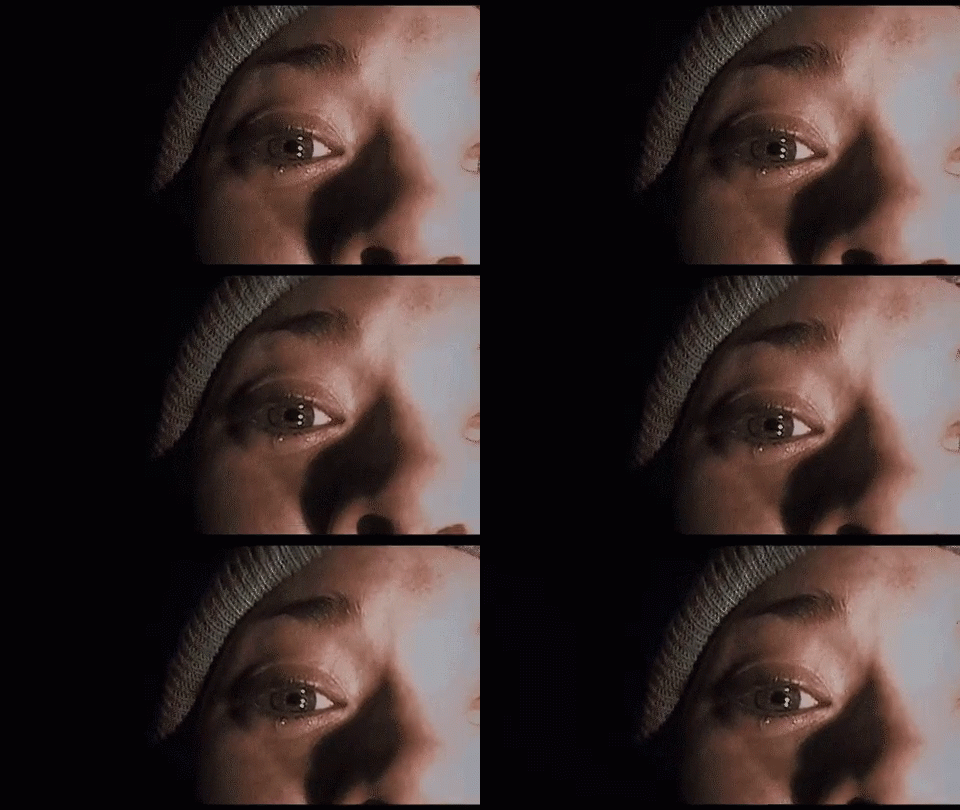
Blair Witch Cry GIF - Blair Witch Cry Scared - Discover & Share GIFs
Three student filmmakers are on the hunt in the woods of Maryland for a legendary evil that may or may not have murdered seven children and five men in the 1940s. They become lost.  Their footage – the film – is found.

The introduction – as the kids meet and speak with the townsfolk to unearth the mystery – is clever and utilitarian.  The snippets of information given during these mostly humorous encounters are valuable, and the interviews are indistinguishable from any conversation you might have with a resident of a small Maryland town.

When the trio move from the town to the woods, in search of the sites of the murders, make no mistake, it is horrifying.  And not in the Kevin Williamson “tongue-in-cheek, stylish and ironic” sense.  It is not violent, nor gross, but bare-bones and primal.  They are hopelessly lost.  They begin to break down. Something is tracking them.  Your vantage point is their clumsy vantage point, through the eyes of a film and a video camera.

The reviews of the film state that the actors were given minimal training with film and video cameras, and then they were let loose to act spontaneously along the lines of the plot.  This may or may not be true, but either way, all three actors convey realism, and the camera-work (well edited) intensifies the terror.

I also thought about this film more than I expected to.  One scene in particular, where the female filmmaker films an apology to her parents and the mothers of her two companions – runs your blood cold.  It stuck with me, because the actress seemed so bare and alone.

Finally, the ending scene is one of the most gripping I’ve ever seen.  Through quick visuals (in a dark melee) much is revealed that stitches The Blair Witch Project together, proving it not only creepy, but accomplished.

Two personal anecdotes.  Some folks may feel the film stagey because the filmmakers shoot their personal interactions, which obviously helps the plot.  I participated in student films in college, and everything, including banter, tends to get filmed because video costs nothing, the film allotment is free or subject to a huge reduction, college students making films are hopeless hams, and everyone wants to laugh at “The Making of . . . . ”

Second, I went to summer camp in Southern Maryland off the Wicomico River.  Legends abound of witchcraft, strange worship, murder, and the like, in the woods off the camp (the stories were, of course, amplified by sadistic camp counselors ).  That said, you hike too far in any woods an hour outside of Washington, D.C., you can get real lost, real fast.

This film is not for everyone.  Some folks behind me in the theater were exasperated by the hand-held camera (which can make you queasy) and loudly complained, ‘What was the big deal?”  My guess, and it is only a guess, is that they heard the buzz, thought to see the work of young auteurs, and had no idea they were walking into a stripped-down, cleverly realized supernatural Deliverance.

The cynical Western of the 70s has a few decent entrants.  The Ballad of Cable Hogue and The Life and Times of Judge Roy Bean come to mind.  Butch Cassidy showed it in sleek form (though it was released in 1969), and The Wild Bunch was the birth. Richard Brooks’ Bite the Bullet is a lesser work, a film that doesn’t catch its stride until well into the last third, giving you precious little to savor until that point.

Essentially, the film is a turn of the century Cannonball Run. A disparate cast of characters comes to town to run a 700 mile race.  There’s the gambler looking for his last big score (James Coburn – in a nice touch, he is introduced kicking the boot of another character, just as he had his boot kicked in The Magnificent Seven), the wild young kid looking to make a name for himself (Jan Michael Vincent, pre-crack up), the mysterious ex-whore with a heart of gold (Candice Bergen), the proud and quietly suffering Mexican (some Mexican guy), the over-the-hill man looking for his place in the era (Ben Johnson), and the sporting English gentleman (some English guy).

Off they go, with Gene Hackman to round them out. Hackman is a pre World War I man of the ages; he loves animals (if this wasn’t the forerunner to Robert Redford in The Electric Horseman, I’ll eat my Willie Nelson records, an empty threat for I own none). He is kind to women and whores, treating them as equals. He is a civil rights advocate, and he even is a little anti-war.  This is the story, and the characters live and learn – and become better people for it – through the grueling marathon.

The script has some punch, but is mostly leaden.  You’ll find that Coburn quoted Bible verse well-ahead of Samuel L. Jackson in Pulp Fiction and someone punched an animal on film before Alex Karras in Blazing Saddles.  You’ll suffer through “I’ve forgotten how good a bad women feels” and “Killin’ a man don’t prove you’re a man” (delivered unconvincingly by fashion model Bergen) but you’ll also enjoy “Why don’t you tell me the story of your life.  Just skip everything until the last few minutes.”  Particularly good – the whore who asks Hackman pre-coitus, “How do you like it?” – to which he retorts, “Without conversation.”

Coburn and Hackman are fine, but they aren’t exerting themselves, and you see in their performances a defter Mel Gibson/Danny Glover tandem, with a bit more grit and dust.  Bergen is invisible, as should be expected. She is the Andie MacDowell of her age (Raquel Welch did better in Hannie Caulder and that’s saying nothing).

Brooks’ direction is workmanlike and uninspired (he is, after all, a workmanlike and largely uninspiring director, with credits from Cat on A Hot Tin Roof to Elmer Gantry to Looking for Mr. Goodbar).  That said, he reaches a few moments of renown.  In one sequence, he effectively uses slow-motion to depict a horse sprint between Coburn and Vincent.   Vincent is losing, and his horse is fading, so Brooks splits the screen for effect (not split by a bar, ala’ The Boston Strangler, but split so that Coburn and Vincent are side-by-side), but Brooks keeps Vincent in slow-motion, while Coburn remains in real time.

Alex North’s score was nominated for an Academy award.  I cannot see why.  It is a bad Aaron Copland copy, and in that Copland has been used rather freely, from The Magnificent Seven to Spike Lee’s He Got Game, the cheap facsimile (replete with orchestral diversions into standard American ditties) was hardly necessary.

Being John Malkovich.  Spike Jonez’ masterpiece was the best film of 1999.  But what was most surprising is how well this erstwhile director of some great music videos (“Sabotage” by the Beastie Boyz and Weezer’s “Buddy Holly” are prime examples of Jonze at his peak, making gold in the craphouse that is music video by riffing off of 70s television) managed to keep a true line for all 112 minutes.  The film blends physical comedy, greed, lust, existentialism, and celebrity in perfect parts, and it offers several of the more finely realized comic scenes in years.  Moreover, the performances of John Cusack, John Malkovich, Catherine Keener, and Cameron Diaz are all strong and witty.  Keener is especially effective as a remorseless sexual capitalist.  Mary Kay Place and Orson Bean also turn in unique and hilarious supporting performances.

The film is explainable, but I recommend against reading in-depth treatments of the plot, not because some great, dark secret will spoil the film for you, but rather, because the film is so audacious in content and presentation that prior explication could stifle the enjoyment.  Suffice it to say that the title pretty much explains it.  It is Jonez’ “Alice in Wonderland” and it is a work of genius.