Archive

Tag Archives: film

Sean Baker (The Florida Project) delivers an uproarious, tender, unexpected love story, powered by a rollicking, unyielding performance from Mikey Madison as the lead (last seen by me as one the Manson gals of Once Upon a Time in Hollywood, the one who Leonardo DiCaprio ultimately dispatches with a flamethrower).

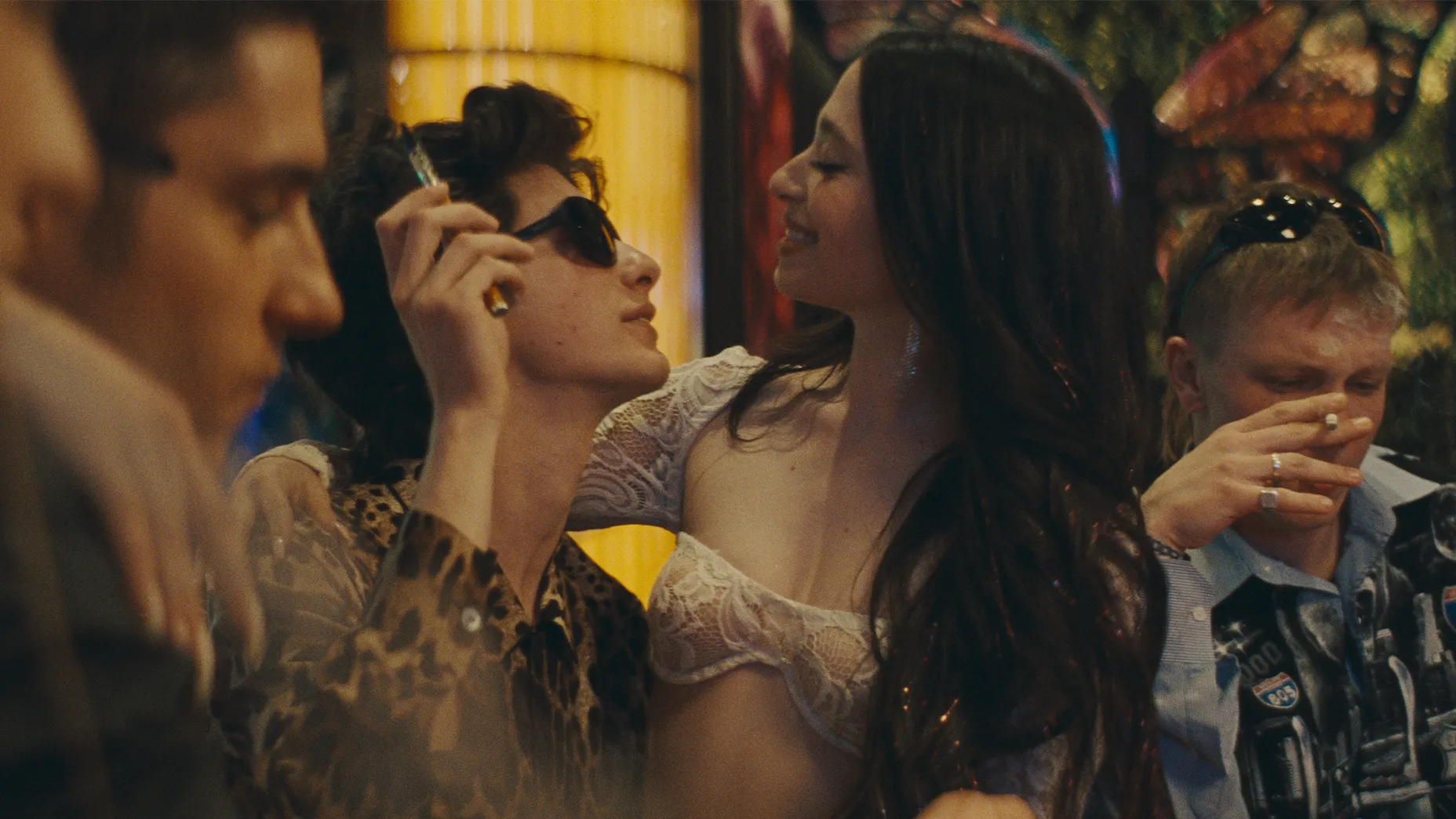
Anora, or Ani, works as a stripper at Headquarters in Midtown, a sanctum where she peddles her wares (simple company, lap dances, and in the private rooms, maybe more). She supplements her income as an escort. Sex is transactional, which does not devalue her ability to enjoy it, but the financial nature permeates the act such that her brittle nature seems organic rather than a symptom.

Then, she meets her knight in shining armor, Vanya, the child-like, fun-loving son of a Russian oligarch (Mark Eydelshteyn), who blows through Daddy’s rubles like water, rents her for the week, and then, after a bender in Vegas, marries her. This obviously does not go down well, and the oligarch must rely on his Armenian reps in New York to rectify the situation. They are not quite the Eastern thugs of lore, and their intercession is more Three Stooges than John Wick.

As they say, hilarity ensues.

As does much more. The connection between the man-child Vanya and Anora is in part about money, yes, but you can feel a spark, and even though Anora remains focused on the payments, soon, she fancies herself Julia Roberts. This is love, and he is hers, even if he just started shaving. You know that it cannot be, but Baker has you as enthralled as Anora, on pins and needles, hoping against all hope and reason. When the forces of power intercede, they are partially represented by an Armenian thug Igor (Boris Yurasov) who reveals a gentle, protective disposition and an alternative approach, one that Anora fights with the same verve and fire she exhibits to hold on to Vanya.

Ultimately, there is a reckoning, a declaration of independence, and a new beginning, but before we get there, Anora and her unwelcome coterie of Armenian minders endure an evening that harkens to Scorsese’s After Hours.

As with The Florida Project, Baker has such command of place, you feel immersed. Here, due to the whirlwind nature of the story, Baker’s pace is not Florida languid, but Big Apple urgent and exhilarating. It’s a joy ride with heart.

Madison, Eydelshteyn, and Yurasov all deserve Oscar nominations, and my fingers are crossed, as Madison and Yurasov received nominations for the Golden Globes.    

I have many films to see, but this is currently the leader in the clubhouse for best of the year.

Elliott, a vacuous, self-satisfied, snarky Canadian teenager (Maisy Stella) is visited by her 39 year old self (Aubrey Plaza) during a mushroom trip. Plaza’s old ass has much to say to Elliott’s young ass, much of it a violation of the Prime Directive, the guiding principle of Starfleet that prohibits its members from interfering with the natural development of alien civilizations.

Yes. I watched Star Trek. What of it?

The set-up is well worn. Elliott wants to get off the family cranberry farm and find herself in the big city of Toronto. She is meant to be celebrated for her freedom and grab-life-by-the fistful approach. She’s gonna’ shake the red juice off her small town boots and let loose before global warming interferes with her cell service. She’s a rebel. But she’s also a loudly stupid and narcissistic rebel, and all the soft piano, oboe, and terrible acoustic dirges cannot make her interesting.

With a lead who could act and a less obvious, smarter script, My Old Ass could have been a clever twist on the coming of age flick, Freaky Friday meets A Christmas Carol.

Stella (member of the music duo Lennon & Maisy), however, cannot act. She is one-note, snotty, and charmless. She makes Disney Channel kids seem method. 

The film has a few genuine moments where Plaza, Elliott’s mother, and her would-be first boyfriend all present Elliott with a remembrance, a well-rendered insight, a moment of tenderness. In response, Elliott – not allowed to say “dude, what the fuck? for the umpteenth time- offers a “dude, what the fuck?” countenance. Any expressed emotion crashes into her stubbornly smug visage, where it thuds. Such that we are thinking, “Miley Cyrus could have really done something with this role!”

Worse, no one has bothered to make the trick explainable. After the drug trip ends, inexplicably, Plaza still texts and calls and visits Elliott. Tripping as portal to an Apple data plan? This is lazy mush and indicative of the ragged nature of this endeavor. 

The script is mostly middling sitcom. Plaza and Elliott say cool stuff like “when do we …?” Followed by “oh my God. This happens …” Plaza says to Elliott: “Moisturize!” Elliott replies with a form of “What the fuck? Dude!???” Elliott to Plaza: “Can I kiss you?” Plaza replies with “ewwwwwwwwwwww!” or some derivation of same. Stella says “fuck” and “dude” and “like” and “sick” a lot. She spouts hip cliche’-ridden observations that may tickle the fancy of an 18 year old peer, but test the patience of anyone who has read a magazine. Or a cereal box.

When we get to the meat, Plaza reveals a particular thing Elliott must prepare for, something so obvious, it seems a perfunctorily preordained. It is asked to serve as the emotional linchpin of the movie, yet the most Stella can muster is the disappointment of a girl who pours a bowl of Lucky Charms only to find a low marshmallow count. 

Sometimes, in these flicks, you get some funny, well-drawn secondary characters who maybe could drag Stella along. But everybody is pretty vanilla and meh. When they have something to say, it is leaden with announcement and unforgivably banal. 

The film might have been saved if Plaza told Elliott not to take a particular hike and she did it anyway and then she was almost murdered by the Green River killer.

Missed opportunity. 

Last point. Yes, teens say “like” and “fuck” nonstop, like men in war curse beyond any comprehension. But to actually let characters lapse into this doggerel in a script? Jesus. It may as well be serial farting. 

The picture was on a few top 25s and 50s and very highly rated on Rottentomatoes.com.

Undeservedly so. Like dude, what the fuck. 

On Amazon. Thankfully, for free. 

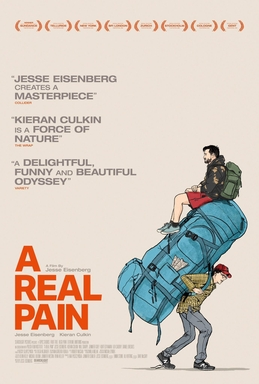
A beautiful, meditative story about family, and the disconnect between ancestry, past, and shared blood. Writer-director Jesse Eisenberg (The Social Network), and Kieran Culkin (Succession) are disconnected cousins who used to be very close when young, and are now held together by a strong attachment to their recently deceased grandmother. In remembrance and per her wishes, they join a tour group to Poland to visit her origins, including the concentration camp she survived. In that journey, they hash out some old differences, reveal their insecurities and grievances, and otherwise, commune with the past. Culkin is enagaging,  charming, yet emotionally dictatorial, and peripatetic. Eisenberg is OCD, eclipsed, a little bit pissed off about it, and, yet, desperate for his cousin’s ability to connect while at the same time weary of having to clean up his emotional messes.

The film is never overt, but it is very touching, particularly when the fissures between the cousins arise in the midst of a supportive group of fellow tourists (one of whom is Jennifer Grey, from Dirty Dancing, who is really quite good, even if she looks nothing like she used to given the radical plastic surgery she underwent many years ago). They are all on their own journey for different reasons, and they quickly become another family to the two protagonists.

Eisenberg’s script is sharp and his direction leisurely. At times, his take felt a little like Sofia Coppola, such is his comfort with the silences and the scenery (his shooting at the camp is haunting). The pain of the characters, as juxtaposed against the history, is made more acute, but again, there is no resolution, no great battle royale, no truly deeper understanding. But, quite tenderly, the bonds are strengthened. The experience may not change their trajectories, but that seems baked into Eisenberg‘s cake.

A lovely, bittersweet picture.

This entire review is a spoiler.

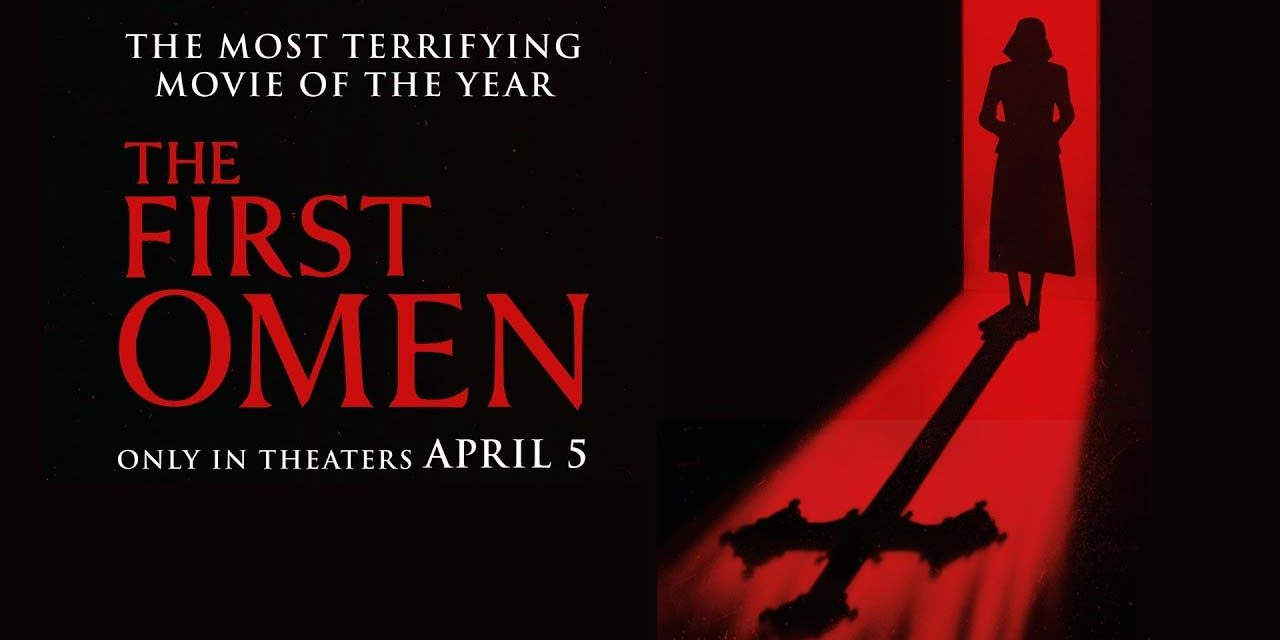
As you may or may not know, when Damien Thorn was placed with the American ambassador to the Vatican (Gregory Peck), his own wife (Lee Remick) had just “lost” their baby during childbirth. Mrs. Thorn would have been devastated, but the ingenious Catholics were Luigi-on-the-spot, procuring another baby boy – Damien – for the old switcheroo. Soon, Damien is in America, freaking out baboons, having the temper tantrum of the ages when driven to church, and killing (or having killed) everyone in his way, including, eventually, Mom and Dad.

I’m a huge fan of the original and even like the sequel, where William Holden and Lee Grant have to deal with their devil of a teenage adopted son. I sort of lost track after that but understand there was a third flick, which wasn’t so good.

So now we go back to before Peck and Remick became the unwitting guardians of Satan. It is 1971 and Margaret, a fresh and seemingly innocent nun, comes to Rome, where she is stationed at an orphanage. Before long, she notices strange doings, and is soon approached by a dissident priest, who informs her that this is no ordinary orphanage, but rather a cabal of right-wing radicals within the Church, so desperate to regain power against secularism – gasp! – they are willing to bring Lucifer back in human form, if only to make themselves relevant.

Because evil had been on a real downslope in the century.

As a cultural Catholic, well-versed in the Church’s byzantine rituals and excesses, I have a lot of bandwidth for this kind of silliness. But even for me, this is painfully stupid. And also, I think, a ripoff of Ron Howard’s hideous fireman movie, where an embittered fireman lights a lot of fires in Chicago to avoid budget cuts.

You do not want to steal a lot from Backdraft.

Sure enough, Margaret finds a fake door that brings her to old files of hideously deformed babies.

The orphanage is, in fact, a baby factory, where Satan (in the form of a jackal) impregnates the girls. Most of the grotesque babies die, confirming they are not The One.

But Old Satan keeps at it.

And I think, this is a ripoff of M. Night Shymalan’s Unbreakable, where Samuel L. Jackson blows up every plane, train and automobile he can hoping to find the “unbreakable” Bruce Willis, who will have survived what cannot be survived.

Also stupid, but somehow, it worked for me.

When Margaret rifles the files, there is a missing picture of one of the would-be hosts.

Guess what?

That girl is Margaret.

You see, the whiz kids in the rectory figured out that if Satan mates with his own spawn, and a child is delivered, then the Church will finally get Damien, not a deformity, and the pews will be full again! And when Margaret first got to town, her nun roomie took her out clubbing, like when the Amish get one crazy weekend in New York, and someone slipped Margaret a mickey so the Devil could get at her.

So, Margaret gets a C-section in the creepy catacombs, and Damien is born.

As is his twin sister.

Sigh.

This is not as bad as it reads. There are some very scary touches, and a smart buildup.

But there is no fun in this picture. In the first Omens, there was real dread and investigation as Peck got closer to the truth, and you wanted to know how folks who found out were going to buy it, and if they’d get Damien in the end.

Here, Margaret acts rather than thinks, and she does not need to be persuaded – dawning hits like a blinding light rather than a slow revelation. Why keep any files at all? Lazy lazy lazy.

Worse, we know they don’t get Damien, and how people meet their end is either repetitious (as in the first movie, a priest catches a piece of a church in the skull and a nun hangs herself after announcing, “It’s all for you!”) or just humdrum.

What is built up to is so hurried and confusing, it cannot sustain interest.

Also, if Margaret is necessary for coupling with Satan and producing Damien, why are the evil nuns so mean to her?

Well, I know the answer to that.

Nuns can be mean.

I took my cat to the vet yesterday and had that strange interregnum – too late to go back to work and too early to have a drink. So I flipped on the TV and lo and behold, Dog Day Afternoon was starting.

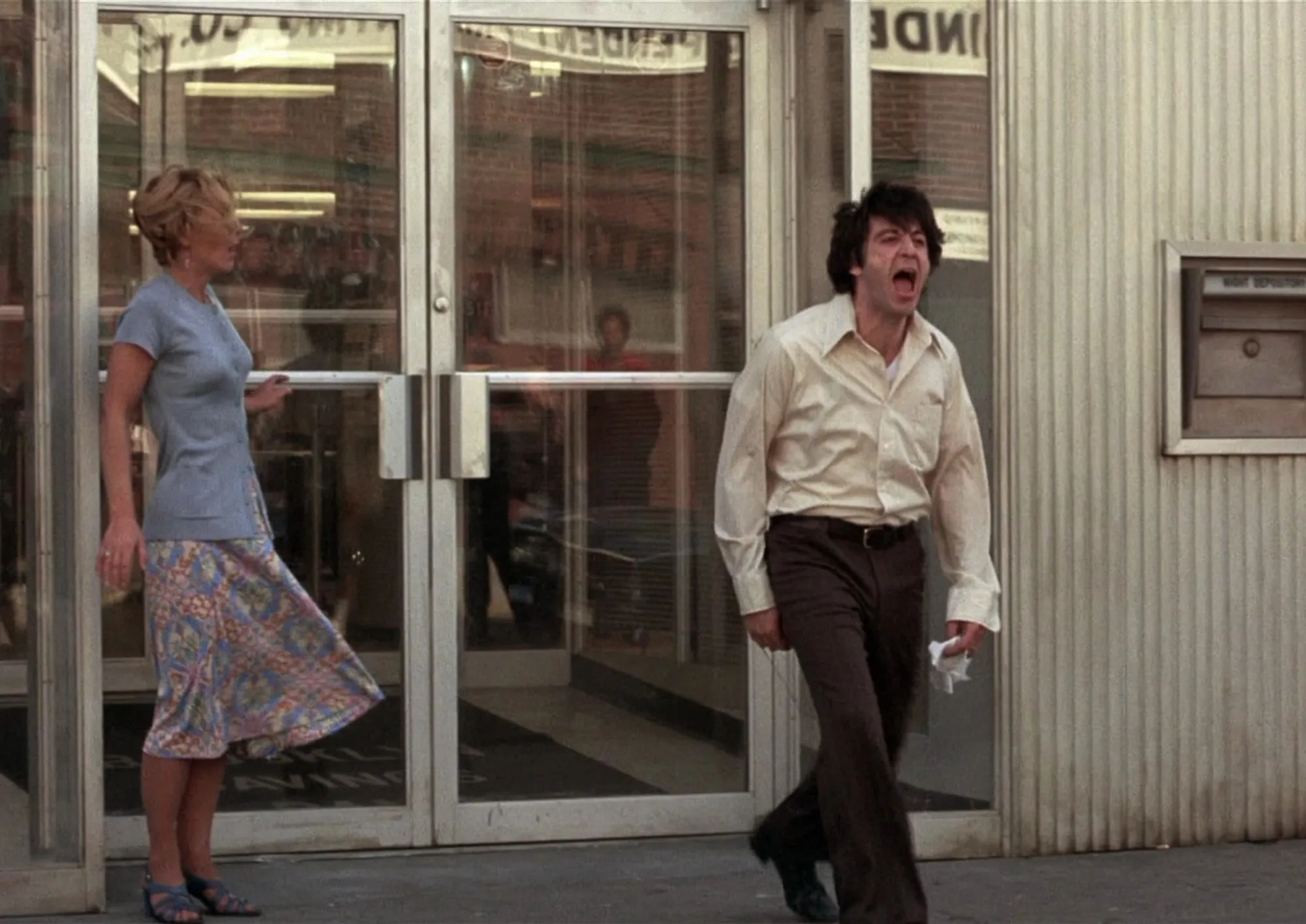
“Prescient” doesn’t even begin to capture Sidney Lumet’s masterpiece. Sonny (Al Pacino) and Sal (John Cazale) rob a bank in Brooklyn and before you know it, everything goes to shit, it’s a hostage situation, and they are surrounded by 100 cops, led by the overmatched and harried Charles Durning.

This is one of those 70s “New York City seems like hell” flicks. The robbery occurs on a sweltering summer day, and the police seem itching to gun down Pacino if only to get out of the heat. But soon, the TV cameras roll in, the crowds arrive, and before you know it, Pacino is a street-performer, not negotiating so much as whipping everyone up, screaming, “Attica! Attica!” and otherwise savoring the moment and, for lack of a better phrase, sticking it to “the Man.” His rage and theatrics are infectious. The crowd bays, bystanders want “in”, the hostages (plucky New Yorkers all) play-act and become featured cast members, and soon, the cops are the ones being led by the nose. Everybody has their 15 minutes.

But Sonny’s ride must end. Sal is a dimwit (when Pacino asks him what country they should fly to in escape, Cazale responds, “Wyoming”). The origins of the heist – to get money for Sonny’s boyfriend Chris Sarandon’s sex change – become public when Sarandon is sprung from a suicide attempt at Bellevue to come talk some sense into Pacino. The hostages start to lose the fun of it as well, and Cazale’s biggest worry becomes the fact that the networks are reporting “two homosexuals” in the bank. When Pacino is put on the line with his wife, you can see how he could be driven to such extremes and also what an awful person he has been to her. His mantra is, “I’m dying.” He is, in front of us, in slo-motion, but we sense we’ve missed a lot of the decline.

There is a great scene where the manager, having suffered a diabetic episode, is tended to by a doctor, gets his shot and chooses to stay with his employees:

               As Sonny grabs him to try to help him up, Mulvaney wrenches

               away.  A little physical here.

                                     SONNY

                         Hey!  I’m tryin’ to help you.

                                     MULVANEY

                         I stay here.  Damn it.  I just needed the insulin.  I’m used to it.

                         Go on.  Go on.

                                     SONNY

                              (to Doctor)

                         You tell me.  Is he endangering his

                         health, because if you tell me he

                         is, I’ll get him out.

                                     MULVANEY

                         I’ll be God damned if you will.

                                     SONNY

                         Oh, Jesus!  You want to be a martyr

                         or a hero or what?

                                    MULVANEY

                         I don’t wanta be either, I just want

                         to be left alone.  You understand

                         that?  I wish the fuck you never

                         came in my bank, that’s all, don’t

                         try to act like you’re some angel of

                         human kindness!

You can see Pacino’s hurt.  As if maybe he really thought this would work out and that he is a good man.

But soon, the FBI take over, and they are helluva lot more together than poor Durning and company.

Pacino is riveting,  alternately electric and doomed, eliciting your scorn and then sympathy. He’s all furtive energy minus the excess and “hoo ah!” You know this had to go bad, and so does he, and it’s depressing to see him hope, just for a minute, and then know he’s a loser and finished. Sarandon is fantastic (he was nominated for supporting actor), ridiculous and yet, affecting in his affectations, as if he knows he’s absurd but can’t shake the affliction.

It won an Oscar for Frank Pierson’s (Presumed Innocent, Cool Hand Luke) original screenplay, which doesn’t have a false note in it.

I recently devoured Quentin Tarantino‘s Cinema Speculations, wherein he recounts his childhood and the succession of films his mother’s boyfriends would take him to see when he was a kid. Most of the films he discusses are ones you probably shouldn’t take a kid to see.

When my mother and father got divorced, I was six years old and my father was supposed to take us every other weekend for two nights. That arrangement became a little less frequent over the years, and by later grade school, he was taking me and my brother on a Saturday day and an overnight. We would spend the weekend with him at his apartment and pretty much do the same thing every time: go shopping, do his errands, look for stereo equipment, maybe spend an hour or two at his law office, go Putt Putt golfing, and then to Shakey’s Pizza in Rockville or The Charcoal Grille in Bethesda. Dinner was from Swanson’s, so you got a entree’, two sides, and a dessert.

And movies. We went out to the movies a lot. Or, we stayed in Dad’s apartment, where he had a special key that was hooked up to some kind of internal cable system, and we could watch close to first-run movies there instead of going out. Or just catch what was on TV.

My father loved movies, he loved to talk about movies, he lived for movies. So much so that he would go through a certain kabuki with me where he would let me take a look at The Washington Post and ask what I wanted to see. I would pick a Herbie the Love Bug and he would say, “Nah. I heard about this good movie.” And then, like Quentin Tarantino with his mother’s boyfriends, you went to see a lot of dark, heavy, violent flicks, like The Laughing Policeman, The Silent Partner, Death Wish, or The Taking of of Pelham One Two Three. Or the remake of Farewell My Lovely, Night Moves, or The Eiger Sanction.

And Rolling Thunder. Which I noticed was available, and, as I couldn’t sleep anyway, I watched last night

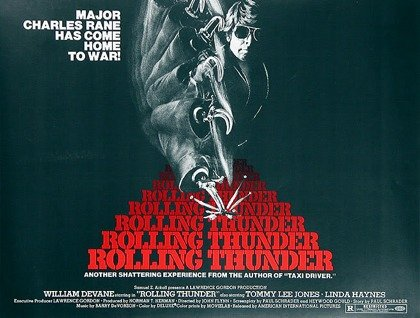
Tarantino’s book has an entire chapter on the film, one of Paul Schrader’s first screenplays after Taxi Driver. Major Charlie Rane (William Devane) and Sergeant Johnny Vohden (Tommy Lee Jones) return to Texas after seven years of brutal captivity in a North Vietnamese prison camp. The adjustment is fraught, and even greater tortures are brought to bear on Devane, who is being treated by an Air Force psychiatrist (the just recently deceased Dabney Coleman) in his attempt to readjust. Tragedy ensues. Devane snaps. What follows is a classic 70s revenge flick.

The film travels wonderfully. There is a crisp foreboding to Devane’s return. While San Antonio welcomes him with marching bands and celebrations, and he is reunited with his long suffering and loving wife and the son who he last saw as a baby, Devane is damaged, and beneath the cheery gleam of a welcoming Texas, there is rot and danger. His son has anxiety issues. His wife has found another man (Devane says to her evenly, “you’re not wearing a brassiere” to which she replies, “oh, no one wears them anymore”). He cannot sleep in the house, preferring a cot in the garage.

So much is done well in the lead-up to the Death Wish-ian payoff, it goes unnoticed because, after all, this is a shoot ’em up, just desserts pic. Per Tarantino: ““This opening thirty minutes is a grippingly detailed character study, and by the time it’s over the audience doesn’t just sympathize with Charlie Rane, we really do understand him. Apparently better than anybody else in the film. It’s a much deeper depiction of the casualties of war than the [other movies of that era].”

I remember watching the film with my father. It is engrossing, both subtle and visceral, like a lot of pictures we saw together. It is also wildly inappropriate, also like a lot of pictures we saw together. I had trouble wrapping my head around something horrible that happens to Devane; not a spinning, vomiting Linda Blair kind of visual, but a brutality so smartly connected to a mundane part of the household, it just traveled with me, and probably not in a good way. Even last night, I fast-forwarded.

But on Sundays, when we were dropped off, I would not tell my mother about any of these movies, because I felt me and my Dad had this thing, this bond, and it was cemented in our little secret, Jujufruits and Junior Mints in hand.  And perhaps we did, although I’m probably mythologizing it. After all, my father needed to have something to talk to me about. Or at a minimum, just a two hour break from my babbling.

The picture is currently on Amazon Prime. Nostalgic for me but it really holds up.