
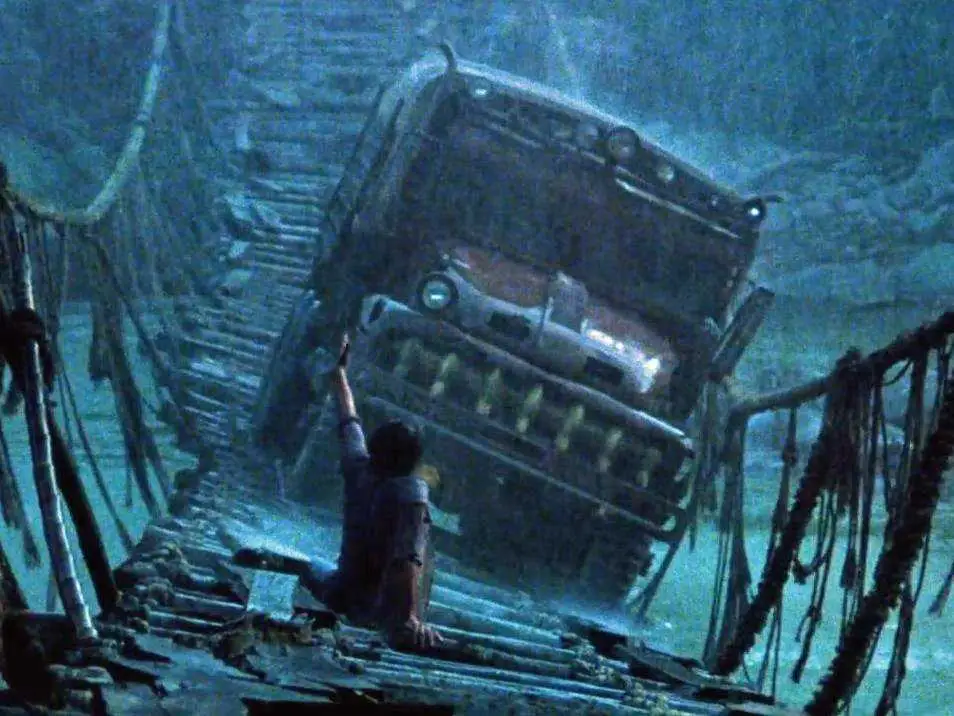
William Friedkin’s follow-up to the massive successes of The French Connection and The Exorcist, the film has met with greater favor in recent years, but at the time, it was a dud at the box office. While it has its charms, the tepid response at its release was deserved.
By way of set up, Roy Scheider is part of a 4 man stick-up crew in New York City that robs from the mob. Three are killed in the caper and Scheider goes on the run, to a small town in Chile, There, he works as a laborer under an assumed name on subsistence wages for an American oil company. He is joined by a French financier, an Arab terrorist, and a hit man of indeterminate background, all incognito and under the gun for their own reasons. None has the means to get out of town. Guerillas, however, blow up an oil well 200 miles away, and the four men are hired to ferry highly combustible dynamite containing nitroglycerin in two trucks through a hellacious terrain of winding mountain roads, dismal swamps, and, at times, torrential rain. The dynamite is necessary to cap the well and extinguish the geyser of fire.
The problems.
First, Roy Scheider is not a lead. Never has been. His intensity is unquestioned but his range is limited, and he’s only asked to be wary and furious, which he does fine. He’s just not very interesting.
Second, given the massive jostling and bouncing in the trucks during the expedition, one does wonder, “Why again was a helicopter out of the question?” Assuming it just was because somehow the flight was more unstable than the truck (which when you see the journey, is ludicrous), I’m still with one commenter, and I don’t think this is niggling:
“This big oil company calls in a helicopter and asks the pilot to transport unstable nitro that would be unsafe to handle, but never thinks to ask the helicopter pilot to bring with him some stable explosives that they can use right away. Was it more cost-effective to pay 40000 pesos (plus supplying two large trucks and apparently a bunch of additional new auto parts) and risk a 218-mile land journey than it would have been to just fly in some new explosives?
Third, other than the French financier (Bruno Cremer), with whom we spend a lot of time explaining his backstory, we don’t really get to know these men, and in their journey, they share very little.
On the plus side, many of the ordeals are stunning (getting the trucks over wooden, swinging bridges is one of the most riveting things I’ve ever seen in movies); the visual grit of the film is palpable, which in the age of sterile CGI, is always welcome; there is also a matter-of-fact lack of sentimentality that melds well with the harshness of the environment; and the picture introduced Tangerine Dream (Thief, Risky Business, Near Dark) and the synthy soundtrack is dissonant but effective, as the environs seem almost otherworldly.
Bill Burr, Quentin Tarantino, and my son (his biting rejoinder pending) are decidedly more enthusiastic. Hell, Tarantino deems it “one of the greatest movies ever made.”
On Amazon, for $3.99.
 filmvetter