Dreadful in every respect. Ostensibly about an impeccably tailored group of LA police vigilantes formed to take down gangster Mickey Cohen in 1949, Gangster Squad sports a script so hackneyed it seems like a goof. The picture is a mash of The Untouchables and LA Confidential, if those films were re-written by a 13 year old boy whose sole inspiration was Rambo II.

Some gems:

“To the sarge. You’re a bull in a china shop but we’d follow you anywhere.”

***

“I’ve been with a lot of outfits but none better than you group of misfits”

“To the Gangster Squad!”

***

“I signed up for this so I could tell my boy I tried to do something about it”

***

“Can you remind me of the difference between us and them? Because at this point I can’t tell anymore.”

***

“If I leave, Keeler dies for nothing.”

***

“Tomorrow they’ll take my badge. Tonight I’m still a cop.”

***

“Let’s finish it.”

***

“We gotta’ take out that gun!”

“Watch this, hoss.” (six shooter beats machine gun)

***

“Wanna’ dance?” (Man with gun drops it so a fistfight can occur)

***

“Every man carries a badge. Mickey Cohen pledged allegiance to his own power.”

***

“Jerry threatened to leave the force but he never did. I guess he couldn’t shake the call of duty that echoed in his ears.”

You simply cannot believe what you are hearing.

The squad is led by the wooden and true Josh Brolin and is rounded out by a playboy (Ryan Gosling), a cowboy (Robert Patrick), a black guy (Anthony Mackie, who uses a knife just like James Coburn in The Magnificent Seven), a Hispanic (Michael Pena, who is Patrick’s Tonto, and maybe even his son, depending on your reading of a death scene), and a geek (Giovanni Ribisi).

Not quite Costner’s gang in The Untouchables, but damn close.

All the character are awful, but Gosling is by far the worst, utilizing a Brooklyn accent on helium. The result is a really dreamy Elmer Fudd.

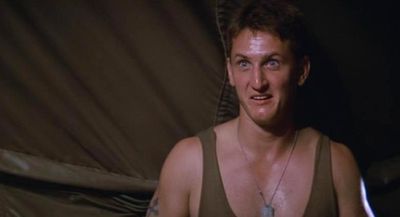
And Sean Penn as Cohen?

Image result for Sean Penn Mickey Cohemn

See Sean Penn in Casualties of War.

The picture also gives us Emma Stone as the Kim Basingeresque world weary ingenue?

Taylor Swift must have been unavailable.

***

Ryan Gosling. “Don’t go.”

Emma Stone. “Don’t let me.”

***

***

The plot thuds along.  Our avengers mess with Cohen, but their efforts must be expedited because Cohen is setting up a wire service which will give him control of all betting west of Chicago . . . in a week! If it becomes operational, he will be too big to take down.

But our heroes can’t find the location of this new wire service.

Perhaps they shouldn’t have blown up his trucks carrying the wire service equipment instead of following them.

No matter. Because Cohen places the wire service HQ, the jewel in his criminal crown, in the back of the nightclub that doubles as the hottest spot in LA.

The film was not well received but it is troubling that it was not roundly demolished, it is so crappy.

For example, in one scene, a thug’s overcoat (in balmy LA, mind you) catches on fire when he is backed into flames. He removes the burning coat, kills a man, and yet, in the next shot, voila!  The overcoat has returned to his body, unsinged!

The film also shows Mickey Cohen watching footage of one of his boxing matches, an Cohen explains how he held on to the championship.

The real Cohen, however, never had a championship fight (he lost to World Featherweight Champion Tommy Paul two minutes into the first round), which I suppose is nitpicking.  Yet, despite being a “championship” boxer, Cohen loses a fistfight to Brolin to close the movie, which is not nitpicking.

The following critics gave the film positive reviews: Ricardo Baca (Denver Post), Richard Roeper, Rafer Guzman (Newsday), Rex Reed (The New York Observer), John Hanlon (Big Hollywood) and Peter Debruge (Variety).

Follow the money, I say. Follow the money.
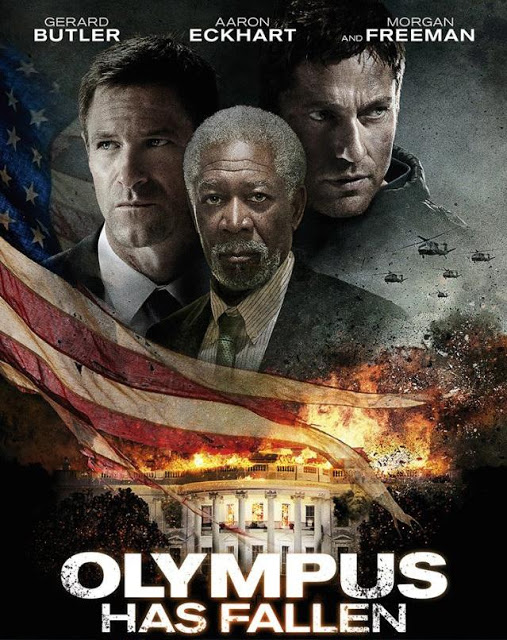

I saw this on my flight back from Rome. I tried something new, a review in real time, where I watched and typed, watched and typed.

Big trouble early. The First Lady is Ashley Judd and she telegraphs where we may be going when she tells our hero, Secret Service agent Gerard Butler, that the president (Aaron Eckhart) can get the country off its dependence on foreign oil but cannot pick her earrings. I think I know who the bad guys are.

President Eckhart and wife leave Camp David in a motorcade in brutal, snowy weather, they hit black ice, and as the car totters on a bridge, Butler must make a tough call. Goodbye Ashley.

18 months later, Butler is haunted. And cashiered at the dreaded desk job at Treasury.   Martial music portends trouble and Butler is dressed for it. Unshaven, dark on dark, like Christopher Moltisanti.

A massive unidentified military plane gets in near spitting distance of the White House before receiving a final warning from the two, and only two, jets hawking it.  When it shoots the jets down, and starts shooting up the White House, no worries. We send one, as in the loneliest number, other jet to intercept. The threat is seemingly neutralized at the expense of the top of the Washington Monument.

As this goes on above ground, the President is hurried to his bunker beneath the White House with the VP, the Secretary of Defense (Melissa Leo), the South Korean prime minister and a boatload of aides and security personnel.  The president is apparently a sexist, because it is Leo to whom he says, “Ruth. Where is my son?”  Sadly, she did not respond, “I’m not the fu**ing nanny.”

Meanwhile, Butler is out in the street in front of the White House, which is suddenly overrun with Asian ninja-skilled terrorists. He’s killing a boatload and it is on, on like Donkey Kong.

Oh snap. The president gets jumped by the South Korean prime minister’s security team. They’re really North Korean! [insert joke here] And the White House has been overrun above ground and below . . . Hey, wait. Olympus HAS fallen!

Luckily, Butler is in Olympus. He’s John McClane! I’m intrigued. Forget the play by play. I watch uninterrupted. This experiment has failed.

LATER:  I was wrong about the bad guys. Not big oil. Former Secret Service agent Dylan McDermott went traitor and snapped at the president about “globalization and Wall Street” and the $500 million necessary to buy the presidency. I smell Tea Party, who as we all know, have a natural affinity for the North Koreans.

Regardless of its politics, this is the most anti-American film I’ve ever seen. Not so much philosophically, but competence-wise.   As noted, the Secret Service takes the President on icy bridges at night and the skies around D.C. have become a lot friendlier 12 years after 9-11.

Also, Morgan Freeman is Speaker of House and thus, acting president.  Freeman is also a total puss. He actually started withdrawing troops from the Korean DMZ and the Seventh Fleet after the terrorists killed the VP and threatened to kill the President.

President Eckhart makes Freeman seem like Teddy Roosevelt. It seems the U.S. has a nuclear failsafe system. 3 people can provide numbers to defuse our nuclear missiles in case of a rogue launch, making us defenseless in the process, which seems to be the aim of the terrorists. So what does Eckhart do? He orders two of the code handlers to give up their codes so they won’t be killed. Eckhart has the third. But it turns out the terrorists didn’t need the third code. Because they intended to blow the missiles up in the silos. Which required only one code.

Nice system.  Good choices. Bad movie. Impeach Eckhart.


This biopic of Alfred Hitchcock’s making of Psycho attempts to juggle three stories:  the strain on the relationship between the director (Anthony Hopkins) and his wife (Helen Mirren), Hitchcock’s own perverse infatuations with his leading ladies, present and former (Scarlett Johannson as Janet Leigh and Jessica Biel as Vera Miles), and the actual making of the movie, with its unsettling, revolutionary ties to the Ed Gein murders.  Each of these threads is presented in a tepid and/or listless manner.

Hopkins and Mirren are quite good, but the script gives Hitch little to do but mope about his wife’s inattention, and Mirren’s near-dalliance with another writer (Danny Huston) is a bit uncomfortable.  Either the 68 year old Mirren, or Alma Hitchcock (she was 60 at the time of the making of Psycho) are too old for the communication of unquenched sexual urges necessary for the role.

As for Hitchcock’s own urges, the film cops out.  The director is shown as a peeping tom, and any darker heart is reflected only by his silly imagined conversations with Gein.  Leigh and Miles commiserate a bit on the director’s peculiarities, but nothing particularly upsetting is revealed, and neither actress is capable of delivering some deeper psychic injury or fear.  At best, they cluck, “oh, be careful.  You know old Hitch.” Given the director’s very disturbing behavior prior to, during and after Psycho, the wispy treatment seems cowardly. But even if the filmmakers were reluctant to travel that dark path, they missed many other opportunities to illuminate the eccentricities of the director. The lore has it that Leigh and Hitchcock were both unhappy with John Gavin’s work in his love scene with the former, and that Hitchcock instructed her to “take matters in her own hands” to amp up the passion. Yet this gem of a vignette is left out?

Finally, there is the risky making of Psycho, a film Hitchcock bankrolled himself when the studio became leery over the subject matter.  Hitchcock is ostensibly based on Alfred Hitchcock and the Making of Psycho by Stephen Rebello. which I have not read but hope is more interesting than was portrayed in the film.  The making of the film is characterized as worrisome at times. The director’s financial stress is shown, and he pouts when his wife is away, but that’s about it. Nothing of Hitchcock’s craft is developed, and some of the hurdles, such as the fight with the censors over the shower scene, are played mainly for laughs. So much is missed.

Take Rebello in a 2010 interview:

But she is killed in the shower in the novel. In fact, Hitchcock told many people that he was most attracted by Bloch’s notion of a murder coming out of the blue in an everyday, confined setting—the shower, where we feel relaxed and complacent but where we’re utterly vulnerable.  Hitchcock was thrilled with the idea of shocking audiences by casting a major star as the heroine and killing her off so early in the picture. That violated every Hollywood rule. Bloch’s heroine has her head cut off in the shower, not exactly the kind of thing that even Hitchcock could have gotten away with, even if he had been tempted. Bates in the novel is middle-aged, pudgy, alcoholic, brooding, unattractive, repugnant. He also has extensive conversations with his mother, which would have been fatal and a cheat on film. Casting Anthony Perkins was a lucky masterstroke; he’s as charming, attractive, sad, perverse, and lethal as earlier Hitchcock killers like the one Joseph Cotten played in Shadow of a Doubt and Robert Walker played in Strangers on a Train. Perkins had already worked with top directors like William Wyler, Anthony Mann, and Stanley Kramer, and Paramount had spent lots of money promoting him as a successor to the late James Dean or comparing him to the young James Stewart or Henry Fonda. Although he had become a teen idol and even made some hit records, things hadn’t quite clicked and, at the time, Perkins felt typecast and owed Paramount a movie. Hitchcock could hire him inexpensively. It was a perfect storm.”

There is so much here, but the film merely gives us Hitchcock cackling at killing Leigh early and the tut-tutting over the ghastly plot, with Alma disapproving, the powers that be huffing “You can’t do that!” and Hitch gleeful as the bad little boy.

One added point.  As noted, Johannson and Biel are pedestrian, but they aren’t the only ones.  The bullying studio head is played in embarrassingly broad fashion by Richard Portnoy, James D’Arcy’s Anthony Perkins is an impression rather than an embodiment, and Ralph Macchio is unfortunately unearthed for a short scene as the writer, Joseph Stefano.  The Karate Kid is not missed.  And I can watch Robocop only so often to remove the taste of yet another Kurtwood Smith uptight authority figure performance.

At the end, you’re left with a damning question – why make this picture?  It does little to communicate Hitchcock’s demons or his genius, it meanders and plays it safe, an unfortunate testament for a cinematic trailblazer. One that should not have been delegated to director Sacha Gervasi, whose resume’ is anchored by his 2008 documentary of a Canadian metal band, Anvil: the Story of Anvil.

Tom Cruise plays a former military detective, a ghost drifter who is drawn into the role of lead investigator for the defense of an Iraq War sniper accused of a senseless shooting spree in Pittsburgh. As he digs deeper, he unravels the true motive for the killings and the web of intrigue surrounding them.

Jack Reacher is a competent thriller, and Cruise is convincing as a smart, tough ex-military hero. He exudes a certain intelligent menace despite his short stature (the Jim Grant books had him a lot bigger) and the story whips along. The bad guy, a disfigured Werner Herzog, is a treat, and the scene where he gives a man a chance to avoid execution is memorable.  There are also some sharp exchanges in the script which, if not Dirty Harry, is subversively conservative.

Still, the aim of the villains is weak (a construction company???); the late introduction of Robert Duvall as a sidekick for Cruise strains credulity; and the effort to mask the necessary killing in the cloak of a shooting spree is, upon reflection, wild overkill, the kind of gambit that would elicit the attention the bad guys sought to avoid.  These weaknesses are forgivable, but when Cruise drops his gun to go mano a mano with his nemesis, the film veers into Road House territory, if only for a moment.

Watch 2 Guns | Netflix

Bad in an instructional way, serving as an exemplar of most everything wrong with American action blockbusters today.

The film attempts to replicate the “bang bang” buddy cop repartee of Lethal Weapon fails utterly. Wahlberg and Washington bust their humps to make it work, but the dialogue is unfunny and disjointed, and the central plot device (they rob a bank that has too much money in it) is an old trope.

The story is not silly enough to be camp or cohesive enough to be plausible.  It seems to laugh at itself but it does expect you to take it somewhat seriously. Serious or campy, the action is minimal and what action there is comes off blocky and mundane.

When the exchanges between Wahlberg and Washington thud to the ground, we get warmed-over Tarantino. Bill Paxton’s turn as a CIA baddie suggests the eclectic but he is really no more than a Roger Moore-era Bond villain.

Last, there is cheap, hip anti-Americanism. DEA, CIA, U.S. Navy, all rotten to the core. Olmos is also given free reign to condescend to the gringos, and when Washington runs into trouble on the Mexican border, it’s in the form of anti-immigrant yahoos flying the Stars and Bars and insulting Muslim Americans.

Unbearably, when Wahlberg and Washington have to cross the Mexican border illegally, they do it with stoic Mexicans to the tune of some shitty, self important pop tune by Danger Mouse. You can feel the characters grow more charitable in outlook, which will help when they waste a couple of dozen bad guys later.

Thank you, Mr. Director from Iceland and Mr. Writer of Law and Order.

From third through about sixth grade, I suffered night terrors. I was also an intrepid sleepwalker. The former malady evinced itself in my waking up, eyes wide open and fully cognizant of my surroundings, but in abject fear. That fear sent me running to the place I deemed safest. At home, it was my mother’s room, though my brothers made great sport in waylaying me as I sped down the hall screaming. If I spent the night at a friend’s house, their parents were also at risk. That I was invited back after one of these episodes is a testament to their patience and generosity. Crying and screaming, I’d burst through the door and launch myself onto their bed, hands covering my face. Something was after me, I couldn’t look at it, and I could only be coaxed out of the nightmare by soothing words and television. I watched a lot of Johnny Carson growing up.

During that same time, on other occasions but less frequently, I would sleepwalk. However, I didn’t confine my travels to the house. Instead, I would get out of bed and walk around the neighborhood. I recall the misty feel, the trance-like state, and the absolute inability to stop myself. I’ve often wondered what someone would have done had they seen me out at 2 am, on a cold December morning, ambling around like a zombie in my pajamas. But I was never spotted, always ending up in my own bed. The only proof of the occurrence was my vague recollections, dirty and/or bloody feet and the times I started the evening at a friend’s house down the block, only to be listed as AWOL by his mother in the morning. My mother would see the front door wide open, and find me in my own bed.

Insidious uses the realm of sleep to create (or, in my case, re-create) a terrifying world where, presumably, children like me go when afflicted. The son of Rose Byrne (Bridesmaids) and Patrick Wilson (Little Children) sleepwalks to the attic, bumps his head, and falls into an inexplicable coma. Only, it is not a coma. Instead, he has drifted into what is later explained as “The Further,” a dream-state that is unfortunately populated by the restless dead, who hope to capture the boy simply because they thirst for his life, and more dangerous demons, who want his body to re-enter the world and wreak havoc. Modern medicine fails, the less-conventional expert steps in, and away we go. It is revealed that Wilson suffered night terrors as a boy, and the unwanted attentions of this particular demon as a child:

Wilson is sent in to get his son.

Director James Wan’s (Saw, The Conjuring) world is creepy (the two demons in particular); the scares are initially restrained, but plentiful, and meted out in increasing doses; and the acting first-rate. As the mother, Byrne is sympathetic and appropriately destabilized, and Wilson plays the father as truly scared and vulnerable – he is gripped by initial cowardice and denial; he does not want to go back to the world that so plagued him as a child. The medium (Lin Shaye) is compelling and her two researcher assistants provide necessary comic-relief without being obtrusive – this is the same set-up as Poltergeist minus the over-the-top “This house is cleeeeeeeeeeeeaaaaan” nonsense.

The film’s primary strength is its patience. As Wan explains:

Between ‘Saw’ and ‘Paranormal Activity’, along with the ‘Blair Witch Project’, it’s been proven time and time again that the scariest movies are ones that are made outside of the studio system, where you have the control to say, “You know what? I’m not going to open the movie with a big, scary action set piece. I’m just going to slowly build characters and get you sucked into the family, get you liking the characters before things start to happen.”

If there are weaknesses, they are slight: the set-up is very derivative, the middle third is rushed, the revelation of Wilson’s demon in childhood photos is too overt, and Barbara Hershey (as Wilson’s mother) is wasted. To amp up the intrigue, Wan should have used Hershey in flashback, a helpless single mother trying to cope with her spooky son.

True, the movie hit home, but even without my sleep disturbance past, I’d have been won over, because Wan and writer Leigh Whannel credit The Changeling, an as yet unreviewed filmvetter favorite.

Related image

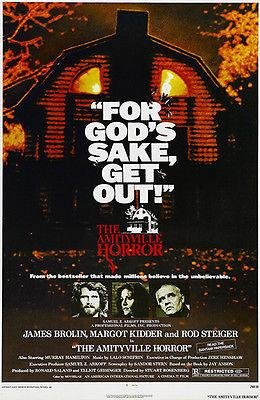
Often listed as a top picture in the horror genre, this 1979 release is rather dull and clunky.  Based on a “true” story that is decidedly untrue, the Lutz’s (James Brolin and Margot Kidder) move into a cheap dream house in Long Island knowing full well a 20 year old murdered his entire family there the year before. When their local priest, Rod Steiger, comes to bless the house, the demons therein drive him out and eventually, blind him. The house soon possesses Brolin, and Kidder (and her three children) are endangered.

The house itself is awfully creepy and the score features a chilling sing-songy ghostly whisper of children’s voices.  But Brolin is flat and ridiculously coiffed, even for 1979, Kidder is uninvolved, the children may as well have been mannequins, and Steiger overacts the hell out of his role.

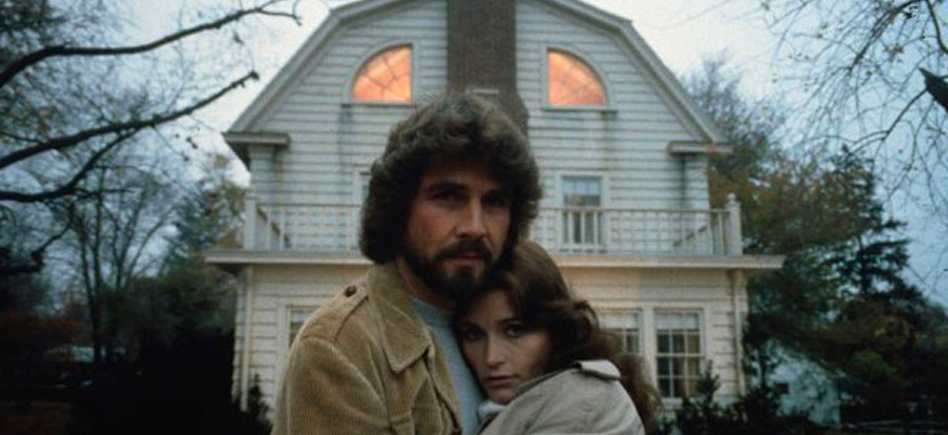
Performances aside, the movie just isn’t that scary. Sure, flies congregate, the walls bleed, creepy eyes shine in the window, and there appears to be a guy dressed as the devil behind a wall in the basement, but these features come off about as frightening as a decently prepared house on Halloween. Director Stuart Rosenberg, who helmed some interesting films (Cool Hand Luke, The Drowning Pool) is clearly uncomfortable with the genre, and apart from some disturbing externals of the house, offers very little visually. It’s a blocky, uninteresting picture, and the ending (Brolin goes back for the dog!) is ridiculous, though not as ridiculous as when locals tell Brolin he is the spitting image of the 20 year old killer.

No 20 year old killer looks like this:
Image result for Amityville horror

Image result for Trading Places

A funny, cynical 80s movie that holds up well, unlike, say Splash.  While Dan Aykroyd is obtrusive and over-the-top as the snooty Philadelphia financier who, in the service of a sociological inquiry/$1 bet, is framed as a thief and drug dealer by his financial titan bosses and replaced by the homeless Eddie Murphy, John Landis’ picture overcomes his scene-chewing.  Well, Murphy does.  He is electric and inventive, Jamie Lee Curtis voluptuous and winning, and as the scheming Wall Street chieftains Duke and Duke, Ralph Bellamy and Don Ameche are having such fun it is infectious.

A friend passed on a nifty oral history of Trading PlacesThe best bit:

LANDIS: The most remarkable story, casting wise: I thought, ‘Well, I need someone who was a movie star in the ‘40s, who never has never really played a villain, and I was thinking, ‘Hey, what about Don Ameche?’ And the casting woman said, ‘Don Ameche’s dead.’ And I said, ‘I don’t think so, I would know if Don Ameche is dead.’  And so we called the Screen Actor’s Guild, and his residuals were being sent to his son in Phoenix, Arizona. And I thought, ‘Well that’s not a good sign.’ And he didn’t have an agent, and I thought, ‘Shit, goddamm, who else could we get?’ when one of the  secretaries said, ‘I heard you’re looking for Don Ameche.’ We said ‘Ya.’ She said, ‘I see him all the time walking on San Vicente in Santa Monica.’

So I called information, and I said, ‘I there a Don or D Ameche on San Vicente in Santa Monica?’ And there was! So I called him. And you know he has that unmistakable voice, and you realize, Don was a huge star, in the late ’30s, definitely a big star in the ’40s — I mean he was Alexander Graham Bell for chrissakes! — a major star in the ’50s, Broadway star, radio star, movie star, television star.

And I said, ‘Mr. Ameche?’ ‘Yeeessss…?’ ‘My name is John Landis, I’m with Paramount Studios, and I’m making a film and I’d like you to consider a part.’ So I had a script sent over. ‘And could you please read this and can you come in tomorrow?’ And he said, ‘Yes.’ Would you like us to send a car?’ He said, ‘No no, I can drive.’ I said, ‘Great.’

And he came in and was prepared to read for me. I was so shocked. I said ‘You don’t have to read for me.’

He hadn’t made a movie in 14 years, he’d been doing dinner theater.

While we were shooting later in Philadelphia — he was so wonderful — I said, ‘Don, may I ask a question? How come you haven’t worked in 14 years?’ And he said, ‘Well, nobody called!’

Carrie (1976 film) - Wikipedia

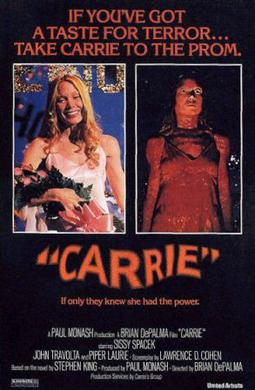
Carrie is often listed as one of the scarier films of all time (untrue) and one of the better adaptations of a Stephen King scary novel (true – in fact, The Shining and Salem’s Lot are the only rivals). It certainly has a staying power, so much so it has spawned two remakes and a Broadway musical.

The story is simple.  Untutored by her religious zealot/lunatic of a mother (Piper Laurie), Carrie gets her period in the shower after gym class, naturally freaks out and is humiliated by her classmates. When one of the more thoughtful ones (Amy Irving) tries to make amends by having Carrie escorted to the prom by her popular boyfriend (William Katt), one of the less thoughtful ones (Karen Allen) doubles down on the humiliation. Carrie, who has become increasingly aware of her telekinesis, responds, er, inappropriately.

Brian DePalma caught a much deserved rap for overly-aping Alfred Hitchcock, especially in his early films, and Carrie, his breakout picture, is Exhibit A.  It opens with a shower scene, Pino Donaggio’s score is Bernard Hermann through-and-through (Hermann was supposed to score the picture but died before filming), and when Carrie uses her powers, we hear the 4 note violins of Psycho.  The scene leading to Carrie’s ultimate indignity, where a bucket of pig’s blood is spilled on her head, speaks for itself (and much of Hitchcock’s oeuvre).  Some mock the picture for this fealty, but there are worse directors to copy.

Hitchcock aside, Carrie stands on its own, even if some of its filler seems cheezy and dated.  Laurie is riveting in her fanaticism (and her depressing prescience – they all did laugh at her), Irving and Katt offer an unheralded sweetness to the story, and the prom scene, projected with a gutsy and effective split-screen technique, is loaded with indelible, nightmarish visuals.

But the engine of the picture is Spacek, who DePalma makes downright homely and spooky.  We all knew a kid like that in school.  A few tormented her.  A few were kind.  Most ignored her, perhaps tactically, or laughed meekly when she was catching hell. Or, you just looked right through her.  Spacek shows her pain and her promise, which is viciously crushed by the bullies.

So, it’s hard to root against her, even in the midst of her wanton slaughter.

Released in 2005, The 40 year Old Virgin is raucous, frank, funny, well-grounded, and fortified by the sweet lead performance of Steve Carell. Carell, a 40 year old technician at an electronics chain, is a lonely man-child, surrounded by mint-condition action figures and video games. His younger co-workers (Paul Rudd, Seth Rogen, Romany Malco) learn he is a virgin and push him out in the world so he can “bust a nut.” They each have their own theories, which are terrible, but Carell does happen upon a young grandma, Catherine Keener, and a romance develops. It all ends well in a joyous finale, a brilliant post-coital rendition of “Aquarius” and one of the finest ends to any film.

This is a roller coaster ride of potential mates (the criminally drunk Leslie Mann, the creepily seductive Jane Lynch, and the sex freak Elizabeth Banks) and inevitably disastrous consequences.

Everyone is funny, including Jonah Hill, David Koechner, Kevin Hart, and Carell’s mate from The Office, Mindy Kaling, even in the briefest of scenes. The milieu – young working stiffs in retail – also lends itself to not only hilarity derived from the vagaries of the job, but communality. The bro’ talk is sharp and true, if occasionally overdone, but is counterbalanced by Carell’s sweet humanity and earnestness.

Fast forward 7 years.  Apatow is a film titan, producer of 14 movie comedies and two TV series, but director of only 3 feature films. His fourth is the execrable This is 40.  Gone is the working world and the empathetic center of a lost boy.  Instead, Rudd reappears in rich California suburbia, a struggling indie record company owner whose financial pressures still allow for nights away with his craven, hissing, shrewish wife (Mann) in what has to be a $1000 night oceanside resort. So much for communality.

Worse, the film is populated by unfortunate and unfunny characters. Rather than finding common cause or sympathizing in their plight, an exalted Apatow mocks them through his condescending leads. And as it all unravels, he amps up the gross-out factor to the point where Rudd is spreading his legs, demanding that Mann inspect his asshole for polyps or fissures.

Ah, success.