Archive

Year

A precocious Welsh teen narrates his way through what director Richard Ayoade clearly hoped would be his Rushmore.  Submarine is no Rushmorefirst and foremost because, unlike Wes Anderson’s Max Fischer, Ayoade’s protagonist, Oliver Tate, is a charmless, boring, dolt whose observations about the world around him are unconvincing, banal, and strain so hard to be wise that they come off as too cute by half.  I should have seen it coming, as the film opens with an obnoxious written note to American audiences from the character of Tate introducing us to Wales and thanking us for not invading his country.  Thereafter, Tate’s dull voiceover intones that he does not like scenery, he believes his neighbors are ninjas, he can only see himself in a “disconnected reality” and other like observations meant to be charming and insightful.  He’s also monitoring the sexual activities of his parents by checking their bedroom dimmer switch. Full disclosure: my son and I turned it off after 11 minutes.

I watched Thor with my son on Father’s Day (we trolled Netflix streaming for choices).  Thor (Chris Hemsworth) is cast from the heavens, in part for his hubris and in part due to the machinations of his conniving, “why does Daddy love you more?” brother Loki (Tom Hiddleston).  Thor ends up near Area 51 sans power, and while here on earth, gets shamelessly mooned over by Natalie Portman (she’s supposed to be the geeky, withdrawn scientist type – riiiiiiiiight), learns the meaning of humility and heads back to the heavens to settle somie scores and show some sacrifice.  I should have seen this before The Avengers for absolute continuity but no matter – neither film suffered for my error.   The action sequences are brisk but not  so overhwelming as to cause fatigue and there are some good lines.  Portman is ridiculous in her portrayal of a women of science made weak in the knees.  She positively swoons.  Still, It was good, clean, mindless fun.   

Of course, Thor has some issues with protocol here on Earth:

I did that last night at dinner with my water but it wasn’t as funny.  Father’s Day can only forgive so much.

Ridley’s Scott’s prequel to the Alien series fares much better than troubled installments 3 and 4 (which were not directed by Scott).  It does so without reliance on the now famed Alien monster or creation of another “haunted house in space” where the crew is picked off one-by-one.  Instead, Scott’s film opens with an ambitious recreation of the demise of our creators (or, at least, our forefathers).  In 2089, two scientists (Noomi Rapace and Logan Marshall-Green) deduce that disparate human societies with no connection and at different intervals in the world’s history communicated with another species (or is it?) from space.  So off they go, with another crew on an epic journey to discover from whence we came.  A cool Charlize Theron is in charge of the vessel Prometheus, but the ship is helmed by the down-home Idris Elba and it is guided by an android, David (Michael Fassbender).  They find what they are looking for but it is not what they thought, and Alien is born.

For what could have been a ponderous big idea picture, this movie is very tight, and if never quite as horrifying as Scott’s first movie, it is tense, scary and moody.  The feel is enhanced by a brooding, foreboding Marc Streitenfeld score.  Moreover, the characters feel gritty and realistic and each adds nice touches to roles that could otherwise have been stale.  Elba’s Stephen Stills-liking captain of the ship is an old soul; Theron’s corporate master hides a sense of humor; and Fassender, to whom one of the scientists makes a Pinnochio-reference, is half-boy in wonderment and half-efficient, emotionless machine, a worthy addition to the fine line of Alien androids who came before:
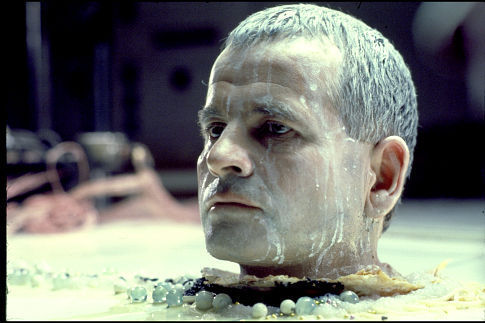
Alien (1979)

Ian Holm

Lance Henriksson

Scott also cleverly borrows from his own Blade Runner in the portrayal of David, who doesn’t possess Rutger Hauer’s maniacal desire to find his creator but does show more than a passing interest in the subject matter.

The script provides some explanation for why we started creating androids who are more than automatons:

Charlie Holloway: David, why are you wearing a suit, man?

David: I beg your pardon?

Charlie Holloway: You don’t breath, remember? So, why wear the suit?

David: I was designed like this, because you people are more comfortable interacting with your own kind. If I didn’t wear the suit, it would defeat the purpose.

Charlie Holloway: Making you guys pretty close, huh?

David: Not too close I hope.      

Scott bites off a little more than he can chew by adding an unnecessary twist at the end, and thereby rushing some scenes that could have been better developed.  It also has a few silly notes, like throwing in Rapace’s inability to get pregnant and having Rapace tell a crewmember he can’t bring a weapon because the mission is scientific . . . and he complies.  Come on!  Doesn’t he know that in space, no one can hear you scream?

Otherwise, it’s a very good picture, enhanced by the 3D.

 

This documentary is directed by Carl Colby, the son of the subject, former CIA Director William Colby. In all likelihood, therein lies the problem. Carl is torn as to which themes to stress, much as he is torn by the legacy of his father.  He settles on three.  First is a straight up documentary about a clandestine Cold Warrior who saved Italy from Communism and was critical to the Phoenix Program, eventually rising to the directorship of the CIA, where he was battered by Congress’s withering post-Watergate assault on the Agency.  Footage from Italy, Vietnam, and congressional hearings is provided, along with interviews of numerous members of the American power structure at the time, including Donald Rumsfeld, Bob Kerry, Bud McFarlane.  Bob Woodward and many others. This part is occasionally interesting, but since critical emphasis is placed elsewhere, the historical report lacks any real depth.

Carl Colby also presents a portrait of his family, with the strict and moralistic William Colby at the head, his wife Barbara at his side, as they were stationed from post to post. The interviews with Barbara Colby are affecting as she explains how her husband worked and the impact of Catholicism on his personality, and there are some charming vignettes, but we don’t get much of a sense as to how Colby interacted with anyone in the family.  Occasionally, Carl’s voiceover expresses disappointment about his father’s secretive nature, but there are no real insights.  Carl drops hints of various issues (an epileptic and anorexic sister, a late in life divorce), but they are only given the most cursory treatment (we never learn that, in fact, the sister died in 1973).  For a man “nobody knew,” secrets are to be expected, but we should get better from a son. 

Carl offers a third, more personal theme – the effect of having such a mysterious and enigmatic father. This aspect of the film is the weakest and most awkward. Very abruptly at the end, we’re informed that in 1996, Colby took a canoe from his Southern Maryland home after dinner and was found days later, dead.  The coroner concluded that Colby drowned after a stroke or heart attack. Carl does not provide an alternative theory though he strongly suggests the miserable, guilty William Colby did himself in, after some wine and clams(?)  Carl has been quoted as saying, “Call it whatever you like. I think he’d had enough of this life.”

Carl tells us – as he has in some form or fashion throughout the documentary – that Daddy wasn’t there for him, intoning, “I’m not sure he ever loved anyone and I’m not sure I ever heard him say anything heartfelt.”   Given the limited presentation, and in particular the absence of remembrances from William Colby’s other 3 children and his second wife, Carl’s view strikes me as unique.  Indeed, Carl told The Washington Post “I preferred the old dad, not the new . . . The old dad taught me how to sacrifice. The new dad . . . was just an ordinary guy with ordinary desires.”  That says a lot.  It is as if Carl has settled on his father as a dark, tortured soul and the coda to his life – a love affair with another woman that lasted 13 years that was by all accounts happy – didn’t fit his meme, so he ignored it.

The pushback on the gore porn of Saw, Hostel, etc . . . is in full swing.   The Paranormal Activity flicks, The Woman in Black, Trick ‘r Treat, The Last Exorcism, and now, The Innkeepers all fall in a sub-genre that emphasizes pace, suspense and the little things that do not require splatter, chunks of flesh and no possible hope of escape.

The Innkeepers is about a haunted Connecticut inn on its last legs.  Two slacker employees (there are 3 guests and the workers can’t manage to have clean towels for any of them), one of whom is working on a website trying to trumpet the inn as a haunted locale, do 12 hour shifts on the inn’s last weekend in operation.  Bored, and stoked by a guest (Kelly McGillis) who is some sort of amateur medium in town for a convention, the duo pass the time filming and recording the inn in an attempt to engage its ghost.  They succeed, and the patience director Ti West exhibits in getting to a truly scary payoff is impressive.

It’s not flawless.  The principals are a bit stilted, though they warm to their roles; the humor is not always humorous; the character development is not super; and I wish we were given a little bit more on the history of the ghost.  But the strength is the feel and that feel is well-represented in the trailer.

Also, one caution – remember Kelly McGillis from Witness? 

This is McGillis from The Innkeepers

Matthew McConaughey plays a smarmy, slick, charming southern lawyer . . . in every single movie he makes.  He does it again here, inexplicably drawling his way through a role as a hotshot Los Angeles criminal attorney retained to defend Ryan Phillipe, a rich boy accused of a brutal rape.

The entire film rests on selling you the real possibility that Phillipe is innocent.  And there is not one moment when you believe that Phillipe is innocent.

Look at him.  Guilty, guilty, guilty.

Now that the story is hosed, we’re left with McConaughey’s schtick, a motley crew of character actors without character (dewy-eyed Marisa Tomei, as McConaughey’s ex-wife prosecutor; tough old cop Bryan Cranston; hippie P.I. William H. Macy; and the peripatetic bondsman John Leguizamo) and “twists” so implausible that Director Brad Furman must have assumed the audience had checked out by the time of the reveals.

With Terms of Endearment, Broadcast News, and As Good as it Gets on his resume’, James L. Brooks commands the respect of viewing one of his movies, even if it was not well-reviewed.  So, I watched How Do You Know, the story of a 31 year old Olympic softballer (Reese Witherspoon) who is cut from the team and thereafter, alternates between two romantic futures – a freewheeling, rich, fun and unserious Major League baseball pitcher (Owen Wilson) and a nervous, polite, endearing corporate-type under federal investigation (Paul Rudd).  Rudd’s predicament stems from the wrongdoing of his father (Jack Nicholson) and ultimately, he must choose jail for himself or Dad.

The film is fine in parts, and it has its funny moments, almost all of which come from Wilson and Nicholson, but it doesn’t catch hold or intrigue.

The chemistry between Wilson and Witherspoon and more acutely, Witherspoon and Rudd, is just not there.  Wilson is his daffy, charming self (though as much a baseball pitcher as I am an astronaut), so he’s trying, but Witherspoon is horribly miscast as a jock who doesn’t buy into a future of love.  She is not at all jock material, and she seems to know it.  Her response is confusion.  This is a younger Sandra Bullock role.   And Rudd so overplays his mooning infatuation that you soon hope he does not get the girl and, in fact, is jailed.  Most times, Rudd’s sweet mug works, but too often in this movie, you just want to smack him in the mouth.

There’s also too many cutesy scenes and quirky characters, where everybody has the witty line.  The scene in a delivery room (Rudd’s secretary has a baby and gets a marriage proposal from a cookie cutter galoot) is so precious you may retch.  Even the relationship between Nicholson and Rudd, which has some pretty good laughs, is too broad and thus unconvincing.

There are, however, funny moments and some very good lines even beyond the ones in the trailer. And I’ve certainly seen worse romantic comedies.

I cover the first two pictures here: www.filmvetter.com/2012/04/30/paranormal-activityparanormal-activity-2-4-stars/

Nothing new to report, except that installment three is even scarier.  One particular trick of note:  while trying to capture the “ghost” on videotape and cover two rooms, our hero puts a camera on an oscillating fan, so it goes from left to right and back again slowly.  Brilliant.  Everytime you get that vantage point, you’re terrified of what will be in frame.

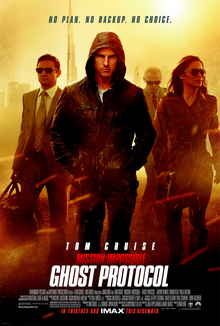
Cruise is BACK!  But is it likely you missed him?  His super spy Ethan Hunt is doggedly disinteresting.  So, fantastic action set pieces (a breakout from a Russian prison, a break-in and demolition of the Kremlin, a car chase in a sandstorm, a finale in a modern multi-story parking garage) are made less exciting because you’re not invested  The action sequences are first-class, especially a high wire act outside the Burj Khalifa, but if you don’t care if Cruise falls, does it matter?

Cruise spends huge chunks of this picture running really fast and very far (it’s more The Gods Must Be Crazy than Casino Royale).  Endurance becomes the primary facet of his character.  Moreover, 2/3 of his team (Paula Patton and Jeremy Renner) are very dull (Simon Pegg, as the technical wizard, is not and provides most of the laughs).

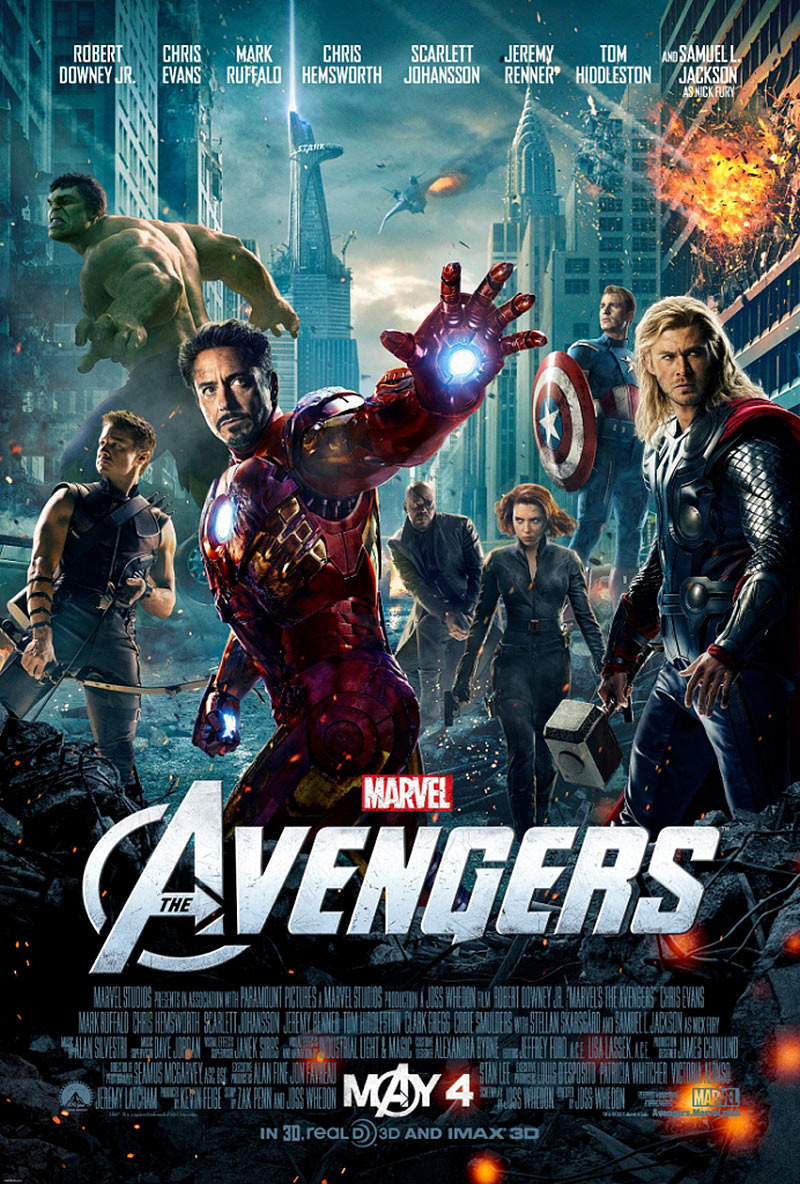
The Avengers (2012) - IMDb

With the exception of the upcoming Dark Knight picture, The Avengers is of the same stripe as the films previewed before it (Spiderman, Battleship) – loud, visually thrilling, punctuated by the wisecracks of people in a maelstrom, and … loud.  The Avengers includes a slew of Marvel characters, almost all of whom have had their own loud, visually thrilling films: Iron Man, Captain America, Thor and The Hulk join The Black Widow, Nick Fury and Hawkeye to fight Thor’s power-hungry brother Loki.  Since they are a varied group of personalities, they bicker, trade philosophy (Fury would be the Dick Cheney of the group; Iron Man the Barack Obama), and crack wise (Robert Downey’s Iron Man/Tony Stark gets almost all the nifty lines).

Loki comes to rule and it takes the Avengers fighting his flying army of space creatures in NYC to demonstrate that Earth is not some defenseless denizen of sheep.

Really though, he is not nearly scary enough (he looks like the second banana in Wham!) and you never get the sense he’s that big a threat.

The picture is dizzying, occasionally funny, well-paced but really, really long and immediately forgettable.