Five college kids – the jock, the stoner, the brainiac, the slut and the virgin – go away for a party weekend at a remote cabin in the woods. They are warned off by a creepy hick who runs the nearest gas station, but they are young and confident and will have none of his superstitious guff. In the cellar of the cabin, they find a diary, unlock a mystery, unleash a trio of zombified monsters, and . . . Well, you know the rest.
You don’t know the half of it. I thought the good reviews were the result of a reprise of Sam Raimi’s creepy, zany approach in Evil Dead and Evil Dead 2, with maybe some clever Kevin Williamson (Scream) thrown in. I was way off, though the picture does feel as fresh as those movies when they came out. Certainly, some of the lines are slyly self-referential, but wrapped around the standard “don’t go in the woods” approach is a whole different twist. I can honestly say I’ve seen nothing quite like it in the horror genre.
Producer/co-writer Joss Whedon is after my own heart in his summation of the plot: “On another level it’s a serious critique of what we love and what we don’t about horror movies. I love being scared. I love that mixture of thrill, of horror, that objectification/identification thing of wanting definitely for the people to be alright but at the same time hoping they’ll go somewhere dark and face something awful. The things that I don’t like are kids acting like idiots, the devolution of the horror movie into torture porn and into a long series of sadistic comeuppances. Drew and I both felt that the pendulum had swung a little too far in that direction.”
Again, I can’t say much, but of particular note are the contributions of Richard Jenkins (the ghost father in “Six Feet Under” and the beleaguered one in Step Brothers) and Bradley Whitford (Josh, from “The West Wing”). ‘Nuff said.
Judge Dredd is a mix of Soylent Green,Robocop, Escape from New York, and Assault on Precinct 1 – minus the scripts. A nuclear, environmental disaster has reduced American society to one massive city, spanning from Boston to D.C. Crime is rampant and police officers act as juries and executioners at the point of arrest, if warranted. Judge Dredd (a wasted Karl Urban, who played McCoy in Star Trek) and his new rookie partner (Olivia Thirlby), are called to a triple homicide in a massive skyscraper, public housing structure run by ex-prostitute turned drug dealer mogul (Lena Headey, the villainous Queen Cirse in “Game of Thrones”).
Her newest narcotic is slo mo, taken via inhaler, and it alters time for the user. Better, for the director, we get to see bullets slowly enter and exit flesh through the eyes of the drug users. Pretty cool.
I presume this picture is derived from a comic book or graphic novel and that the producers figured 90 percent of the audience would have some idea of the backstory or would not care. So, we learn nothing of Dredd (though human, he is less expressive and fleshed out than Peter Weller’s Robocop or even Schwarzenegger’s Terminator). Heady is cruel (she skins rivals and slaughters innocent bystanders). The partner lost her parents to nuclear-related cancer and she is nervous, this being her first day on the job. This is dystopia Okay. No chit chat. Let’s start shooting everything up.
Other than a brisk pace, nifty action, Avon Barksdale from”The Wire” (Wood Harris) and a few snappy lines, there’s not a lot to this movie, but it’s a worthy shoot ’em up.
Sylvester Stallone wrote this gem and wisely insisted on starring (possible replacing, if you can imagine, Ryan O’Neal, Burt Reynolds or Robert Redford), leading to many more Rocky movies, and some Rambos, and a dozen other mumbling portrayals. Say what you will about what it spawned, but Rocky is near flawless.
Rocky is a busted up club fighter living in the bleak hell that is mid 70s Philadelphia. He’s a sweet guy, but he is an admitted bum, getting a fight every few weeks and paying the rent by collecting for a local loan shark. We meet Rocky after a sixth round knockout of another bum nets him $40, and he’s just been unceremoniously evicted from his gym by its manager, Burgess Meredith. His best friend is a meat packing cretin (Burt Young) who lives with his paralyzingly shy sister (Talia Shire), who Rocky is sweet on. Rocky’s fortunes change, however, when the champion, a Muhammad Ali figure named Apollo Creed (Carl Weathers), has a ranked contender drop out from a well-promoted fight. Creed fixes on a gimmick – give a nobody – the “EYE-talion Stallion” – a shot at the title.
This is often heralded as the quintessential boxing movie, but boxing is secondary to a moving, beautiful love story between Shire and Stallone, and the portrayal of a Philadelphia so cruel and cold that Rocky seems like its only validation.
Shire is so withdrawn, a character taunts Rocky, suggesting she is “retarded.” She is not, but she is painfully muted. Rocky’s persistence, and the innate sweetness in him, pulls her out. The scenes of their first encounters, and particularly, the scene where he takes her on a first date, are realistic, poignant and heart wrenching. As they come together, you can see that each provides the other a confidence and support they’d never known. Stallone and Shire share a haunting chemistry of losers, and their story really is the movie.
As is the city. Director John Avildsen uses the gritty corners and grimy haunts of poor and working class Philly and the verisimilitude contributes heavily to the drama. Rocky lives in a hell, where folks sit on the cold streets, trash is strewn everywhere, and it is not enough to ignore someone – you must abuse them. So, Rocky’s loan shark boss has a driver who mocks Rocky mercilessly. When Rocky tries to tell a neighborhood girl to get off the streets or she’ll get a “rep,” she responds, “Screw you, creepo” and when he is kicked out of his gym, Burgess Meredith humiliates him publicly.
Of course, when Rocky gets his shot, Meredith, hat in hand, comes to help. The result is one of the most beautiful scenes in Hollywood history:
The picture received 10 Oscar nominations, including ones for Stallone, Shire and Meredith, and it deservedly won Best Picture.
The only fault is the fight itself, which is hampered by fighters who look buff and have some moves (Weathers simulates a nice stinging jab), but unrealistically degenerates into a clumsy brawl. While Avildsen does the best he can with the budget (a mere $1 million shot in less than a month), his interspersing of stock arena footage cannot save the fact that the Rocky-Apollo fight looks very small indeed, and you can see empty seats in the background of various shots of the fighters. Given the budget and the quick pace of filming, these weaknesses are easily overlooked.
There is no more overrated talent in Hollywood than Oliver Stone. His career is supported by the twin pillars of excess and machismo, encased in a childish political ideology that reveres Chavez and Castro but reviles Bush. Three of his films – U Turn, Alexander and W – are mind-numbingly awful, The Doors ends up, like its protagonist, a bloated mess, and even some of his more solid films (Platoon, Wall Street) age very poorly with the simplicity of their characters and binary nature of their struggles. Born on the Fourth of July has its moments, but it’s propelled by Tom Cruise’s sweat glands more than anything else. JFK and Nixon are better, but they are no more than historical cartoons and do not wear well with time either. And why Stone is lauded for the abattoir that is Natural Born Killers has always escaped me.
So, where can a garish, shallow auteur obsessed with manhood and devoid of nuance find his milieu? Professional football.
Al Pacino is the coach of the Miami Sharks, world-weary and past his glory (in Any Given Sunday, you win Pantheons, not Super Bowls, and Pacino has won 3). His mentor, the team owner, is dead, and the franchise is now run by the owner’s daughter, Cameron Diaz. His star quarterback, Dennis Quaid, is breaking down, and after a mid-season injury, Pacino must rely on a selfish, gifted third stringer (Jamie Foxx). Pacino must teach Foxx how to run the team, to leeeaaaaaddddddd, and in the end, how to become a better man. As he does it, a whirlwind of images (Lebaron, Lombardi, Tittle, Unitas) whoosh by, and then there is lightning and thunder claps. It’s pretty heady and kind of exciting if you don’t dwell on how stupid this all is.
Stone doesn’t give you much time to dwell because the picture moves like a freight train even while capably handling numerous subplots. There’s the star linebacker (Lawrence Taylor, who does a fine job), literally one hit away from paralysis, yet one tackle away from a $1 million bonus. There are the team doctors (James Woods and Matthew Modine) who square off because Woods lets the players play with dangerous injuries and Modine objects. There is Quaid and his driven wife (Lauren Holly) who will not give up her throne as the quarterback queen, even slapping Quaid when he suggests he might have to retire because of injury. LL Cool J is a the selfish RB, all about “getting mine” and Aaron Eckhart is the whiz kid offensive coordinator, stunted under the old school style of Pacino.
We get games in monsoons, whiz-bang on field collisions, gruesome injuries, frenzied and ferocious linemen, hot Miami chicks galore, perfect spirals, and more. There is also a hell of a pep talk by Pacino, alternately absurd and inspiring–
Beyond the speeches, there are nice exchanges in the script, such as this one between Foxx, who is just starting to show his chops, and Pacino, where Foxx explains the other side of the schmaltzy, “no I in TEAM” crapola
FOXX: You can feed the press that whole sacrifice and glory-of-the-game crap. But I been there. I seen a long line of coaches… with that same old bullshit halftime speech … You know it’s bullshit because it’s about the money. The TV contracts, fat-cat boosters in the skyboxes. Coaches trying to up their salaries. You looking for the next black stud to take it to the top 10. Get you in a bowl game. It’s the same way in the pros. Except in the pros, the field hands get paid.
PACINO: Don’t play that race card on me, kid. 25 years I work with men of your color.
FOXX: Maybe it’s not racism. Maybe it’s placism. Brother has to know his place. Right, boss?
PACINO: I don’t understand what you’re talking about. You don’t trust anybody because of what happened in college? You knew the rules. You were the one that broke them.
FOXX: How did I break them? How? I lost a million-dollar signing bonus because I took a $300 suit from a booster to go to a wedding. What’s a brother supposed to do in college? He ain’t got money. He wants to go out on a date. Wants to get some nice clothes. Everybody had their hands out but it was me they suspended. I dropped six rounds in the draft because of that. The coaches labeled me: “He’s trouble. He don’t wanna play ball.” You talk about sacrifice. I sacrificed $10 million because dumb rednecks like the coach in San Diego made me a cornerback because I got quick feet. He separated my shoulder tackling 250-pound motherfuckers. I don’t do that! I was a great football player. But nobody let my shoulder heal, and they traded me out of there.
PACINO: You go ahead. Blame everybody but yourself.
FOXX: Whatever.
PACINO: Because that’s what a leader’s about. Sacrifice. The times he’s gotta sacrifice because he’s gotta lead by example. Not by fear and not by self-pity.
FOXX: Who you think you’re talking to? Half my career is over and you want me on the bench.
So, I like this film very much, and I like it even more every time I see, which never happens with Oliver Stone flicks. That does not, however, mean it is a good film.
For example, Oliver Stone cannot write women who aren’t whores or connivers, but at least here, he concedes the point and just makes Diaz a mannish ballbreaker. Her character is the most macho one in the film, which is not a good thing.
Stone also could not or would not get the rights to use actual NFL franchises/logos. I’m sure the cost was prohibitive or perhaps the NFL didn’t really want its brand tarnished. But if you’re going to make up teams, the Dallas Knights need to have uniforms a little less ridiculous than this:
“I shall tackle thee, m’lady”.
Stone also casts himself as a sports announcer so he can say “Holy Cow!” or “What a play!” But Stone does not have “the voice” and he sounds like he’s eating sunflower seeds. It’s not as bad as Spike Lee playing a reporter in Summer of Sam but it is pretty bad.
The theme is also oppressive. Men and lost fathers are everywhere. Foxx is fatherless, Pacino lost his in WWII, Quaid is a little boy in Pacino’s hands, Diaz was the son her father never had. All of this is served in one big syrupy ladle.
Last, in the final game, a dude’s eyeball is knocked out of his head. Come on.
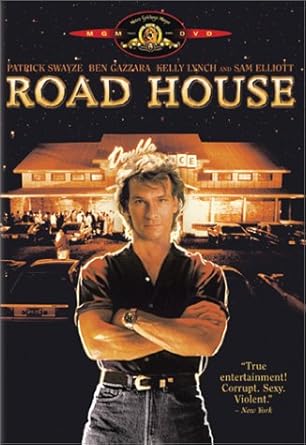
A small town is run by the ruthless Ben Gazarra, who shakes down the local businesses to support his decadent lifestyle. He lives in the gaudiest mansion, and he is surrounded by a thick, loyal squad of yokel goons. He also has a few 80s trashy blondes in his coterie, like Julie Michaels–
Interesting note on Julie. Roadhouse was her debut. In her subsequent roles, these were the names of her characters: Naran Anie, Professor, Professor (uncredited), Accident Victim, Accident Victim (uncredited), Sandy, Mom, French Patron (uncredited), California Blonde, California Blonde (uncredited), Pedestrian, Female Bar Patron #2, Barrista, Fashion Show Patron, Florist, Slutty Woman, Female Fan, Julie Mermaid mother, Harem Girl (uncredited), Groupie (uncredited), Female Club Goer, Maggie, Woman on Bike, Laundry Wife, Marilyn Monroe #2, Catherine Moore, Caitlin’s Sister, Frat Girl, Woman (uncredited), Vampire, Jane (uncredited), Catherine, Tami, Sillicate UC, Cage Dancer, Agent Elizabeth Marcus, Susan, Irene, Waitress, Waitress (uncredited), Amy Cutler, Freight Train, Susie Q, Cinnamon.
I digress.
One business won’t knuckle under to Gazarra – The Double Deuce. Instead, bar owner Kevin Tighe calls in a zen master bouncer with a degree in philosophy (not joking – the script references that the professional bouncer has a degree in philosophy from NYU). That bouncer is Dalton (Patrick Swayze) who stands up to Gazarra, calls in a bouncer compadre (Sam Elliott), cleans up the bar and the town and says all of the following:
“Pain don’t hurt.”
“Nobody ever wins a fight.”
“My way… or the highway.”
“All you have to do is follow three simple rules. One, never underestimate your opponent. Expect the unexpected. Two, take it outside. Never start anything inside the bar unless it’s absolutely necessary. And three, be nice.”
“Take the biggest guy in the world, shatter his knee and he’ll drop like a stone.”
“You’re too stupid to have a good time.”
“It’ll get worse before it gets better.”
Roadhouse also features Kelly Lynch, the emergency room physician who patches Dalton up.
The year this picture came out, she was in Drugstore Cowboy. I wonder which film she is most proud of? Regardless, I’ve had stitches like 5 times and there’s never a Kelly Lynch at the emergency room. Ever.
By now, Roadhouse has become a cult classic, but when I saw it, I knew it was something special taken at face value, no sniggering. To this day, I can’t stop watching it. It’s an awful film, and the inquiry should end there, but there is such earnestness in the effort that at 2 am, having just had 5 beers and a half bag of gummy bears, when Swayze says
“I want you to be nice until it’s time to not be nice.”
I’m like, “Hell, yea. Dalton. That’s some heavvy ass shi**!”
I’m not much for sports hokum. The elegiac bunk of The Natural, Field of Dreams, or even Any Given Sunday reveals more about the filmmakers’ insecurities than the game being played and the characters who play it. But even I am not immune from hokum anchored by Gene Hackman and based on the true story of the 1954 Indiana state high school basketball champions from tiny Milan.
Hackman is the new coach with a dark past, bringing a fundamental style of play and stubborn ways to a cloistered small town that does not want him. Barbara Hershey is the teacher leery of his influence. Their conversations about what constitutes success are smartly written (she loathes the small town, plans the escape of her students and views Hackman’s” hoop dreams” as an anchor keeping young men from getting out). Dennis Hopper is the alcoholic assistant coach, redeemed in the eyes of his player son as the team battles adversity. David beats Goliath, and the music swells along with the heart.
The performances are all strong, and the casting of the fresh-faced team is perfect. The boys, town and milieu feel 1950s, as does the play, and the boys can play. One only needs to watch the overrated White Men Can’t Jump to realize the foolishness of casting non-players; Woody Harrelson is passable, Wesley Snipes ludicrous. The film is also chock full of inspiring and exciting vignettes as the boys march forward to victory.
Hackman is commanding, in his sparring with Hershey, when he confronts the team’s star player, who is in the middle of a 1950s version of a holdout, and in his handling of the overbearing townsfolk. I also like his simple, homespun speeches:
Ah, Bobby Knight.
This one is better:
There are a few problems. The love affair between Hershey and Hackman seems both improbable and awkward. I no more want to see him kiss a younger woman than Tommy Lee Jones. The score is also very 80s, stirring but techno infused. But it’s still one of the better sports films made.
Barry Levinson’s 1982 classic about a bunch of young guys in 1959 Baltimore is not only a brilliant ensemble period film, but it heralded a new form of comedic art. The film is best explained in this Vanity Fair piece , which I highly recommend and which makes any substantive review on my part superfluous —
Whit Stillman films are similar to Woody Allen films if you dispense with the angst and replace older urban New York Jews with younger urban New York prep school/deb type WASPs. Also, toss out the whole “big notion” premises of death, morality and faith and replace them with passing fashion, pop culture, and functional philosophy. And since Stillman does fewer films than Allen, listening to the witticisms of attractive scions of varying degrees of wealth as they contemplate their navels is neither grating or played out.
Stillman directed two prior films, Metropolitan and Barcelona, the former dealing with New York City private high school kids and the latter taking two of those characters and transplanting them to liberal, carnal Spain. If you’ve seen Metropolitan and Barcelona, this is similar in tone, content and style. However, this one is a bit more fun loving and free, as it chronicles the fall of disco in New York City through the eyes of several fresh out of college young urban professionals (though the moniker of “yuppie” is hotly debated) who negotiate their first jobs (publishing house, advertising, prosecutor’s office, environmental law firm) during the day and cruise the disco at night. It’s also a little more personal. Even though Stillman has a usual ensemble cast, which thankfully includes the brilliant Chris Eigeman, in this film, Chloë Sevigny is our primary guide and with her we suffer the perils and awkwardness of casual sex for an intellectual frump in the 80s. It is painful indeed to watch her seduction tecnhiques, which includes a breathless, “There’s something really sexy about Scrooge McDuck.”
As in all Stillman films, the conversations that meld college bull sessions and comparative literature courses are the gems, such as this back-and-forth on Lady and the Tramp.
William Friedkin is apparently “back” with his black crime picture Killer Joe, but he never really went away. I suppose what critics mean about Friedkin’s return is that he’s “back” in his 1970s The Exorcist and The French Connection form, the one-two punch of Friedkin’s career. These films are nothing to sneeze at, the former being the greatest high-brow scare flick ever made, the latter number 93 on AFI’s top 100, but since those halcyon days, Friedkin suffered his Heaven’s Gate (Sorcerer); helmed some off-kilter duds (Deal of the Century, a black comedy about arms dealers with Chevy Chase (?)) and Bug (here’s the IMDB set-up so you can run quick to your Netflix queue — “An unhinged war veteran holes up with a lonely woman in a spooky Oklahoma motel room. The line between reality and delusion is blurred as they discover a bug infestation”); and delivered a gripping, underappreciated crime picture that utilized the musical stylings of Wang Chung for the score (To Live and Die in LA).
Rules of Engagement, an effective, thoughtful, political potboiler about a Marine officer (Samuel L. Jackson) tasked with protecting an American embassy under siege in Yemen. In extricating embassy staff, the ambassador (Ben Kingsley) and the ambassador’s family, Jackson gives the order for his men to fire into a crowd that includes women and children. For that act, he is brought up for court martial and must rely on his Vietnam pal (Tommy Lee Jones) who is squaring off against a tough, determined prosecutor (Guy Pearce). The shooting is recapitulated from various vantage points, the characters compellingly provide their assessment of what happened (of particular note, Blair Underwood, who was probably too good looking to be a bigger star, is excellent as part of the Marine contingent), and political skulduggery is uncovered.
The picture moves fast, alternating between flashbacks of the shooting, courtroom drama and a sojourn back to ‘Nam. It is also topical and adult, reluctant to direct us to any pat conclusion (Stephen Gaghan wrote it, and followed it up with the Academy Award winning Traffic and the Academy Award nominated Syriana). Jackson and Jones are not exactly breaking new ground here, but they are very good actors who know what to do with the material. Finally, with the exception of Kingsley (whose imperiousness and cowardice are cartoonish), all the characters feel real. Roger Ebert disliked the film, noting, “At the end we have a film that attacks its central issue from all sides and has a collision in the middle.” That’s exactly true, and it is the movie’s strongest attribute. There is no assured resolution of many of the issues it raises, but the story at the center holds you to the point where you can come to your own conclusions. The political shenanigans at the end feel very tacked-on, but otherwise, this is a strong movie.
Of course, anything less than a full filmic indictment of the Jackson character was enough to send some reviewers into apoplexy. Hence, Michael Atkinson from The Village Voice: “William Friedkin‘s bathetic flag-fucker Rules of Engagement is as dogged and concise an apologia for using militarist might to control civilians as any City Hall publicists could ever concoct . . . . Who’s talking this neo-con psycho-talk, exactly”? Given that, as noted, Gaghan wrote it and was pilloried later by the right for his allegedly lefty take in Syriana, consider Atkinson’s broadside a strong recommendation indeed
I’ve had the misfortune of watching this movie twice (I endured it because I remembered a better film). Mel Gibson had his own cut, which was better than that of director Brian Helgeland (screenwriter for LA Confidential), though still pretty bad. The picture is a loose remake of John Boorman’s 1967 Lee Marvin vehicle Point Blank. The story is uncomplicated. A crook (Gibson) pulls of a heist, is double-crossed by his girlfriend and partner and left for dead. He does not die, but returns, to collect his share of the money. It turns out his partner used that share to buy his way back into “the Syndicate,” so Gibson works his way up the chain, killing folks up a higher level of authority until he gets to the top. The original was arty, tough and noir, and Marvin’s anger convincingly propelled the simplistic plot, which culminated in a cool shoot-out in then-abandoned Alcatraz.
Gibson’s version exchanges San Francisco for Chicago, tough for brutal, and noir for ostensibly hip (which, as defined by Gibson, is taking every opportunity to smack women and crunch bones). While Gibson throws in a touch of humor in the plot, his performance is leaden. He emulates Robocop and The Terminator, not Marvin.
Gibson’s version ends better (he uses a kidnap of the top Syndicate man’s son to get at him, while Helgeland settles for a lame shoot-out on a Chicago train platform), but it’s a pointless endeavor. The only redeeming qualities are some wry performances as criminal lowlifes by Gregg Henry, James Coburn, William Devane, John Glover, David Paymer and Lucy Liu.