Archive

Rating

Licorice Pizza' Review: Blossoms & Waterbeds | We Live Entertainment

When I was in grade school, I had a crush on a girl in my class. I learned that she rode horses down at stables about 3 or 4 miles from my house. Such was my infatuation, and obviously unable to share my feelings in the unforgiving world of Catholic grade school, during the school year on the weekends, I would regularly take my bike down to where the stables were, an area completely unfamiliar to me in Rock Creek Park D.C., on the minor chance that I might see her. As a testament to my persistence, this behavior continued into the summer months. I never did see her, but I never lost hope, and I met scads of other people in my travels and got into many adventures.

Paul Thomas Anderson’s Licorice Pizza is a nostalgic delight, and watching the movie, I felt the feelings of that time. Not only did it touch this old crusty heart and its buried 5th grade crush, but it also evoked the freedom I had in the 1970s. I could do pretty much anything. My parents were tangential to my daily life. I was an unsupervised Huck Finn, floating from place to place and not expected to be seen until dinner time, if then.

I recently got together with a friend of mine (he was one of thirteen kids, I was one of five), someone who I grew up with through grade school and high school, and we were laughing about the stupid stuff that we did as rudderless vagabonds. One thing seems small, but if it occurred today, it would probably involve investigations, the police, and the local news jamming a camera in some guy’s face as he was hustled, handcuffed, to the paddy wagon.

My friend and I would regularly walk the streets and in to schools and buildings and any old place that had an open door (we’d also dig through trash, searching for the Holy Grail of a Playboy magazine or something cooler). As we ambled into one church school, we met a janitor, and we just started to walk around with him. We returned the next day and then most late afternoons to help him clean up, and then he would buy us a Coke or a candy bar from the machine. We didn’t know him and he seemed like a bit of a hippie. He didn’t think to say, “Get out of here, this is my job.” He was a pretty nice guy and there were no shenanigans. And for the life of me, I can’t remember why we stopped, but we probably just moved onto the next thing.

But that was standard. I had other grade school friends who would sing with me in front of the Hamburger Hamlet – and none of us could sing – hoping someone would throw us change. When one of their streets was blocked off for a traffic rerouting, at night, we would drape our bodies over the barricades as if we had been murdered, just to get people out of their cars when they hit the dead end. Stupid stuff, pre-booze. You were on your own and unfettered with no one to evaluate the logic or wisdom of your choices.

Licorice Pizza brought those days back. We are introduced to 15 year old child actor Gary Valentine (Cooper Hoffman) and 25 year old Alana Kane (Alana Haim), both of whom live in Southern California in the era of the oil embargo. Valentine is a minor celebrity, but his acting star is waning as he develops into the ungainly teen in all of us. He is, however, nothing if not persistent (he winningly describes himself as a “song and dance man”), and soon, after establishing a connection he believes is true love with Alana, he establishes a waterbed business and then a pinball palace, all with a troupe of young acolytes, including his brother, and mainly with the participation, if not direction, of Alana.

Theirs is a beautiful love story, mostly unrequited, with both protagonists suffering the pain of watching the other flirt or more with others. Gary is a mature 15-year-old, a fiercely independent romantic who loves Alana and at the outset, has no problem saying it. Alana is an immature young woman, constantly beleaguered by her surroundings and her family, who fiercely fights the fact that she is bound to Gary. When you see them hurt each other, and Thomas Anderson subtly places you in the frame, you watch their expressions when they see the other with someone else. Again, I was transported to my youth. I felt the pain when someone you really “loved” in grade school or high school hurt you, almost assuredly unconsciously, but sometimes, with purpose. Your armor wasn’t there, your “cool” undeveloped. It stung. A scene where Gary calls Alana knowing that she has been out on a date with his older friend, where his breathing communicates his anguish, is a beautiful and piercing reminder.

The film is a joy. A breezy, journey through 1973 Southern California, where Alana and Gary come to terms with their attraction, while essentially getting into adventures, including not only the aforementioned businesses, but run-ins with, of all people, Hollywood producer and former Barbra Streisand boyfriend Jon Peters (Bradley Cooper, demolishing his scenes) and who appears to be a very close facsimile to William Holden, Jack Holden (Sean Penn) (the film’s Jack Holden starred in the film The Bridges at Toko-San rather than The Bridges at Toko-Ri).

The look of the film is so spot on your jaw drops. Little things, like the old fancy neighborhood restaurant and pub, The Tale o’ the Cock, feel exactly like the restaurants and bars that populated my old neighborhood growing up, and I did not grow up in the San Fernando Valley. The dark wood, the wine bottle glass windows, the lattice. Perfect.

The performances are relentlessly good. Hoffman, the son of the late Philip Seymour Hoffman, has a presence that you could see in his father as early as Scent of a Woman and Nobody’s Fool. Haim, a member of the band Haim, it’s so raw and natural it may be difficult for her to expand. I’m just having difficulty seeing her in another role.

tt’s almost inconceivable, but this is the first film role for both actors.

The best film of the year and one of the best I’ve seen in some time.

Don't Look Up (2021) - Spoilers and Bloopers - IMDb

Alternate title.

“I Am Smarter Than You.”

Adam McKay, the talent who brought you Anchorman and Talladega Nights, is indeed smarter than you and the cross he must bear is that he is cursed to live in a nation of Luddites and buffoons. If you chortle and nudge your partner knowingly during this ball of crap, and maybe even raise an “it’s funny because it’s so true” eyebrow, there is an 87% chance you have a “ If you are not appalled, you are not paying attention” bumper sticker on your car.  So, if you sport that message, or its kin (“Hate Has No Home Here”), this is a must watch!

Added bonus with McKay? Now, he’s not funny.

Two scientists, a clueless Leonardo DiCaprio and a droll Jennifer Lawrence, learn that a meteor is hurtling to earth. When they sound the alarm, every caricature of the fevered dreams of a rich Hollywood do-gooder is introduced, each dumber or more racist or venal or crass than the next, all in service to an obvious, endless sermon poorly masquerading as a black satire.

McKay is the whingy douchebag who used to tack on political messages to films like The Campaign, where Will Ferrell punched a baby and a dog, and The Other Guys, where Will Ferrell played a fastidious NYC detective who was given a wooden gun. It was a fey conceit you could overlook because it occurred during the credits and you were walking out of the theater after watching some boffo fart humor (and here, I kid not – McKay’s Step Brothers is a modern classic, and a lot of McKay’s earlier stuff is the creme de la creme of fart humor).

But now, after some success outside the realm of farts (The Big Short, Vice), he’s made his hobby the main course.

Cringe bad. On Netflix.

West Side Story' Is Not for Puerto Ricans Like Me

Steven Spielberg‘s vibrant, fluid update subtly modernizes but stays traditional to the original in all the right places.  The “daddy-o” is largely excised but the film still feels like a night at the most expansive Broadway theater.

To be fair, it’s hard to miss the mark too wide with such rich source material. Unlike most musicals, in West Side Story, no number is unmemorable. There isn’t even one that is weak.

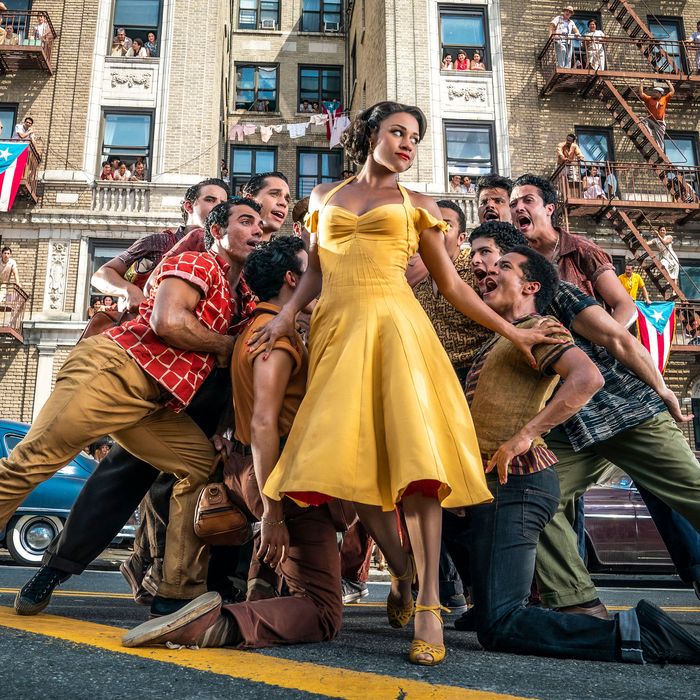
The dance at the gym and “America” are particularly good. In the first, Tony and Maria do not melt into the frantic gyrations of the Jets and Sharks, but rather are drawn beneath the bleachers, where, smitten, they have a charming conversation. Before the scene becomes too standard, a snap of Maria’s fingers beautifully cements their attraction and we are returned to the fantasy of dance. In the latter, the call and refrain of the Sharks as to the merits and drawbacks of their new home starts small in an apartment and blossoms in a wondrous, joyful romp culminating in the intersection of a city street.

Screenwriter Tony Kushner (Angels in America) makes several changes to the original, placing the gangs in the peril of urban renewal, beefing up the role of Chino, humanizing Officer Krupke, and providing a critical backstory for Tony which tempers his infatuation with an internal struggle that explodes at the rumble. While more talky, none of the updating is balky or detracts from the music and choreography, which remains front and center.

Three nits. First, Tony (Ansel Elgort) takes a while to imprint. His first number (“Something’s Coming”) doesn’t help. It is geographically limited, stuck as he is in the basement of the drugstore, and Tony just feels a bit muted. It is only until he meets Maria that he starts to connect with the audience.

Second, Spielberg gives us a sparse “Cool”, and moves the song back to before the rumble. It feels like a missed opportunity.  The 1961 film placed the number after the killings, smartly delaying it from the stage play so the Jets could exercise their frustration and hate after the murders in a bravura ensemble dance. Here, the song is a little bit lackluster, and you pine for the highly stylized original, Worse, it’s Tony and Riff, a couple of Jets relegated to onlookers, gymnastically squaring off over a gun. 

Finally, the placement of “I Feel Pretty” is awkward, falling right after the rumble. It’s a delicate, ingenious number, but you are jarred to be placed into such a moment of hope and beauty given where Spielberg has taken you tonally just seconds before. 

Everyone is good and despite my fears, Rita Moreno as Doc’s widow never nears gimmick (she’s a lock for best supporting actress ). The picture is perhaps not doing as well as it would with a marquee name (Elgort is the best known of the young troupe and that ain’t saying much). But one can hope it makes stars, in particular, Rachel Zegler as Maria and Ariana DeBose as Anita. It is difficult to take your eyes off of either. Zegler was selected from over 30,000 applicants for the role and invests Maria’s innocence with a blossoming independence and steel that pays off ten-fold in “A Boy Like That.” DeBose is never less than commanding. And, unlike the original, they, like all the actors, expertly do their own singing.

James Bond: No Time To Die - Profile Poster | All posters in one place |  3+1 FREE

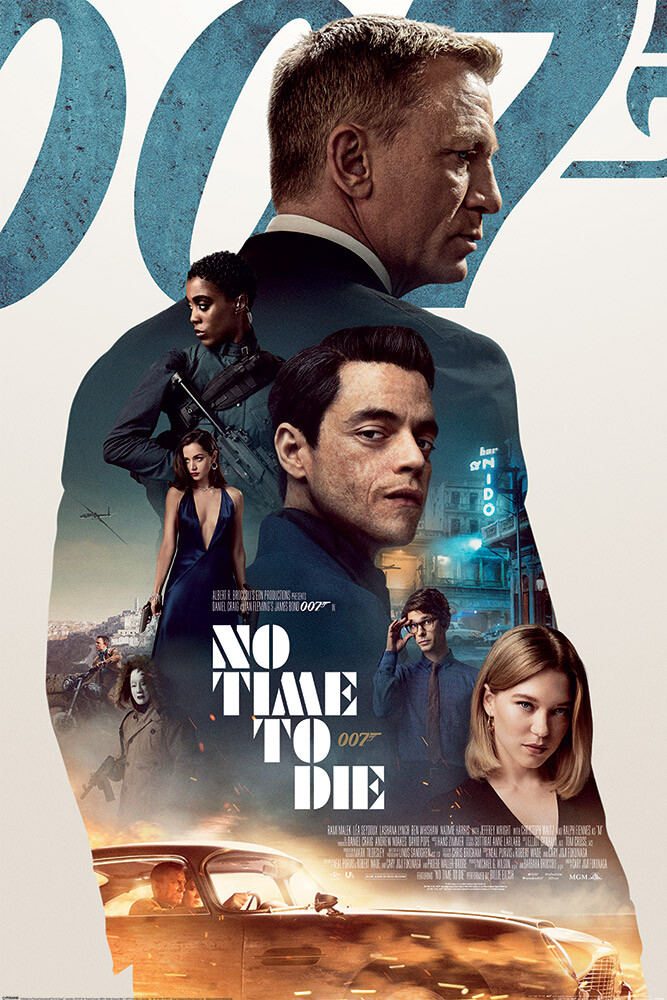
There seemed to be some concern that the new Bond movie would be overly feminized, what with the introduction of screenplay writer Phoebe Waller-Bridge (Fleabag) and two female agents, one of whom actually replaced 007 after his retirement, which is where we find Daniel Craig at the beginning of the film. Bond is in a doomed committed relationship again and this time, he’s ready to share his feelings about the love of his life Vesper and let go for his next chapter. Oh James, to open up and trust.

He’s the most feminine thing in the movie, which should have been titled “Eat Pray Blofeld.”  The female agents (Lashana Lynch and Ana de Armas) kick ass and take names and manage to be adept, vibrant and sexy in the process. But Bond has become introspective, gooey and even uncomfortably corny, throwing off a few puns that would make both Roger Moore and Mike Myers wince.

Worse, Bond’s love, Lea Seydoux, is dull as dishwater. There is not an ounce of chemistry between her and Craig, and when he stands at the crypt of Vesper to say his final goodbye, you conclude that poor Bond has settled. So vacant and unmemorable is Seydoux, I forgot she was in the last Bond flick.

To the extent Waller-Bridge has made the franchise more women-centric, it is not necessarily feminist in approach. Lynch is essentially window-dressing, her entire persona more catty neighbor than licensed to kill.

Nor am I stuck in the past. One expects Bond to undergo updating. Hell, Craig’s entry mercifully ended the silly Vidal Sassoon era of Pierce Brosnan and the merciless lampooning of Austin Powers in one fell swoop. But the feel here is much more sitcomish, which is not an easy fit. Am I supposed to take Lynch seriously when she kvetches over the loss of her 007 identification? Where is the female equivalent of:

The picture is also interminably and unforgivably long, almost 3 hours, and the primary villain, Rami Malek, is underdeveloped to the point where his grand design of destruction is an afterthought. He doesn’t seem that into it. As you are watching Malek and Bond verbally joust, you will juxtapose the wonderful back-and-forth between Craig and Javier Bardem in Skyfall with the philosophical exchange here and pine for the days of sharp, malicious repartee. Malek and Craig are in a titanic struggle to out-bore each other, and sadly, it’s a draw.

Speaking of boring, the title song by Billie Eilish is the most forgettable in the series. It sounds as if someone is trying to get you sexually aroused with a Gregorian chant.

There is also a Russian Larry, Moe or Curly, I can’t decide, a dastardly genetic engineer who bumbles through the entire picture unintelligibly. When you can understand him, you realize that he is aping the comic stylings of Yaakov Smirnov.

Finally, the end is laughably self important and schmaltzy, Bond as Christ.

On the plus side of the ledger, Craig is still winning in moments, the locales are fresh and lush, and a few of the action sequences (two car chases) are expertly filmed by Cary Joji Fukunaga (True Detective).  But even in the shoot ups, the film falters. No Time to Die continues the mistake of the last installment, Spectre, where there is no bullet fired from Bond at the furthest vantage point that will not immediately hit his target, Bond as John Wick.

A sad end to the Craig era.

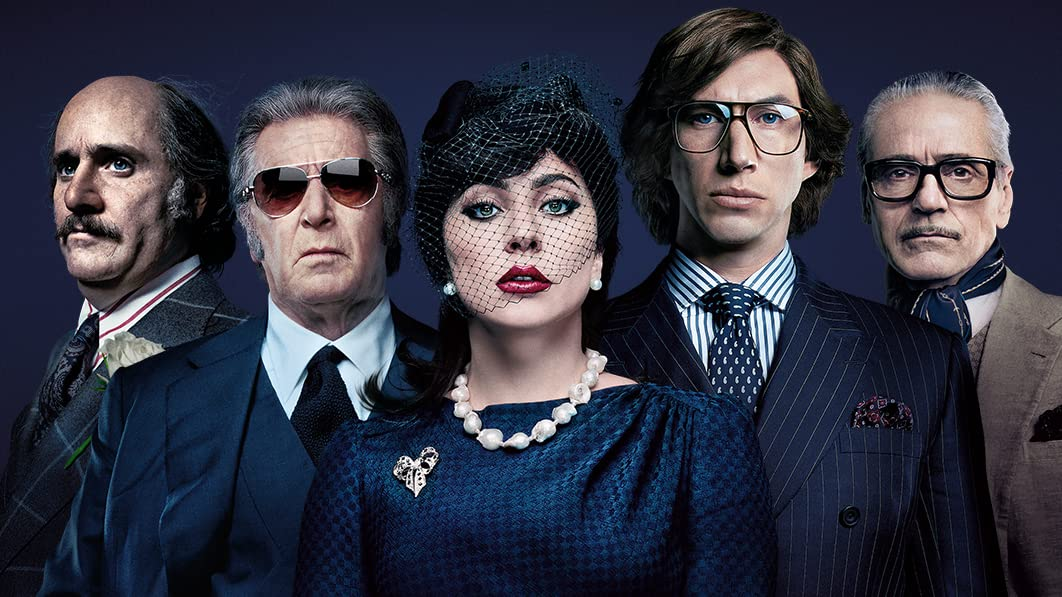
Ridley Scott would not seem to be the first choice to helm this story of an Italian fashion family’s tragica fine, but he does quite nicely, even without a canvas that would more naturally fit his visual talents. The Gucci empire, such as it is introduced to us, is a lucrative endeavor, but held in check by the natural infirmities of family and conservative stewardship. Enter the middle-class ambition of Lady Gaga, who marries Maurizio Gucci (Adam Driver) and then systematically steers him into fratricidal maneuvering. She opens the doors for massive expansion and wealth while also inviting the germ that will ensure no one in the family, including her, shares in it. It’s sad, sometimes very funny and black, and well-acted.

On the “well-acted” part, there may be some pushback, primarily because 1) none of the characters are Italian and 2) all of them give an Italian accent that sometimes nears Chef Boyardee (or, in the case of Jeremy Irons, lapses into Downton Abbey). Eh, it’s fine, and often, hilarious; there’s not a moment Jared Leto is butchering his accent that you aren’t transfixed (his comic turn nearly steals the film).

Apparently, Lady Gaga worked with a dialect coach to help her perfect the Northern Italian accent, which is ridiculous, because for the most part, she’s not speaking Italian, but rather, English with an Italian flair. No matter. She has advanced leaps and bounds beyond her energetic yet balky performance in A Star is Born. She’s the heart of this picture and as Lady Macbeth of the fashion industry, she’s ferocious and indelible.

You don’t have to rush to the theater for this one. There are no sweeping Scott battles, sea voyages or other vistas that must be viewed on the big screen. The film is made for streaming release and take-out pasta.

From 'Basic Instinct' to 'Showgirls': The rise and fall of the erotic  thriller

We were sitting down last night to eat Chinese, ready to watch the finale of The Alienist on HBO Max, when this popped on.  As I looked at my kung pao, and then at my wife, none too proud of myself, I asked, “Can we keep watching this until we see Sharon Stone’s genitalia?”

She acquiesced.

Sadly, that scene had passed, but we did watch the rest of the picture.  A few thoughts:

1) This is a “pre-proliferation of-internet pornography” picture, and even without the glimpse of Stone’s privates, I was impressed by the ample nudity (a lot of Stone, her girlfriend, and tons of Michael Douglas butt) and the extended sex scenes.

2) The film has aspirations to Hitchcock, but it is weak and often, hilariously mannered, and it essentially phones in any real suspense, substituting beautiful, inconvenient San Francisco locales for people to meet.

3) It is also rife with tropes, like the drunken buddy cop partner (George Dzundza), the sex so good your back gets scratched by fingernails, the hard-bitten cop who doesn’t need pencil-pushing headshrinkers messing with gut street instincts, and various versions of, “You’re way over the line, mister!”

4) It tries for a Suspicion-like ending but fails, with unintended comic results (how many times can Sharon Stone have an orgasm and at its peak, throw her hands down towards Douglas as if she were going to stab him with an ice pick?)

5) Michael Douglas has to be the most successful dick of a leading man in history,  Granted, he got his Oscar as Gordon Gekko, a true villain, but by leading man, I mean someone who is supposed to engender a smidgeon of empathy.  Sure, you felt bad for him in Fatal Attraction, but not really bad, even though a woman boiled his pet rabbit, kidnapped his child and tried to murder his family. He’s always at least half a dick.

6) The film has innumerable lazy turns, but my favorite is how no one ever takes Douglas “off the case” (sure, he is suspended, but he’s really up in the investigation all the way to his naked butt), despite sleeping with the suspect; killing her girlfriend (and providing a wildly implausible lie about how that happened); sleeping with his psychological counselor who works for the police; and beating up a colleague who later that night is found with a bullet in his temple.

Yet, the one time he is sidelined by his partner (“hey man, you can’t come up there with me, you’re suspended”), Douglas agrees and the partner gets fileted.

Plus, apparently, Douglas has “history” – 5 shootings in 6 years, two of which were tourists “caught in the crossfire.”

That’s one helluva a police union.

Anyway, the movie is bad, guilty pleasure watchable, and, as noted, overly dependent on Sharon Stone’s vagina.

Amazon.com: The Sand Pebbles [DVD] [1966]: Movies & TV

They really don’t make these kinds of films anymore. The broad, historical sweeping epics which found fashion in the 80s were for the most part not very good and none had any of the leisurely quiet moments or ambiguity of this picture. They blared big budget bloat and were neither smart or interesting. If you don’t believe me, give Gandhi, The Last Emperor, A Passage to India, The Mission, or Out of Africa another whirl without getting heavy-lidded. And if you want to venture into the 90s, three words of warning: Oliver Stone’s Alexander.  Or, Braveheart, The Patriot, Gangs of New York, Rob Roy, all blood and volume and ghastly excess. Titanic, beautifully photographed, with a script written for the mind of a chipmunk. Dances with Wolves? Lush, dull and uninvolving.

The 2000s? They remade Ben Hur into Grand Theft Chariot.

There are outliers. The Last of the Mohicans is very good and Master and Commander stellar. Gladiator is fun, but the fights and the CGI are what you remember.  

That’s about it.

The decline of the historical saga makes sense. The universality of social media and technology supplanted the novelty of on-site location in foreign, exotic locales, and today, perhaps the quickest way to shut down a pitch meeting would be to explain that your film opens in/with “China 1926” and is 3 hours long.

The story revolves around the American naval presence in China in the 1920s and the travails of one particular vessel, the San Pablo (harken back to an old history course and see if you can dredge up “gunboat diplomacy”). Steve McQueen is the quiet, unsophisticated engineer, a grit-under-your-fingernails loner who has a good heart. An impossibly young Candice Bergen is an American missionary schoolteacher who takes a liking to him. Their relationship is interrupted by her missionary father, who believes the  American presence is creating havoc and, naively, that they are immune to the brutalities of war, and McQueen’s captain (Richard Crenna), a by-the-book leader losing his grip on the men with a vainglorious streak that proves lethal. Then, there are the tensions amongst the crew (which includes Richard Attenborough, Simon Oakland and the just recently deceased Gavin MacLeod), as some settle on McQueen as their own bad juju Jonah.

The visuals are stunning, the drama authentic, even in the show-ier style of the time. There’s also great but subtle cynicism in the picture, which quietly indicts American imperialism and cultural bigotry while reinforcing its values, and it has a decided championing of the little guy, be he Chinese or American.

But what really struck me were the visuals and the leisurely pace.  To watch a movie on the big screen where the grandeur and beauty of a foreign land was a star equal to the actors and 3 hours at the movies was just ducky must have been quite something in 1966.

An aside; when I was was a kid, I’d come from grade school and religiously watch the 4 o’clock movie, which included this picture. To be precise, it included parts of this picture, because you had to fit it into 2 hours, with commercials.

The movie, directed by Robert Wise, was nominated for best picture, cementing McQueen as a star (he was nominated for best actor his one and only time here).

On Amazon Prime.

Turn the phone off, order Chinese and give it a go.

Meditative and deliberative, Director Karel Reisz gives us entree’ into the world of Axel Freed (James Caan), college literature teacher by day and degenerate gambler by night. Though it may be too much of a throwback for some, writer James Toback paints an anguished and multi-faceted portrait of a moth perpetually drawn to flame, a man who has internalized his addiction as a statement of freedom, verve and iconoclasm. However, Caan seems to sense he is a fraud, and as the film progresses, he gets himself into the kind of trouble where his family and not even his sympathetic bookmaker (a young, manic Paul Sorvino) can help.  It is here where the heart of the picture beats.  You watch Caan agonize, humbled, and then terrified as the wise guys become menacing rather than an ornament to his cool. Soon, there is a dawning, if not the expected one.

Caan is unsympathetic yet engaging, and he is always a star. He’s the grandson of a furniture magnate, and his mother is a doctor, and when things get very bad financially, he always has them as a crutch, an out, making his consort with flashy thugs and the more dangerous element of 1970s New York City a bit of a conceit. No matter what he wagers, his philosophizing about risk and chance is just so much b.s. because he high wires with a net.

But his net are people of substance – an up-by-your-bootstraps Lithuanian immigrant and a physician tending to the poor – and you can see his shame in comparison. It is Caan’s mother who, when bailing him out, reminds him of where his money is going, into a criminal element that preys on the weak.

It nags him, but he seems to revel in slumming, which includes his relationship with his Texas girlfriend, a very good Lauren Hutton, a good time gal who has been around the block and down into the sewer with an addict before. Her revelation of that journey and her eventual, limp, exhausted rejection of a spiraling Caan are piercing.

Caan is compelling as a self-deluding addict desperate to survive his debts and his own moral rot (he was struggling with cocaine when he made the picture). Toback smartly gives us the opportunity to watch him teach. Caan seems like a really good professor of literature, which is important because there has to be some “there” there in which to invest. When I heard they remade this film with Mark Wahlberg, I assumed the script was revised so he was a high school shop teacher.

Jerry’s Fielding’s soundtrack is spot on, evoking the dread and juice of gambling.

The ending is a bit rushed, but otherwise, this is a solid picture and a worthy third of the triple feature of California Split and Mississippi Grind. On Amazon Prime.

De Palma a la Mod

A behind-the-scenes vignette from this film distorts its true putrescence. As the story goes, before scenes, serious actor Sean Penn kept whispering to the out-of-place and in-over-his-head small screen star Michael J. Fox the words “television actor”, to either torment him or to rally him.

It didn’t work. 

That said, while there is no question Fox is terrible, his awful performance serves the purpose of obscuring a host of other faults in this debacle.

There are, for example, hideous performances all around. Penn is execrable, delivering a turn of overacting so extreme you can almost smell it. He’s like a whirling dervish of beef, brew and Old Spice. Young John C. Reilly, John Leguizamo, and Ving Rhames are near incompetent and, like most everyone, entirely unconvincing.

But no one was given anything very good to say anyway. The script by playwright David Rabe is so overt it hits like an ABC “After School Special.” A stagey “What are we doing here, Sarge?” is pretty much every line of the picture.

Rabe served in Vietnam as a medic, which just goes to show that experience isn’t always the best progenitor of art.

Watch and see if you can hold your breakfast. 

Brian De Palma’s direction is self-indulgent. I can think of few auteurs less suited for the verisimilitude of a period war picture than a guy who fetishizes Hitchcock. There is a scene where Fox’s fellow soldiers attempt to frag him by putting a grenade in the latrine where, for no reason other than an ostentatious build-up similar to the baby carriage in The Untouchables or the bucket of pig’s blood in Carrie, Fox has gone to attempt to light a cigarette, interminably. Because, when you want to smoke, no place is better than a Vietnam shithouse surrounded by big pails of excrement to enjoy it. His lighter won’t work and after trying it for the umpteenth time (maybe more than 15, he really wants that smoke), Fox drops it, and lo and behold, the grenade is reflected off of the lighter’s stainless steel.

A Vietnam picture is no place for this sort of arty playfulness.

It gets worse. When Fox survives, he sees one of his tormentors, Reilly, peeking at him from behind sandbags, and all I could think of was– 

The film also sports terrible art direction and location scouting. Vietnam looks like Disney’s Jungle Cruise, an incredible feat given some of it was shot in Thailand. Wherever they were, the actors were serviced by some of the best spas and salons available to them. I just never knew the combat experience in Vietnam was so tidy. Fox in particular looks like he was steam cleaned in every scene. Even when he has a head wound, his bandage is so brilliant white, it almost looks like a headband missing a feather. 

Finally, there is Fox’s height. In the old days, an actor’s short stature was taken into consideration. They’d put him on a hidden box, or shoot him from an angle that would favor him. Hell, in a tracking shot, they’d even build a trench for his leading lady as they ambled down the street.

Most film actors are short. 5’7″ seems to be the norm , but at 5’4″, Fox is diminutive, near tiny. Yet De Palma offered him no help. In the scene above, when Fox grabs a taller soldier, a “cherry”, by the lapels to chew him out, he looks like a toddler clinging to an adult’s overalls. Which is fitting, because for most of the film, with his childish, plaintive-comic mien, Fox presents like he lost his Mommy in aisle five of the Long Binh PX.  Yes, he’s short, but that’s not the whole of it. There is not an ounce of gravitas in the actor. “Oh, Jeez” sounds perilously close to “Oh Jeez, Mallory.”

The film is based on an actual war crime. What a woeful remembrance. 

With The Way of the Gun, writer-director Christopher McQuarrie assuredly expended the juice he’d earned writing The Usual Suspects to helm this noir-ish tale of a couple of fuck-ups (Benicio del Toro and Ryan Phillipe) who engineer a kidnapping with slapdash bravado and brutality. They have no idea the forces at play, and the greatest joy in the flick is their dogged aplomb as shit just gets worse and worse. These two losers are decent in the moment, but as exemplified in the movie’s best exchange, not exactly master planners:


Scenes like this one exemplify McQuarrie’s insistence on rejecting the cool in favor of the absurd. But that doesn’t mean he can’t direct an action sequence, and the final shootout is one for the ages. The film is also aided by Joe Kraemer’s moody, understated and anticipatory soundtrack (one of his firsts).