Archive

5 stars

Peter Jackson Reveals How Paul and Ringo Feel About 'Get Back' - Variety

Peter Jackson’s Get Back on Apple TV is a fastidious, thorough, fascinating look at how the band worked and communicated. Apart from being a monumental technical achievement, this 7+ hour flick is a gift to hard-core Beatles fans and maybe fans of pop music, in terms of seeing how the sausage is made by the greats. For everyone else, I suspect it will be Sominex with a laudanum chaser, but I’m a Beatles fan, so I totally dug it.

There is not much more to be said about the documentary, save for the live-blogging of the first two episodes (third to follow) by Xmastime blogspot, which is the funniest, most engaging thing I’ve read all year.

Licorice Pizza' Review: Blossoms & Waterbeds | We Live Entertainment

When I was in grade school, I had a crush on a girl in my class. I learned that she rode horses down at stables about 3 or 4 miles from my house. Such was my infatuation, and obviously unable to share my feelings in the unforgiving world of Catholic grade school, during the school year on the weekends, I would regularly take my bike down to where the stables were, an area completely unfamiliar to me in Rock Creek Park D.C., on the minor chance that I might see her. As a testament to my persistence, this behavior continued into the summer months. I never did see her, but I never lost hope, and I met scads of other people in my travels and got into many adventures.

Paul Thomas Anderson’s Licorice Pizza is a nostalgic delight, and watching the movie, I felt the feelings of that time. Not only did it touch this old crusty heart and its buried 5th grade crush, but it also evoked the freedom I had in the 1970s. I could do pretty much anything. My parents were tangential to my daily life. I was an unsupervised Huck Finn, floating from place to place and not expected to be seen until dinner time, if then.

I recently got together with a friend of mine (he was one of thirteen kids, I was one of five), someone who I grew up with through grade school and high school, and we were laughing about the stupid stuff that we did as rudderless vagabonds. One thing seems small, but if it occurred today, it would probably involve investigations, the police, and the local news jamming a camera in some guy’s face as he was hustled, handcuffed, to the paddy wagon.

My friend and I would regularly walk the streets and in to schools and buildings and any old place that had an open door (we’d also dig through trash, searching for the Holy Grail of a Playboy magazine or something cooler). As we ambled into one church school, we met a janitor, and we just started to walk around with him. We returned the next day and then most late afternoons to help him clean up, and then he would buy us a Coke or a candy bar from the machine. We didn’t know him and he seemed like a bit of a hippie. He didn’t think to say, “Get out of here, this is my job.” He was a pretty nice guy and there were no shenanigans. And for the life of me, I can’t remember why we stopped, but we probably just moved onto the next thing.

But that was standard. I had other grade school friends who would sing with me in front of the Hamburger Hamlet – and none of us could sing – hoping someone would throw us change. When one of their streets was blocked off for a traffic rerouting, at night, we would drape our bodies over the barricades as if we had been murdered, just to get people out of their cars when they hit the dead end. Stupid stuff, pre-booze. You were on your own and unfettered with no one to evaluate the logic or wisdom of your choices.

Licorice Pizza brought those days back. We are introduced to 15 year old child actor Gary Valentine (Cooper Hoffman) and 25 year old Alana Kane (Alana Haim), both of whom live in Southern California in the era of the oil embargo. Valentine is a minor celebrity, but his acting star is waning as he develops into the ungainly teen in all of us. He is, however, nothing if not persistent (he winningly describes himself as a “song and dance man”), and soon, after establishing a connection he believes is true love with Alana, he establishes a waterbed business and then a pinball palace, all with a troupe of young acolytes, including his brother, and mainly with the participation, if not direction, of Alana.

Theirs is a beautiful love story, mostly unrequited, with both protagonists suffering the pain of watching the other flirt or more with others. Gary is a mature 15-year-old, a fiercely independent romantic who loves Alana and at the outset, has no problem saying it. Alana is an immature young woman, constantly beleaguered by her surroundings and her family, who fiercely fights the fact that she is bound to Gary. When you see them hurt each other, and Thomas Anderson subtly places you in the frame, you watch their expressions when they see the other with someone else. Again, I was transported to my youth. I felt the pain when someone you really “loved” in grade school or high school hurt you, almost assuredly unconsciously, but sometimes, with purpose. Your armor wasn’t there, your “cool” undeveloped. It stung. A scene where Gary calls Alana knowing that she has been out on a date with his older friend, where his breathing communicates his anguish, is a beautiful and piercing reminder.

The film is a joy. A breezy, journey through 1973 Southern California, where Alana and Gary come to terms with their attraction, while essentially getting into adventures, including not only the aforementioned businesses, but run-ins with, of all people, Hollywood producer and former Barbra Streisand boyfriend Jon Peters (Bradley Cooper, demolishing his scenes) and who appears to be a very close facsimile to William Holden, Jack Holden (Sean Penn) (the film’s Jack Holden starred in the film The Bridges at Toko-San rather than The Bridges at Toko-Ri).

The look of the film is so spot on your jaw drops. Little things, like the old fancy neighborhood restaurant and pub, The Tale o’ the Cock, feel exactly like the restaurants and bars that populated my old neighborhood growing up, and I did not grow up in the San Fernando Valley. The dark wood, the wine bottle glass windows, the lattice. Perfect.

The performances are relentlessly good. Hoffman, the son of the late Philip Seymour Hoffman, has a presence that you could see in his father as early as Scent of a Woman and Nobody’s Fool. Haim, a member of the band Haim, it’s so raw and natural it may be difficult for her to expand. I’m just having difficulty seeing her in another role.

tt’s almost inconceivable, but this is the first film role for both actors.

The best film of the year and one of the best I’ve seen in some time.

With The Way of the Gun, writer-director Christopher McQuarrie assuredly expended the juice he’d earned writing The Usual Suspects to helm this noir-ish tale of a couple of fuck-ups (Benicio del Toro and Ryan Phillipe) who engineer a kidnapping with slapdash bravado and brutality. They have no idea the forces at play, and the greatest joy in the flick is their dogged aplomb as shit just gets worse and worse. These two losers are decent in the moment, but as exemplified in the movie’s best exchange, not exactly master planners:


Scenes like this one exemplify McQuarrie’s insistence on rejecting the cool in favor of the absurd. But that doesn’t mean he can’t direct an action sequence, and the final shootout is one for the ages. The film is also aided by Joe Kraemer’s moody, understated and anticipatory soundtrack (one of his firsts).

In America (2002) directed by Jim Sheridan • Reviews, film + cast •  Letterboxd

Ireland week continues in the Filmvetter household. Tuesday was Philomena. Last night, In America. Between them, I’ve crammed enough emotion in the pit of my stomach to fashion a golf-ball-sized tumor.

At least with Philomena, there were respites, where I could alleviate my welling up with some levity between Judi Dench and Steve Coogan.

Not so last night. I’ve seen many movies with incredibly poignant scenes and heartbreakingly rendered familial dynamics. There are scenes in Terms of Endearment that still create a lump in my throat. A friend, without warning, once recommended a Kevin Kline film, Life as a House, that I don’t know whether it was good or bad, but I do know it shattered me. And he knew my particular vulnerabilities. He knew I cried at Cocoon. He knew I cried harder at the Star Trek movie where Spock died, such that my wife was reduced to soothingly (no doubt, eyes rolling, as they should have been) imparting, “It’s alright. He comes back in the sequel.” But no warning was given, and Kevin Kline loses his job and gets a cancer diagnosis in the first 10 minutes, whereafter he reunites with his wayward son, and they build a house and Kline dies. Brutal. I hold the recommendation against him to this day.

I digress.

Jim Sheridan (In the Name of the Father, My Left Foot) portrays an Irish family escaping a tragedy to come to New York City in 1980. The parents, Paddy Considine and Samantha Morton, each deal with the loss in their own way; he shuts it off and turns inward, she insists the tragedy in no way hurt her daughters. They land at a run-down tenement where the drug addicts inhabit the stoop and an artist neighbor (Djimon Hounsou) screams and pounds the wall, plagued by his own tragedy. Given their innocence, their assimilation is nerve-wracking (the most harrowing scene being the playing of a carnival game) and uplifting, as they integrate into a community that is alternatively welcoming and hostile. It ends as an unforgettable fable, which allows for acceptance.

It’s the most beautiful film I’ve ever seen. I know I had seen it before, but I didn’t remember much of it, which seems impossible. I now assume it was so heart wrenching and piercing the first time that I probably wept uncontrollably and then did everything I could to ban it from my consciousness. Sheridan wrote it with his two daughters after his own personal tragedy, and their pain and tribute is stitched in the film’s marrow.

The performances are flawless (Morton and Hounsou were Oscar-nominated). The two girls who play the daughters (Sarah and Emma Bolger) give the most natural turns I’ve ever seen.

A gem.

My father introduced me to The Magnificent Seven when I was 7 years old.  We were channel flipping, and we sat back on his big red sectional and settled in with a bowl of candy corn and circus peanuts.  He told me the music was Elmer Bernstein doing Aaron Copland (he used to wake me and my brother up with “Fanfare for the Common Man” blasting from the hi-fi speaker set tailored made for a newly divorced man) and that the picture was based on a Japanese film. These tidbits were of no particular interest to me at the time. I was too busy trying to figure out who of the seven gunmen I wanted to grow up to be, and as the film progressed, I became increasingly alarmed at the potential demise of any or all of them. Indeed, as aptly put by one fan, “This is the sole reason we spent half of our preadolescence prancing around our houses with plastic guns, cowboy hats and an overwhelming desire to become heroes. Just like them.” 

50 years later, I have come to the somewhat disheartening realization that I grew up to be none of the characters.  Certainly not Yul Brynner, the cool as a cucumber King of Siam refashioned as a man in black.  Nor Steve McQueen, the steady, wry “talker” of the crew (I can talk, but rarely in McQueen’s pithy homilies). 

I never neared the lanky, laconic quick draw that was James Coburn, who utters the coolest line in film history

It gets no better than that, at 7 or 57.

Nor was I the brawny, decent Charles Bronson; the gold-greedy, laugh-having Brad Dexter; or the hot-headed kid who idolizes the crew (Horst Bucholz).  Now, there are times I have felt as cowardly and unsure as Robert Vaughn, but in reality, I ended up being none of those dudes. 

Half a century later, where mowing the lawn and an occasional campout are as close as I get to the frontier, I feel more like bad guy Eli Wallach, who runs into seven hired guns and damned if they didn’t all find Jesus at the same time. Wallach is a middle-management crook who steals what he wants from the peasants but otherwise, seems affable enough. And he can’t comprehend his bad luck. His last words, to Brynner:

“You came back for a place like this. Why? A man like you? Why?”


If you don’t know the film, the plot is simple.  Six professional gunmen and one wannabe sign up for a pittance to protect a poor Mexican town that is being repeatedly ransacked and worse by a band of thugs led by Wallach.  It is the best of 60s Hollywood.  Strong characters, tight dialogue, solid action, sweeping cinematography, a rousing score, liberal sentiments (“You think I am brave because I carry a gun; well, your fathers are much braver because they carry responsibility, for you, your brothers, your sisters, and your mothers. And this responsibility is like a big rock that weighs a ton. It bends and it twists them until finally it buries them under the ground”) presented in conservative reality (“We deal in lead, friend”), and, to boot, a girl and a boy fall in love

Two asides.  First, one has to hand it to director John Sturges for dexterous casting.  A Russian Brynner plays a Cajun, and proud sons of Berlin (Bucholz) and Red Hook (Wallach) play Mexicans. Ah. Simpler times.

Second, they loosely re-made this picture and the result was a filmic carbuncle.

On Hulu and sporadically, everything else.

Win A Copy Of The Gentleman On Blu-ray - Life of Dad - A Worldwide  Community of Dads

Guy Ritchie doing what Guy Ritchie does best, this is a rollicking, smart and often times hilarious caper film. The cast is fantastic, Michelle Dockery (Downton Abbey) personifies the modern meld of sexy and capable, the soundtrack rocks from the opener and Hugh Grant, who I used to deride as a pouty, hair flipping, mincing one-trick pony, shows why he is perhaps one of the best character/lead actors around.

On Hulu, Amazon Prime.

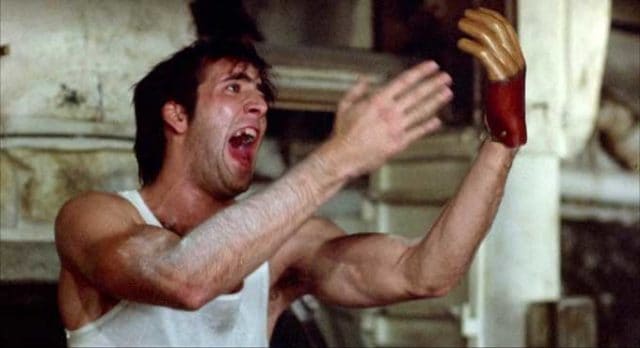
The Top Five Nicolas Cage Yelling Scenes in Movies

I had never seen this movie in its entirety, only clips (“MY HAND!!!!” and “Snap out of it”) or a few scenes.  It’s a charming film, made more so by funny and smart performances all around.  Every character, save for John (scene stealer) Mahoney, is an old country-linked Italian in 1980s Brooklyn, so I expected broadly comic, and there are some such scenes.  But for the most part, the film eschews “Mama Mia!” and instead, provides opportunity for Cher, Nicholas Cage (his weird instincts and passion are transfixing), Danny Aiello, Olympia Dukakis, Vincent Gardenia, William Hickey and others for a little introspection, some intelligent mugging, some surprising underplaying, and some truly tender moments. 

The picture feels almost like a long-running and beloved stage play.  I guess that makes sense, given it was written my renowned playwright John Patrick Shanley (“Doubt”).  Shanley snatched the Oscar for best original screenplay, and while I would have gone with Broadcast News, I’m okay with it. 

At 102 minutes, the film is also a shining exemplar of economy.  I laughed, I cried, and I didn’t need to go to the bathroom. 

Currently on Showtime.    

BB25D191-021E-46FC-9F3F-E4CB44B5B54C
This film is now on the HBO rotation and I surprised myself when I realized I hadn’t reviewed it. It is an exceptional picture, a crisp and intelligent thriller.

Michael Clayton (George Clooney) is an attorney at a prestigious corporate law firm. But he’s no legal eagle. Rather, he’s a “fixer “, a guy who can get you a heads up on an indictment or bail out the son of a big client for a drunk and disorderly. Clayton also happens to be a gambling addict with a host of debts.  This is Clooney’s best role. There’s not a hint of his bankable but often annoying, self-satisfied “you know, I’m acting” grin.

His entire persona aligns with the disappointments of his endeavors. As a fixer, he is anything but glamorous or intrepid. When called to the home of a major corporate client after being oversold by his managing partner, Clayton has to firmly tell the man (who has just fled the scene of a hit-and-run after drinking and likely engaging in infidelity) that his talents are pretty pedestrian — the client needs a good criminal lawyer and Clayton “likes” someone local for the job. When the fuming and underwhelmed client taunts Clayton with, “A miracle worker. That’s Walter on the phone twenty minutes ago. Direct quote, okay, ‘Hang tight, I’m sending you a miracle worker’”, his response is a summation of his self-worth: “Well he misspoke . . . There’s no play here. There’s no angle. There’s no champagne room. I’m not a miracle worker, I’m a janitor. The math on this is simple. The smaller the mess the easier it is for me to clean up.“

Clayton’s game is poker, which, of course it is, because it is the only game where the winner can take your money and humiliate you in the process.  

Still, Clayton maintains a resolute decency and innocence as he is enveloped by a conspiracy involving the law firm’s largest client, its’ ambitious and single-minded general counsel (Tilda Swinton) and the firm’s mercurial wiz litigator (Tom Wilkinson), who  goes off his meds and imperils both the corporation and the firm. Clooney is almost pathetic as he feigns sophistication while asking the firm’s managing partner if, in fact, there is something truly insidious about the corporation. A perfectly cast Sydney Pollack replies, “This is news? This case reeked from day one. Fifteen years in I gotta tell you how we pay the rent?“

This is a legal thriller that more than meets both bars. The story is engrossing and writer-director Tony Gilroy must have spent some time in a modern law firm, because he has the milieu, the patter, and the casual arrogance of the place down cold. Big time law firms are funny places, populated by very smart people who convince themselves they are priests, and damned if they don’t attract their own sort of worshipful congregations.

Nominated for Best Picture in 2007, unfortunately for Gilroy and the film, the same year as No Country for Old Men.

D3FC856D-B9C5-43D3-AC05-FD8CE064E0CD

I don’t think that there is a series of movies I enjoy more. Like The Trip (to the North of England), and The Trips to Spain and Italy, taking a road sightseeing and culinary tour with Rob Brydon Steve Coogan is edifying and hilarious.

More than a travelogue, Michael Winterbottom’s films are studies in culture, cuisine and history, through the eyes of two very smart and silly narcissists, the kind of friends who probably only see each other once or twice a year but effortlessly fall into the same knowing patter. It is easy to settle in to watch their conversation and one-up imitations (both actors are skilled impressionists and constantly battle each other with competing bits).  Each man is the only important audience member.   Restaurant and hotel staff and lunch and dinner guests run the gamut from confused to overwhelmed to a tad put-off. However, as the films have progressed, Winterbottom increasingly allows family and romantic situations to enter, often with poignant results, particularly here. Beautiful film.