The film is conceptually ingenious, spooky, nerve wracking, terrifying and meticulously paced and acted. This tale of a family’s descent into madness and the occult scared the bejeezus out of me. Only slightly gory, the horror is all psychological. It is, however, very cruel to its characters, sometimes too cruel even for me.
Imagine HBO’s Veep, but instead of the made-up travails of a narcissistic, ambitious politician in the form of Julia Louis Dreyfus, you have Khrushchev, Beria, Molotov, Zhukov and Malenkov, all jockeying for power and survival after Stalin has passed. Like Veep, writer-director Armando Iannucci’s movie is undeniably hilarious, providing the entire swath of the comedic, from slapstick (the scene where each central committee member arrives at Stalin’s unconscious body on the floor, only to engage poorly with his urine, is gut-busting) to sharp wit delivered so fast, you catch it 30 seconds later. Steve Buscemi’s scheming Khrushchev is inspired, as is Jeffrey Tambor’s vain toady Malenkov (good to see him again since his banishment for his own crimes against the state).
The only aspect that drops this a half point is the milieu. It is undeniably funny, but we are dealing not with the trials and tribulations of Vice President Selena Meyer, which are ultimately trivial, but the terror and horror of the Soviet state, which sometimes tempers the laughs.
But only a little (at least, for me). It is, after all, a very black comedy. The film is currently on the Showtime schedule and was also one of The New York Times top 10 for 2018. It’s also one of mine, thus far.
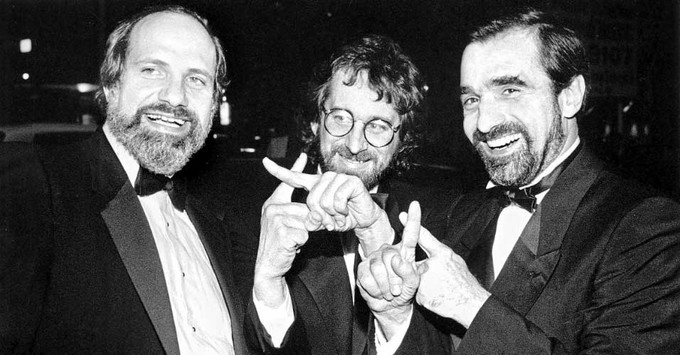
Brian De Palma is a fascinating subject, in many ways, as fascinating a subject as a director. His best work is admittedly and unabashedly derivative, basically a total homage to Hitchcock (Carrie, Dressed to Kill, The Untouchables). He has also made some atrocious films (Body Double, Casualties of War, Bonfire of the Vanities) and some films you can hate and then love and then hate again (Scarface, Carlito’s Way).
No matter how you feel about De Palma’s work, his recollections of film making in 70s and 80s Hollywood are a blast, and he’s a very easy and open storyteller. This is an entertaining, comfortable review of his work presented entirely in clips and a single interview.
A few great tidbits: as a teenager, De Palma tailed his own father when he was cheating on his mother; during the execrable Casualties of War, Sean Penn would physically bully Michael J Fox and whisper to him “television actor.”
Good, fun stuff. I’d take this sort of retrospective over a slathering like HBO’s Spielbergany day of the week. Currently on Netflix streaming.
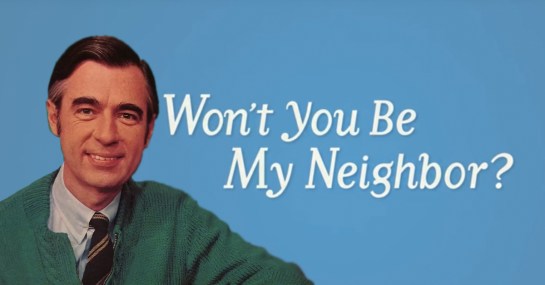
Mr. Rogers should have been right in my wheelhouse when I was a kid. I was around six or seven when he went national. However, public television was not a staple in my Catholic household. The only glimpse I got was when I went to the home of my Jewish friend, whose parents included PBS in their progressivism, but by the time we became pals, Fred Rogers was there to be mocked, not appreciated.
It’s a shame, because watching this documentary and Rogers interacting with little kids, you can see both the wonder in their eyes and the deep connections he developed. There is a vignette with a little boy who is explaining to Mr. Rogers’ most famous hand puppet, Daniel, about how his cat was run over by a car. The boy is being stoic but when Daniel becomes emotional, you can see the boy become protective as well. His concern transfers to the puppet and in the transfer, he creates a beautiful and healthy way to express his grief. It’s a stunning exchange.
Genuinely sweet, good and largely uncomplicated public figures are a difficult find. This documentary does a great job of telling the story of one such man. It has faults – it is thin on his background, it over emphasizes some cable noise about his effect on children (i.e., made them soft), and it succumbs a little to the “these dark times” trope – but these are nits. Highly recommended as both entertainment and moral tonic.
Wes Anderson’s second stop-motion animated picture is charming and inventive. Not as compelling or brisk as The Fantastic Mr. Fox (there are moments when the wizardry is doing too much of the heavy lifting), but still, very winning.
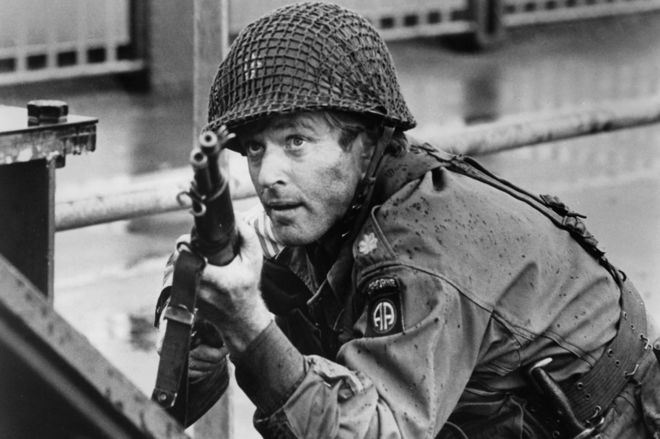
This is a dinosaur, a sweeping, big budget 70s war flick loaded with A and B+ stars of the time, directed with an accomplished economy and flourish by Sir Richard Attenborough (Gandhi).
Imagine the equivalent of this cast in one movie today:
OSCAR WINNERS
Laurence Olivier
Anthony Hopkins
Robert Redford
Sean Connery
Gene Hackman
Michael Caine
Maximilian Schell
OSCAR NOMINEES
Elliot Gould
Ryan O’Neal
Liv Ullman
James Caan
BAFTA WINNERS
Edward Fox
Dirk Bogarde
The picture is post-Vietnam era cynical but not overly so, depicting the tragic clusterfu** that was World War II’s Operation Market Garden, an ill-fated attempt to cripple Germany quickly post-D Day via a lightning paratroop strike into Holland. Everything that can go wrong does go wrong, due in no small part to bureaucratic incompetence and the willful discounting of intelligence.
Attenborough manages to let stars be stars while incorporating the performances seamlessly into a well-thought out and accomplished military drama. William Goldman’s script is also very moving, empathetic to the plight of the foot soldier and bereft of a lot of “hoo rah!”
There is really only one casting weakness. I get that you want “young” for General James Gavin, who was 37 years old at the time of the operation, but O’Neal is just too pretty and soft for the role, and his attempt to overcome it (being stern) is unavailing. He looks and acts like a peeved choreographer.
Some fun tidbits: Most of the stars took a pay cut, agreeing to a $250,000 weekly fee, with the exception of Redford, who hauled in $2 million for 10 minutes of screen time.
Also, with two lines, and a spot right behind Redford on a collapsible boat in a brutal river crossing, it is none other than John Ratzenberger (Cliff Clavin from Cheers). Spoiler – Cliff doesn’t make it
One reviewer remarks, “It’s a provocative, serious, ridiculous, screwy concoction about whiteface, cultural code-switching, African-American identities and twisted new forms of wage slavery, beyond previously known ethical limits.” Another: “An absurdist, startlingly original Molotov cocktail through the pane glass window of Hollywood, ‘Sorry to Bother You’ is a riot, the year’s craziest comedy and the most demented call to arms in memory.” A third, perhaps inevitably: “An impassioned, chaotically accurate response to dark and troubling times.”
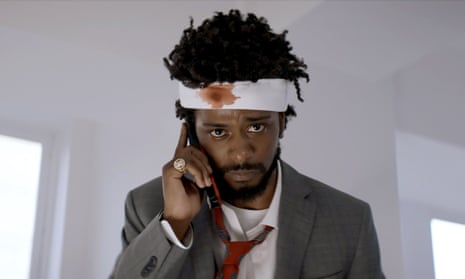
Thankfully, Boots Riley’s debut film bears little resemblance to these painfully misguided and rote intonations, beyond being original and absurdist. Rather, the story of an upwardly mobile telemarketer (Lakeith Stanfield of Atlanta, who is just the right amount of bewildered and decent yet persuadable) who loses his way and uncovers the most insane corporate skullduggery since “Soylent Green is people!” is playful, trippy, inventive, and surreal with a few brutally caustic comic bits thrown in for good measure. It’s decidedly less political than advertised by the critics, and when it is political, the message is so broad and zany, you could affix it to just about any ideology you wanted.
It was mind-blowing to learn that it is the first movie for writer-director Riley, who crams so much visual creativity into the flick it eventually ends in an exhausted mess. The picture is original in most parts, but it owes a great deal to Mike Judge’s Idiocracy. It’s also a tad reminiscent of wacky Coen Brothers, Spike Jonze, and Scorsese’s After Hours. Not for everyone, certainly not required to be seen in a theater, but an absolute treat when the price gets right.
The movie gets an automatic half point deduction because it was so intense and gripping that I had to leave the room a few times and scream to my family, “What’s happening now?” I have to assume there were some problems with the picture during those moments. Otherwise, John Krasinski’s sophomore effort as a director is taut, assured (you feel he really had a vision as to almost every scene), and at the right times, edge-of-your-seat terrifying. It is also bolstered by wonderful performances that are necessarily non-verbal. Krasinski is moving as a beleaguered father trying to protect his family, and Emily Blunt’s travails as she communicates them are almost too much to bear.
The only thing you need to know about the plot is that the monsters can hear EVERYTHING!
This expensive, sweeping, surreal saga was an international production but most of the heavy lifting was done by the Soviets, who lent their land, 17,000 soldiers, their director and many millions of dollars to re-creating the battle. From Wikipedia:
To recreate the battlefield authentically, the Soviets bulldozed away two hills, laid five miles of roads, transplanted 5,000 trees, sowed fields of rye, barley and wildflowers and reconstructed four historic buildings. To create the mud, more than six miles of underground irrigation piping was specially laid. Most of the battle scenes were filmed using five Panavision cameras simultaneously – from ground level, from 100-foot towers, from a helicopter, and from an overhead railway built right across the location.
Actual filming was accomplished over 28 weeks, which included 16 days of delay (principally due to bad weather). Many of the battle scenes were filmed in the summer of 1969 in often sweltering heat. In addition to the battlefield in Ukraine, filming also took place on location in Royal Palace of Caserta, Italy, while interior scenes were filmed on the large De Laurentiis Studios lot in Rome. The battle sequences of the film include about 15,000 Soviet foot soldiers and 2,000 cavalrymen as extras and 50 circus stunt riders were used to perform the dangerous horse falls. It has been joked that Sergei Bondarchuk was in command of the seventh-largest army in the world. Months before the cameras started filming, the 17,000 soldiers began training to learn 1815 drill and battle formations, as well as the use of sabres, bayonets and handling cannons. A selected 2,000 additional men were also taught to load and fire muskets. This army lived in a large encampment next to the battlefield. Each day after breakfast, they marched to a large wardrobe building, donned their French, British or Prussian uniforms and fifteen minutes later were in position. The soldiers were commanded by officers who took orders from director Sergei Bondarchuk via walkie-talkie. To assist in the direction of this huge, multi-national undertaking, the Soviet-Ukrainian director had four interpreters permanently at his side: one each for English, Italian, French and Serbo-Croatian.
The expanse of the endeavor is breathtaking and the efforts of the Soviets are plainly evident in the cinematography:
The script is, well . . . dated. The players intone with great import, and before most lines, they damn near lean into the frame. As Wellington, Christopher Plummer is so effete and aristocratic, he approaches the Monty Pythonesque. I implore you, go to 4:03 of the above scene for my brief in support. Yet, somehow, he works. Rod Steiger’s Napoleon is a raving consumer of all things Lee Strasberg, yet he too seems to work. Indeed, one of the charming qualities of the script is when, in the middle of the goddawful melee, the soundtrack goes silent and we hear each man’s thoughts in voice-over. “Who is this man, who fights on his ass,” Napoleon muses as he watches Wellington dig in.
Full disclosure: this move was a staple on the 4 o’clock move when I was growing up and along with Zulu and Where Eagles Dare and countless other war pictures, informed my young sensibilities in the areas of hyper-masculinity, glory, bravery under fire and all the rest of it. White collar life is empty of such things, so my emotional nostalgia may be at play here.
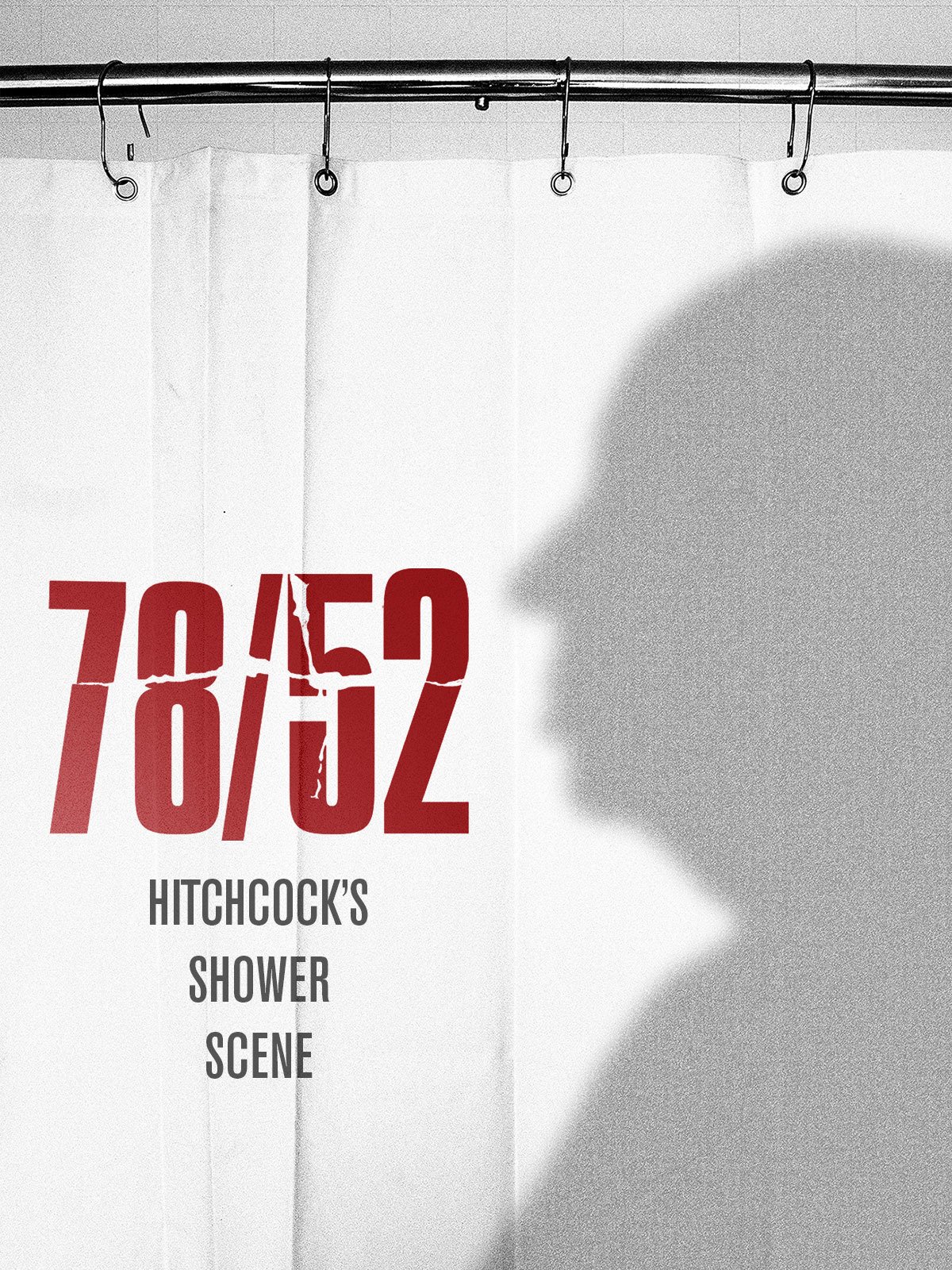
An engrossing documentary which synthesizes the artistic and cultural impact of Alfred Hitchcock’s Psycho, and in particular, the murder of poor Janet Leigh (the title refers to the setups and cuts in the shower scene), with a technical analysis of its construction. Segments of the interviews of filmmakers, actors, critics, and academics are conducted as those commenting watch the scene. It’s a neat touch to have them affected and excited as the murder flickers before their eyes, some mesmerized, some providing a play-by-play, all in awe.
Many of the memories of the film’s premier are wildly entertaining. Peter Bogdanovich’s recounting of the theater erupting in screams that matched Bernard Hermann’s score is particularly vivid.
There is also an impressive amount of film scholarship tying Hitchcock’s technique to previous works of art, and a solid case is made that the picture constitutes “an act of aggression [by Hitchcock] against fans, critics, and actors.” And if you ever want to know what was stabbed to give the effect of a knife piercing flesh, you will have your answer.
There are some stretches that get a little high-falutin’ (mainly from the film academics, who, naturally, see import in everything). There are also some questionable participants, including the kid from Lord of the Rings(who has no appreciable connection to the film but seems fan-boyish), while one interviewee, the estimable David Thomson (who wrote the brilliant The Moment of Psycho: How Alfred Hitchcock taught America to Love Murder), gets one comment, which is criminal neglect.





 filmvetter