Archive

4 stars

I’m not much for sports hokum.  The elegiac bunk of The NaturalField of Dreams, or even Any Given Sunday reveals more about the filmmakers’ insecurities than the game being played and the characters who play it.  But even I am not immune from hokum anchored by Gene Hackman and based on the true story of the 1954 Indiana state high school basketball champions from tiny Milan.

Hackman is the new coach with a dark past, bringing a fundamental style of play and stubborn ways to a cloistered small town that does not want him.  Barbara Hershey is the teacher leery of his influence.  Their conversations about what constitutes success are smartly written (she loathes the small town, plans the escape of her students and views Hackman’s” hoop dreams” as an anchor keeping young men from getting out).  Dennis Hopper is the alcoholic assistant coach, redeemed in the eyes of his player son as the team battles adversity.  David beats Goliath, and the music swells along with the heart.

The performances are all strong, and the casting of the fresh-faced team is perfect. The boys, town and milieu feel 1950s, as does the play, and the boys can play.  One only needs to watch the overrated White Men Can’t Jump to realize the foolishness of casting non-players; Woody Harrelson is passable, Wesley Snipes ludicrous.  The film is also chock full of inspiring and exciting vignettes as the boys march forward to victory. 

Hackman is commanding, in his sparring with Hershey, when he confronts the team’s star player, who is in the middle of a 1950s version of a holdout, and in his handling of the overbearing townsfolk.  I also like his simple, homespun speeches:

Ah, Bobby Knight.  

This one is better:

There are a few problems.  The love affair between Hershey and Hackman seems both improbable and awkward.  I no more want to see him kiss a younger woman than Tommy Lee Jones.  The score is also very 80s, stirring but techno infused.  But it’s still one of the better sports films made.

Whit Stillman films are similar to Woody Allen films if you dispense with the angst and replace older urban New York Jews with younger urban New York prep school/deb type WASPs.  Also, toss out the whole “big notion” premises of death, morality and faith and replace them with passing fashion, pop culture, and functional philosophy.  And since Stillman does fewer films than Allen, listening to the witticisms of attractive scions of varying degrees of wealth as they contemplate their navels is neither grating or played out.

Stillman directed two prior films, Metropolitan and Barcelona, the former dealing with New York City private high school kids and the latter taking two of those characters and transplanting them to liberal, carnal Spain.  If you’ve seen Metropolitan and Barcelona, this is similar in tone, content and style.  However, this one is a bit more fun loving and free, as it chronicles the fall of disco in New York City through the eyes of several fresh out of college young urban professionals (though the moniker of “yuppie” is hotly debated) who negotiate their first jobs (publishing house, advertising, prosecutor’s office, environmental law firm) during the day and cruise the disco at night.  It’s also a little more personal.  Even though Stillman has a usual ensemble cast, which thankfully includes the brilliant Chris Eigeman, in this film, Chloë Sevigny is our primary guide and with her we suffer the perils and awkwardness of casual sex for an intellectual frump in the 80s.  It is painful indeed to watch her seduction tecnhiques, which includes a breathless, “There’s something really sexy about Scrooge McDuck.”     

As in all Stillman films, the conversations that meld college bull sessions and comparative literature courses are the gems, such as this back-and-forth on Lady and the Tramp

marjorie nugent

Richard Linklater offers the story of Bernie Tiede (Jack Black), a gay mortician who companions a significantly older woman, Marjorie Nugent (Shirley MacLaine) and then, in a fit of rage and exasperation at her domineering ways,  shoots her in the back and stuffs her in a freezer, pretending she is still alive (not ala’ Norman Bates).  Tiede is the town Robin Hood, the town being Carthage, Texas, and in many ways, Carthage is the star of the film.  Linklater uses very few professional actors, instead interspersing the dramatic narrative with interviews of real-life Carthage citizens, almost all of whom are squarely on the side of Tiede, and almost all of whom are hilarious.  To them, Nugent was a nasty, wicked old wretch and Bernie Tiede was the man who bought you a nice gift, sang the beautiful song that escorted a loved one to the hereafter, directed the town play or just gave you a nice wave everyday.  And he was driven to it.

Of course, in the presentation, Linklater neglects a few ugly details of the real life Tiede (not all of the vast sums he spent of Nugent’s wealth went to charity), but it appears the basic premise is true – Tiede was well-loved and Nugent well-hated (her own nephew observed, “‘Bernie’s not the first one who thought about killing her.  He’s just the first one who went through with it”).

Black is mesmerizing as Tiede, hilarious, hapless and harried, but uncontainably sweet and just a  little guilty (even before the murder).  MacLaine is effective as an old witch and Matthew McConaghey is amusing as the dogged D.A.  But the stars are the real people of Carthage, who Linklater neither mocks or mythologizes, wisely letting them be.

My only criticism is the choice to make Tiede so sympathetic.  Black does a great job in keeping him from being saccharine, with occasional flashes of guilty pleasure at his newly found wealth, but Linklater keeps away from any real dark heart, opting for a feel-good film.  Which is fine, but I think it could have remained feel-good and still been a little more revealing.

Riveting, though a little soulless, this dystopian thriller mixes some Lord of the Flies with Logan’s Run and The Running Man.  It is anchored by Jennifer Lawrence’s strong and touching performance (Lawrence was deservedly nominated for best actress in Winter’s Bone). 

It is the future.  The “haves” live in splendor, wealth and fashion, while the “have nots” reside in 1 of 12 poorer districts, which, at some point, rebelled against the central authority.  As s punishment/control mechanism, the central authority conducts an annual Hunger Games, where 2 teens from each district are selected by lottery.  They are then sent to the equivalent of The Emerald City for training and gussying up as if they were to meet the great and powerful Oz.  Instead, they are offered up in an elaborate ritual, televised for the masses and announced by two Ryan Secrests (Stanley Tucci and Toby Jones), wherein they are released in the wild to fight to the death.  Lawrence volunteers after her younger sister is chosen.  Traps abound, and aid can be given by wealthy viewers who “favor” their champion (for example, Lawrence is injured, but a patron sends her healing ointment via mechanical device as she huddles in a tree).  The orchestrator of the games (game master Wes Bentley and evil sage Donald Sutherland) can also tweak circumstances and change rules to amp interest and/or for political reasons.        

I was totally hooked, and the addition of a wisened and cynical Woody Harrelson as an advisor to Lawrence (he was a winner from her district and he is clearly scarred by the experience), as well as Lenny Kravitz as her charm/clothing consultant (the kids have to do a dog-and-pony show ala’ “American Idol” so the viewers get to know them) are substantial. 

The lack of background as to how a society engineering  these games came to be is problematic, and the film’s treatment of the powers-that-be is glancing.  There is also a fair amount of discomfort as you find yourself rooting for one child to kill another.  The New Republic’s Tim Noah high-handedly called it “morally repugnant” because the film “wants to have it both ways.  It wants us to register severe moral disapproval of a society that would require children to hunt one another as if they were woodland creatures. But—because it also wants to be an entertainment with a sympathetic heroine and some good old-fashioned suspense—The Hunger Games also invites us to root for the right person to win the competition by, um, killing other children.”  I think Noah is being a bit hysterical here, going overboard as to how the filmmakers want us to be repulsed by the concept of The Hunger Games.  He’s wrong; the games themselves are a brilliant vehicle so fantastical that having to expend energy on their moral condemnation is like insisting an audience object to Eastwood’s brutality in Dirty Harry even as he metes it out to the bad guys.  Who has the time to be so scrupulous?

But Noah identifies how the movie lets you off the hook by making a few of the combatants so loathsome you feel better about your bloodlust (“The nice (usually younger) kids, whom she tries to save, all get killed by others. The few she must kill are all nasty preppies apparently raised from birth to be smug, violent and cruel”).  

It would have been more honest to have Katniss kill someone neutral, if not sympathetic, but there are sequels to be had here.

Cinemascope: The Departed [2006]

A meaty, engrossing crime picture, right in Martin Scorsese’s wheelhouse.  Jack Nicholson is a Boston crime boss who has a quasi-adopted son/mole in the Boston PD (Matt Damon).  In that same department, a small unit (headed up by Martin Sheen and Mark Wahlberg) is set up to get Nicholson, and they recruit a police academy trainee (Leonardo DiCaprio) who has one leg in the tough streets of Southie (his dad’s side) and another in the upper crust of Boston (his mom).  Meanwhile, a second task force, headed by Alec Baldwin, is also trying to get Nicholson and can’t get a handle on why they are thwarted at every turn.  DiCaprio is “erased” from police files, purposely gets arrested, and infiltrates Nicholson’s organization, which is populated by colorful, brutal goons (Ray Winstone, David O’Hara), in order to identify the mole.  Meanwhile, Damon keeps screwing Baldwin’s pooch.

A cat-and-mouse hunt ensues, as Damon searches for DiCaprio and vice versa.  Damon is also dating a psychologist (Vera Farmiga) who treats cops and ex-cons, including DiCaprio.

Almost to a person, the performances are rich and rough.  DiCaprio is now in full bloom, grown out of the Titanic baby face and having just previously offered two nuanced and substantial performances in The Aviator and Blood Diamond.  Nicholson is bloody and funny, and, well, Nicholson.

All the supporting characters are strong and natural save for Farmiga (she’s too feminine for the role and when she becomes infatuated by a clearly unstable DiCaprio, it is unconvincing) and Wahlberg, who, ironically, was nominated for best supporting actor.  He yells an awful lot and delivers a few speeches, but volume and line memorization do not deserve a nomination.  Wahlberg seems uncomfortable and masks it with rage.   And once again, Matt Damon does all the heavy lifting and gets none of the credit.  His turn as the fatherless boy who is being manipulated by Nicholson is alternately frightening and heartbreaking, yet he remains a very charming sociopath.

The picture whizzes by.  Scorsese effortlessly paces what could have been a morass of a story, providing his signature quick-cut expositions to perfectly chosen music (The Stones, Badfinger, Allman Brothers).

Broadcast News - Rotten Tomatoes

James L. Brooks has the ability to make you laugh out loud just before he brings a tear to your eye, a skill he has honed in Terms of Endearment and As Good as It Gets. His missteps (How Do You Know, Spanglish) still contain very funny dialogue, even if the whole doesn’t work.  But to be fair to Brooks, Paul Rudd, Reese Witherspooon, Adam Sandler and Tea Leone are not very formidable substitutes for Jack Nicholson, Shirley MacLaine, and Debra Winger.

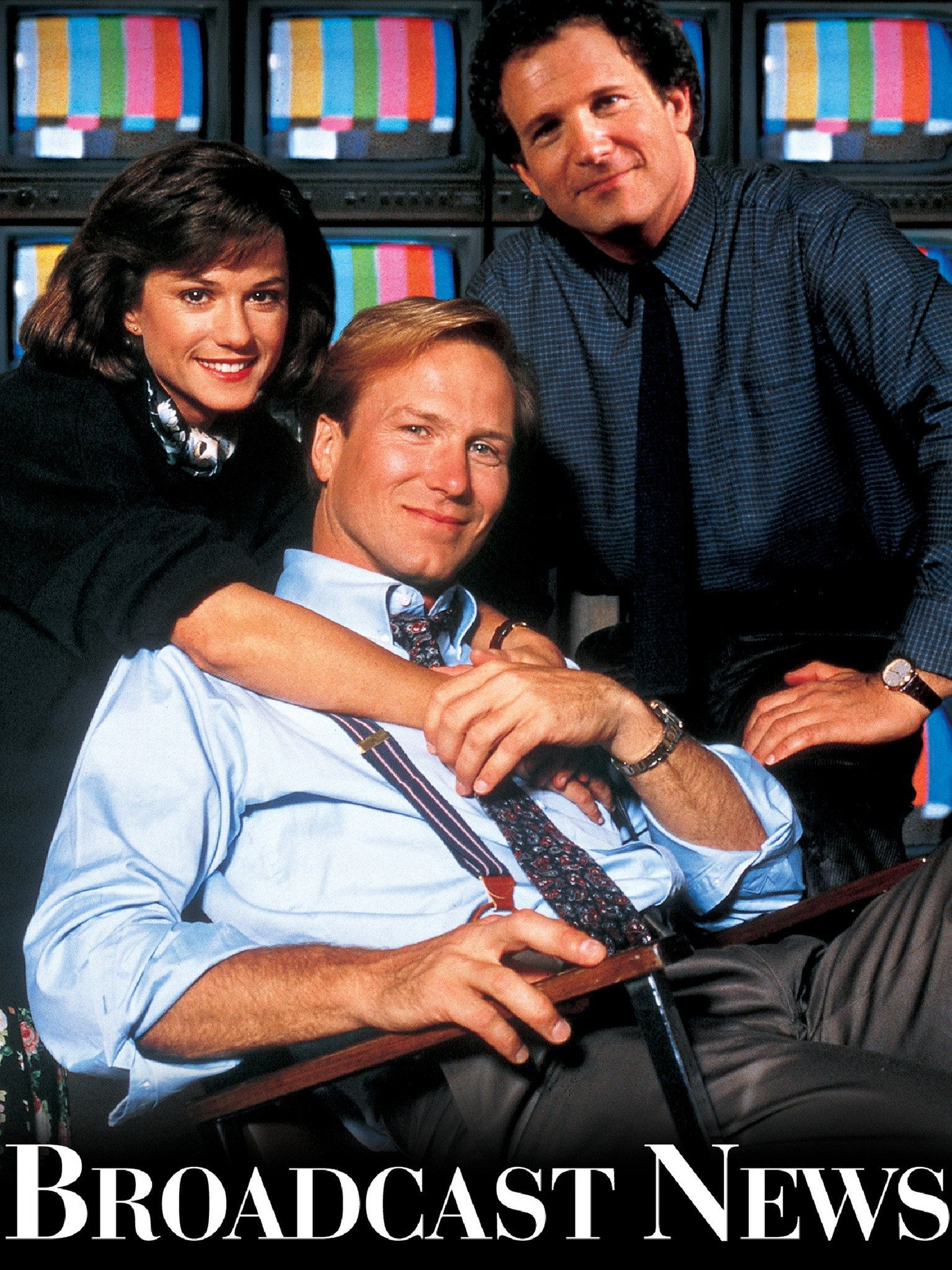
In Broadcast News, Brooks melds a love triangle with a story about journalism and ethics that is prescient.  Holly Hunter is the producer of the Washington bureau of a major news network, Albert Brooks is a gifted but un-telegenic correspondent, and William Hurt is the new up-and-coming golden-boy, groomed to replace the current anchor (Jack Nicholson, in a hilarious cameo).  Hurt is attractive but shallow (as Brooks says, he is against everything Hunter is about).  But Hurt is also sweet and in his own way, genuine.  He fancies Hunter and when Brooks tries to anchor the weekend news in an effort to save his job, Hurt is there, giving him advice, some of which is excellent (“punch” a thought in each sentence) and some of which makes Brooks very uncomfortable (“Just remember that you’re not just reading the news, you’re narrating it. Everybody has to sell a little. You’re selling them this idea of you, you know, you’re sort of saying, trust me I’m, um, credible. So when you feel yourself just reading, stop! Start selling a little”).  Hunter becomes infatuated with Hurt, and as they grow closer, Brooks professes his long love for Hunter and reveals the ethical threat that is Hurt.

The picture is loaded with crisp, witty dialogue, and at its best, it evokes the great Grant/Stewart/Tracy v. Hepburn romantic comedies. The picture also injects something of substance (the deterioration of the news), not with the acid cynicism of Network, but gently, so as not to get in the way of the story and humor.

There is also great physical comedy, provided by Joan Cusack as a gawky assistant producer, and Brooks, who endures the great humiliation of flopsweat during his shot at anchor.  The scene is one of the funniest in film history.

The movie has one problem, but it is a big one.  Holly Hunter is so mannered and quirky that you simply cannot understand Hurt’s attraction to her, much less that of Brooks. Sure, the good looking neophyte might be intrigued by the neurotic but fascinating “other” ala’ Robert Redford and Barbra Streisand in The Way We Were.  But Hunter takes “odd” up several notches, and in many scenes, her facial expressions approximate her work in the live cartoon Raising Arizona.  Her temper is also so volcanic as to suggest mental illness.

Certain lines cannot be crossed in a romantic comedy.  I was reminded of the awful Hugh Grant-Sandra Bullock vehicle Two Weeks Notice, wherein Bullock has an attack of diarrhea on the highway and Grant has to commandeer a stranger’s RV so she can relieve herself.  This may work for Will Ferrell and Zach Galifinakis.  But no romantic lead can be shown in such an unflattering light.  Hunter does not sink to such depths here, but her portrayal does border on the grotesque and it detracts.

There is also the weakness of the import of Hurt’s great journalistic sin (he recreates a moment of emotion in an interview) .  There is no question – the act was unethical.  But in the context of some of the other stagey and easy shortcuts engaged in by Hunter and Albert Brooks, their high dudgeon (which is critical to the picture) rings hollow, and the film never gives them a comeuppance on this point other than Hurt’s rebuttal to Hunter after she accuses him of crossing the line — “It’s hard not to cross it.  They keep moving that little sucker, don’t they.”

This is a very funny parody of the unraveling of Richard Nixon, by this story, at the hands of two high school girls, one of whom lives at the Watergate and happens upon G. Gordon Liddy and the gang during the break-in.  To shut them up, the girls are given jobs as dog-walkers at the White House and become seminal in our nation’s history.

Dave Foley (from “Kids in the Hall”) is hilarious as H.R. Haldeman, Dan Hedaya is a workable Nixon – not quite as sweaty as Anthony Hopkins and nowhere near the master of all Nixons, Frank Langella, but still, he’s appropriately shifty and skulking.  Priceless is one girl’s fantasy about Nixon – she has fallen in love with “Dick”, who supplants Bobby Sherman in her world – and in one fantasy, Hedaya rides up on horseback on the beach to tell the girl “Pat understands”.

Bruce McCullouch (also from “Kids”) and Will Ferrell are laugh-out-loud as a fey and bickering Bernstein and Woodward.

Lasse Hallstrom’s film about a Maine orphanage and the maturation of one of its residents (Tobey Maguire) is a beautiful and sentimental picture notable for strong performances by Michael Caine and a score of child actors, and exceptional performances by Maguire and Delroy Lindo. Filmed in Maine and Massachusetts, the film’s score is as heart-tugging as its locale (in orphanages, children leave, die and undergo numerous ordeals, so be prepared). Nonetheless, with the exception of one or two scenes, Hallstrom is restrained in his depiction of the life of a Maine obstetrician and orphanage director who also performs illegal abortions (the film is circa 1940s).

Maguire, an orphan twice-returned, becomes Caine’s protege, but as with all young men, Maguire leaves the orphanage to see the world (or more of Maine) himself. Caine wants him back to carry on his work. Maguire wants to find out about life, and does.

Nothing happens here that you don’t expect to happen, but everything is so well-paced and finely acted, the film works even in the face of your foreknowledge.  Maguire, whose unrelenting wistfulness and glistening eyes can seem manipulative, is an apt choice to play a young man who has always done rather than felt – he has not yet formed his own identity through experience.  Such a role can be easily butchered.  Think a young Robin Williams, the naif who stares at wonderment at all he sees. This is Maguire’s sweet spot and he nails it.

Delroy Lindo, as the crew boss of a group of migrant apple pickers, is commanding. Lindo has an ability to convey so much in one chosen look – violence, confusion, pride – that you find yourself studying rather than watching him. Caine won best supporting actor, and he is, as usual, very good.  But Lindo was overlooked.

The film is unabashedly pro-choice in outlook. I did not find it at all preachy, but a significant thematic rift between Caine and Maguire centers on the issue, and there is no question as to where the filmmakers come down. This may not be the kind of thing you want in a film, but the forthrightness is not offputting.

Finally, while I was uplifted by the film, I was also completely undone and what I perceived as a beautiful but painful story, others may find schmaltzy and overt.  Rachel Portman’s original score is almost unfairly touching.

It was kismet that just after watching 1982’s 48 Hours, I’d stumble onto a modern Irish buddy cop picture.  Brendan Gleeson (Boyle) is an Irish policeman in Connemara, content to do his duty while occasionally lifting recreational drugs off of car accident victims or engaging call girls dressed as policewomen for their pleasures.  The FBI, in the form of Don Cheadle (Everett) arrives and they require Gleeson’s assistance in stopping a drug shipment and the brutal gang (led by Mark Strong and Liam Cunningham) facilitating it.

Much more comedic and wry than 48 Hours, The Guard does set up Gleeson as the racist.  When briefed by Cheadle and shown pictures of the white gang, Gleeson goes wide-eyed and says, “I thought only black lads were drug dealers?”  When Cheadle upbraids him for being a bigot, Gleeson responds, “I’m Irish, sure. Racism’s part of my culture.”  But the stronger dynamics are the Cheadle as fish-out-of-water line and a little of Gleeson’s Oscar to Cheadle’s by-the-book Felix.  Gleeson has no real enmity behind his racism and uses it merely to probe Cheadle.  Their interplay gets funnier as they get to know each other.

Best is the depiction of Ireland, which is not so much whimsical as hilariously casual. Gleeson finds some guns meant for the IRA and when delivering them to their contact (the idea of confiscation is never considered), seems bemused that the organization still exists.  The presumption is that almost all the police are on the take, and Gleeson’s explanation as to why he cannot assist Cheadle in the canvassing of potential witnesses to a murder is pitch perfect:

BOYLE:  So what d’ya have planned for the day?

EVERETT:  Well obviously we don’t know who killed McCormick or why. There was no useful forensic evidence found at the crime scene, so I thought we might start by canvassing the area around where the body was discovered. See if anybody heard anything, something they might have thought was relatively insignificant, but which in light of the murder may have a far greater importance. I mean, when I caught that sonofabitch Tyrell Lee Dobbs it was a result of something as seemingly inconsequential as a laundry mark, if you can believe that. The guy had a personal hygiene issue that was almost pathological. The other thing to consider is that McCormick was probably in the process of reconnoitering drop-off points all along the coast. Our friends Sheehy, Cornell and O’Leary are no doubt in other parts of the country doing exactly the same thing. So I’ll liaise with Inspector Stanton and Detective Moody, have them and their men start a coordinated push in all the relevant locations…

He trails off, realizing that BOYLE is concentrating on his food and is not listening to him.

EVERETT:  Sergeant?

BOYLE: I’m sorry, you lost me at “we”.

EVERETT:  We. You and I.

BOYLE:  It’s my day off. Did I not say?

EVERETT:  It’s your day off.

BOYLE:  I’ve had it booked a good while. Ask Stanton.

EVERETT:  We’re investigating a murder and the trafficking of half a million dollars in cocaine–

BOYLE:  Half a billion dollars.

EVERETT: –half a billion dollars in cocaine, and you’re telling me it’s your day off?

BOYLE:  Twenty-four hours won’t make any difference.

EVERETT: Twenty-four hours won’t make any difference

BOYLE:  They’re always saying it does, on those cop shows on the telly, but it doesn’t. Not in my experience, anyways. And why are you always repeating everything I say?

There is also a side story showing Gleeson taking care of his mother (Fionnula Flanagan) in the latter stages of her cancer that is sweet but not distracting.

Finally, the trio of bad guys have a running discussion of philosophy and culture that is Joycean yet Tarantinoesque. It’s rare you’re introduced to crooks in the midst of the following discusssion:

SHEEHY: –Schopenhauer.

O’LEARY:  I’d say Nietzsche.

SHEEHY:  Nietzsche. You haven’t even fucking read any Nietzsche.

O’LEARY:  I have, too. Ah…The Antichrist.

SHEEHY:  Quote me something, then.

O’LEARY:  “What does not kill me–”

SHEEHY:  Ah, for fuck’s sake. Every child knows that one.

CORNELL: Bertrand Russell.

SHEEHY: Bertrand Russell. Will you listen to him. The fucking English. Everything has to be fucking English. Name your favourite philosopher, and lo and behold, he’s fucking English.

CORNELL: He’s Welsh.

SHEEHY: Hah?

CORNELL: Bertrand Russell was Welsh.

SHEEHY: Bertrand Russell was Welsh?

He considers whether or not to take issue with CORNELL’s statement, but then accepts it might be true.

SHEEHY:  You know I never knew that. I didn’t think anybody interesting was Welsh.

CORNELL: Dylan Thomas?

SHEEHY: Like I said, I didn’t think anybody interesting was Welsh.

O’LEARY: “You will not get the crowd to cry Hosanna until you ride into town on an ass.” Nietzsche.

SHEEHY and CORNELL look blankly at O’LEARY. Then —

SHEEHY: Yeah that’s a good one.

CORNELL: Good quote, yeah, nice one.

You might think it showy and contrived, but it’s not. 

 

48 Hrs. Blu-ray (Remastered | Paramount Presents #19)

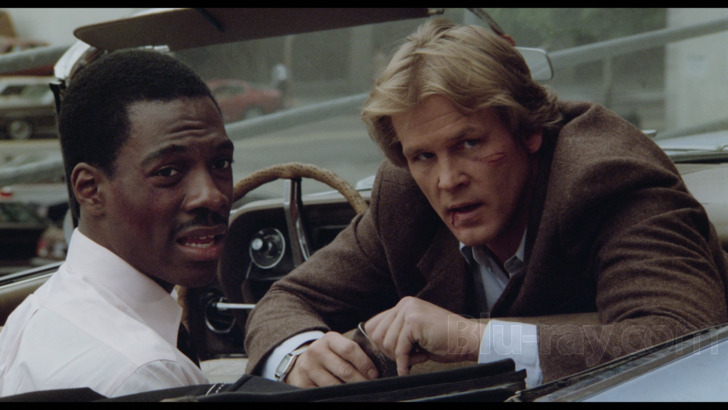
Eddie Murphy kinetically debuts as hustler Reggie Hammond, released from prison for 48 hours under the brutal watch of Detective Jack Cates (Nick Nolte) to hunt for Hammond’s ex-partners, who have gone on a cop-killing spree in San Francisco. The film catapulted Murphy to stardom. It was also the first picture to feature a Saturday Night Live comedian in a raw, crime story and stands as one of the better “buddy cop” pictures ever, though Murphy is really only deputized.

Yes, Murphy is very funny, sometimes side-splittingly so, but he does not treat every scene as an opportunity to do a bit or schtick.  He picks and chooses his moments, trusting in the story directed and mostly written by Walter Hill (The Long Riders). Murphy has one virtuoso scene, when he poses as a cop to roust a redneck bar, but even there, where he puts a knife to a man’s face and tells him, “I’m your worst fu***** nightmare, I’m a ni**** with a badge”, he’s in keeping with the picture’s tough tenor. Nolte’s Cates is brutal, unpleasant and an unrelenting racist, almost shockingly so, given our current advanced ethos, yet, they bond in a manner that feels authentic. Given we’re dealing with tough cops and criminals, the racial dynamic is not off-putting.  It just adds to the tension.

I was also surprised by the gritty brutality of the movie. The body count is high, but rather than explosions and elegant slo-motion, Hill takes more of a Sam Peckinpah approach. The shootings are bloody and awkward, not stylized. And the bad guys – Albert Ganz (James Remar) and Billy Bear (Sonny Landham) – are scary bad.

James Horner’s original music (he’s been nominated 5 times and won for his scoring of Titanic) is apt, a moody mix of jazz and Asian chimes.  Hill also uses San Francisco to his full advantage, mixing the grimy feel of Bullitt and Dirty Harry with a little early 80s glitz.

It has a few weaknesses. Annette O’Toole, for whom I have had my own weakness since Robby Benson’s One on One, is wasted as Nolte’s long-sufferring gal.

And the finale, where Cates and Hammond just “play a hunch.” is a bit lazy.

Still, an uproarious, and assured flick, much more than it seems.