Archive

3 stars

There are very real and unsettling moments of dread and terror in this story about FBI agent Lee Harker (Maika Monroe) tracking a serial killer in the rural areas of Oregon, circa 1990s. The film is eerie, creepy, and meditatively brooding. It also commendably avoids gore porn and hackneyed, now seemingly obligatory jump scares, while credibly blending the occult with the manhunt. Director Oz Perkins is deft and ingenious with the camera, particularly in flashbacks to various murders. He, or his editor, know how to cut a film.

But … the picture is loaded with plain dumb choices. Perhaps the dumbest being the selection of Nicolas Cage as the serial killer.

I’m not spoiling anything. He appears in the first scene and he is most definitely the serial killer. Ghostly white, screechy voice, clearly deranged, and yet, comfortably ensconced in the same community that has been suffering mass killings for a significant period of time. He’s almost as bad as Pennywise, the clown in It, who lives in a burg where children have a 43% mortality rate. Okay, the FBI can’t really do anything about a supernatural clown that haunts the sewers, though people inexplicably stay in whatever preposterous New England town Stephen King presents (“But honey, the teacher-to-student ratio in Londonderrychester is to die for!”). But a clearly deranged loon who looks like the adult child of Edgar Winter and Phyllis Diller flipping out when he buys supplies at a hardware store that he frequents, and no call to the police? Too much.

The story also relies on a plot device that could work if some care were given. A little bit of a spoiler does follows in this paragraph. The supernatural force controls individuals, and thus they are possessed, for lack of a better word, into doing the Devil’s work. The explanation of how that possession works, is, shall we say, lacking in elucidation (a trusted film correspondent writes, “The silver ball. WTF? Dumb. Dumb. Dumb”). There is also the problem of how the ball is deposited. Better suited to the 1950s and early 60s in terms of getting a foot in the door. Not in Bill Clinton’s America.

There’s also the issue of Agent Harker, who appears to be on the spectrum and whose own tortured background plays heavily into the story. She just doesn’t seem like an FBI agent. She veers between catatonic and stilted, but Monroe can’t imbue any heart. It is critical you care about her fate, but as presented, she’s often just above a mannequin. Worse, other characters (her boss, Blair Underwood and family) are supposed to somehow warm to her, which, given her clear aberrant mien, is asking way too much. 

And for a picture that in many ways rejects some of the formula and tropes of the genre, are we really going to put a rookie agent on the floor, poring over spread-out photos and reports as she tackles the conundrum of Phyllis Winter, who practically wears a sash emblazoned with, “Been Killin‘ Families Since the 70s!”?

 And light switches. Nobody seems inclined to turn on the lights. That’s Jimmy Carter’s America!  

Okay. I’m being hard on a film that ultimately, I recommend. Because the feel and tone and a lot of the choices are right. And it was directed by Anthony Perkins’ son. Who played this guy in Legally Blonde. Which is, like, my favorite movie ever. 

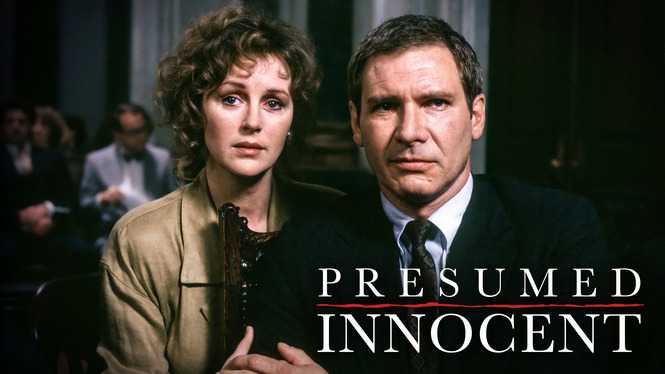
Crisp and taut work by the reliable Alan Pakula (Klute, The Parallax View, All the President’s Men), expert enough that you don’t think about the silliness of it all until the end.

And boy is it silly.

Harrison Ford, with a bad haircut, plays a deputy prosecutor (Rusty Sabich) who has an affair with a subordinate colleague, Greta Shacchi. She is young, exciting, a risk taker, and sexually promiscuous/irresistible.

Rusty, however, is a family man with a loving Plain Jane wife (Bonnie Bedelia), a nice suburban brick house, and a lot to lose. When Scacchi is brutally murdered, Rusty is given the task of prosecuting the killer. But the evidence implicates Ford and soon, he is fighting for his life, enlisting top flight defense lawyer Sandy Stern (Raoul Julia) to defend him. Turns out Scacchi slept with pretty much everybody in the entire judiciary system. Rusty just wasn’t all that special and she was no wide-eyed ingenue, despite his own obsession with his young charge.

Then the twist. [SPOILERS ON A 34 YEAR OLD MOVIE FOLLOW]

Bedelia, sensing the younger woman’s threat to her own family, is the killer! But it’s not enough for her to eliminate the competition, she must teach Rusty a lesson, tame him. So she not only killed his lover, but, per Wikipedia, “left enough evidence for Rusty to know that she committed the crime but did not anticipate him being charged.”

How?

She secreted Rusty’s semen and put it in the dead woman!

Jiminey Christmas! That’ll teach him.

[Side note – how depressing – Rusty and wife are clearly past child-bearing age and what, they’re still using condoms? I mean, I supposed she could have saved it another way, but that seems even more diabolically comical].

Thankfully, for Rusty, Stern is a capable defense attorney, the coroner misplaced the semen sample, a mug with Rusty’s prints found at the scene was disappeared by his investigator pal and even better, Scacchi also slept with the judge (Paul Winfield), for whom she was soliciting bribes.

Case Dismissed.

Maybe one of the dumbest whodunnits ever, the flick came on the heels of Fatal Attraction, the lesson of both being, “Don’t cheat on your wife. Seriously. Don’t.”

Still, it was plenty entertaining as long as you didn’t think too much about it.

Or perhaps think about it at all.

They just released a remake of this on Apple with Jake Gyllenhaal playing the role of Ford. We tuned in for the first episode, which was not good. Gyllenhaal is too young, too emotional, and borderline oafish, and the set-up is wearyingly predictable. Plus, the key to Scott Turow’s novel and the first picture is that Rusty is kind of ordinary schlub entranced by a sexpot. Jake Gyllenhaal is no ordinary schlub and can’t play one. Worse, Gyllenhaal’s Rusty is so into the Scacchi character, even post-mortem, he’s in therapy. Which we get to see. Which sucks.

If it is any consolation, apparently, they have taken care of any import of slut-shaming the Scaachi character. Which is kind of dumb, because Scaachi wasn’t slut-shamed in the original. Rather, she was just breezily promiscuous, manipulative, ambitious, and corrupt. Per Vanity Fair, now, she “cares” for Rusty – blech – a fact I don’t have the time or inclination to confirm.

Perfectly pleasant, adept, and without a moment of originality, a very nice 2 hours delving into Michael Jordan and his first sneaker contract. You will likely enjoy the movie, and then you’ll never think about it again.

Of note is the easy charm of Ben Affleck as Nike founder Phil Knight, the dogged everyman turn by Matt Damon playing Nike basketball scout Sonny Vaccaro, the wry Jason Bateman (Nike Marketing manager Rob Strasser), and the steely resolve of Viola Davis playing Michael Jordan’s mother. All give superb, professional, wholly unchallenging turns that complement both each other and Alex Converey’s tight, predictable script. Marlon Wayans playing Jordan coach and confidante George Raveling also contributes in a poignant scene where he advises Vaccaro on how to approach the budding star.

On the minus side, this is a movie about signing a basketball player to a shoe deal, and the film doesn’t really find anything particularly insightful about this mundane negotiation, other than Damon’s dawning that Jordan will be a God amongst men. So godly is His Airness that while he is present, inexplicably, we only see the back of his head. Jordan never speaks, which both reinforces the picture’s theme that he is near-deity and serves as a tremendous cop-out and missed opportunity.

 I mean, don’t we all want to know what God thinks when negotiating a shoe deal?

Mind you, the script is larded with b.s. Nike’s underdog status in the competition to sign Jordan is poppycock, as is the fact that his agent David Falk (a hilariously entertaining Chris Messina) was hostile to the deal. The dollar amount the young upstart company was allotted to go after Jordan is also understated by half.  And Vaccaro never made the decision to breach negotiating etiquette by going over Falk’s head to visit Jordan’s parents in North Carolina, a fiction seminal to the movie. 

The mushy camaraderie of this band of Nike visionaries may also have been a bit much. Worse, the truth may have made for a more interesting picture. Per Slate, “Vaccaro, as might be expected, disputes all these other versions of events robustly, saying “Phil Knight’s lying, Michael’s lying more than Phil, and Raveling is insane. All three of them need to destroy me to live happily ever after. Everyone’s trying to rewrite history. It goes beyond Jordan. I am the savior of Nike.’ It seems that Vaccaro, far from being the easygoing, collegial guy the film depicts, had a tendency to burn bridges. He fell out with Raveling in 1991 and was fired by Nike without explanation that same year.’” Now, that’s a guy I want to see a movie about, not the milk-and-cookies, faux cynical but really schmaltzo character Damon cooks up.

Okay. It’s not a documentary – enough of my curmudgeonly nitpicking. There is certainly greater appeal here for others. When I watched Winning Time on HBO – the laughably ridiculous rendition of the Lakers ascent in the late 70s/early 80s at the advent of Magic Johnson – it was hard to stifle a laugh throughout, and my wife and daughter joined in. But they also liked the series more than me. It was set in a milieu and about a subject they knew nothing about and they were more than happy to enjoy it without worrying about accuracy or any hackneyed presentations. Here too, though she found if “Hallmarky,” my daughter dug Air and noted that she didn’t really know much about any of it before seeing the movie.

Also, if you pine for all things 80s, from Cyndi Lauper to Tecmo Bowl to skateboards, run, don’t moonwalk, to Amazon Prime, because this thing is loaded with “Let’s Get Physical” Reagan-era montages.   

A WWII thriller and a staple on the Channel 7 four o’clock movie growing up, Steven Spielberg once named it as his all-time favorite war movie. I don’t know about that, but as a kid, I was pretty jazzed.

Richard Burton and Clint Eastwood lead a group of commandos dropped behind enemy lines in Bavaria – where the barmaids are buxom and the enemy plentiful – to kill an American general who has been captured by the Nazis. They must get to the general before the Germans extract critical information from him.

The picture is more than competent (though overlong at nearly 2.5 hours; in the 70s, on TV, it was cut to 90 minutes, and did not suffer for it). The movie is also smart, as much a whodunit as war thriller, and uber-violent to boot. 

One major problem, however, is the setup. The American general is held in a castle fortress accessible only by cable car. Putting aside the suspension of belief necessary to accept ingress and egress, which is right and proper, the castle also houses hundreds of soldiers, heavy equipment, a barracks, a helicopter pad, a radio room, and enough ammo and explosives to blow itself up. All, of which, apparently, was ferried up in two cable cars that hold 8 people a piece. 

Another problem is just a terrible cheat. In The Dirty Dozen, Lee Marvin and Charles Bronson, dressed as German officers, must mingle with the Nazis in the chateau they plan to blow up. The fact that only Bronson knows how to speak German amps up the dread, leaving Marvin to play it stern and taciturn whenever a real Nazi speaks to him at a pre-all-hell-breaks-loose soiree’. Quentin Tarantino does the same thing with Brad Pitt at the film premiere in Inglorious Basterds , though he plays a bit more comic. But Tarantino also utilizes the speaking of German, or, rather, the sign language of a German, to brilliant, suspenseful effect, when Michael Fassbender makes a critical error and is thus found out, which was presaged in The Great Escape:

But I digress. 

Here, as Burton and Eastwood approach a checkpoint, where their papers are to be reviewed, you wonder which one is going to speak German.  I assumed Burton.  Then again, I never assumed Eastwood would sing in a musical, but Lord Almighty, that’s him singing Gold Fever in Paint Your Wagon:

So, who knows, right?  Well, it turns out, neither of them speak German.  Instead, they speak English LOUDLY, and the guards figure they don’t want to interrupt two German officers speaking loudly. Translated? Neither actor wanted to learn a little German, so we are left to believe that the guards heard German, even though we did not. Very lame.

On the plus side, Eastwood is Eastwood cool and he conservatively, single-handedly, kills at least 100 Nazis. At 10 years of age, I was sold. There’s also a fair amount on double-crosses (the picture is written by Alistair MacLean), and while I can’t prove it, I suspect Tarantino saw the picture and it informed his unparalleled French cellar bar shootout in Basterds.

On HBO Max.  

P.S. After writing my suspicions about Tarantino, I Googled a bit and now claim semi-vindication. Tarantino has lauded the picture on numerous occasions, particularly during his promotion of Basterds

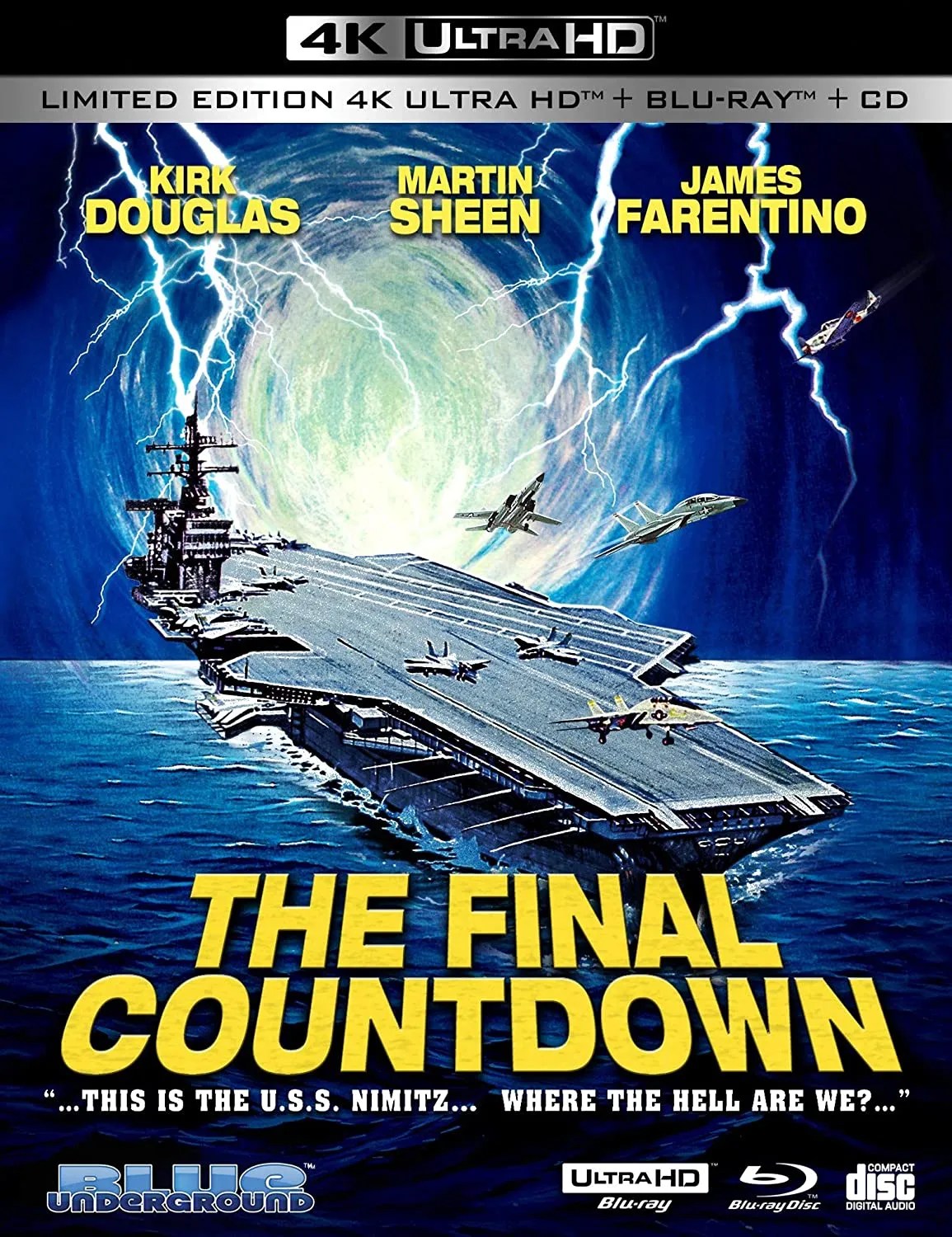
An old Twilight Zone episode depicted three soldiers on National Guard duty in Montana who went back in time and found themselves spectators to the Battle of the Little Big Horn. They struggled with the implications of intervention, essentially foreshadowing Star Trek and violation of the “prime directive” (i.e., never mess with history when time traveling lest you step on a bug and forever alter what is meant to be). They eventually jumped into the fray.  This flick is essentially the same concept, but with a modern aircraft carrier being time-portaled back to the day before Pearl Harbor.  Kirk Douglas, Martin Sheen, and James Farentino have to contend with the same conundrum.  

It’s fun. A little discordant, alternating between whimsy (the commander of the modern USS Nimitz, Douglas, has a certain Disney movie mien to him, but then there are very bloody scenes that punctuate the film). But solid.

It is also clearly a joint effort with the Navy. There is so much aerial footage and extended scenes of flying and taking off that it feels like a recruiting ad, Top Gun sans the volleyball. Curious sidenote. The Department of Defense actually sued the producers for reimbursement, alleging fraud on the reporting of actual flying time. My father’s law firm represented the producers, including Kirk Douglas’ son.

On Amazon.

P.S. There was a big to do in the last several years over a Reddit discussion: “Could I destroy the entire Roman Empire during the reign of Augustus if I traveled back in time with a modern U.S. Marine infantry battalion or MEU?”

A short story followed. Hollywood then bought the short story. Good rundown below. Stay tuned.

Visually arresting, wonderfully acted, and almost unbearably bleak (as only a World War I trench drama can be), director Edward Berger has created the filmic equivalent of Erich Maria Lemarque’s language (“We are not youth any longer. We don’t want to take the world by storm. We are fleeing from ourselves, from our life. We were eighteen and had begun to love life and the world; and we had to shoot it to pieces”). The miserable existence of the characters is interspersed with moments of such great humanity – the joy at the theft and cooking of a shared goose and the circulated kerchief of a French girl for sniffing come to mind – the pointlessness of it all is underscored.

But there are problems.

First, the dramatization of a last-ditch attack before the official armistice is over-the-top.  In the book, Paul, our protagonist, dies on a peaceful day, which is in many ways more poignant.  Here, he and his comrades are felled after a foolhardy and hubristic final charge ordered by a madman. The plot change feels insecure. Similarly, the injection of peace negotiations allows for some clunky foreshadowing along the lines of, “If you dictate such harsh terms, Pierre, there’s gonna’ be schnitzel to pay!”                 

Second, Saving Private Ryan has placed such a premium on verisimilitude in war pictures that they seem to one-up each other in conveying both the horror and the disorientation.  Which is normally to the good, save for an overuse of technical wizardry that can often border on the distracting (I am wondering if the drone is the new CGI).  At some point, you feel a little dirty for being exposed to so many new and awful ways to depict death.

On Netflix.

Hardworking scout and would-be NBA assistant coach Adam Sandler (Stanley Sugarman) finds himself on the outs with his employer, the Philadelphia 76ers, after the owner (Robert Duvall) dies and Sugarman becomes enamored with an unknown street hoops player in Spain.  Duvall’s son, Ben Foster, who always resented Sugarman’s relationship with his Pop, revokes Sugarman’s elevation to assistant coach and shuns the unicorn Spaniard (real NBA player Juancho Hernangomez) Sugarman has discovered.

What follows is an unoriginal but entertaining sports drama. Nothing trailblazing, but filled with enough good things to elevate the material, such as–.

1. Scads of NBA stars, with speaking and/or playing cameos.  If you’re an NBA fan, this is right in your wheelhouse.

2. Sandler, who, when he is not yukking it up in mostly awful comedies with his pals, can surprise you with a raw vulnerability (Uncut Gems, Funny People, Punch Drunk Love, The Meyerowitz Stories).

3. An acceptance of sports tropes that borders on reverential immersion.  Stanley has a deep dark secret about his playing days, Hernangomez needs a daddy, and daddy gets his hijo in shape with consistent runs up a Philly hill (to be fair, they do reference Rocky, but still) and the longest workout montage in film history (it practically has an intermission). Damned if it doesn’t work.

4. Hernangomez, who has some acting chops, and is surprisingly affecting as a young fish-out-of-water.

There are problems.  Sugarman’s secret is insufficiently recapitulated, his family dynamic is too cute by half, and Hernangomez is tarnished and his stock devalued because he had an assault conviction in Spain (a fight with his daughter’s mother’s boyfriend).

Ha!  Not in this NBA.

It should have been an attempted murder.

Of his father! 

I’ve done much worse with just under 2 hours.  On Netflix.


Per usual, Olivia Coleman is transfixing, and the film is almost a master class on how to construct a psychological thriller. It is hard to believe it is Maggie Gyllenhaal’s first feature.  

Sadly, the film is not a psychological thriller. Rather, it’s a psychological character study of a middle aged woman and the choices she made as a young mother and professional. Coleman is a college professor on holiday in Greece, and during her stay, we cover the source of her disaffection from her two adult daughters, her kinship with a young woman (Dakota Johnson) who is clearly in maternal and familial crisis, and her inner turmoil at her own pathological selfishness and insecurity. It is the latter issue upon which the film turns. It is also its undoing, for while each flashback gives us greater insight as to her personality and her current state, it does not quite articulate why she does a particularly loony thing, a looniness made loonier by how she resolves the lunacy. Spoilers follow. 

In her twenties, Coleman was driven mad by her own demanding daughters, so much so she abandoned them for several years, for the arms of an adoring colleague and a passionate affair. She eventually returned, but the coldness in her manner and guilt over her actions is evident years later, on holiday, when she encounters Johnson in similar conflict.

Gyllenhaal stacks the deck. The entirety of what we see of Coleman’s children in flashback and Johnson’s daughter in the present is wildly unflattering. The girls are not only obnoxious, but incessant, obtrusive and maddening. I may be having a generational problem here, because I cannot imagine such behavior being countenanced for a second, either growing up or when my daughter was that age, but perhaps Gyllenhaal was making a statement on the tyranny of children. 

Regardless, Coleman becomes a confidante to Johnson but she also rather cruelly forces her into kinship by hiding the child’s beloved doll. In doing so, she takes a demanding child, who is already on the last nerve of the harried Johnson, and makes her a devil. Coleman can see this and either she wants to punish the child or she is leveraging the heightened distress of the brat to wheedle her way into Johnson’s trust. Either way, loony tunes. 

The film pretty much ends with Coleman admitting to the crime, and Johnson, naturally, looking past any connection the two had established to conclude that Coleman is, indeed, a kook. 

Which is undeniable and renders the layered and patient build-up pointless, a shame, because the film was meticulously crafted to go somewhere better. 

This is one of those pictures where the 98% Rottentomatoes.com score from the critics and the 48% score from the audience makes great sense. Fix me in the latter camp. I kept waiting for the murder to happen. 

Which reminds me of when I saw Monster’s Ball in the theater and an unimpressed man behind me was getting get shushed by his wife until finally, he declared he was leaving “unless there was motherfuckin’ monsters coming soon.” Then Billy Bob Thornton and Halle Berry had their steamy love scene and he was temporarily assuaged.

On Netflix.

A series of feelgood vignettes, largely through the eyes of a child (Jude Hill) in 1969 Belfast during “the Troubles”, Kenneth Branagh’s film is at times charming, and at others, a bit wince-inducing.  There are beautiful, funny and tender moments, and then there are some scenes that are almost as head-scratching as the annoyingly off-kilter soundtrack (Van Morrison is meant for listening, not for accompanying a film; the songs – and there are 10 of them! –  jut into the narrative with all the subtlety of . . . well . . . Van Morrison).

The film falters because of tone – at one moment, we see a world so idyllic as to be fantastical, almost a Busch Gardens-meets-The Quiet Man version of Ireland – and then it is interrupted by religious and sectarian violence that in and of itself seems ridiculous in its staginess.  All well and good, if we accept that we are seeing this story through the eyes of child. Similarly, we can also accept the Sergio Leon-esque confrontation between street thug and father followed by that same father crooning to his wife in an MTV-esque episode.

But then we have to slog through Branagh’s more mundane and serious depiction of the family in crisis (should they stay in Belfast or go).  It’s almost as if you were confronted with a real discussion as to the atrocities of the Nazis in JoJo Rabbit (which some dunkelheads suggested should have been the case).

There is also a dissonance between the father (played by a very weak Jamie Dornan, more hair model than working class hero) and the mother (Caitriona Balfe), who acts rings around him.

Bottom line – what’s good is good, and Hill is winning, but it’s a bit of a mess.    

Amazon.com: Nobody [DVD] : Various, Various: Movies & TV

“From the writer of John Wick . . .”

The film is John Wick, all the way down to its inexhaustible army of Russian pawns offered for slaughter. Instead of a laconic Keanu Reeves, we get a little less laconic and just a hair more put-upon Bob Odenkirk (the play against type is pretty cool). Still, while the film offers a massively high body count and is a little bloodier, it is pretty much the same as Wick minus the underworld mumbo-jumbo.

I’ve expended 2 hours in less fruitful pursuits. On HBO Max.