Archive

Genre

Romantic.  Comedy.  Can one be successful with only a little bit of both?  The Jennifer Aniston-Vince Vaughn vehicle, The Breakup (2006), fell into the category, as it depicted the deterioration of a relationship primarily built on convenience and a shared apartment.  The scenes between Vaughn and Aniston were so arch and cringe-inducing you wondered, ‘where the hell is the ‘rom’ much less the ‘com’?'”

Friends with Kids makes The Breakup seem like Love Actually.  Three couples form the center: the unmarried, platonic sister-brother like duo (Adam Scott and Jennifer Westfeldt); the canoodling, just pregnant, earthy types (Maya Rudolph and Chris O’Dowd);and the sizzling, “just had sex in the bathroom” couple (Jon Hamm and Kristen Wigg).  We meet them at a fancy dinner in Manhattan and then fast forward four years to a second meal at the home of Rudolph and O’Dowd.  Scott and Westfeldt are unchanged, but Rudolph and O’Dowd are now sloppy, harried and laden with kids (she screams at him for doing nothing, he does less, and their kids scream all around them).  Hamm and Wigg bring their own newborn, who appears to be just one source of tension in their quietly crumbling relationship.  Scott and Westfeldt survey the wreckage, determine they can do it better, have their own baby while maintaining their independence (and separate apartments in the same building) and live happily ever after.

Well, no.  Westfeldt is in love with Scott, and Scott has absolutely no clue – he’s bought into their experiment.  In the meantime, they go on a ski trip with their friends, each bringing a new beau (Megan Fox and Ed Burns).  Hamm and Wigg implode, and Westfeldt realizes that her love for Scott is so strong she must profess it.

So, let’s tally.  The first scene of mayhem and bitterness (the four years later dinner) is depressing.  The scene of Scott and Westfeldt trying to make years of friendship square with sex to conceive is uncomfortable.  The scenes of Scott casually mentioning how awesome Fox is to Westfeldt are brutal.  The ski trip is akin to the dental examination in Marathon Man.  And Westfeldt’s profession of love, which is spurned by Scott, will open the vodka.

I liked the picture, but it ain’t no rom-com.  Scott, as always, is perfect, both wry and when it is called forth, impressively anguished.  What is funny in the picture is largely due to the crude banter between Scott and Westfeldt.  The other characters play well, save for Westfeldt, who also wrote and directed.  She is so pitifully earnest, it didn’t seem a fair fight.  And the exchanges between the couples are often illuminating.

The film is also quietly traditional.  Scott and Westfeldt do appear to be doing well on the outside with their arrangement, but as the fissures show, during the ski trip from hell, Hamm, in his own deteriorating marriage with Wigg (note: the mastermind of Bridesmaids provides not one single laugh in this picture) delivers an angry, vicious broadside against their hubris.

Scott delivers an effective rebuttal, which, of course, cements Westfeldt’s love for him:

You think that we don’t love each other? You know, I have loved this girl for nineteen years, Ben. That is fully half my life. I know everything there is to know about her. I know the mood she’s in when she wakes up in the morning – always happy, ready for the day. Can you imagine? I know that she is honest; she won’t even take the little shampoo bottles from the hotel room, or sneak into the movie theater for a double feature. She always buys a second ticket. Always. I know that we have the same values, we have the same taste, we have the same sense of humor. I know that we both think that organized religion is completely full of shit. I know that if she is ever paralyzed from the neck down, she would like me to unplug her – and I will. I know her position on just about everything, and I am on board. I am on board with everything about her, so you tell me, Ben. What better woman could I have picked to be the mother of my child?

Nonetheless, the film culminates in Scott’s realization that Hamm was right – you can’t just craft a perfect bubble of domestic bliss by jettisoning the inconvenient parts, such as “’til death do us” and fidelity.

Still, this movie can be a trial.  And the picture is not too traditional.  It is probably the only film to conclude with the line, “Fu** the sh** out of me.”

This is a very funny parody of the unraveling of Richard Nixon, by this story, at the hands of two high school girls, one of whom lives at the Watergate and happens upon G. Gordon Liddy and the gang during the break-in.  To shut them up, the girls are given jobs as dog-walkers at the White House and become seminal in our nation’s history.

Dave Foley (from “Kids in the Hall”) is hilarious as H.R. Haldeman, Dan Hedaya is a workable Nixon – not quite as sweaty as Anthony Hopkins and nowhere near the master of all Nixons, Frank Langella, but still, he’s appropriately shifty and skulking.  Priceless is one girl’s fantasy about Nixon – she has fallen in love with “Dick”, who supplants Bobby Sherman in her world – and in one fantasy, Hedaya rides up on horseback on the beach to tell the girl “Pat understands”.

Bruce McCullouch (also from “Kids”) and Will Ferrell are laugh-out-loud as a fey and bickering Bernstein and Woodward.

Lasse Hallstrom’s film about a Maine orphanage and the maturation of one of its residents (Tobey Maguire) is a beautiful and sentimental picture notable for strong performances by Michael Caine and a score of child actors, and exceptional performances by Maguire and Delroy Lindo. Filmed in Maine and Massachusetts, the film’s score is as heart-tugging as its locale (in orphanages, children leave, die and undergo numerous ordeals, so be prepared). Nonetheless, with the exception of one or two scenes, Hallstrom is restrained in his depiction of the life of a Maine obstetrician and orphanage director who also performs illegal abortions (the film is circa 1940s).

Maguire, an orphan twice-returned, becomes Caine’s protege, but as with all young men, Maguire leaves the orphanage to see the world (or more of Maine) himself. Caine wants him back to carry on his work. Maguire wants to find out about life, and does.

Nothing happens here that you don’t expect to happen, but everything is so well-paced and finely acted, the film works even in the face of your foreknowledge.  Maguire, whose unrelenting wistfulness and glistening eyes can seem manipulative, is an apt choice to play a young man who has always done rather than felt – he has not yet formed his own identity through experience.  Such a role can be easily butchered.  Think a young Robin Williams, the naif who stares at wonderment at all he sees. This is Maguire’s sweet spot and he nails it.

Delroy Lindo, as the crew boss of a group of migrant apple pickers, is commanding. Lindo has an ability to convey so much in one chosen look – violence, confusion, pride – that you find yourself studying rather than watching him. Caine won best supporting actor, and he is, as usual, very good.  But Lindo was overlooked.

The film is unabashedly pro-choice in outlook. I did not find it at all preachy, but a significant thematic rift between Caine and Maguire centers on the issue, and there is no question as to where the filmmakers come down. This may not be the kind of thing you want in a film, but the forthrightness is not offputting.

Finally, while I was uplifted by the film, I was also completely undone and what I perceived as a beautiful but painful story, others may find schmaltzy and overt.  Rachel Portman’s original score is almost unfairly touching.


Having seen The Avengers, I’m backtracking to the source movies. The first Iron Man was clever; the second near incomprehensible. Thor was above average. The Hulk movies will have to wait, be it the Ang Lee Hulk movie starring Eric Bana or the later version with Edward Norton. I still can’t get over how, if you have a mutation that makes you really big, your pants expand as well.

They didn’t do that in Watchmen.

Moving on.  Captain America tells the story of a rail thin kid (Chris Evans) whose had plenty of sand kicked in his face.  All he wants to do is go to Germany and fight Nazis, which is particularly pressing because one Nazi (Hugo Weaving) is fooling around with the supernatural to become even stronger and more diabolical than Hitler (see Raiders of the Lost Ark, Hellboy).  Stanley Tucci, the German-American doctor who sees the gentility in Evans, puts him in a machine and soon, Evans is buff and ready to take on Nazis.  He has an inexplicable British gal minder, Hayley Atwell, and a gruff regular army foil, Tommy Lee Jones.  All characters are boring and stock, particularly Evans, who has the face and demeanor of soft butter. A lot of stuff happens after his transformation, but full disclosure – we turned it off after an hour.

Is Will Ferrell ready for a dramatic role? As an alcoholic salesman fired from his job (typically, cruelly, as his boss has to get digs in during the termination meeting just so we know we’re on Ferrell’s side), for the most part, he seems just a spit-take away from breaking into Ron Burgundy or Frank the Tank. A thousand clown roles creates a hearty persona.

He’s fired, bullied at the convenience store, and when he gets home, his stuff is on the lawn, courtesy of his wife, who discovered he had an affair, changed the locks and left town. Ferrell then starts living on his lawn.

His neighbors are quirky, there’s a wise neighborhood child, and the moment I saw Michael Pena in the opening credits, I knew he’d be the Hispanic cop assigned the task of saying, “Dude. You can’t be living on your lawn.” There’s not a character in this who resembles a real person, and no amount of acoustic guitar/piano in the background can change that.

Ferrell is supposed to be endearing or at least sympathetic. For the most part, he’s neither. Rather, he’s bland, one note and when he tries to show depth of feeling, he just looks uncomfortable. He confesses his life and mistakes to an improbable pregnant new neighbor (Rebecca Hall) who, upon moving cross country to a new neighborhood ahead of her husband, naturally takes a shine to a weirdo drunk living on his lawn. Even his confession of what I think was an accused date rape only flummoxes her for a moment. You just keep hoping Vince Vaughn will show.

The film is also sloppy. Ferrell is able to blackmail his neighbor into giving him power from a cord, but in the deep throes of alcohol need, desperate for drink, he downs the backwash from old Pabst cans. With what he has on his neighbor, he’d certainly have been able to wrangle enough for a six pack. And when he’s desperately looking for beer, he checks his mini-frig, and it is empty. The next morning, however, he’s grilling bacon. Where did he get bacon?

Finally, there’s the insipid suburbia bashing as Ferrell decries the mother down the street who “blew her brains out because her daughter didn’t make cheerleading” and preaches, “I’m no different than any of you. I just don’t hide in my house.”

Heavy, man.

“I’m not a racist,” says Dave Brown. “I hate all people equally.” Dave Brown is a crooked, brutal, misogynistic L.A. cop who can turn a phrase now and again and, as is evident, can crib from Dirty Harry. Woody Harrelson plays Brown with a growing intensity. Just about every bureaucratic pressure is brought against him after he is caught on tape delivering a Rodney King to an unfortunate citizen. And in many ways, that’s the least of his worries. His ex-wives (Anne Heche and Cynthia Nixon) are sisters and he has a daughter with each, making for a challenging domestic life. He’s also an alcoholic and drug abuser, a thug, a sex fiend, and a murderer. And he’s going broke.

Similar to Bad Lieutenant, Rampart’s greatest virtue is the performance of its lead. There are also some well-written Wire lite exchanges, and director Owen Moverman (following up on his impressive The Messenger) films 1999 Los Angeles in a bleached, dreamy manner. But otherwise, this is a meandering, exhausting tale of the descent of a mildly interesting bully, made even longer by an utterly pointless relationship between Harrelson and a bar pick-up/defense attorney (Robin Wright). His exchanges with the bureaucrats hounding him (Steve Buscemi, Sigourney Weaver, and Ice Cube) are banal, his heart-to-hearts with ex-wives shed no light, and his discussions with his very bitter, uncommunicative older teen daughter are grating. Harrelson does a very effective job of conveying the importance and centrality of his home, especially in his moving scenes with the younger daughter, but that’s all Harrelson. The script offers little assistance (a personal disappointment because it was co-written by one of my favorite crime novelists, James Ellroy).

Not to mention, there is no street cop so well-connected or union protected that he could still be on duty after becoming front page news in a brutal beating and then involved in a deadly force shooting. Of course, were Harrelson suspended, Moverman would have to lose the cool shots of Harrelson in his police cruiser, contemplating his surroundings and his future.

It’s no shock the audience gave this a 38% and the critics gave it a 78% on rottentomatoes.

When dealing with race and the civil rights era, Hollywood is guilty of many sins.  In Mississippi Burning, blacks were little more than props and corpses.  Return of the Titans and Glory Road gave us treacle, with blacks ennobled and whites edified by the close quarters of the locker room, the baptism of sweat, and each race providing the other the lowdown on their versions of pop culture.  Men of Honor presented Cuba Gooding Jr. not as a man, but as a superman, literally prepared to drown in order to establish his place.  Ghosts of Mississippi was the story of Alec Baldwin’s dogged pursuit and Whoopie Goldberg’s shaming patience and little else.  All of these movies were pat, uninvolving and blandly heart-stirring.

The depiction of ingrained societal racism in Conrack, the surprise of A Soldier’s Story or the depth of character of In the Heat of the Night is a rarity:

Even more rare are civil rights-era films that strike a fair balance between the protagonists yet still feel authentic.  The Help continues the trend.  A much lighter film than most of its ilk, ala’ Driving Ms. Daisy, most of the characters soon bust out of the broad and into the wildly cartoonish.  Unsurprisingly, the center of the film is not really the help, but rather, the hysterical shrieking racist society queen Hily Holbrook (Bryce Dallas Howard).  Hily is so odious as to appear sociopathic.   But the film takes no chances, surrounding her with a coterie of henchwomen who fear her disapproval and endorse every initiative she proposes, including the creation of a separate household bathroom for the help of Jackson, Mississippi.  Perhaps this was necessary because her character, literally, must be so vile as to deserve unknowingly eating sh**, but it doesn’t make for anything beyond grating when Hilly is not biting into that surprise of a pie.

We also have a newcomer to town, Celia Foote (Jessica Chastain).  Celia is shunned by Hily because she’s of poorer West Virginia stock and she married Hily’s former beau.  Celia is a character in the film solely to be ostracised, to wallow in it, and then, to be given strength by her sassy, powerful house maid, Minny Jackson (Octavia Spencer), who had also been abused by Hily.  In Chastain’s big wet eyes of wonder, we see the dawning of racial understanding as she assesses her own station vis-a-vis Minny.  The happy ending?  Minny will be given a job for life, free use of any bathroom in the mansion, and, presumably, stock options.  Both Chastain and Spencer give similar, over-the-top performances (Chastain’s suggests Priscilla Queen of the Desert; Spencer every sitcom housekeeper of the last 30 years).  Both were nominated for best supporting actress.  Spencer won.

But the true triumph of Minny and the rest of the help is the publishing of The Help, a book written anonymously by Skeeter Phelan (Emma Stone).  The book exposes the secrets of Jackson’s households as provided by the maids who serve in them.  At first, naturally, the maids are not interested in the project.  But then Medgar Evers is shot and in a scene as inevitable as dawn, everybody signs up.

Stone is a terrible choice for this role.  She’s an accomplished comedic actress, but she lacks any real depth – the best she can do is a screwed up face that is supposed to suggests emotion but looks more like a pre-sneeze.

Worse, we’re stuck with her uninvolving subplots, as the plight of the whites eventually takes precedence over the humdrum, silent suffering of their servant counterparts.  Those trials include a deep, dark family secret — her mother (Allison Janney) ousted  Skeeter’s childhood nanny (Cicely Tyson) in order to impress a local gaggle of racist women.  The scene is provided in flashback and it is beyond ridiculous.  Tyson is so humiliated you expect the women to start throwing cutlery at her for her menial offense.  Add on Skeeter’s barely fleshed out love affair – her beau is standoffish, then smitten, then furniture, and then, he walks out after Skeeter is no longer anonymous for reasons unexplained.  Granted, this has been deemed a woman’s picture, but I’m not sure the designation requires every male character to be shy of lobotomization.  Regardless, Skeeter’s nonsense takes away from the film’s one good thing . . .

Viola Davis, who I first saw as the mother of a boy molested by a priest in Doubt.  Davis was nominated for best supporting actress in Doubt though she appeared in just one scene, and what a scene it was (alas, she lost), and she was deservedly nominated for best actress in The Help, losing again to Meryl Streep’s Margaret Thatcher.  Her performance as the first of the maids to work with Skeeter is moving and nuanced.  She rises above stereotype and really comes across as authentic, something not one other character in The Help manages.  This scene is an example, where Davis confronts Hilly, showing both rage, confusion and ultimately, compassion:

Other than Davis, there’s little to recommend this movie, a disappointing follow-up by Tate Taylor to his stark and cool Winter’s Bone.

Image result for Proof of Life

Proof of Life is a competent but dull thriller/romance.  Russell Crowe is the hot shot “negotiator” assigned to extricate Meg Ryan’s husband, David Morse, from the clutches of South American kidnappers.

Director Taylor Hackford tries to reprise the simmering steaminess he got from Jeff Bridges and Rachel Ward in Against All Odds and Richard Gere and Debra Winger in An Officer and a Gentleman.  He has a harder road to hoe here.  Crowe and Ryan rub against each other, as they apparently did in real life doing shooting, but sparks do not emit.  Crowe is only offering a sly “mate” every now and again, and no matter how strong the effort, Ryan can never get too far from perky popsicle.

There are  a few good things:  David Caruso was actually built to be a supporting actor (his run as a post “NYPB Blue” movie lead – Jade and Kiss of Death  – sent him quickly back to television for “CSI”) and he is sly and funny as Crowe’s number 2, an integral part of his professional extrication team (though he’s always been a strange choice for gritty physicality; he seems more ballet than brute).

This is also one of the last films before Meg Ryan finally succumbed to the excesses of plastic surgery and became

Image result for Bad surgery meg Ryan

https://i0.wp.com/www.top10films.co.uk/img/war-of-the-worlds.jpg

My boy Will got back from camp yesterday and while he was away, I DVRed Spielberg’s War of the Worlds (2005).  I’d forgotten how scary the first half of this movie is.  I’d also forgotten how effective Tom Cruise is as the “in over his head” father of two who must escape the aliens while protecting his children (Dakota Fanning and Justin Chatwin).  Cruise has always infused a little of Risky Business in all his roles, hindering his ability to play period or even mature.  That bright smile is too youthful and winning, and Cruise as a weathered or dispirited character seems both a stretch and a waste.  Even his Ethan Hunt in the Mission Impossible movies is always kept running at full clip lest we realize he’s having too much fun to be such a serious international spy.

Here, however, Cruise plays weary, completely out of depth and even selfishly beleaguered in being stuck with his two children at a moment when the world is being ravaged and dominated by aliens.  His performance is riveting and is enough to overcome some clunky father-son, “why weren’t you there for me?” dialogue with Chatwin.

As the family wends its way from New Jersey to Boston, where Cruise hopes to reunite the children with their mother, massive Imperial Walker-like monsters emitting ominous foghorn sounds vaporize some people, and collect others for extraction of their blood, for fertilization.  I think.  This is where the movie gets weaker.  Since the alien invasion is so unexpected, we have no clue, no Jeff Goldblum scientist, to explain what is happening.  Like Cruise, we can only guess.  I respect the bravery of the decision with regard to the narrative, but after all of Spielberg’s set pieces are finished (the initial appearance of the aliens, the aftermath of the crash of a jumbo jet, the alien attack on a ferry crossing the Hudson), one starts to wonder why the aliens are so meticulous about finding Cruise and Fanning, who, after surviving the ferry attack, are hiding out in the root cellar of an unstable Tim Robbins.  Thus far in the picture, the m.o. of the aliens had been indiscriminate and brutal, yet near the end, they send a snake-like probe into the basement, followed by an investigatory party of 4 aliens, followed by yet another probe.  The only reason for this deviation in behavior is to create a very tense scene that seems out of place when, flushed out, Cruise and Fanning are merely scooped up.  The extended sequence also allows for some tiresome back and forth between Robbins (let’s fight) and Cruise (let’s not).

The ending is also a let-down. The aliens get sick and die.  Movie aliens have many of the same problems we do as an occupying force, but we look much better in comparison.  If you thought it took us some time to get our footing in Iraq or Afghanistan, at least we figured out we could breathe the air in those places before undertaking the endeavors.  The ultimate fault of the aliens in War of the Worlds seems a little rudimentary, though not so stupid as the aliens in Signs, for whom water was acid, making Earth a strange choice for colonization.

One other complaint.  For all of Spielberg’s gifts and power, he can be gutless in his presentation of popcorn fare (see another Cruise vehicle, Minority Report, a film noir spoiled by Spielberg’s constitutional inability to have the audience walk away sad).  There is no way Chatwin survives this picture.  But not only does he survive, he beats Cruise and Fanning to Boston for a family homecoming and a stirring end.

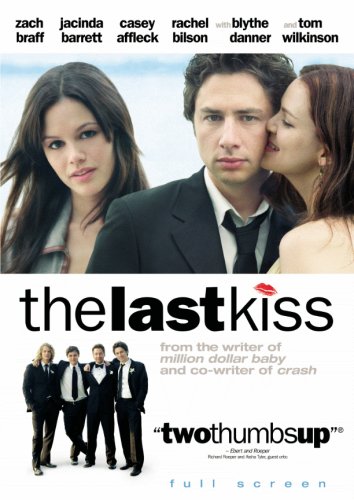
Amazon.com: The Last Kiss (Full Screen Edition): Zach Braff, Jacinda  Barrett, Rachel Bilson, Casey Affleck, Michael Weston, Eric Christian  Olsen, Marley Shelton, Lauren Lee Smith, Harold Ramis, Blythe Danner, Tom  Wilkinson, David

Zach Braff’s gruesome, false dramedy about a guy in his twenties who “has everything” but gets the jitters when his long time girlfriend (Jacinda Barrett) becomes pregnant.  He then recklessly beds a college hottie (Rachel Bilson), and the audience is treated to the extended punishment of his shrieking girlfriend, his unctuous attempts to elicit forgiveness, and side-stories of friends and family similarly bollixed by love, which, as I understand it, reduces everyone to shrieking hysterics.

This indeed may be the way of love for many people, but I sure don’t want to watch it, even with an implausible, redemptive, happy ending.  Braff’s responsibility is minimized.  He only starred in and co-wrote this disaster, with, shockingly, Oscar-winning screenwriter and Scientology attacker Paul Haggis (perhaps this is an excess of Scientology?)

But a curse is a curse, and his post-The Last Kiss, non “Scrubs” work is a cautionary tale — one Canadian movie (The High Cost of Living) and a cameo on a 2012 episode of “Cougar Town.”  He played the pizza delivery guy.